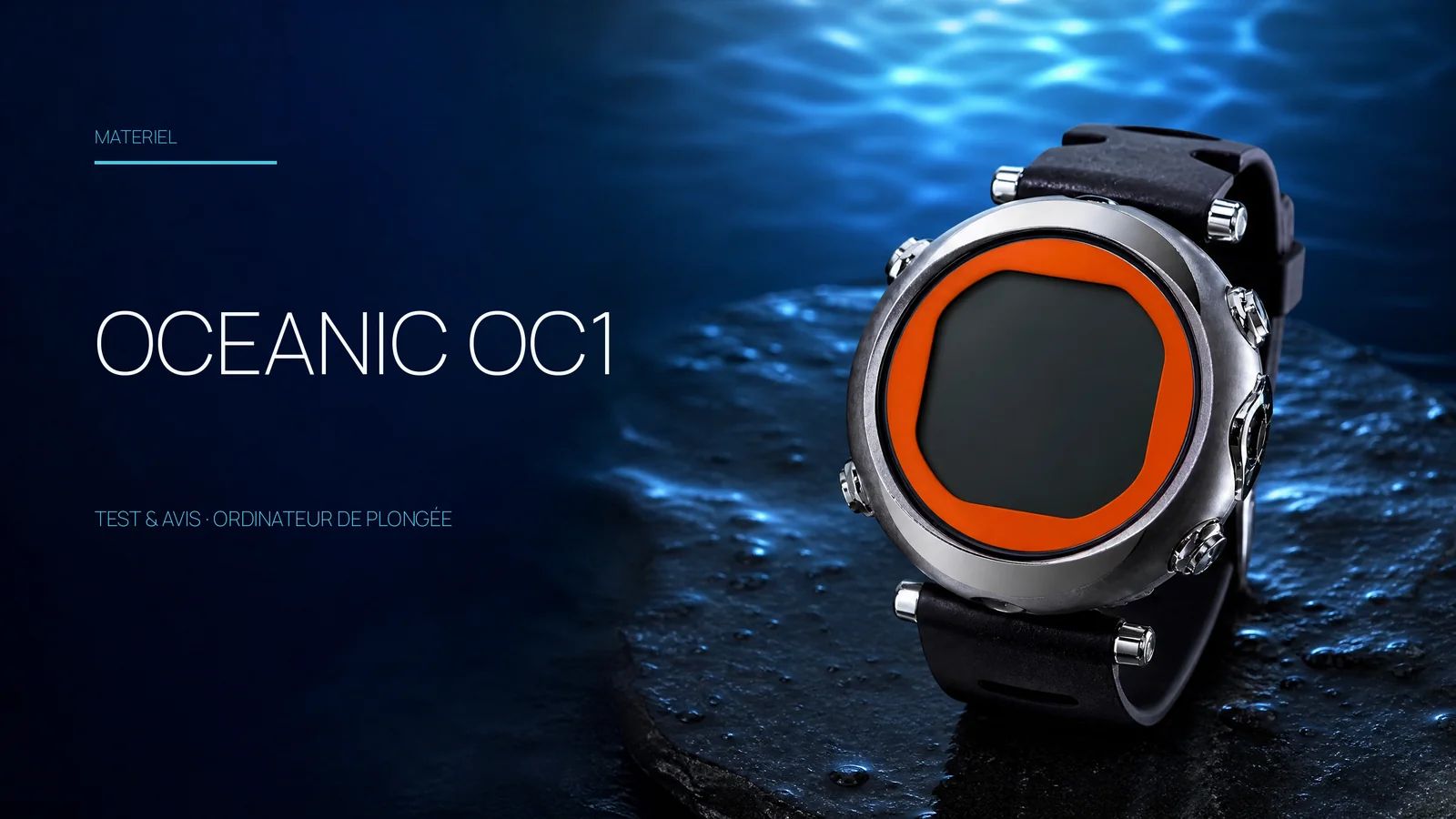
Oceanic OC1 Dive Computer Review: The Titanium Dual-Algorithm Pioneer
Detailed review and test of the Oceanic OC1 dive computer. An ultra-robust titanium casing, wireless air integration, and the exclusive choice between DSAT and Bühlmann algorithms.
Although it is an older generation model with a matrix screen, its forged titanium casing and dual algorithm (DSAT / Bühlmann) make it an excellent dive watch, often found second-hand at a very good price.
Does the OC1 support Trimix dives?
No, it supports air and Nitrox up to 100% O2 (up to 3 different gases), but it does not manage Trimix or closed-circuit rebreathers (CCR).
Can I change the battery myself?
Yes, the CR2450 battery is user-replaceable. However, a professional pressure test in a workshop is always highly recommended after opening the compartment.
How does the dual algorithm work?
The OC1 lets you choose your decompression model: Pelagic DSAT, more suitable for recreational no-decompression diving, or Pelagic Z+ (based on Bühlmann ZHL-16C), more conservative and recommended for repetitive, cold water, or deep profiles.
To learn how to get the most out of your gear underwater, discover the AquaExposure training.
Introduction
To complete our technical overview and wrap up our catalog of reviews, it was impossible to ignore a model that truly marked its era: the Oceanic OC1. Upon its release, this watch-computer represented the technological pinnacle. Forged titanium casing, built-in digital compass, and wireless (hoseless) air integration; it had all the markings of a pioneer. But the true strength of the OC1, the reason why it is still seen on the wrists of experienced divers in the dark quarries of Belgium, is its famous "Dual Algorithm." It offers the freedom to switch from one decompression model to another depending on the type of dive. Faced with today's ultra-bright AMOLED screens, does this dot-matrix LCD icon still have a place in your technical gear? Here is our rigorous evaluation.
Summary Verdict
Global Score: 3.8/5
Criterion
Score
What this means
Algorithm & stops
4.5/5
Excellent concept of \"Dual Algorithm\" (DSAT or ZHL-16C).
Air & multi-gas
3.5/5
Management of 3 Nitrox gases and 3 transmitters, but no Trimix.
Screen & ergonomics
3.2/5
Dot-matrix LCD screen, readable but dated compared to modern color standards.
Battery & power
4.5/5
Superb battery life (300h) and user-replaceable CR2450 battery.
Connectivity & app
2.0/5
Transfer via proprietary USB cable only, no Bluetooth.
Compass & instruments
4.5/5
Highly performing 3D digital compass and complete timing modes.
Robustness & depth
5.0/5
Indestructible forged titanium casing, certified to 200m in gauge mode.
Price & service
3.2/5
Very good second-hand investment, but tracking down parts requires some effort.
This computer is suitable for: The recreational or advanced diver (Air/Nitrox) looking for a virtually indestructible titanium watch on the second-hand market, with air integration and high rigor in the choice of algorithm.
This computer is not ideal for: Technophiles demanding wireless smartphone synchronization, a color screen, or divers using Trimix mixtures.
Detailed Analysis
O1 Algorithm & stops (4.5/5)
Oceanic's "Dual Algorithm" is a brilliant feature that emphasizes safety and control. Under no circumstances is it about manipulating settings to attempt a dangerous or non-standard approach to saturation calculation. The goal is to optimize the safety profile according to the context.
Algorithm: Direct choice between Pelagic DSAT (Spencer/Powell database, ideal for square recreational profiles) and Pelagic Z+ (based on Bühlmann ZHL-16C, ideal for repetitive or cold and deep dives). (Score: 5/5)
Gradient Factors: No fully free GFs, but conservatism factors (ON/OFF) that simulate a higher altitude. (Score: 3.5/5)
Deco display: Ceiling, stop time, and tissue loading bar graphs are clear. (Score: 4.5/5)
The OC1 is a highly performing tool for advanced Nitrox training, allowing excellent logistics for you and your buddy.
Number of gases managed: Up to 3 gases (Air and Nitrox 21-100%). (Score: 3.5/5)
Trimix: Not supported. (Score: 1/5)
Air integration: Outstanding for its time. The device can pair with up to 3 wireless transmitters, allowing you to track your primary tank, your deco cylinder, or even display your buddy's tank pressure remotely. (Score: 5/5)
O3 Screen & ergonomics (3.2/5)
Faced with today's ultra-bright displays, classic LCD technology imposes a more austere, yet infallible style.
Screen type: Dot-matrix LCD with adjustable backlight (OceanGlo). (Score: 3/5)
Readability: Very sharp oversized digits, although contrast in low-visibility environments requires activating the backlight. (Score: 3.5/5)
Navigation: 4 metal push buttons. Their firmness guarantees no accidental presses, but requires a firm press when wearing thick dry gloves. (Score: 3.5/5)
O4 Battery & power (4.5/5)
This is where older technology crushes modern smartwatches in terms of peace of mind.
Battery type: Standard CR2450 button cell. (Score: 4.5/5)
Autonomy: Around 300 hours of diving on a single battery. (Score: 5/5)
Transmitter: CR2 3.6V battery (user-replaceable), approximately 1500 hours battery life. (Score: 4/5)
O5 Connectivity & app (2.0/5)
The digital bridge betrays the computer's initial design date. The absence of Bluetooth makes the workflow heavier.
Synchronization: Via a proprietary physical USB cable specific to Oceanic. (Score: 1.5/5)
Companion app: OceanLog software on PC/Mac, functional for data extraction but without the flexibility of modern mobile applications. (Score: 3/5)
O6 Compass & instruments (4.5/5)
The integration of advanced sensors made the OC1 an exceptionally complete computer at its launch.
Built-in compass: 3D digital, tilt compensation, with heading return function. (Score: 5/5)
Modes: Full watch (time zones, alarms), Gauge (depth gauge up to 200m), and Freediving (Free Dive). (Score: 4.5/5)
O7 Robustness & depth (5.0/5)
The OC1 is a true miniature armor that withstands rough handling and abrasive marine conditions.
Casing: Forged titanium. Exceptional shock resistance, anti-corrosion, and limits weight on the wrist. (Score: 5/5)
Depth: Operational and guaranteed to 100 meters in computer mode, and an impressive 200 meters in depth gauge (Gauge) mode. (Score: 5/5)
O8 Price & service (3.2/5)
This model is now a "classic" that must be hunted on the second-hand market.
Value for money: Excellent if you find a complete package with a functioning transmitter. (Score: 4/5)
Service availability: Since Oceanic is now part of the Huish Outdoors group, service exists, but finding proprietary cables or specific spare parts can sometimes take time. (Score: 3/5)
What to know before buying (second-hand)
Mandatory pressure test: If you buy this computer second-hand, have the CR2450 battery replaced immediately by a certified workshop and request a pressure chamber test to ensure the integrity of the O-ring.
Cable verification: Make sure the seller provides the download USB cable, as it has become very difficult to find as a standalone spare part.
Strap format: The titanium casing is generally paired with a heavy-duty elastomer strap or an adapter for zulu/nato straps, which are often more practical for adjusting over thick drysuit sleeves.
Safety Reminder
The Oceanic OC1 is a model of reliability, but using wireless air integration does not dispense with redundancy: keep a mechanical pressure gauge on your first stage. Furthermore, regardless of your decompression status or the need to manipulate the 4 buttons on the dial to read your parameters, a golden rule applies at all times: make sure your gear is used as designed, keeping your regulator in your mouth underwater. No instrument manipulation or compass reading justifies compromising immediate access to your gas source.
Our Verdict
The Oceanic OC1 remains a superb piece of dive horology. By opting for a titanium casing and integrating early the flexibility of a dual algorithm (including the highly rigorous ZHL-16C), the brand created a product made to cross decades. While its dot-matrix LCD screen and wired connectivity exclude it from comparisons against 2026 connected models, the OC1 remains an extremely robust and secure primary or backup instrument for the second-hand market. It will delight the demanding diver who prioritizes materials solidity and mathematical algorithm control over multimedia features.
Power Source
The watch runs on a standard CR2450 Lithium button cell battery. Thanks to the low power consumption of its dot-matrix LCD screen, battery life reaches approximately 300 hours of active diving. Although user-replaceable, a workshop pressure test remains recommended after each battery change.