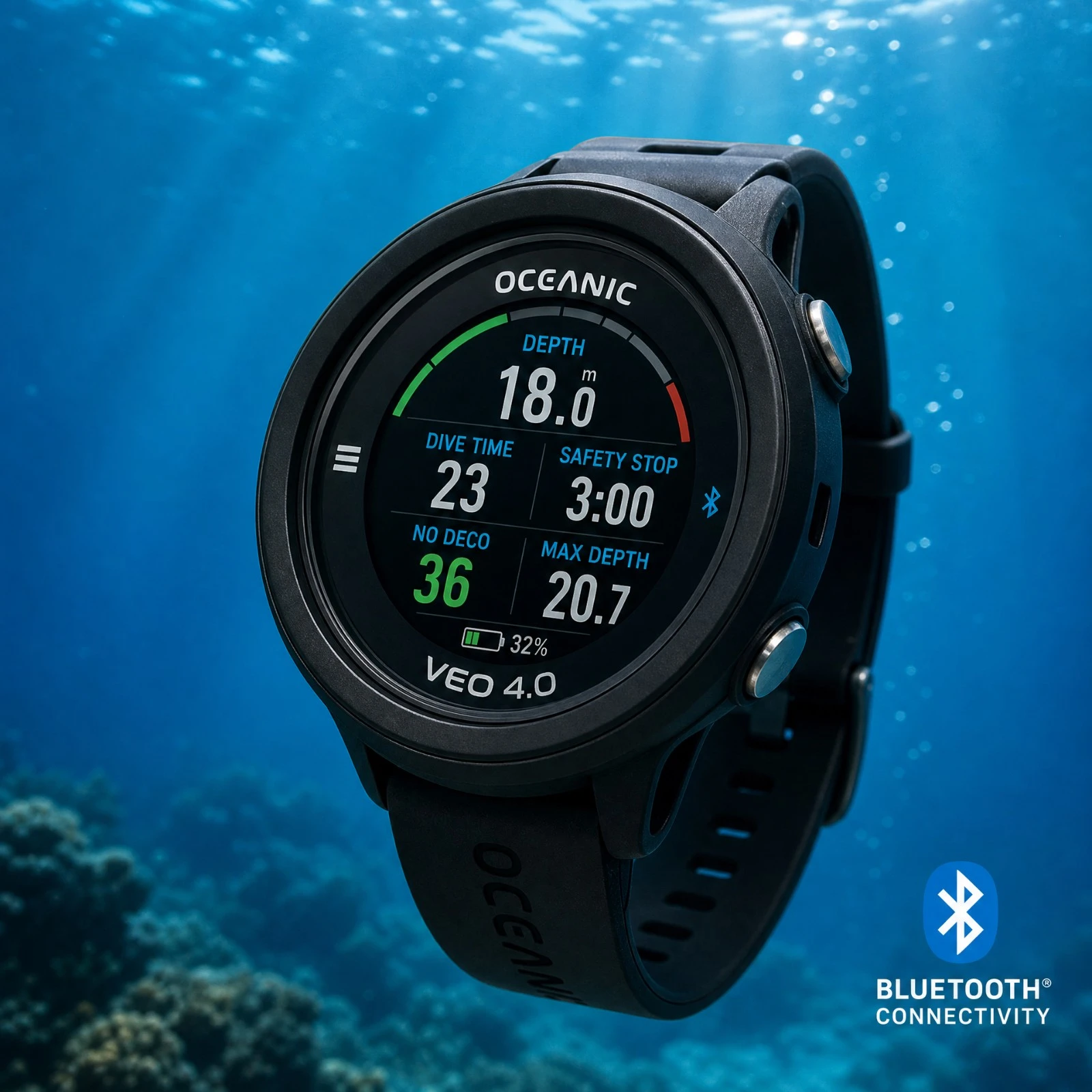
Our comprehensive review of the Oceanic VEO 4.0 dive computer. Versatile with Bluetooth, triple gas support, and Oceanic's renowned dual algorithm.
To learn how to get the most out of your gear underwater, discover the AquaExposure Training.
1. Introduction
Scuba diving requires absolute clarity in the communication of vital information. Underwater, our brains process a multitude of simultaneous signals. Every detail matters.
The water pressure, buoyancy management, and attention to our dive buddy consume a significant portion of our mental capacity. It is crucial that the dive computer simplifies this complexity.
The classic, hockey puck-shaped format has long lived up to this promise of direct clarity. It embodies a pragmatic and technical approach to underwater instrumentation.
Today, the Oceanic VEO 4.0 carries on this visual legacy. It deeply modernizes its digital core. This model features seamless Bluetooth connectivity and offers the brand's renowned dual algorithm.
It is designed for divers who reject complex interfaces. They demand complete flexibility in their decompression profiles. Let's analyze in detail what this device actually offers underwater.
2. The Verdict in Summary
The Oceanic VEO 4.0 receives an overall score of 3.4/5. This result reflects an excellent balance between advanced features and a deliberately streamlined interface.
| Criterion | Score | What it means |
|---|---|---|
| Algorithm & levels | 4.6/5 | The dual algorithm (DSAT / Z+) is exceptional and adapts to all profiles. |
| Air & multi-gas | 2.3/5 | Generous management of 3 gases (Air/Nitrox up to 100% O2) for decompression. |
| Screen & ergonomics | 2.9/5 | Classic segmented screen with very large characters, but technologically simple. |
| Battery life & power | 3.9/5 | Impressive battery life (300 hours) on a CR2450 battery that is replaceable by the user. |
| Connectivity & app | 4.0/5 | Fast and very efficient Bluetooth synchronization via the DiverLog+ app. |
| Compass & instruments | 2.5/5 | Apnea mode and depth gauge are present, but no electronic compass. |
| Resistance & depth | 3.5/5 | Certified for 100m in scuba mode and 120m in gauge mode. |
| Price & customer service | 3.7/5 | Excellent value for money for a 3-gas computer with Bluetooth. |
3. Detailed Analysis
Algorithm & Milestones
It's the crown jewel of Oceanic's offerings. The VEO 4.0 allows you to choose between two distinct decompression algorithms. This flexibility is a major advantage for adapting your profile to match that of your dive buddy.
The Pelagic DSAT optimizes bottom times for successive shallow dives. It is the ideal setting for a typical cruise where dives are performed consecutively in the twenty-meter depth range.
The Pelagic Z+ is based on the Bühlmann ZHL-16C model. It is more conservative and is perfect for deep, cold, or square dive profiles. You can adjust the conservatism factor and configure the deep stop option.
The altitude adjustment is done automatically. This algorithmic management is extremely precise. It fully justifies its score of 4.6/5.
Air & Multi-Gas
The VEO 4.0 goes beyond the entry-level range by managing up to three gas mixtures. It accepts Air and Nitrox with an adjustable oxygen content from 21% to 100%.
This capability perfectly complements divers during their advanced decompression training. The transition from one gas to another underwater is carried out with unwavering logic.
The device does not offer a Trimix mode or a rebreather (CCR) mode. It offers no wireless air integration. These limitations explain its score of 2.3/5 for this specific criterion.
Screen & Ergonomics
The brand has redesigned the display to increase the size of the numbers. They are 20% larger and more readable with a slimmer profile. The segmented LCD screen remains basic but is remarkably effective.
It offers side-by-side bar graphs for nitrogen and ascent rate. These visual indicators ensure such direct readability that even with thick gloves, the information is immediately apparent.
Navigation is performed using two buttons that allow you to advance or quickly scroll through the menus. The SmartGlo backlight has an adjustable duration. The overall product receives a score of 2.9/5.
Battery Life & Power Source
The device operates with a standard CR2450 button battery. You can easily replace it yourself. This design eliminates the need to constantly recharge it between dives.
The advertised battery life reaches 300 hours of operation. This guarantees multiple seasons without any worries. The data is preserved during the battery change.
This energy management system is a model of reliability. It frees the diver's mind during long periods of isolation. The score of 3.9/5 reflects this peace of mind.
Connectivity & App
This is an area where the VEO 4.0 truly excels. Thanks to the integrated Bluetooth 4.0, synchronization becomes a breeze. You use the free DiverLog+ mobile application, available on both iOS and Android.
This application allows you to modify all your gas and alarm settings directly from the boat's deck. You can then download your dive data to your phone immediately after surfacing.
The internal memory stores 24 dives or 50 hours of recording time. The seamlessness of this wireless connection fully justifies its excellent rating of 4.0/5.
Compass & Instruments
The basic module does not have an electronic compass. It has four distinct operating modes: Air, Nitrox, Gauge (depth gauge), and Free Dive (apnea).
The audible and visual alarms are very comprehensive. They immediately draw attention in case of exceeding the defined parameters.
When sold within a Navcon system, it is paired with a mechanical analog compass. As a standalone module, its instrumental capabilities earn it a score of 2.5 out of 5.
Resistance & Depth
The hockey puck format is designed to withstand the inevitable bumps and knocks of life on a boat. Whether mounted on a wrist strap, an elastic lanyard, or inserted into a console, the VEO 4.0 can take a beating.
It is certified for 100 meters in standard diving (Norm and Free modes). It can reach depths of up to 120 meters in Gauge mode. Its profile has been refined by 20% compared to previous models.
This physical robustness inspires immediate confidence. It allows it to achieve a well-deserved score of 3.5/5.
Prices & Customer Support
Offering gas management for three gases and Bluetooth connectivity at a price point of around €300 to €350, Oceanic provides excellent value. This price is very attractive considering the level of technical performance offered.
The relationship between the features offered and the price asked is excellent for advanced divers. The score of 3.7/5 validates this aggressive pricing strategy.
The technical support warrants a separate analysis, which we will detail below.
4. Who is this computer for?
This computer is designed for recreational or advanced divers who are looking for a readable and straightforward device. It is perfectly suited for those who require wireless connectivity and the flexibility of two decompression algorithms.
Its recommended use ranges from Open Water to light technical divers performing confirmed decompression dives using Nitrox. Its modular design allows it to be purchased with a wrist strap and later inserted into a console.
It is not ideal for divers who require wireless air integration via a pressure transmitter. It will also disappoint those looking for a high-resolution color display.
5. Customer Service and Support
The after-sales service for Oceanic is managed by the Huish Outdoors group. It is generally good and well-structured. However, its organization remains very focused on North America.
In Europe, the quality of support depends heavily on the local distributor. Processing times may vary depending on your geographic location.
It is preferable to go through a competent physical retailer who can act as a liaison with the brand if needed. This approach ensures smoother support for your equipment.
6. Nutrition
The choice of a user-replaceable battery significantly changes hardware management. A CR2450 battery is readily available for purchase.
This option proves to be excellent for long cruises. You don't need to monopolize an electrical outlet in your cabin. You won't have to worry about forgetting a specific, proprietary cable.
The 300-hour battery life significantly expands the possibilities for use. The work, repetition, and pushing of personal limits underwater require equipment that is always ready to dive.
To find out which battery to buy for this computer, check out our complete guide on batteries for dive computers. To learn how to replace the battery yourself step by step without risking damage, read our complete tutorial on how to change your own dive computer battery.
7. Links to other models from the same brand.
If you appreciate Oceanic's philosophy but are looking for a watch format suitable for everyday wear, explore other options. The brand's catalog offers some interesting alternatives.
You can view our analysis of the watch model on our dedicated page for the Test Oceanic Geo 4.0.
For those who want a color display and wireless integration, the brand's high-end products are worth your attention. Check out our Oceanic ProPlus 4.0 review.
8. Call-to-Action (CTA) for a comparison tool.
To compare this computer with other models, see our diving computer comparison tool.
© 2026 AquaExposure. All rights reserved. Reproduction prohibited without authorization.
Share
Table of Contents
- 011. Introduction
- 022. The Verdict in Summary
- 033. Detailed Analysis
- 04Algorithm & Milestones
- 05Air & Multi-Gas
- 06Screen & Ergonomics
- 07Battery Life & Power Source
- 08Connectivity & App
- 09Compass & Instruments
- 10Resistance & Depth
- 11Prices & Customer Support
- 124. Who is this computer for?
- 135. Customer Service and Support
- 146. Nutrition
- 157. Links to other models from the same brand.
- 168. Call-to-Action (CTA) for a comparison tool.
Questions about the Journal
Can I use the photographs from this journal?
All images are protected by copyright. For any commercial or editorial use, please contact us via our form.
How can I be notified of new articles?
Follow us on social media or join the Sentinels Circle to receive our immersion stories before anyone else.
Do you offer hands-on workshops?
Yes, we organize masterclasses and field expeditions for members of our school. Check the Training page for details.


