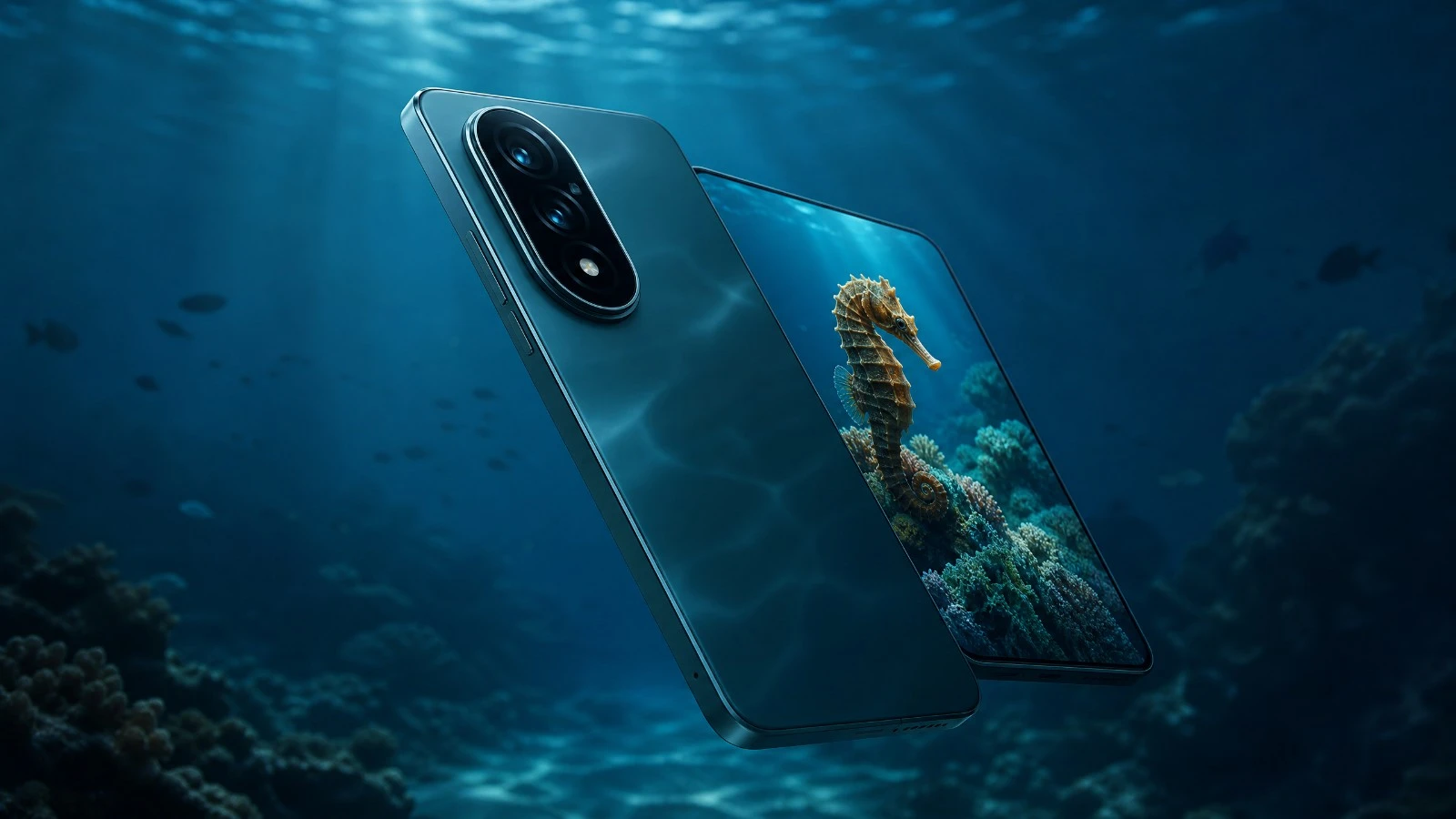
Oppo Reno 15 Pro underwater camera test: natural light performance. AquaExposure score 3.7/5. Housing options and pricing. Is it worth it?
To learn how to get the most out of your gear underwater, discover the AquaExposure Training. For the past few months, I've been hearing the same question in my workshops: is the Reno series worth it for underwater photography, or do you absolutely need a Find X to get serious results underwater? The question is legitimate. The Reno 15 series is clearly positioned below the Find X9 at Oppo - no Hasselblad branding, no 200 MP periscope telephoto lens on the main sensor - but at €629, it targets a segment where underwater photographers make real trade-offs. Here's what I found after a complete analysis of the specifications and underwater conditions in natural light.
Summary of Findings
Global AquaExposure score: 3.7/5
| Criterion | Weight | Score | Points |
|---|---|---|---|
| B1 - Optics and sensor | 20 % | 3.8/5 | 0.76 |
| B2 - RAW and colorimetry | 25 % | 4.0/5 | 1.00 |
| B3 - Storage and transfer | 15 % | 3.0/5 | 0.45 |
| B4 - Body and thermal management | 15 % | 4.0/5 | 0.60 |
| B5 - Battery | 10 % | 3.8/5 | 0.38 |
| B6 - Autofocus | 10 % | 3.8/5 | 0.38 |
| B7 - Housings | 5 % | 3.5/5 | 0.18 |
| Total weighted score | 100 % | 3.7/5 |
Designed for: recreational divers who want a versatile smartphone with a good camera without breaking the bank, travelers looking for a single, compact device for both above and below water use, and photographers who already use ColorOS and want a reliable RAW workflow.
Not ideal for: divers who regularly do long sessions with many RAW and video files (the USB 2.0 is a real bottleneck), users who want to quickly transfer data to an SSD between dives, or those looking for the best color accuracy available in the Oppo range (you need to upgrade to the Find X9 for that).
B1 - Optics and sensor (3.8/5)
The main sensor of the Reno 15 Pro is a 200 MP sensor with a 1/1.56-inch size, an aperture of f/1.8, and mechanical OIS. The triple camera system also includes a 50 MP ultra-wide-angle lens with an f/2.0 aperture and a 116-degree field of view, and a 50 MP telephoto lens with an f/2.8 aperture and an equivalent focal length of 85 mm (3.5x optical zoom), also with OIS.
Confirmed technical specifications (GSMArena, January 2026): Main sensor: 200 MP, 1/1.56", aperture f/1.8, OIS. Ultrawide angle: 50 MP, f/2.0, 116 degrees, fixed focal length. Telephoto: 50 MP, f/2.8, 3.5x optical zoom, OIS. Minimum focus distance: approximately 10 cm (macro via ultrawide angle). Chipset: Dimensity 8450 (4 nm). Burst mode: up to 20 images per second.
What matters underwater with this camera: The f/1.8 aperture on the main sensor is a good starting point for natural light between 3 and 15 meters. The 1/1.56-inch sensor size is smaller than the very large sensors found in flagship phones (the Poco F8 Ultra has a 1/1.31-inch sensor, and the Find X9 Pro has an even larger one), which results in slightly less light collection in challenging conditions – dark backgrounds, surface glare, depth. This isn't a major drawback for standard recreational diving, but it's something to be aware of. The OIS (Optical Image Stabilization) on the 3.5x telephoto lens is a real advantage for capturing distant subjects without stabilization from an underwater housing.
B2 - RAW format and colorimetry (4.0/5)
The native Pro mode in ColorOS 16 (Android 16) generates DNG files in 12 bits. White balance can be manually locked from 2000 K to 9000 K. Video recording supports H.265 (HEVC) 10-bit, with an "Oppo Log" profile available in Pro video mode for proper post-production flexibility. The ISP is the same as that found in the Dimensity 8450, and includes Oppo's "Natural Tone" engine.
Important point: The Reno 15 Pro is not a Hasselblad device. This partnership is reserved for the Find X Ultra series at Oppo. There is no secondary multispectral sensor on this model. The color science is solely that of Oppo, without external third-party calibration.
What changes underwater: The absence of a Hasselblad sensor doesn't necessarily hinder performance in natural light at depths between 0 and 15 meters. At these depths, color correction is done in post-production on the RAW DNG files anyway. What matters is the quality of the raw file - and in this regard, the native 12-bit DNG format of the Reno 15 Pro offers sufficient latitude for correcting lost tones when descending. MotionCam Pro and Blackmagic Camera are available on the Play Store (for Android GMS devices), which opens the door to RAW video if you want to go beyond the capabilities of the native app.
B3 - Storage and Transfer (3.0/5)
Two versions are available: 256 GB or 512 GB of internal storage, UFS 3.1. No microSD card slot. A critical point in this test is that the connector is USB-C 2.0, which is limited to a theoretical transfer rate of 480 Mbps, or approximately 35 to 40 MB/s in real-world write speeds.
"What this means in practice: A RAW DNG file with 200 megapixels weighs between 45 and 60 MB depending on the scene. A session of 200 RAW photos represents 9 to 12 GB to transfer. At 40 MB/s, this takes between 4 and 5 minutes to transfer to an external SSD via OTG - compared to less than 30 seconds with the USB 3.2 on the Poco F8 Ultra. This makes a difference when you're on a boat doing two dives in the morning."
For videographers shooting in 4K or photographers who shoot extensively in RAW, this is the most frustrating limitation of the Reno 15 Pro. The practical solution is to schedule the file transfer during a less busy period rather than between dives. The 512GB version is recommended to avoid having to transfer files mid-day.
B4 - Chassis and Thermal Management (4.0/5)
The Reno 15 Pro is certified IP68 (immersion up to 1.5 m / 30 min) and IP69 (high-pressure jets). This double certification is what I look for in any smartphone intended for diving. The chassis combines an aerospace aluminum frame, Gorilla Glass 7i on the front, and a glass back. A multi-layer vapor chamber is present for thermal management. The phone measures 151.2 x 72.4 x 8 mm and weighs 187 grams.
Confirmed data (GSMArena + Notebookcheck, June 2026): Dual IP68/IP69 certification, aluminum frame, Gorilla Glass 7i, weight 187 grams, thickness 8 mm.
The compact format is a real advantage for integration into universal enclosures. At 187 grams, it's one of the most manageable formats in this range of specifications. The dual IP68/IP69 certification provides a real safety margin in case of an enclosure closure error on the surface - the primary defense remains the enclosure itself, but a secondary layer of protection exists. Passive thermal management via vapor chamber is adequate for diving sessions (the water temperature naturally limits sensor heating).
[!WARNING] Silica gel: mandatory. Aluminum frame + steam chamber: standard condensing profile for cold water. The double IP68/IP69 rating does not protect against internal condensation within the housing, this is a different phenomenon. Replace the silica gel before each dive below 15°C.
Tropical Overheating: The Dimensity 9400 is a thermally efficient chip. In water at 28°C, software overheating occurs after approximately 25 minutes of continuous video recording. This is comfortable for underwater clips lasting 3 to 5 minutes.
B5 - Battery (3.8/5)
6200 mAh with high-density Li-Polymer chemistry. Supports 80W wired charging (100% in 53 minutes according to GSMArena). Manufacturer's rated lifespan: 1500 cycles before capacity drops to 80%.
Important note regarding cold water: Traditional Li-Polymer chemistry (without Silicon-Carbon) is sensitive to temperature drops. Below 10°C, expect a noticeable drop in voltage. When diving in the Mediterranean Sea during winter or in the North Atlantic, the battery can lose 20 to 25% of its effective capacity within the housing. The solution is to enter the water with at least 80% charge.
For a typical day of 2 to 3 dives, with screen usage between dives, the Reno 15 Pro performs well in moderately warm water (18°C or higher). Battery planning becomes more important in colder water. The 17 hours of active use score measured by GSMArena confirms that the battery capacity is adequate.
Before each diving session, remember to check your external battery. Use our portable battery comparator tool to choose the right power bank for your dive equipment and desired battery life.
B6 - Autofocus (3.8/5)
The autofocus system combines all-pixel PDAF on the main sensor and an infrared laser/ToF module. The laser module cannot be manually disabled (it is managed by the system's AI). There is no LiDAR. Focus Peaking is available via MotionCam Pro (not natively in the stock app). Oppo's "PureTone" feature is presented as an AI-based anti-particle filter for portrait and standard photo modes.
Important Note: The laser module can interfere with focusing through a camera housing membrane if the distance is very short (macro shots at less than 15 cm). In this case, using manual focus via MotionCam Pro with Focus Peaking is the most reliable method.
The "all-pixel" PDAF is a good choice for subjects in motion (fish, cephalopods, rays) in clear water. The combination of PDAF + ToF provides adequate responsiveness without LiDAR. For macro photography of stationary subjects (nudibranchs, sea urchins, coral), manual focusing with Focus Peaking in MotionCam Pro is preferred when the distance becomes critical.
B7 - Compatible Enclosures (3.5/5)
The Reno 15 Pro measures 151.2 x 72.4 x 8 mm and weighs 187 grams. This compact size allows it to fit into most universal cases without requiring any custom modifications.
Divevolk SeaTouch 4 Max Universal - Depth: 60 meters. Screen access: A gel touch membrane that preserves full access to the capacitive screen underwater. Compatible with all apps (MotionCam Pro, Blackmagic Camera, native ColorOS app). This is the recommended option for a complete RAW workflow. The size of the Reno 15 Pro is compatible with the internal space of the SeaTouch 4 Max.
Kraken Sports universal - Depth: 40 meters depending on the model. Access: Configurable physical buttons. An acceptable option for basic photography, but without touch access to advanced menus.
Recommended verification before purchase: Please confirm the exact dimensions of the Reno 15 Pro (151.2 x 72.4 mm) with Divevolk France or your retailer before ordering. Universal enclosures have varying tolerances depending on the models and manufacturing years.
What you need to know before buying.
Field Cases and Workflow
The Divevolk SeaTouch 4 Max remains the central option. The compact form factor of the Reno 15 Pro is an advantage here: it leaves less dead space in the housing and provides better access to the volume buttons, which are often used as shutter triggers. For the workflow between two dives, the USB-C 2.0 transfer speed is a weak point: expect overnight transfers rather than quick rotations on the surface.
Current Rates (June 30, 2026)
New: - Amazon.de / Amazon.co.uk (global version available in Europe): €629 (512 GB / 12 GB RAM) - source: GSMArena price tracker, consulted on June 30, 2026 - Oppo.com official European price: €629 - displayed price at the time of launch in January 2026 - Idealo.fr: starting from €609 (offers from the grey market to be verified according to warranty) - Fnac / Darty France: availability to be confirmed depending on region (the Reno 15 series was launched in Europe in January 2026, according to Notebookcheck)
Condition / Refurbished: - Back Market: Limited or unavailable stock as of the date of writing (device released in January 2026, limited used market). Estimated price for "good condition": between €430 and €490 if units become available by the end of 2026. - Leboncoin / Vinted: Monitor prices between €450 and €520 for items in very good condition with original box.
The used market angle: Released in January 2026, the Reno 15 Pro is less than 6 months old. The used market remains limited. If budget is the primary concern, an alternative is to monitor summer promotions from official retailers, where the price may drop between €549 and €579 for the 256GB version. Waiting until the end of 2026 will allow access to the first serious refurbished units with a savings of €100 to €150.
Our Verdict
The Reno 15 Pro scores a 3.7/5 in our AquaExposure rating system. This is the score of an honest smartphone in its category - not a flagship, but a device capable of producing usable RAW files in natural light underwater, with IP68/IP69 robustness that inspires confidence even before entering the water.
What holds it back from a score of 4.0 is that the USB-C 2.0 port feels outdated in 2026 on a phone costing €629, and the 1/1.56-inch sensor remains smaller than the very large sensors found in the best camera phones of the same generation. For standard recreational diving between 0 and 20 meters in natural light, these limitations are manageable. However, for intensive RAW photo or 4K video sessions, they become restrictive.
If you already own a Reno 15 Pro or are looking for an Oppo smartphone in this price range for diving, it's a solid choice. If you're torn between the Reno 15 Pro and the Find X9 Pro for serious underwater use, the €370 difference is justified by the Hasselblad color science and the USB-C 3.2 - not by marketing.
Frequently Asked Questions (FAQ)
Is the Oppo Reno 15 Pro good for underwater photography?
With an AquaExposure score of 3.7/5, the Reno 15 Pro is a solid option in the mid-to-high-end segment. Its 200 MP sensor with OIS, its native 12-bit RAW DNG format, and its dual IP68/IP69 certification make it a reliable tool for underwater photography in natural light, provided you pair it with a universal housing like the Divevolk SeaTouch 4 Max. Its main drawback is the USB-C 2.0 port, which slows down the transfer of RAW files after each outing.
What waterproof case is suitable for the Oppo Reno 15 Pro for diving?
The Divevolk SeaTouch 4 Max universal is the primary option: it supports depths of up to 60 meters and features an active touch membrane that preserves access to all apps. The compact size of the Reno 15 Pro (151.2 x 72.4 mm) makes it easier to fit into universal housings. The Kraken Sports universal housing is an alternative, supporting depths of up to 40 meters. Please verify the exact dimensions for compatibility before placing any orders.
Does the Oppo Reno 15 Pro shoot in RAW underwater?
Yes. The native Pro mode in ColorOS 16 generates 12-bit DNG files directly, without the need for third-party applications. MotionCam Pro (RAW video) and Blackmagic Camera for Android are available on the Play Store, as the Reno 15 Pro is an Android GMS device. The white balance in Kelvin can be locked, which is essential to compensate for the blue cast that appears from 3-5 meters away.
What is the difference between the Oppo Reno 15 Pro and the Find X9 for underwater photography?
The difference is real and is justified in terms of price. The Find X9 Pro (around €1,000) adds the Hasselblad partnership with its secondary multi-spectral sensor, a 200 MP periscope telephoto lens, and superior color science for extreme conditions. The Reno 15 Pro, at €629, offers solid RAW capabilities, a generous battery, and the same IP68/IP69 certification. For recreational diving between 0 and 20 meters in natural light, the technical difference doesn't always justify an extra €370.
Should an anti-fog treatment be used with this device?
Yes, absolutely. With its driver chassis (often made of aluminum) and thermal dissipation through a vapor chamber, the risk of condensation into cold water (below 15°C) is significant. The use of an anti-fog treatment (silica packet or insert) inside the housing is mandatory before each dive.
To learn more: Smartphone overheating and condensation underwater: the physics of the enclosure -- Explanations of thermal mechanics, dew point, and silica gel protocol.
How can I quickly transfer my photos and videos from this device?
The wired connection of this device is limited to the USB 2.0 standard, which makes physical transfers quite slow. To quickly transfer your RAW files or video clips, it is highly recommended to use the fast wireless protocol of the ecosystem (Oppo Share), or to extract the memory card if the enclosure and device allow it.
Learn More - Underwater photography equipment comparison tool
Are you hesitating between several smartphones for underwater photography? Our complete comparison is available here: Comparison of smartphones for underwater photography 2026.
To understand how the Find X9 performs underwater and what Hasselblad truly changes: OPPO Find X9 Pro and Ultra: complete underwater photography guide.
Are you just starting out and wondering about the equipment before even considering a phone? The honest answer is in this article: What underwater camera or device is best for beginners.
Do you want to learn how to get the most out of your smartphone underwater? The AquaExposure training is built entirely around natural light - no flash, no unnecessary complexity. Over 1000 real-world dives condensed into a practical course. Discover the training.
Share
Table of Contents
- 01Summary of Findings
- 02B1 - Optics and sensor (3.8/5)
- 03B2 - RAW format and colorimetry (4.0/5)
- 04B3 - Storage and Transfer (3.0/5)
- 05B4 - Chassis and Thermal Management (4.0/5)
- 06B5 - Battery (3.8/5)
- 07B6 - Autofocus (3.8/5)
- 08B7 - Compatible Enclosures (3.5/5)
- 09What you need to know before buying.
- 10Field Cases and Workflow
- 11Current Rates (June 30, 2026)
- 12Our Verdict
- 13Frequently Asked Questions (FAQ)
- 14Is the Oppo Reno 15 Pro good for underwater photography?
- 15What waterproof case is suitable for the Oppo Reno 15 Pro for diving?
- 16Does the Oppo Reno 15 Pro shoot in RAW underwater?
- 17What is the difference between the Oppo Reno 15 Pro and the Find X9 for underwater photography?
- 18Should an anti-fog treatment be used with this device?
- 19How can I quickly transfer my photos and videos from this device?
- 20Learn More - [Underwater photography equipment comparison tool](/fr/comparateur-materiel-photo)
Questions about the Journal
Can I use the photographs from this journal?
All images are protected by copyright. For any commercial or editorial use, please contact us via our form.
How can I be notified of new articles?
Follow us on social media or join the Sentinels Circle to receive our immersion stories before anyone else.
Do you offer hands-on workshops?
Yes, we organize masterclasses and field expeditions for members of our school. Check the Training page for details.