Why does the turtle speed up when I approach slowly?
The direction of your approach matters as much as your speed. A frontal approach, even slow, is interpreted as a predatory signal. Approach from the side, swimming parallel to the turtle.
What is the best angle for photographing a turtle?
Shooting from slightly below (low angle) is the angle of dignity. It places the turtle as a noble subject with the blue water as background. The overhead angle (from above) should be avoided, as it is a dominance angle.
When a turtle swims towards me, is it curiosity or stress?
Observe the body language. A curious turtle swims calmly, with regular fin strokes. A stressed turtle accelerates, changes direction abruptly, or partially retracts its head.
How long should I stay still before a turtle approaches?
It varies by species and site. Generally, 5 to 10 minutes of stillness is enough for a curious turtle to reduce its distance. The key is to settle on the bottom and stop moving entirely.
There was a dive site in Cyprus where I learned something important about myself, and it wasn't what I was looking for.
The groups would arrive each morning with their brand new cameras and their aspirations to be Instagram influencers. And every morning, the same scenario: as soon as a green sea turtle appeared in the blue, it was a rush. Everyone would swim towards it, from above, from the front, diagonally. The animal would dart away with two strokes of its fins, and the photographers would return with blurry photos of a carapace fleeing.
I would go back once or twice a week, and I had started doing something different with the beginners I accompanied. I would ask them to lie on the seabed, to stop moving, to let their arms hang along their bodies, and to wait.
In the first few weeks, the turtle would pass by at a distance. Then it would get a little closer, continue to graze on the seaweed, and then move away. Week after week, the circles got smaller. And one day, after several months of this silent ritual, it came and settled on my dive computer.
It hadn't decided to trust me that day. It had decided to trust me the first day that I had stopped chasing it.
What Most Divers Do Wrong With Turtles (and Why the Animal Fleees)
By Benjamin Coste
Approaching turtles too closely is a common mistake among divers. This can scare the turtle, causing it to flee. Here's why:
Disturbance: Turtles are sensitive to disturbance. When divers approach too closely, they can stress the turtle, causing it to flee. Predation: Turtles are prey animals. Approaching too closely can make them vulnerable to predators, such as sharks or other large fish. * Competition: Turtles may flee if they perceive a diver as a threat to their food or territory.
To avoid scaring turtles, it's important to maintain a safe distance. Here are some tips:
Maintain a distance of at least 2 meters (6 feet) from turtles. Avoid approaching turtles directly. Instead, approach them from the side or behind. Move slowly and deliberately. Avoid sudden movements that could startle the turtle. Avoid touching turtles. Turtles have sensitive skin and can be easily stressed by touch. * Be aware of your surroundings. Pay attention to any other animals or objects in the water that could pose a threat to the turtle.
By following these tips, you can enjoy observing turtles without scaring them.The sea turtle is arguably the most photographed subject in recreational diving. It is also one of the animals that is most approached inappropriately.
Not out of malice. But out of ignorance of the signals. And by a very human mental habit: confusing the presence of an animal with its consent to be photographed.
When a diver sees a turtle, their first instinct is to approach. Quickly, in order not to miss the shot. Head-on, because that's where the head is. From above, because that's the natural angle when swimming in open water.
These three instincts are the three fundamental errors.
A frontal approach is a predator approach. An approach from above is the eagle's angle on its prey. A quick approach, even a "gentle" one, is an emergency signal in the language of marine reptiles. The turtle doesn't know you have a camera. It knows that something big is moving towards it at a non-zero speed.
It flees. You follow it. It speeds up. You interpret this as concern and slow down, but you continue to move forward. For it, the danger persists. It disappears into the blue, and you return with a photo of a fleeing turtle instead of a meeting.
This scenario plays out thousands of times a day at tourist sites around the world. It leaves no visible scars on the animal. But it builds, visit after visit, an association between divers and stress. And this conditioning eventually changes the behavior of the species on frequented sites.
Interpreting Turtle Signals: The 3 Circles AppliedEach animal exists within three invisible concentric circles.
The first is the circle of perception. The animal has detected you. It is observing you without altering its behavior. You exist within its field of awareness, but not yet within its risk assessment.
The second is the circle of tolerance. You are close enough that the animal begins to allocate attention to you. It may slow down, slightly alter its trajectory, or lift its head more frequently. It is observing you, but remaining in place. You are within its bubble, not yet within its escape zone.
The third is the critical circle. The animal decides that the distance is too short or that your behavior is too unpredictable. It leaves. This is not a sudden decision, but the culmination of a risk assessment that you have unknowingly contributed to.
With a turtle, the boundary between tolerance and critical is often closer than you think, and it varies depending on the individual, the location, the time of day, and what the animal was doing before your arrival.
A resting turtle – stationary on the seabed or at the surface to breathe – has a larger critical circle. A turtle that is feeding on algae is often more tolerant, because food is a sufficiently strong motivator to absorb some of the surrounding stress. But even in this case, exceeding the tolerance threshold while feeding creates an internal conflict for the animal: to leave (safety) or to stay (hunger). This conflict itself is a form of stress that you impose on it.
The basic rule: maintain a minimum comfort zone of two meters, and observe what the animal's behavior tells you before reducing this distance.
The Approach That Works: Tangential, from the Side, by Swimming AlongsideThe technique I call "Joining" is based on a simple idea: you don't try to get closer to the turtle, you try to move in the same direction as it.
You approach from the side, never from the front or above. You adopt its speed, not your own. You swim parallel to its trajectory, at a comfortable distance, without actively trying to reduce this distance. You let it decide whether it wants to come closer.
This shift in perspective is radical. You move from an approach (I'm moving towards it) to a presence (I'm sharing its space without invading it). And paradoxically, it's often when you stop trying to get closer that you find yourself within shooting range.
The curious turtle – and some really are – will come towards you if you don't represent a threat. Its curiosity, when it exists, is expressed by a slight deviation of its trajectory in your direction, a steady gaze, and sometimes a slowing down. These are invitation signals. Not an invitation to move yourself, but an invitation to stay where you are and let it decide.
The ideal position to allow this process to work: facing the seabed, arms along the body, minimal bubbles, movement through micro-movements of fins. You become an innocuous object in its environment. This is exactly what the "baptisés de Chypre" (Cyprus divers) learned to do, and that's exactly why it worked.
The Framing That Respects: Low Angle, Negative Space, Three-Quarter ViewApproach ethics don't stop when you press the shutter. They continue in your composition choices.
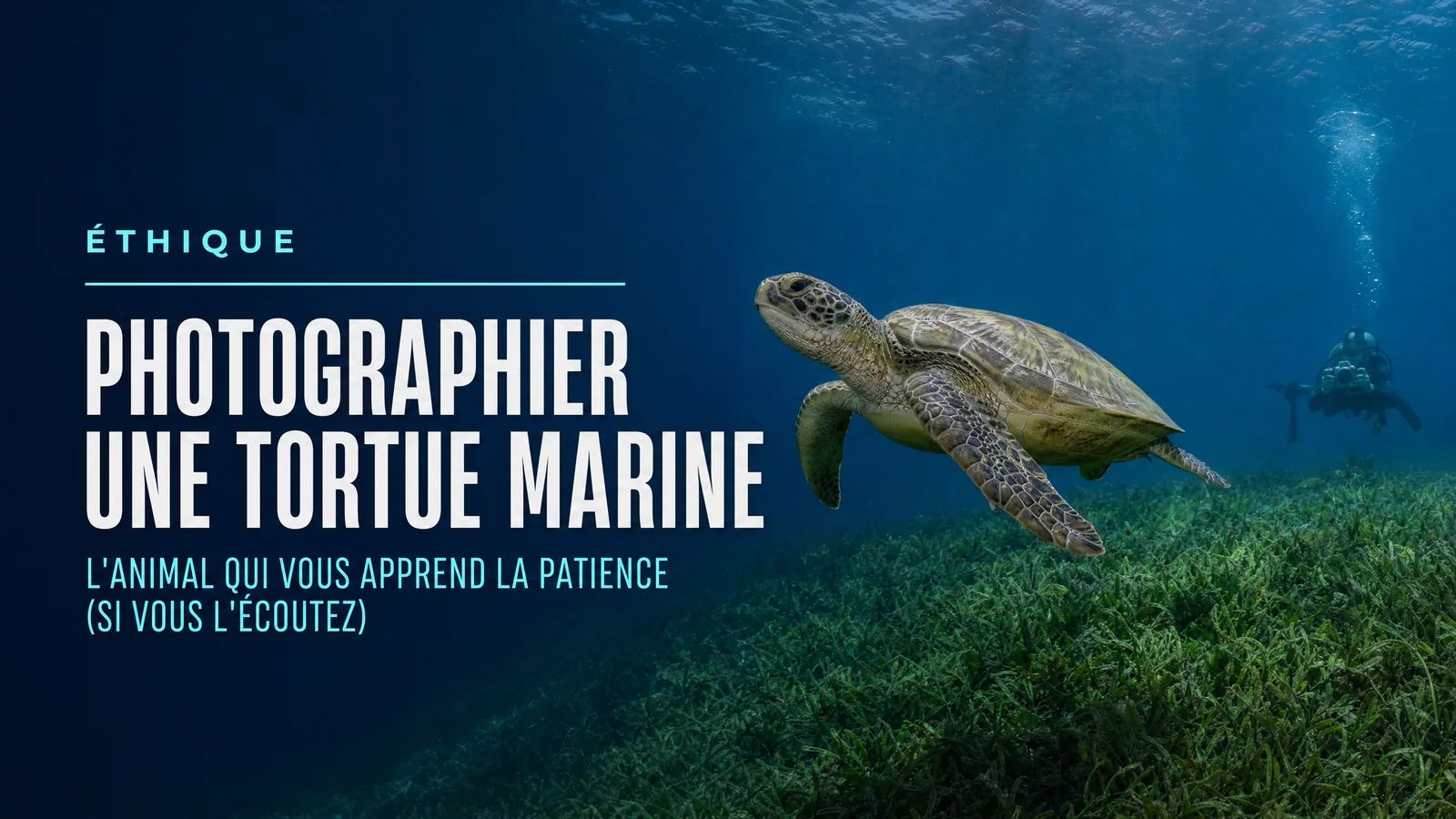
The "dignity angle," in my photographic doctrine, is the low angle. You position yourself slightly below the subject, aiming upwards. The animal gains presence in the frame. It becomes large. It occupies space. It belongs to its environment, and you are the curious observer, not the dominant figure with a camera.
The opposite angle – what I call the "helicopter angle" – must be avoided at all costs. A top-down view turns the turtle into a flat object on a shallow background. It loses its grandeur. And symbolically, it confirms the position you took during the approach: you are above, it is below. This hierarchy is read in the image.
The three-quarter front view is often the ideal compromise: you see the head, the expression of the eyes, the movement of the fins, and you maintain the animal's depth in the frame.
The "looking room" – what photographers call the "looking room" – is non-negotiable. If the turtle is facing to the right of the frame, it must have space in front of it. Pushing it against the right edge of the image creates a visually enclosed space. And psychologically, it's your unconscious way of telling it that it can't escape.
Give it the space to escape in the image. It probably won't. But the frame will breathe, and the animal will be free.
What You Should Never DoNever approach from above. The helicopter angle is prohibited, whether approaching or framing. It's the angle of aerial predators. It's the angle of dominance. Even if you find the photo beautiful, you have stressed the animal to obtain it.
Never chase a turtle that is accelerating. A turtle that is accelerating is not playing. It is calculating that you are a problem. Continuing to follow it at this point turns a meeting into a chase, and a chase into harassment. Stop. Let it go. This is the only ethical decision.
Never approach during resting or feeding phases. These moments are physiologically critical. A resting turtle is recovering energy. A feeding turtle is replenishing its reserves. Interrupting them has a real cost for the animal, not just a temporary inconvenience.
Never block escape routes. Never put yourself between the turtle and the surface, between the turtle and the seabed, or between the turtle and an open space. The animal must be able to leave in any direction without having to pass through you. This rule also applies in groups: if you are several divers, the collective arrangement should never form an arc or a circle around the animal.
Never touch. Don't touch the fins to "help it swim", don't touch the shell to "feel the texture", don't touch the head to "get an amazing image". Touching is the definitive breach of the trust protocol. And in many countries, it is a legal offense.
Frequently Asked QuestionsWhy does the turtle accelerate when I approach slowly?
Because direction is just as important as speed. A slow and direct approach remains a direct approach. The animal interprets the trajectory before interpreting the speed. If you approach it in a straight line, you send a predatory signal even at reduced speed. Change your approach angle: come from the side, tangentially, without orienting your body axis directly towards the animal.
What is the best angle to photograph a turtle?
Counter-buoyancy, without exception. Position yourself slightly below the animal's level, with the camera pointed upwards. You will capture the pattern of its shell against the surface light, the curve of its fins, and sometimes a spectacular backlighting. And your image will say something about the animal: that it is large, that it belongs to this space, that it is free.
If a turtle comes towards me, is it curiosity or stress?
Read the body language. A curious turtle slows down, slightly deviates from its trajectory, maintains a steady course in your direction. Its fins move normally. It approaches at its own pace, with pauses. A stressed turtle that approaches you because you are blocking its path will have more erratic movements, sudden changes in direction, and sometimes an slightly open mouth. In doubt: back away by one meter. If it continues to approach, it's curiosity. If it deviates, you were in its path.
How long should I stay still before a turtle approaches?
There is no guaranteed duration. Five to ten minutes of real immobility is a reasonable minimum on a site where turtles are used to divers. On a virgin site, count more, and accept that it may not happen on this dive. Patience is not a technique, it's a posture. And turtles read postures with a precision that you probably underestimate.
The Image That LastsThere are photos of turtles I took in under two minutes, with an animal that simply passed by within range.
And there's this image – the one I didn't take in Cyprus, because I didn't have a dive computer with me – of a green turtle resting on my dive computer, just a few centimeters from my face, looking at me with the particular expression that reptiles have when they've decided that you're not a threat.
This isn't the best technically possible turtle photo I could have taken. It's the best turtle photo I could have taken, humanly speaking.
The difference between the two is several months of Tuesday mornings spent teaching people how to be still, while they wanted to move. The turtle didn't learn to trust me. I learned to deserve its trust.