Natural light in the Maldives is more than sufficient for photographing manta rays, especially between the surface and 15 meters. Position yourself below the animal to catch the light traveling through the water column illuminating the white belly. Work in wide angle, at ISO 200-400, with a shutter speed of 1/250th minimum. The natural contrast between the white belly and the blue water creates powerful images without any artificial lighting.
How close can you get to a whale shark?
The ethical rule recommends maintaining a minimum distance of 3 meters. In practice, if you position yourself correctly (parallel to the animal, at the same depth, without cutting its path), the whale shark may approach to 2-3 meters on its own. Never swim directly toward it and never block its path. Respecting its rhythm is the key to extending the encounter.
What settings for photographing large pelagics in natural light?
Wide angle mandatory (as wide as possible). Shutter speed of 1/250th to 1/500th to freeze movement. Aperture of f/8 to f/11 for sufficient depth of field. ISO as low as the light allows (200-400 in the Maldives under normal conditions). Shoot in RAW to preserve correction latitude in post-processing, especially for white balance.
Do you need a special lens for manta rays and whale sharks?
A wide-angle lens is essential. For micro four-thirds systems, an 8mm fisheye or a 10-17mm is ideal. For APS-C or full-frame sensors, a 10-18mm or 16-35mm works perfectly. Manta rays and whale sharks are photographed up close (2 to 5 meters), and a lens that is too tight will only capture a fragment of the animal. Wide angle also lets you include context (reef, surface, diver) to give scale to the image.
To learn how to get the most out of your gear underwater, discover the AquaExposure training.
There is a very particular moment in the life of a photographer-diver. It is the moment when an animal larger than you appears in the blue, when your heart accelerates, when your hands tighten on the housing, and when all the technique you patiently learned threatens to evaporate in a single second.
I have lived this moment dozens of times in the Maldives. With manta rays, with whale sharks, with schools of grey reef sharks so dense the blue turned grey. And I can tell you one thing: the first skill of the photographer facing a large pelagic is not technique. It is managing emotion.
This article is a practical guide for those who want to photograph these ocean giants in natural light, without flash or torch. It is the AquaExposure philosophy applied to the most intense encounters diving can offer.
The manta ray at cleaning stations
Understanding the behavior
Cleaning stations are specific sites on the reef where cleaner fish (wrasses, gobies) rid manta rays of their parasites. Mantas return to these stations regularly, sometimes several times a day, which makes encounters relatively predictable.
This is a considerable advantage for the photographer. When you know the station (and the OK Maldives team knows them all), you can position yourself ahead and wait. The manta will come to you.
Positioning
The golden rule is to place yourself facing the current, not on the bottom but just above it, downstream of the cleaning station. The manta typically arrives with the current, descends toward the station, and holds position while the cleaners work. If you are already in position when it arrives, you do not need to swim toward it. You just frame and shoot. However, if you are in its path or on the route it uses to reach the cleaning station, it will either move or turn back and go get cleaned elsewhere. In every case, you will have missed your photo.
Never swim above a manta. Your presence between it and the surface will make it flee. Never chase it: a manta that moves away will not come back if you run after it, but it will often return on its own if you stay still at the station.
Settings
In natural light, the manta ray is ideally photographed with the surface in the background. The white belly of the manta contrasts with the blue water, and the silhouette of the outstretched wings creates a naturally balanced composition.
Wide angle mandatory. The reef manta (Mobula alfredi) commonly reaches 3 to 4 meters in wingspan, and you will often see it up close (2 to 5 meters). A lens that is too tight will only capture a fragment of the animal.
Shutter speed: 1/250th minimum, ideally 1/500th. The manta looks like it moves slowly, but its wings beat constantly and a shutter speed too slow will produce motion blur at the tips.
Aperture: f/8 to f/11 to guarantee sufficient depth of field. The manta is a three-dimensional subject that requires the entire body to be sharp.
ISO: as low as the light allows. Maldivian waters, between the surface and 15 meters, generally offer enough light to work at ISO 200-400.
The manta ray in open water
Outside cleaning stations, encounters with mantas are less predictable but often more spectacular. A manta swimming in open water, feeding at the surface performing its characteristic barrel rolls, or gliding along a wall, is a photographic subject of exceptional grace.
The difficulty is twofold. The animal is moving, and so are you. You need to swim parallel to the manta, never toward it, maintaining a constant distance. It is an exercise in finning, buoyancy, and framing simultaneously that requires practice.
The most frequent mistake is wanting to photograph the manta from the front. The result is almost always disappointing: the animal looks like a flying pancake with no grace or volume. The best angle is three-quarter, which reveals the wing curvature, the head profile with the cephalic fins deployed, and the movement of the body through the water.
In natural light, the best open-water manta images are those where the animal is lit from below, with light traveling through the water column illuminating the white belly. That means positioning yourself slightly below the manta and angling the camera upward.
The whale shark
The approach
The whale shark is the largest fish in the world. In the Maldives, observed individuals generally measure between 4 and 8 meters, and some exceed 10 meters. The first encounter is always a visual shock.
The whale shark approach is different from the manta. The animal typically swims at or just below the surface, often feeding on plankton. It advances at a constant, moderate speed, and its trajectory is relatively predictable.
The ideal position is parallel to the animal, at the same depth, at a distance of 3 to 5 meters. Swimming perpendicularly toward the whale shark or cutting its path will make it dive. Swimming alongside, respecting its rhythm, will let you stay in its company for several minutes.
The challenge of size
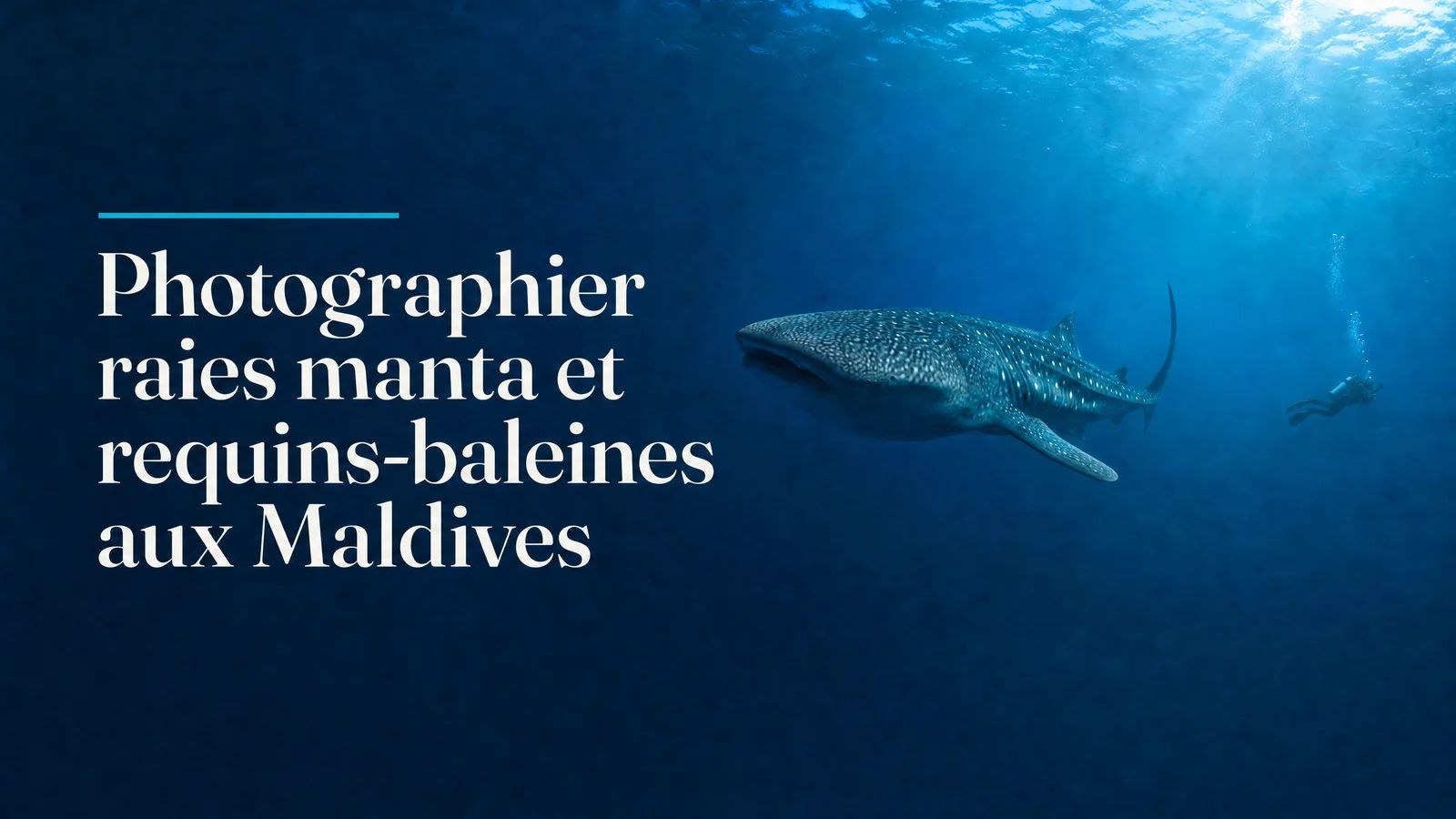
The biggest photographic challenge with the whale shark is its size in the frame. How do you do justice to an 8-meter animal with a sensor measuring a few centimeters? The temptation is to capture the entire animal from head to tail. But the result is often a small fish lost in a great blue, without scale or impact.
Two approaches work better. The first: focus on the head. The whale shark's eye, its massive mouth, the patterns of white spots on its dark skin, all of this creates a powerful portrait that conveys the animal's presence far better than a wide shot. The second: include a diver in the frame. The human scale immediately reveals the whale shark's size and creates an image with instant impact.
Settings
Shutter speed is critical. The whale shark is swimming, you are swimming, and motion blur at this scale is unforgivable. Minimum 1/320th, ideally 1/500th.
Wide angle at the maximum your lens allows. The whale shark is a proximity subject (paradoxically): the best images are taken at 2-3 meters, and at that distance even an ultra-wide angle captures only part of the animal.
Natural light is generally abundant since encounters happen near the surface, often in the first 5 meters. The challenge is rather white balance: the whale shark's skin is dark (blue-grey with white patterns), and in natural light it can appear uniformly dark if exposure is not corrected.
Slightly overexposing (half a stop to a full stop) reveals the skin patterns and gives texture to the image. Post-processing does the rest.
Managing emotion
I return to what I said at the opening, because it truly is the central subject. Technique is learned, settings are memorized, positioning is practiced. But managing emotion when an animal of several meters passes within arm's reach, that is a separate apprenticeship entirely.
My advice is simple but hard to apply. When the animal appears, do not press the shutter immediately. Take five seconds to breathe, to anchor yourself, to observe the scene. Regain awareness of your depth, your buoyancy, your position. Only then, raise the camera.
Those five seconds may cost you one image. But they will save you ten blurry, poorly framed, overexposed images taken in a rush. And the images you take after that pause will be incomparably better.
It is a lesson I learned the hard way in the Maldives. The first times, I shot in panic. Today, I breathe first. And the images are infinitely better for it.
Ethics of approach with large pelagics
In the Maldives, manta rays and whale sharks are protected species. Codes of conduct exist, and OK Maldives enforces them rigorously.
For the photographer, these rules are not constraints. They are conditions for success. A stressed animal from a clumsy approach will flee or change its behavior, and the image will be worthless. A serene animal, continuing its natural activity in your presence, will offer images of incomparable authenticity and power.
Do not touch. Do not chase. Do not encircle. Do not block the path. These rules are absolute, without exception, without negotiation.
FAQ
How do you photograph a manta ray without flash?
Natural light in the Maldives is more than sufficient for photographing manta rays, especially between the surface and 15 meters. Position yourself below the animal to catch the light traveling through the water column illuminating the white belly. Work in wide angle, at ISO 200-400, with a shutter speed of 1/250th minimum. The natural contrast between the white belly and the blue water creates powerful images without any artificial lighting.
How close can you get to a whale shark?
The ethical rule recommends maintaining a minimum distance of 3 meters. In practice, if you position yourself correctly (parallel to the animal, at the same depth, without cutting its path), the whale shark may approach to 2-3 meters on its own. Never swim directly toward it and never block its path. Respecting its rhythm is the key to extending the encounter.
What settings for photographing large pelagics in natural light?
Wide angle mandatory (as wide as possible). Shutter speed of 1/250th to 1/500th to freeze movement. Aperture of f/8 to f/11 for sufficient depth of field. ISO as low as the light allows (200-400 in the Maldives under normal conditions). Shoot in RAW to preserve correction latitude in post-processing, especially for white balance.
Do you need a special lens for manta rays and whale sharks?
A wide-angle lens is essential. For micro four-thirds systems, an 8mm fisheye or a 10-17mm is ideal. For APS-C or full-frame sensors, a 10-18mm or 16-35mm works perfectly. Manta rays and whale sharks are photographed up close (2 to 5 meters), and a lens that is too tight will only capture a fragment of the animal. Wide angle also lets you include context (reef, surface, diver) to give scale to the image.
Want to master the ethical approach to large pelagics?
Encountering a manta ray or whale shark requires preparation. The Module 3 of the AquaExposure course teaches you the ethics of approach, reading animal behavior, and the positioning techniques that make the difference between a failed photo and an unforgettable image.