Is it dangerous to photograph sharks while diving?
The vast majority of shark encounters during recreational diving are perfectly safe. The most frequently encountered species (blacktip, whitetip, nurse shark, whale shark) pose no danger if you respect distance, do not block their exit, and do not chase them.
What camera for photographing sharks?
A wide-angle setup is needed. A smartphone in a DiveVolk housing, a GoPro, or a compact in a housing with a wide-angle adapter all work. The essentials are shutter speed (1/250 minimum) and continuous autofocus if available.
Should you use flash to photograph sharks?
No. Flash stresses sharks, can trigger a defensive response, and does not meaningfully illuminate a subject at 3 meters distance. Natural light produces the best shark images.
How do you approach a shark for photography?
You do not approach it. Position yourself on its patrol circuit and let it come to you. Stay still, breathe calmly, and make no sudden movements. If the shark moves away, do not chase it. Maintain a minimum 3-meter distance and avoid abrupt gestures.
What is the best destination for photographing sharks?
The Maldives offer regular encounters with reef sharks, whale sharks, and hammerheads. French Polynesia (Fakarava, Rangiroa) is famous for its grey reef shark passes. But reef sharks are present on most tropical reefs worldwide.
Can you photograph a shark with a smartphone?
Yes, a smartphone in a waterproof housing (DiveVolk type) works very well for sharks. The native wide angle is suited, the autofocus handles subjects moving at moderate distance well.
To learn how to get the most out of your gear underwater, discover the AquaExposure training.
Photographing sharks: approach, technique, and safety
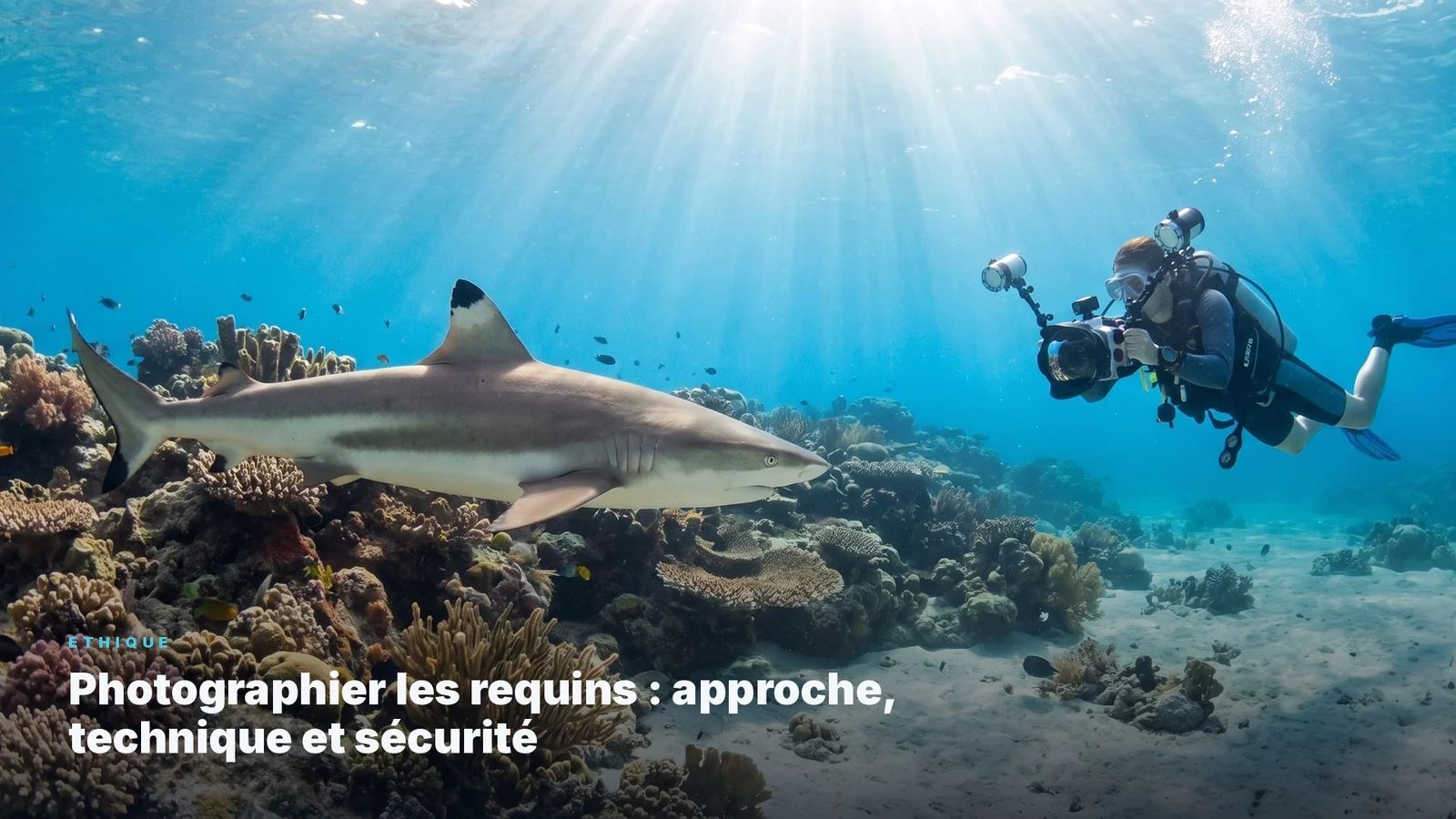
Photographing a shark underwater demands understanding its behavior before thinking about settings. The species accessible during recreational diving (reef shark, nurse shark, whale shark) tolerate human presence if you respect three rules: distance, positioning, and absolute calm. Wide angle is mandatory, continuous autofocus is recommended, and flash is prohibited. The shark is not a trophy, it is a privilege.
I encountered my first reef shark in the Maldives, years ago. I missed it. Not technically: my settings were correct. But I tried to approach too fast, it banked away, and all I got was a photo of a grey tail on a blue background. Blurry, too.
Since then, I have learned that shark photography is first a matter of patience and reading behavior. Technique comes after.
Species accessible during recreational diving
Not all sharks can be photographed under the same conditions. Some are regularly encountered during recreational diving, others require very specific conditions.
The reef shark (blacktip and whitetip)
This is the shark most frequently encountered by divers. The blacktip reef shark (Carcharhinus melanopterus) patrols the flats and reef passes, often in shallow water. The whitetip reef shark (Triaenodon obesus) is more sedentary, often resting under an overhang or in a crevice.
The blacktip is more nervous: it tolerates your presence but does not linger. You have a few seconds when it passes. The whitetip is more tolerant: if you approach slowly, it can stay in place for several minutes.
The nurse shark
The nurse shark (Ginglymostoma cirratum) is the easiest species to photograph for a beginner. It is benthic (resting on the bottom), nocturnal (so often motionless during the day), and not particularly skittish. It is an excellent subject for practicing composition and settings without the pressure of a moving target.
The whale shark
The whale shark (Rhincodon typus) is the largest fish in the world and probably the most photogenic marine animal there is. Encounters typically happen while snorkeling or freediving, not scuba diving (the bubbles bother them). The approach is made at the surface, swimming parallel to the animal, never across its path.
This is a subject where snorkeling photography comes into its own: the best light is at the surface, and the whale shark is often in the first few meters.
Passing species
Grey reef sharks, hammerheads, deep-water whale sharks: these species pass in the current or in the blue, often at a distance. You will not have the chance to position yourself. The only strategy is to already be in the right place, with the right settings, and shoot when the animal enters your frame.
Understanding behavior before framing
The difference between a shark photographer who brings back images and one who does not is not technical. It is a question of reading behavior.
Comfort signals
A shark swimming at a regular rhythm, with broad, fluid fin movements, is a comfortable shark. It probably does not perceive you as a threat. This is the moment to position yourself calmly and prepare your framing.
Discomfort signals
A shark that accelerates, suddenly changes direction, or lowers its pectoral fins (the lateral "wings") is a shark telling you it is not comfortable. The correct response is simple: do not move, do not chase, let it leave.
Never chase a shark that moves away. Never. This is the most important rule in this article. A fleeing shark that you chase can turn around. And a shark that turns because it feels cornered is no longer a photo subject.
Patrol circuits
Reef sharks follow circuits. If you observe from a fixed point for five to ten minutes, you will often see the same individual pass two or three times. This is precious information: instead of chasing the shark, position yourself on its circuit and wait for it to come back to you.
This passive approach is at the heart of the scenography of effacement: you do not hunt the image, you let it come to you.
Positioning and safety
The 3-meter rule
Maintain a minimum distance of 3 meters with any shark during recreational diving. This is a distance that gives you time to react and does not trigger defensive behavior in most species.
For the whale shark, international codes of conduct recommend 3 meters from the body and 4 meters from the tail.
Never block an exit
When you photograph a shark in a passage, a channel, or under an overhang, make sure the animal always has a free escape route. A shark that feels blocked between you and a reef becomes unpredictable. Position yourself to leave open space behind the subject.
Low position
The best position for photographing a shark is slightly below it, in a low angle. This position has three advantages. It gives the subject grandeur in the image. It places the shark against a blue background (negative space). And it makes you less threatening to the animal, because you are not above it (a predator position).
The buddy
Never photograph a shark alone. Your buddy is your lookout. While you frame, your concentration is on the screen or viewfinder, not on what is happening around you. Your buddy monitors the environment and warns you if a second shark approaches from behind or if the subject shows discomfort signals you have not seen.
Technical settings
Wide angle mandatory
Shark photography is a wide-angle discipline. No macro, no telephoto. Two reasons.
The first is distance: even at 3 meters, a reef shark measures 1 to 1.5 meters. With a standard lens, you only frame its head. Wide angle lets you capture the entire animal in its environment.
The second is optical: underwater, the space between you and the subject is filled with water that absorbs colors and reduces contrast. The greater the distance, the bluer and softer the image. Wide angle forces you to get closer (to fill the frame), which reduces the water column between you and the subject.
If you are photographing with a smartphone in a DiveVolk housing or a GoPro, you have a native wide angle. This is one of the cases where these cameras are perfectly suited.
Continuous autofocus
A moving shark does not stay at the same distance from you. If your camera allows it, switch to continuous autofocus (AF-C or AI Servo). If you are on a smartphone or GoPro, the autofocus is automatic and generally sufficient in wide angle (the depth of field is broad).
Fast shutter speed
A shark swims. Even slowly, it is still a moving subject. Aim for 1/250th of a second minimum, ideally 1/500th.
No flash
Flash is prohibited with sharks. Reasons: animal stress, risk of defensive behavior, and technical futility (at 3 meters distance, flash does not meaningfully illuminate the subject but lights up every particle between you and it).
Natural light produces the best shark images. The silhouette of a shark against a setting sun, the play of light on its grey skin, the deep blue surrounding its dark form. That is what gives these images their power.
Composition with a shark
Swimming space
A shark swimming to the right should be placed on the left third of the frame. This is the swimming space rule: leave space in front of the subject so the image breathes and the movement is visible.
Eye contact
The most powerful shark images are those where the animal's eye is visible and sharp. The eye creates a connection with the viewer. Aim your focus on the eye. If the shark passes in profile, wait for the moment when its eye is most visible in your frame.
Environment
A lone shark on a blue background is graphic. A shark in a school of fish, above a reef, at the entrance of a pass, tells a story. The best shark images include the environment because they show the animal in its world, not in a studio.
What the shark is not
The shark is not a trophy. It is not the subject that will validate your career as an underwater photographer. It is not a box to check.
It is a wild animal whose populations have declined 71% since 1970. Every encounter is a privilege that deserves to be treated as such. If conditions are not right (distance too great, nervous animal, current too strong), put your camera away and simply enjoy the encounter.
The best shark photos I have seen were taken by people who had learned to not photograph first. Divers who spent dozens of hours in the presence of sharks without pressing the shutter, observing, understanding, being accepted. Technique came after.
The AquaExposure course teaches this patience and ethics as prerequisites to any underwater wildlife photography technique.
FAQ
Is it dangerous to photograph sharks while diving?
The vast majority of shark encounters during recreational diving are perfectly safe. The most frequently encountered species (blacktip, whitetip, nurse shark, whale shark) pose no danger if you respect distance, do not block their exit, and do not chase them. The main risk is becoming distracted from managing your dive (air, depth, current).
What camera for photographing sharks?
A wide-angle setup is needed. A smartphone in a DiveVolk housing, a GoPro, or a compact in a housing with a wide-angle adapter all work. The essentials are shutter speed (1/250 minimum) and continuous autofocus if available. The lightest and most discreet gear is generally the best choice.
Should you use flash to photograph sharks?
No. Flash stresses sharks, can trigger a defensive response, and does not meaningfully illuminate a subject at 3 meters distance. Natural light produces the best shark images. Color correction in post-processing compensates for red loss if needed.
How do you approach a shark for photography?
You do not approach it. Position yourself on its patrol circuit and let it come to you. Stay still, breathe calmly, and make no sudden movements. If the shark moves away, do not chase it. It will probably pass again in a few minutes.
What is the best destination for photographing sharks?
The Maldives offer regular encounters with reef sharks, whale sharks, and hammerheads. French Polynesia (Fakarava, Rangiroa) is famous for its grey reef shark passes. South Africa (Aliwal Shoal, Protea Banks) offers encounters with tiger sharks and sand tigers. But reef sharks are present on most tropical reefs worldwide.
Can you photograph a shark with a smartphone?
Yes, a smartphone in a waterproof housing (DiveVolk type) works very well for sharks. The native wide angle is suited, the autofocus handles subjects moving at moderate distance well, and the image quality is sufficient for web and social media use. It is even an advantage: the absence of a bulky setup makes you more agile and discreet.
What should you do if a shark gets too close?
Stay calm and hold your position. Do not swim backward (you would be slower and more vulnerable). If the shark seems curious, stay still and let it inspect you. Most "approaches" are curiosity, not aggression. If the shark shows discomfort signs (lowered fins, jerky movements), move away slowly while keeping it in your field of vision.
How do you identify shark species underwater?
Blacktips have clearly marked black fin tips. Whitetips have white tips on the dorsal and caudal fins and a flattened snout. Nurse sharks are brown with a ventral mouth and nasal barbels. Grey reef sharks are uniformly grey with a black caudal edge. When in doubt, take the photo and identify the species on the surface, or use an app like iNaturalist.
Photographing sharks: approach, technique, and safety | AquaExposure