A body with strong high-ISO performance (Sony A7IV, Nikon Z6) and a fast lens at f/2.0 or better. A phone with night mode can also capture bioluminescence if you are patient and have enough light.
Where can I see bioluminescence in the Mediterranean?
Best spots: Villefranche-sur-Mer (Nice), Costa Brava (Tossa de Mar), Balearic Islands (Mallorca, Ibiza), Amalfi Coast. Season: July-October (best concentration).
What is the best time of year?
Autumn (Sept-Nov): BEST for the Mediterranean and the Maldives. Bioluminescence depends on nutrients. Upwellings create dinoflagellate blooms. Autumn combines warm water and nutrients.
The first time I saw bioluminescence, I was a dive instructor in the Maldives. I genuinely thought my mask was broken. No other explanation: I could see tiny blue stars floating around my torch, green sparks disappearing at my fingertips. My buddy looked at me with that smile you reserve for divers who are starting to run low on oxygen in the brain.
No, my equipment was not broken. I was simply face to face with one of the most surreal spectacles in nature: millions of marine organisms producing their own light in absolute darkness.
Today, photographing bioluminescence has become my obsession. And I need to tell you straight away: the critical settings are ISO 3200-12800, aperture f/1.8-2.8, and shutter speed between 1/4s and 2s. Everything else in this article explains why those numbers are not accidents.
What is bioluminescence? (Science to the rescue)
Before talking technique, let us clarify this phenomenon that makes the underwater night look like a parallel universe.
Bioluminescence is the production of light by living organisms. Period. No hidden mirror, no photographic trickery (well, not at the moment of capture). It is a chemical reaction called the luciferin-luciferase reaction.
Here is how it works:
The enzyme luciferase catalyzes the oxidation of a molecule called luciferin. This oxidation releases energy in the form of photons, particles of light. No heat is produced. It is "cold" bioluminescence, which explains why these organisms can glow without burning up.
In the Mediterranean, the main species is Noctiluca scintillans, a single-celled dinoflagellate that produces spectacular blue light when disturbed. You wave your hand and suddenly it is an underwater New Year's Eve.
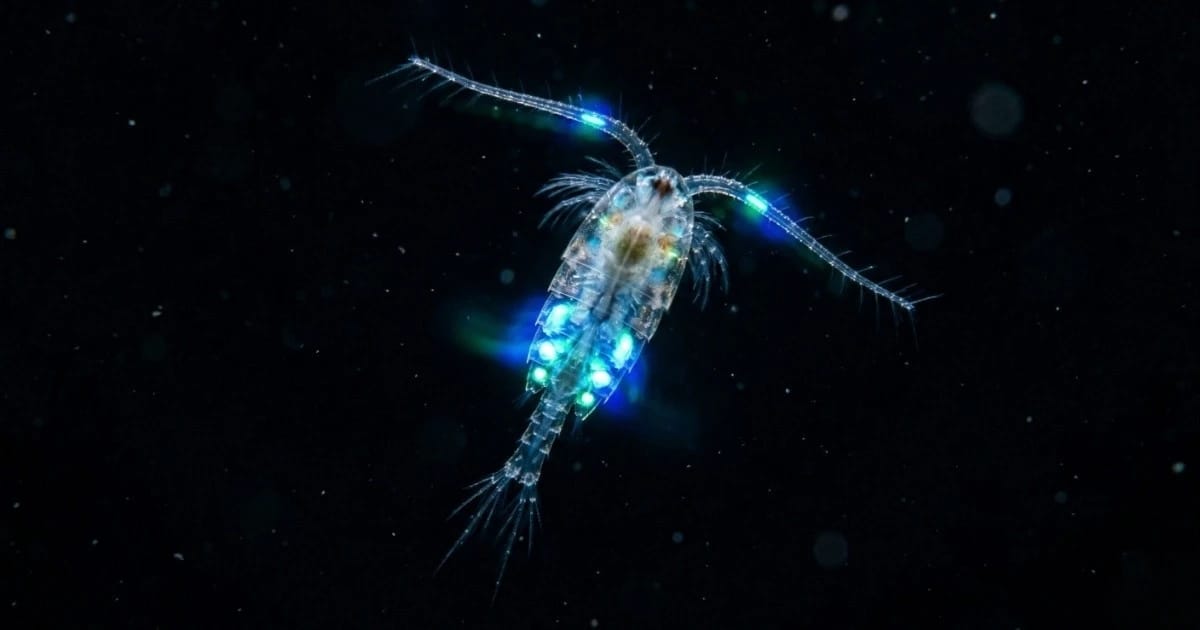
Other organisms join in: small luminescent jellyfish, ostracods (tiny crustaceans), myctophids (deep-sea fish), and bioluminescent squid. Each produces its own light signature to communicate, attract prey, or camouflage. It is a chemical symphony written in photons.
The crucial difference: bioluminescence vs. biofluorescence
Since I need to be rigorous (except when telling the story about thinking my mask was broken), let us clarify a classic trap.
Bioluminescence = light production by the organism itself (luciferin-luciferase reaction). The organism is the source.
Biofluorescence = absorption of light (UV or blue) and re-emission as light of a different color. It is a bit like a glow-in-the-dark paint that shines under UV light. The organism is a reflector, not a source.
Example: certain fluorescent corals appear red or orange under blue light, but that red is not produced by them. It is reflected. On the other hand, a Noctiluca producing blue at night? Pure bioluminescence.
This distinction is crucial for conservation. Biofluorescence in corals is a signal of stress and health. Photographing it helps monitor reef degradation.
Camera settings: the exact recipe
Let us talk technique without detour. The underwater night is like photographing a supernova with a phone. You need to play with three variables:
1. ISO: Sacrifice cleanliness for light
Start at ISO 3200 minimum. Go up to 12800 if the light is truly faint.
Yes, at ISO 12800, your image will have noise. Lots of noise. Random colored squares everywhere. But it is the only way to capture the rare photons of bioluminescence.
2. Aperture: the widest diaphragm possible
f/1.8 to f/2.8 is your friend. The smaller the number, the wider the diaphragm opens, the more light enters.
If you have an f/4 lens, forget it. You will tear your hair out trying to capture sparks that demand extreme sensitivity. Invest in a wide-angle f/2.0 lens or a fast zoom. This is one of the rare times I say "gear truly matters."
3. Shutter speed: between 1/4s and 2s
This is where it gets counterintuitive.
Normally, underwater, you think "fast speed to freeze movement." In bioluminescence, it is the opposite. You WANT light to accumulate on the sensor.
1/4s to 1/2s = the baseline for capturing dinoflagellate light trails
1s to 2s = if you are truly in absolute darkness
The price? Bioluminescence images are NEVER tack-sharp. It is a trail of light, not a classic photograph. And it is beautiful precisely because it is ethereal.
Depth of field and focus
Forget autofocus. It will see nothing. Switch to manual focus (MF) and set to infinity.
Complete configuration example
ISO: 6400 (Mediterranean, good spot)
Aperture: f/2.0
Speed: 0.8s
Lens: 14-24mm wide angle (maximum brightness)
Format: RAW (you will need latitude in post-production)
Where to see and photograph bioluminescence
I have dived in three legendary regions. Each tells a different story.
Puerto Rico: the brightest bay in the world
The Laguna Grande (or Fajardo bioluminescent bay) in Puerto Rico is a mandatory pilgrimage.
The bay is a closed ecosystem with an extremely high concentration of Pyrodinium bahamense (a red dinoflagellate). Every movement you make literally illuminates a blue light trail beside you.
The challenge? It is overcrowded. Hundreds of kayaks full of tourists. Noise. Artificial light pollution. And a local law that, thankfully, protects this ecosystem (diving prohibited, kayaks only at a distance, no flash).
Personal tip: Go very early in the morning (4am) or in low season. The most magical photos I took there were alone with my guide at 5am, before the tours began.
Maldives: nocturnal softness
The Maldives taught me everything. My first bioluminescence experience was there. The atolls are dotted with small zones where Noctiluca scintillans thrives.
Unlike Puerto Rico (a hyper-concentrated bay), bioluminescence in the Maldives is softer, more distributed. The dinoflagellates float dispersed. That makes photography MORE difficult (lower photon density), but it makes the moment more intimate.
Best spots: closed lagoons at night (Ari Atoll, Baa Atoll), far from artificial light sources.
The mistake I made: my first night, I turned my headlamp to full power. I shut down all visible bioluminescence within a 5-meter radius. Dinoflagellates hate bright white light. It inhibits their chemical reaction. Since then, I use a dark red lamp or a dim lamp with a red filter.
Mediterranean: the accessible option
This is where I insist. You do NOT need to travel to the far ends of the earth.
The Mediterranean experiences Noctiluca scintillans blooms, especially in summer and autumn. French spots (Marseille, French Riviera, Corsica), Spanish spots (Costa Brava), and Italian spots (Cinque Terre) regularly harbor them.
The challenge: it is less predictable. You need to scan local diver forums, call clubs, watch reports. But when it is good? It is free, it is close, and it is magical.
The advantage many ignore: Mediterranean bioluminescence is often more intense in slightly warmer waters. Going between July and October increases your chances by 70%.
Nighttime ethics: why it matters
Here, I will be serious. No humor.
Photographing bioluminescence means entering the intimacy of fragile ecosystems. The underwater night is not a nightclub. It is a critical functional habitat where organisms reproduce, feed, and communicate.
Ethical golden rules
1No flash, ever: A flash stops bioluminescence and disorients organisms. Deep-sea fish that use bioluminescence for camouflage suddenly become vulnerable.
1Red light only: A red light (wavelength 650nm+) does not disturb bioluminescence. It lets you see and navigate without destroying the spectacle.
1No unnecessary contact: Every disturbance is an energy expenditure for the organism. Dinoflagellates use their bioluminescence as defense against predators. A too-sudden gesture forces them to illuminate prematurely.
1Limited duration: A bioluminescence dive should not exceed 45 minutes. Beyond that, you risk disturbing reproductive cycles.
1Zero light pollution: No artificial white light. Your camera's display should be reduced to minimum or covered.
Post-production in low light
Now, you come back with noisy, underexposed, ethereal images.
Welcome to the stage where many give up. Bioluminescence images look like failed photos. They are not. It is simply a genre apart.
Step 1: Noise reduction in RAW
Open your RAW file in Lightroom or Capture One. Luminance: +30 to +50. Detail: +20 to +30. Contrast: -10 to -20. Do not be aggressive. Noise is part of the aesthetic.
Step 2: Boost exposure and blacks
Exposure: +0.5 to +1.5 EV. Blacks: +15 to +25. Shadows: +20 to +40 (reveals hidden structure).
Step 3: Color correction
Bioluminescence has a blue (Noctiluca) or green (some dinoflagellates) signature. Resist the urge to "correct" the color to make it "realistic." It IS realistic. Slightly increase blue saturation (+10-15), no action on other channels.
Step 4: Clarity and texture
Clarity: +15 to +25. Texture: +10 to +20 (brings back fine bioluminescence details).
Final result
Your image will never be "sharp" in the classic sense. It will be atmospheric, dreamy, with light trails and visible grain. That is good. That is the intention.
Post-dive: saving your wet housing
A small technical note to finish.
Nighttime underwater photography exposes your gear to very cold and often brackish water (especially in lagoons). After every bioluminescence dive:
1Rinse your housing in fresh water (USB port, battery, everything)
2Dry completely before opening the compartment
3Let dry 24 hours before next use
4Test the lens for internal condensation
I lost a Nikon housing in 2017 because I ignored step 2. Expensive lesson.
FAQ
What is the best camera for bioluminescence?
A body with strong high-ISO performance (Sony A7IV, Nikon Z6) and a fast lens at f/2.0 or better. A phone with night mode can also capture bioluminescence if you are patient and have enough light. But RAW and manual control remain crucial.
Where can I see bioluminescence in the Mediterranean?
Best spots: Villefranche-sur-Mer (Nice), Costa Brava (Tossa de Mar), Balearic Islands (Mallorca, Ibiza), Amalfi Coast. Season: July-October (best concentration). November-December possible after storms (nutrients). Predictability: 60-70% in high season if you go at night after sunset.
What is the best time of year?
Spring (April-May): decent in the Mediterranean, excellent in the Maldives. Summer (June-August): peak in the Mediterranean, good everywhere except Puerto Rico (storms). Autumn (Sept-Nov): BEST for the Mediterranean and the Maldives, excellent for Puerto Rico. Bioluminescence depends on nutrients. Upwellings (cold, nutrient-rich water rises) create dinoflagellate blooms. Autumn combines warm water and nutrients. That is why it is the golden season.
Difference between bioluminescence and biofluorescence?
Bioluminescence: the organism PRODUCES light (luciferin-luciferase chemical reaction). Sources: dinoflagellates, jellyfish, certain fish. Biofluorescence: the organism REFLECTS light after absorbing it. Sources: certain corals, nudibranchs, sharks. For photography: bioluminescence glows naturally at night. Biofluorescence needs an excitation source (UV lamp). Of the two, bioluminescence is easier to photograph without specialized equipment.
Ethical considerations for nighttime bioluminescence dives?
Strict summary of the rules: 1. No flash, ever. Red lamp only. 2. No sudden gestures. Every disturbance = energy cost. 3. Maximum 45 minutes duration. Beyond that, you disturb reproductive cycles. 4. Zero light pollution. No white light. 5. Respect local regulations. Some bays (Puerto Rico) prohibit diving, allowing only kayaking.
Can I photograph bioluminescence with a smartphone?
Yes, with limitations. Modern night modes (iPhone 14+, Pixel 7+) can capture light trails if you keep the phone still (tripod or support), expose for 3-5 seconds (night mode allows up to 5s), get close enough to the bioluminescence (less than 30cm), and stay in an environment free of parasitic white light. Limitations: no manual ISO/aperture control, smaller sensor = less sensitive in low light, no RAW (limited post-production latitude). A smartphone can document a bioluminescence dive. It cannot capture it at a professional level. Use it if that is what you have. But expect softer images with less detail.