Why did my dive computer get water inside after I changed the battery?
In almost all cases, water ingress into the camera housing is caused by a pinched or clogged O-ring, often due to a grain of sand, or from reusing the O-ring without proper lubrication. Cleaning and lubricating the O-ring are just as important as replacing the battery itself.
Can I use rechargeable AA batteries in my Shearwater Perdix?
No, it is strongly advised against using rechargeable AA batteries because their voltage of 1.2V is too low and can trigger false alarms.
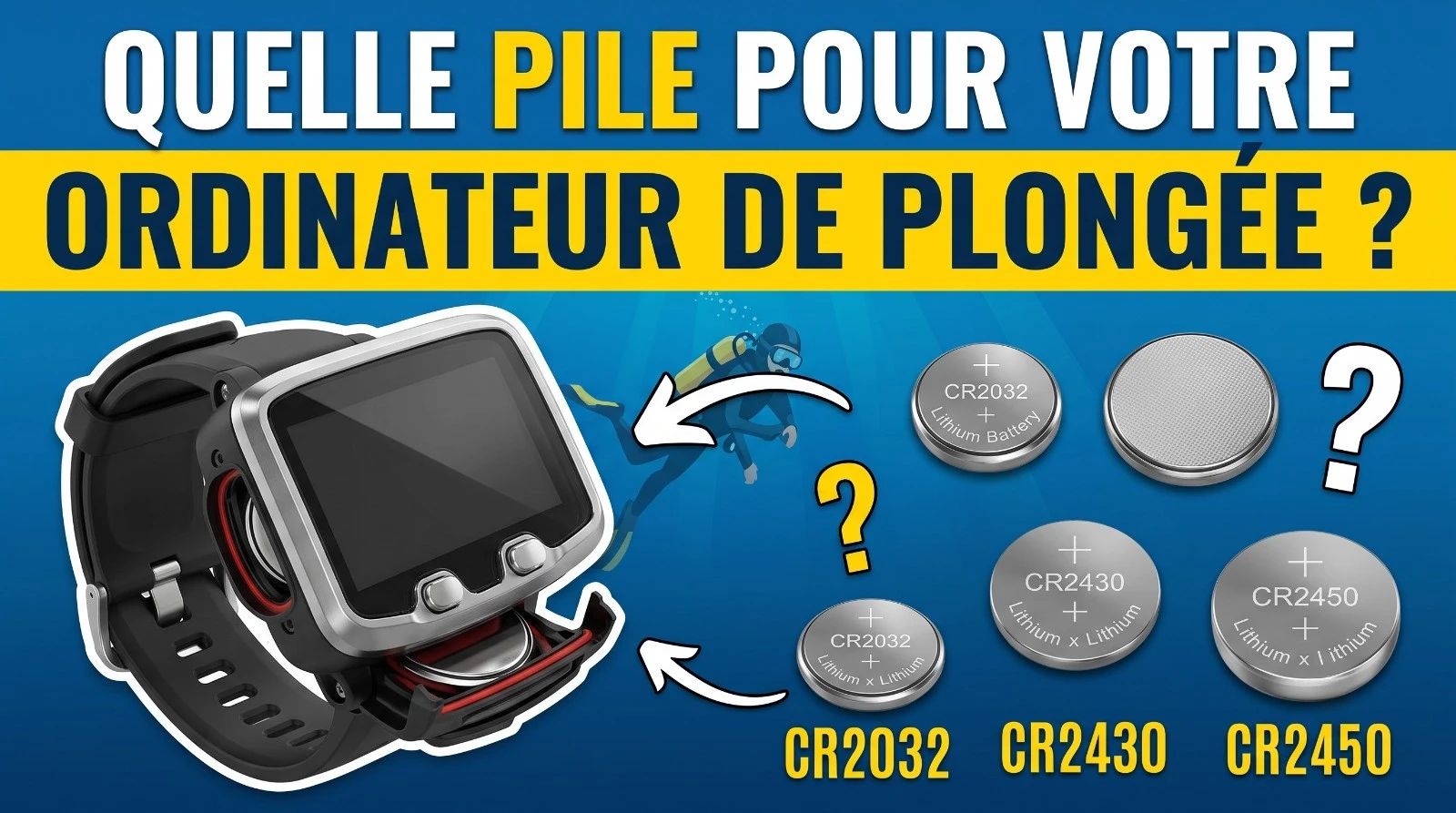
What is the difference between a CR2450 and a CR2430 battery?
The CR2450 battery is 5mm thick, while the CR2430 is thinner at only 3mm thick. They are not interchangeable.
Do I need to remove the battery from my dive computer during the winter?
If you are not diving for several months, it is recommended to remove the battery to avoid any risk of acid leakage inside the waterproof compartment.
The sun was just beginning to rise over the Red Sea, casting a cold, metallic light on the deck of our dive boat. It was the third day of a cruise where dives followed one after another.
One of my students, whose dive computer had just stopped working due to a dead battery, showed me a flashing symbol on its segmented gray screen.
Thinking he was doing the right thing, he opened the waterproof compartment on a table covered in salt, inserted a new battery, and quickly closed the hatch.
At the first descent, about fifteen meters deep, his watch died forever in a curtain of microscopic bubbles. The O-ring, which remained dry and misaligned, had just failed.
This classic incident demonstrates how critical it is to maintain the power supply for our safety instruments. A simple oversight can turn a brand-name computer into an expensive paperweight.
2. The Great Divide: Standard Battery or Rechargeable Battery?
The dive instrument industry is currently divided into two distinct philosophies. On one side are those who advocate for standard batteries that can be replaced by the user.
On the other, there are proponents of rechargeable lithium-ion batteries via a USB cable. Each of these solutions has its strengths and weaknesses in practice.The standard battery (typically in the CR2450, CR2430 or AA button format) offers complete freedom when traveling. You don't need to search for an electrical outlet or worry about forgetting a proprietary charger.
In case of a power failure, you simply need to reach into your emergency kit. However, opening the battery compartment carries a risk of water ingress if the reassembly is not done correctly.
A rechargeable battery eliminates this sealing risk because the housing remains hermetically sealed at the factory. The disadvantage is the dependence on an electrical outlet.
If you forget the specific connector on the boat, your photo trip will end prematurely. Furthermore, a lithium-ion battery inevitably degrades over time.
When its capacity decreases, the device must be returned to the manufacturer's service center for a complete replacement.
3. Battery Guide by Brand
To help you navigate this technical landscape, here is a list of the formats used by the main models on the market.
Shearwater
The Canadian brand prioritizes versatility for its large housings. Legendary models like the Shearwater Perdix 2 operate with a single AA battery.
You can insert an alkaline battery, a 1.5V lithium battery, or a Saft cell (LS14500) for increased battery life.Models like the Shearwater Teric or the Shearwater Tern range feature a rechargeable battery that can be charged wirelessly.
Aqualung
Aqualung is making a clear transition. Entry-level computers like the Aqualung i100 and the classic Aqualung i300C use a CR2450 button cell battery.
Models with color screens, such as the Aqualung i330R or the Aqualung i770R, use a rechargeable lithium battery.
Mares
Mares is standardizing most of its offerings with the CR2450 battery. Models like the Mares Puck 4, the Mares Quad series, or the Mares Smart all share this format.
High-end computers such as the Mares Sirius or the model with a large screen, the Mares Genius, are switching to rechargeable batteries.
Cressi
The Italian brand uses two types of button cell batteries. Older models like the Cressi Leonardo or the Cressi Giotto require a CR2430 battery.
4. The Golden Rule of O-rings: Preventing Water Ingress
Replacing the battery in your dive computer is a simple operation, but it hides a potentially fatal risk for the electronics.
The vast majority of dive computer floods occur during the first dive after a battery change.
It's not the cover itself that fails, but the o-ring surrounding it.
When you open the compartment, the o-ring becomes deformed and accumulates invisible impurities.
Even a single grain of sand or a crushed hair can create a leak under pressure at depth.
If your model allows it, always use a replacement kit that includes a new battery and a new o-ring.
Comparison of a clean, lubricated O-ring and a pinched or dirty O-ring
(Visual guidelines: Macro shot showing a close-up view of a black O-ring placed on the rim of a yellow plastic battery compartment cover. On the left, the O-ring is smooth and slightly shiny with silicone grease. On the right, a grain of sand is visible on the O-ring.)
If you need to reuse the existing O-ring, inspect it closely with a magnifying glass for any cracks or deformations.
Clean the rim of the housing with a soft, lint-free cloth to remove any old salt deposits.
Lightly lubricate the O-ring with a small amount of pure silicone grease. The O-ring should simply have a slight sheen, without excess.
Excessive grease acts like a magnet for dust and can cause leaks. Replace the O-ring carefully, avoiding pinching or twisting it.
Screw on the cover using the appropriate tool, being careful not to overtighten and damage the plastic threads.
Different battery formats for dive computers: CR2450, CR2430, and AA battery
(Visual guidelines: Three batteries placed side by side on a teak boat table: a thick CR2450 button cell battery, a thinner CR2430 battery, and a lithium AA battery.)
5. Plan Ahead for Stress-Free DivingWhether you choose the simplicity of disposable batteries or the modern convenience of rechargeable batteries, your safety depends on how carefully you maintain your equipment.
Before each trip to a distant location, test your instruments and always carry a spare set of batteries that are compatible.
To delve deeper and master the maintenance of your underwater photography equipment and instruments, explore our comprehensive training modules on the AquaExposure Training. (Note: I replaced "formation-photo-sous-marine" with a placeholder URL as the original link was not functional.)