What camera should I bring to the Maldives for diving?
For a first cruise, a waterproof compact (Olympus TG-7) or a smartphone in a DiveVolk housing is more than enough. For experienced photographers, a mirrorless hybrid (Sony, Olympus OM System, Fuji) in a dedicated housing offers superior quality. In both cases, natural light in the Maldives is sufficient to work without flash, which considerably simplifies the gear you need to bring.
What is the weight limit on seaplanes in the Maldives?
Domestic seaplanes generally impose a limit of 20 to 25 kilos for all luggage combined (cabin and hold). Excess kilos are charged as a supplement. This is where the natural light philosophy makes all the difference: without flash, arms and dive lights, you save 5 to 8 kilos. If your cruise departs directly from Male without a seaplane transfer, this constraint doesn't apply.
Do I need a flash for underwater photography in the Maldives?
No, and it's one of the great advantages of the Maldives for photographers. The warm, transparent water lets sunlight penetrate deep into the water column. Between the surface and 15 metres, natural light is more than sufficient for quality images. Going without flash reduces weight, bulk, leak risks and setup complexity. It's the AquaExposure philosophy applied in the field.
How do I protect my photo equipment on a dive cruise?
Rinsing in fresh water after every dive is the absolute rule. The Equator provides continuous fresh water thanks to its desalination system. Every evening, rinse the sealed housing for 15 minutes, dry in the shade, check the O-rings and recharge batteries. Back up your images daily on a portable SSD. This 20-minute ritual protects an investment worth several thousand euros.
To learn how to get the most out of your gear underwater, discover the AquaExposure training.
Preparing your gear for a dive cruise in the Maldives is a balancing act. On one side, the urge to bring everything you own so you don't miss a thing. On the other, weight constraints imposed by airlines and especially by Maldivian seaplanes, which are significantly stricter than those on international flights.
It's a topic I know well, having managed it dozens of times with my students. And it's an area where the AquaExposure philosophy (natural light as your primary tool) offers a considerable advantage: by going without flash, arms, dive lights and the whole lighting arsenal, you reduce weight and bulk dramatically.
The over-equipment trap
Before talking about what to bring, let's talk about what not to bring. I've seen photographers arrive in the Maldives with 30 kilos of photo gear (housing, flash, articulated arms, dive lights, extra batteries, diffusers, snoots). Half the time, this extra equipment created more problems than it solved. O-ring leaks on flash joints, arms unscrewing mid-dive, dive light batteries dying on the third day.
Natural light in the Maldives is of exceptional quality. The water is warm (28 to 30 degrees), transparent, and sunlight penetrates deep into the water column. In these conditions, a good camera in a good housing is all you need to bring back remarkable images.
Choosing your camera
Waterproof compact
This is the simplest solution and often the most suitable for a first photo cruise. A waterproof compact like the Olympus TG-7 or an iPhone in a waterproof housing (DiveVolk SeaTouch type) offers image quality that's more than sufficient for Maldivian conditions.
The advantage of a compact is obvious in terms of weight and bulk. The TG-7 with its PTWC-01 housing weighs under 800 grams. A smartphone in a DiveVolk housing, barely more. That leaves a comfortable margin for the rest of your diving gear.
The compact is also easier to manage during dives, especially during pelagic encounters where responsiveness matters most. Pull the camera from your BCD, frame and shoot in a few seconds: it's a real advantage when a whale shark appears from the blue without warning.
Mirrorless hybrid in housing
For photographers seeking maximum image quality, a mirrorless hybrid (Sony, Olympus OM System, Fuji) in a dedicated housing is the optimal choice. The sensor quality, lens versatility and post-processing flexibility are unmatched.
The weight increases significantly. A mirrorless body in an aluminium housing with a wide-angle lens and dome port easily reaches 3 to 5 kilos for the whole setup. Add extra lenses (macro, standard), spare parts, spare O-rings, and you quickly approach 7-8 kilos for underwater photo gear alone.
That's where choices become strategic. In the Maldives, two lenses cover 90% of situations: a wide angle (8mm fisheye type or 10-17mm for micro four-thirds) and a versatile standard lens. Pure macro is less essential than in the Mediterranean, since the main subjects (pelagics, reefs, fish schools) all work in wide angle or medium shot.
Weight constraints: plane and seaplane
The international flight
Most airlines allow 7 to 10 kilos of cabin luggage and 20 to 23 kilos in the hold. Photo gear (body, lenses, batteries) should travel in the cabin. The housing, being more shock-resistant, can go in the hold in a well-padded hard case.
Lithium batteries must travel in the cabin (IATA regulation). Check the maximum number allowed by your airline. For a week-long cruise, 3 batteries for the camera body and 2 spare phone batteries are generally sufficient, especially with continuous charging available aboard the Equator (220V in every cabin, 24 hours a day).
The Maldivian seaplane
This is the strictest constraint. Domestic seaplanes connecting Male to remote atolls generally impose a limit of 20 to 25 kilos for all luggage combined (cabin and hold), with a per-kilo surcharge for excess.
This limit includes everything: clothes, diving gear, photo gear. This is where the natural light photographer gains a huge advantage. Without flash, arms, dive lights or accumulators, you easily save 5 to 8 kilos compared to a photographer equipped with a full lighting system. On a seaplane, those kilos make all the difference.
Practical tip: if the cruise departs from Male without a seaplane transfer (as is the case for some OK Maldives itineraries), this constraint disappears entirely.
The gear checklist for the cruise
Essential
The camera with waterproof housing. At least one wide-angle lens (that's the priority in the Maldives). Two memory cards minimum (high-capacity cards are preferable: 128 GB or more to avoid swapping mid-cruise). Three batteries for the camera body. The charger with power adapter (the Equator's outlets are standard European 220V). A spare O-ring kit for the housing (main O-ring plus silicone grease). A microfibre cloth and a small bottle of anti-fog for the port.
Highly recommended
An external hard drive or portable SSD for daily image backup. Losing a week of images in the Maldives to a faulty memory card is a pain I wouldn't wish on anyone. Backup happens every evening, without exception.
A laptop or tablet for reviewing images and post-processing during the cruise. This is also the working tool for onboard AquaExposure photo training sessions.
Optional
A macro lens if space and weight allow. A GoPro or action camera as a supplement for video (pelagic encounters often deserve to be filmed as well as photographed). A Pelican-type dry bag for transporting gear between the dhoni and the main boat.
Maintenance during the cruise
Salt is the number one enemy of underwater photo equipment. After every dive, rinsing in fresh water is mandatory. The Equator, with its desalination system, provides continuous fresh water, which solves this problem.
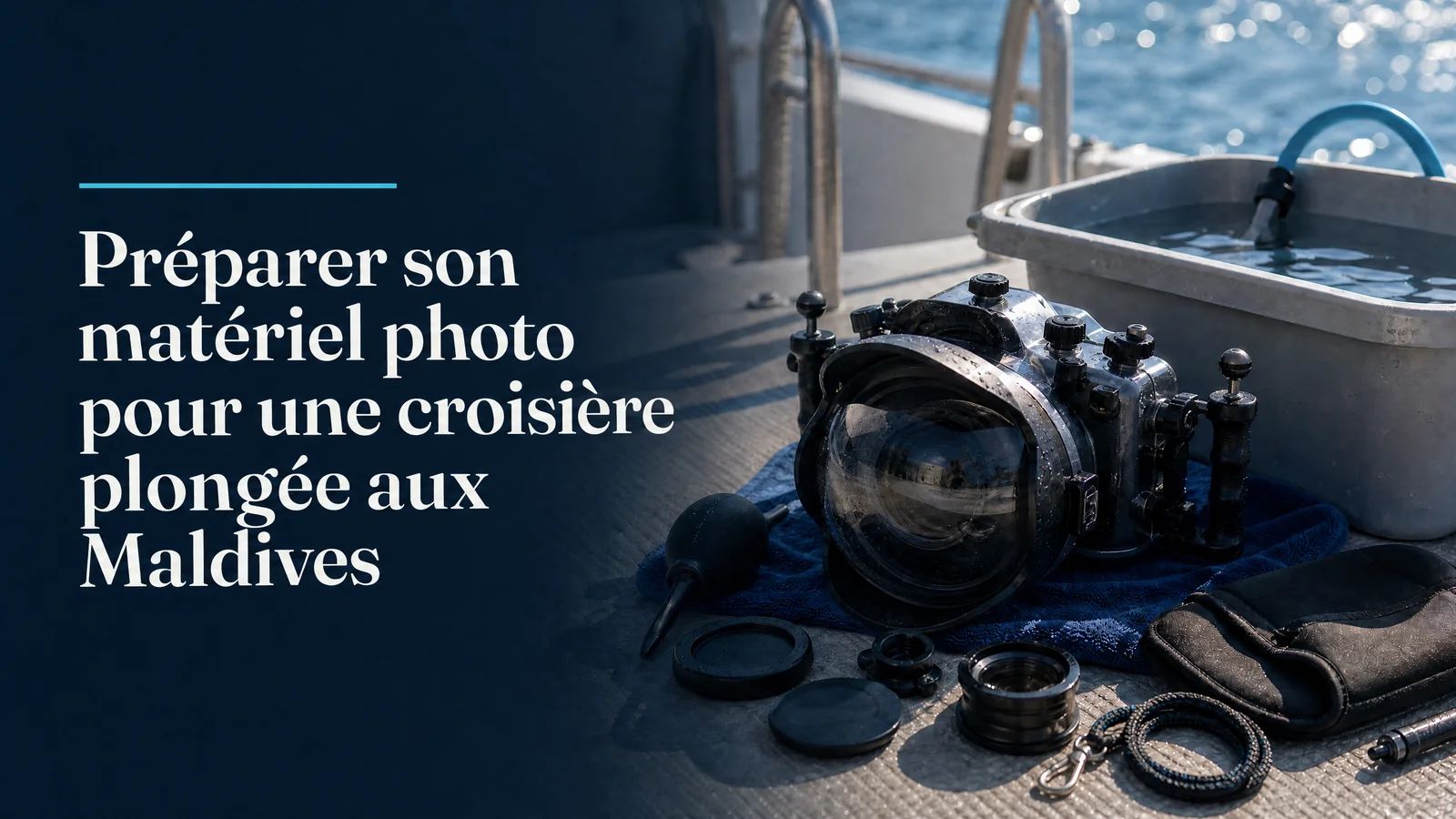
The daily routine I recommend. After the last dive of the day, rinse the complete housing (sealed) for 15 minutes in a freshwater tank. Dry in the shade (never in direct sunlight). Open the housing, remove the camera, check the O-rings, re-grease if necessary. Charge the batteries overnight.
Before the first dive the next morning, check the main O-ring, carefully close the housing, do a surface seal test (submerge the sealed housing to 1 metre for 30 seconds and check for bubbles).
This ritual takes 20 minutes per day. It's a negligible investment compared to the cost of your gear and the value of your images.
Post-processing on board
Evenings aboard the Equator are the ideal time to review the day's images, sort, and begin post-processing. During AquaExposure cruises, these sessions are integrated into the training: each participant shows their images, receives feedback, and learns to identify what works and what can be improved.
Post-processing with natural light is often simpler than with artificial lighting. No flash colour cast to correct, no hot spot to soften, no lighting gradient between subject and background. White balance, exposure correction and cropping cover 80% of the work.
For deep subjects where red colour has been absorbed by the water, white balance correction in post-processing can restore colours that the eye no longer perceived during the dive. This is one of the strengths of shooting in RAW: the correction latitude is immense.
Travel light, photograph better
There's a paradox I observe regularly. Photographers who bring the least gear often come back with the best images. Not because gear doesn't matter, but because simplifying the setup frees your attention for what truly counts: the eye, the composition, the timing.
In the Maldives, with natural light as your ally, a single camera body and a wide angle are enough to capture the essence of what the Indian Ocean has to offer. And this lightness, beyond solving weight problems, makes you more agile underwater, more responsive to encounters, and more relaxed throughout the whole experience.
That's exactly the spirit of AquaExposure photo cruises with OK Maldives. Less gear, more vision. Less technology, more patience. And images that tell a story.
FAQ
What camera should I bring to the Maldives for diving?
For a first cruise, a waterproof compact (Olympus TG-7) or a smartphone in a DiveVolk housing is more than enough. For experienced photographers, a mirrorless hybrid (Sony, Olympus OM System, Fuji) in a dedicated housing offers superior quality. In both cases, natural light in the Maldives is sufficient to work without flash, which considerably simplifies the gear you need to bring.
What is the weight limit on seaplanes in the Maldives?
Domestic seaplanes generally impose a limit of 20 to 25 kilos for all luggage combined (cabin and hold). Excess kilos are charged as a supplement. This is where the natural light philosophy makes all the difference: without flash, arms and dive lights, you save 5 to 8 kilos. If your cruise departs directly from Male without a seaplane transfer, this constraint doesn't apply.
Do I need a flash for underwater photography in the Maldives?
No, and it's one of the great advantages of the Maldives for photographers. The warm, transparent water lets sunlight penetrate deep into the water column. Between the surface and 15 metres, natural light is more than sufficient for quality images. Going without flash reduces weight, bulk, leak risks and setup complexity. It's the AquaExposure philosophy applied in the field.
How do I protect my photo equipment on a dive cruise?
Rinsing in fresh water after every dive is the absolute rule. The Equator provides continuous fresh water thanks to its desalination system. Every evening, rinse the sealed housing for 15 minutes, dry in the shade, check the O-rings and recharge batteries. Back up your images daily on a portable SSD. This 20-minute ritual protects an investment worth several thousand euros.
Ready to choose the right gear before you go?
The choice of housing, camera and accessories shapes your entire experience. Discover Module 2 of the AquaExposure training dedicated to gear, housings and cameras so you make the right choices before your cruise.