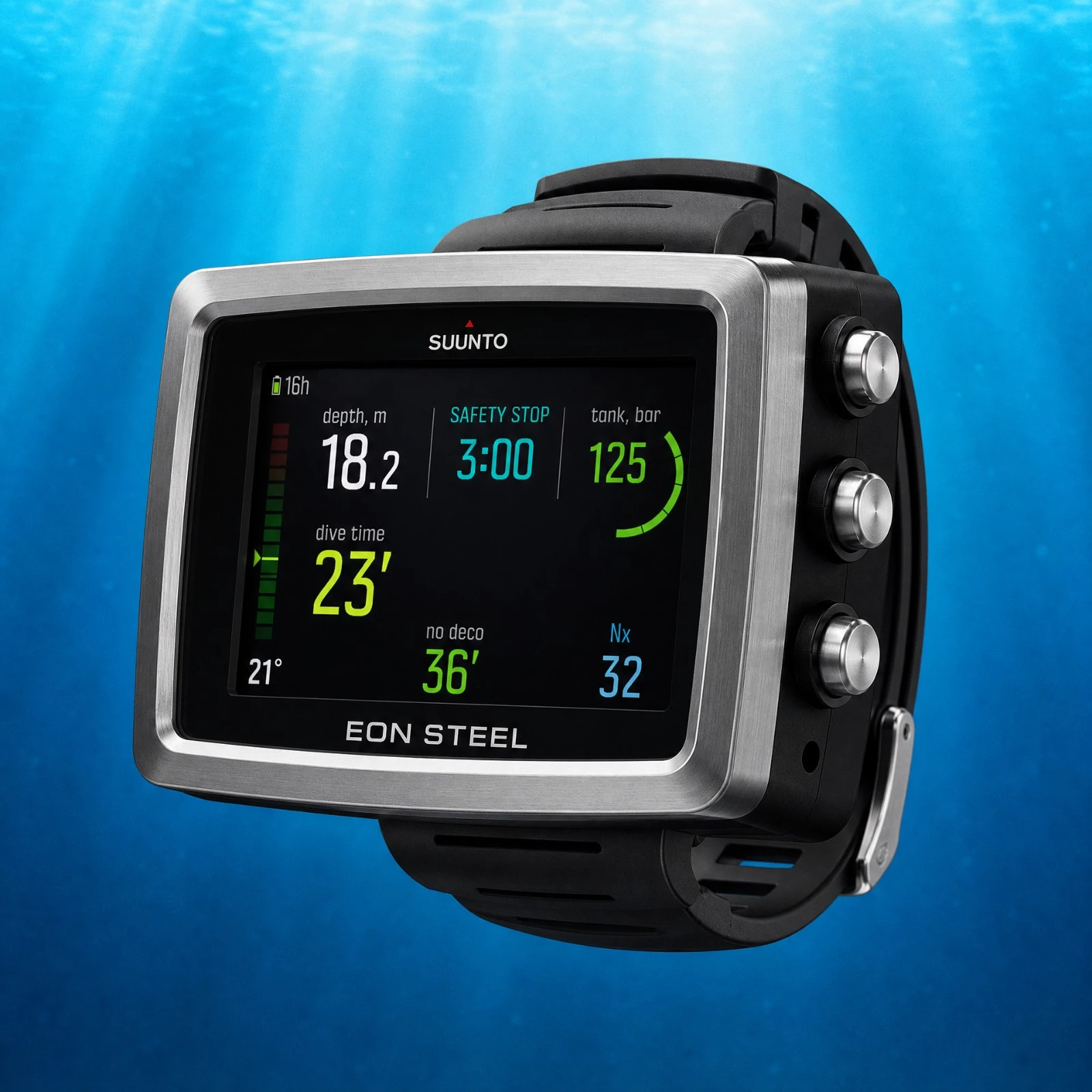
Comprehensive review of the Suunto EON Steel Black. Discover how its Bühlmann ZHL-16C integration and 20-gas management revolutionize this tec computer.
To learn how to get the most out of your gear underwater, discover the AquaExposure Training.
Introduction
When you leave the comfort zone of recreational diving and venture beyond virtual or physical depth limits, your relationship with equipment changes completely.
The dive computer ceases to be a mere depth indicator and becomes the absolute conductor of our decompression process and our survival.
In this environment where mistakes come at a high price, the trust placed in electronic systems must be absolute, unwavering, and permanent.
The Suunto EON Steel Black fits precisely into this line of instruments designed for the most hostile environments that our planet has to offer.
Historically, the Finnish brand has often been shunned by the technical community, which criticized its overly strict adherence to its proprietary model.
Today, the integration of the Bühlmann standard with Gradient Factors is a game-changer and is reshaping a market previously dominated by a few historical players.
We will examine the technical data of this steel block to understand whether its claims of reliability hold up under scrutiny of its internal software workings.
Hard work, repetition, and pushing one's limits are key principles in technical diving, which requires equipment that lives up to its demands.
The following analysis is based on the raw specifications of the device and feedback from the community, providing an unbiased assessment.
Get ready to delve into the details of a machine that has been designed to push the boundaries of underwater exploration while ensuring safety.
The Verdict in Summary
Overall score: 4.7/5
| Criterion | Score | What it means |
|---|---|---|
| Algorithm & decompression levels | 5.0/5 | Bühlmann ZHL-16C model with adjustable GF or Fused RGBM 2, your choice. |
| Air & multi-gas | 5.0/5 | Complete management of up to 20 gases, including hypoxic Trimix and CCR mode. |
| Screen & ergonomics | 4.8/5 | Very large color TFT screen with a customizable interface from A to Z. |
| Battery life | 4.4/5 | Reliable rechargeable battery offering 20 to 40 hours of dive time. |
| Connectivity & app | 4.6/5 | Very stable Bluetooth paired with an excellent Suunto app. |
| Compass & instruments | 4.3/5 | Reference 3D compass without apnea mode, which is logical for this segment. |
| Robustness & depth | 4.6/5 | Certified to a depth of 150m with a brushed stainless steel case and Xensation glass. |
| Price & customer service | 4.1/5 | Around €1000 for high-quality equipment with a reputable customer service department. |
Detailed Analysis
Algorithm & Milestones
The arrival of the Bühlmann ZHL-16C model elevates this device to a new level, finally meeting the expectations of serious divers.
For years, technical divers have had to deal with proprietary algorithms that lacked transparency regarding deep dives.
Free Gradient Factors allow you to adjust both low and high conservatism settings, enabling you to precisely match your profiles to those of your teammates.
This flexibility is such a significant advancement that it fundamentally changes the perception of the device within the technical community.
The interface displays the decompression ceiling, the total ascent time, and a visual representation of the tissues that is very, very, very clear.
We observe a complete absence of distracting alerts that could burden the diver's mental load during critical ascent phases.
The software reliability is excellent since the last major update, which stabilized the entire calculation system.
The diver retains the option of using the Suunto Fused RGBM 2 if they prefer to stick with the historical algorithm of the Finnish brand.
Real-time tissue analysis allows for fine-tuning of the ascent speed, which greatly enhances safety in shallow water depths.
It is a tool that requires a thorough understanding of decompression theory in order to be used effectively and safely.
Air & Multi-Gas
We are facing a veritable war machine for managing complex mixtures during deep-sea expeditions.
The system allows for the configuration of twenty different gases with oxygen percentages ranging from 5% to 99%.
The helium management range extends from 0% to 95%, which covers the entire requirement for hypoxic trimix diving.
The native CCR (Closed-Loop Control) mode manages fixed setpoints with surgical precision while seamlessly integrating bailout planning.
This adaptability, versatility, and comprehensiveness make it a formidable tool for recyclers operating in closed-loop systems.
The transition between bottom gases and decompression gases occurs smoothly, ensuring safe operations even under stressful conditions.
The device can connect to a large number of wireless transmitters and read up to twenty blocks simultaneously.
This air integration feature enables multi-block monitoring, which simplifies reserve management during dives with heavy equipment loads.
However, it is important to keep in mind that these transmitters consume energy and add a potential point of failure to the overall system.
Hardware redundancy remains a golden rule that even the most advanced electronics can never completely replace at its core.
Screen & Ergonomics
The 2.4-inch color TFT screen offers exceptional brightness that penetrates even the murkiest waters or the complete darkness of underground networks.
The physical ergonomics are based on three large buttons on the front panel, which are perfectly spaced for use with very thick, waterproof gloves.
It boasts such direct readability that even with zero visibility, essential information is immediately apparent without any need for adjustment or effort.
The Suunto CustomDisplay software allows you to organize the data fields exactly according to your personal preferences and reading habits.
Navigation using physical buttons only is a deliberate choice that ensures full operability in waters near the freezing point.
The lack of a touchscreen is a blessing for divers who operate in environments where mud and sand are prevalent.
The menus are structured logically to avoid getting lost in endless subfolders when making last-minute adjustments.
The visual alarms use distinct color codes that immediately attract attention without causing unnecessary panic.
The generous size of the characters is a relief for divers whose near vision begins to decline with years of experience.
Each pixel of this screen has been designed to maximize the transfer of information between the device and the diver's brain in record time.
Battery Life & Power Source
The power supply is provided by a large rechargeable lithium-ion battery, which allows for between twenty and forty hours of operation depending on the settings.
The intensive use of the screen at maximum brightness and the connection of multiple sensors will naturally reduce this usage time.
Its performance in very cold water, below five degrees Celsius, remains excellent, with a buoyancy that doesn't collapse abruptly.
The battery indicator is reassuringly accurate, allowing you to plan your dives without worrying about a sudden power failure at depth.
The charging process is done via a proprietary USB cable, which you should be careful not to lose during your travels.
The choice of a sealed internal battery guarantees perfect watertightness by avoiding any risky handling of O-rings by the user.
It is recommended to maintain the charge between twenty and eighty percent during prolonged storage periods in order to preserve the cells.
Energy management is optimized by a processor that puts the device into deep sleep mode as soon as it detects prolonged inactivity on the surface.
This generous autonomy is a major advantage for expeditions where access to a power source is limited or completely unavailable.
The reliability of this energy source is the foundation upon which the safety of your decompression calculations rests during extreme dives.
Connectivity & App
Despite its rugged design and metal block appearance, this device fully leverages the entire connected ecosystem developed by the manufacturer.
The Bluetooth synchronization with the mobile dive log runs quickly, which greatly facilitates the end-of-day debriefing.
Firmware updates can be easily performed using a standard computer and the dedicated SuuntoLink software.
Divers who enjoy analyzing their dive profiles in detail will appreciate the ability to export data in a standard format for use with platforms like Subsurface or MacDive.
This openness to third-party software demonstrates a desire to integrate into the habits of the technical community without imposing restrictions.
The mobile application offers a clean interface that allows you to view your dive profiles with clarity, which aids in understanding the data.
Configuring the computer from a smartphone saves a significant amount of time compared to navigating through physical buttons, which can be tedious.
The user community can share its dive sites and gas settings directly through the Finnish brand's cloud platform.
The stability of the wireless connection is remarkable and does not suffer from the frequent disconnections that are sometimes encountered with other models.
It's a successful blend of the ruggedness required by the underwater environment and the modernity expected by today's connected divers.
Compass & Instruments
The 3D inclination-compensated digital compass is a true industry standard, offering impressive responsiveness underwater.
It can be displayed in full-screen mode for a clean viewing experience or as a discreet overlay to keep an eye on the heading during decompression.
It is a major advantage during complex cave explorations or when carefully examining large shipwrecks.
The temperature sensor displays highly accurate data that helps anticipate body cooling during long decompression periods.
The absence of a freediving option is purely anecdotal in this market segment, which is exclusively aimed at divers who are heavily equipped.
Of course, a basic depth gauge mode is available for those who use charts or who want to use it as a backup instrument.
The compass calibration takes only a few seconds and maintains its accuracy even when the device is tilted significantly on the wrist.
The virtual compass is very, very, very easy to read and allows you to lock a heading with a visual alarm in case of deviation from the intended course.
Absolute pressure sensors react to even the slightest changes in depth to adjust decompression calculations in real time.
The integration of these measuring instruments into a single housing frees up space on the forearms, which are already very crowded for technical divers.
Robustness & Depth
This metal paving stone is designed to be virtually indestructible against mechanical stresses in confined environments.
The casing skillfully combines brushed stainless steel and a reinforced polymer that absorbs impacts from rocks or rusted metal sheets.
The screen is protected by a Xensation glass that offers extreme resistance to impacts and scratches, which are inevitably associated with diving.
The device is certified to operate optimally up to a depth of one hundred and fifty meters, which covers the vast majority of needs.
With its weight of 347 grams on the scale, the density of the materials is immediately noticeable and confirms the extreme purpose of this measuring instrument.
The case design avoids corners where salt and sediment could accumulate and potentially block the push buttons over time.
The fasteners for the elastic bungee-type strap are robust and will not break under tension when putting on the equipment.
It's a piece of equipment that inspires absolute confidence from the first time you hold it, and it's designed to withstand even the most extreme conditions.
The black brushed steel finish gives it a stealthy look that conceals the minor scratches that will inevitably appear over time.
The pressure resistance of this enclosure is a result of Finnish engineering that makes no compromises on structural safety.
Prices & Customer Support
Priced around a thousand euros, this device directly competes with leading technical products on the market, such as the Shearwater Perdix 2.
This high price is justified by the impeccable quality of construction and the comprehensiveness of a software suite that leaves nothing to chance.
The manufacturer's European network is robust and ensures easy availability of spare parts in our Western countries.
The standard manufacturer's warranty applies, with case processing following procedures well-established by the Finnish brand.
The initial investment is significant, but it needs to be considered in light of the many years of service that this instrument is capable of providing.
The resale value on the used market is generally very good for this type of equipment, which is highly sought after by divers who are progressing in their skills.
Accessories such as charging cables and screen protectors are readily available from most specialized retailers.
The cost of wireless transmitters will be added to the final bill if you wish to fully utilize the air management capabilities.
It's an investment that pays off in the long term and accompanies the diver's progression towards increasingly demanding practices.
The peace of mind offered by equipment of this quality is invaluable when operating at depths where errors are not tolerated.
Who is this computer for?
This model is primarily designed for technical divers who use trimix or rebreathers and who are looking for maximum readability in all circumstances.
It is the ideal tool for instructors who require a customized configuration and perfect multi-gas redundancy to ensure safe instruction.
The preparation, planning, and execution of complex dives find a valuable ally here, one that will not falter under pressure.
Cavers will particularly appreciate the integrated compass and the case's resistance to the harshness of rocky crevices.
Underwater photographers who perform long decompression stops will find unparalleled comfort in being able to easily monitor their parameters.
Conversely, an occasional recreational diver will find this device much too heavy and unnecessarily complex for recreational dives.
The traveler who is meticulous about every gram in their luggage will need to turn to models that are much smaller, resembling a watch, as they are better suited to their needs.
Its physical design is intended to be worn over a waterproof suit and will appear out of proportion when worn over a thin, lightweight tropical suit.
Beginners risk being overwhelmed by a mass of technical information that they do not yet master, and which could generate confusion.
It is best to solidify your foundation with a simpler tool before tackling the management of gradient factors and multiple gases.
Customer Service and Support
The after-sales service of Suunto is generally good, with a worldwide distribution network that makes it easier to provide support in case of any problems.
However, it is important to pay particular attention to firmware management, as this has been critical in the past for certain models.
It is imperative to systematically update the device using the dedicated software before undertaking any series of dives, whether they are challenging or remote.
This level of software maintenance is crucial for ensuring the flawless operation of decompression algorithms used underwater.
Warranty replacements are generally handled with care, but may involve unavoidable delays depending on your geographic location.
Troubleshooting is often performed remotely using dive logs extracted by the application, which speeds up decision-making.
Approved repair centers have the necessary tools to test the watertightness of enclosures after any major technical intervention.
Communication with customer support is facilitated by online platforms that allow users to track the progress of their repair requests.
It is always frustrating to have to part with your equipment during the season, but safety dictates that we make no compromises when it comes to electronics.
The brand's reputation is based on its ability to keep its older models in operational condition for a very long time.
Nutrition
The choice of a rechargeable lithium-ion battery fundamentally changes energy management during extended stays away from the coast.
When on a cruise, it will be necessary to establish a strict charging schedule to avoid ever finding yourself with a black screen at the moment of launch.
A capacity of twenty to forty hours provides a comfortable margin that allows for several days of diving without risking running out of air.
The use of multiple wireless transmitters for air management will further draw upon the resources of this internal battery.
It is always wise to keep a backup mechanical pressure gauge on hand to compensate for any electronic failure or unexpected loss of signal.
A full charge takes a few hours and seamlessly integrates into rest periods between dives or overnight on the boat.
Divers for users accustomed to user-replaceable batteries will need to adapt their habits and plan for external backup batteries.
Lithium-ion technology offers a very flat discharge curve, which maintains a constant screen brightness until the last few percentage points of battery life.
The natural aging of cells will lead to a gradual decrease in overall battery life after several hundred full charging cycles.
The internal battery replacement must be performed by an authorized service center to ensure that the enclosure remains watertight.
Links to other models from the same brand.
If you appreciate the Finnish ecosystem but are looking for a more compact format for everyday use, other options are available.
You can explore the capabilities of the watch by checking out our Suunto D5 review, which stands out for its design.
For divers who want a large screen without the advanced technical features, the Suunto EON Core review is relevant.
Finally, those who love connected multisport watches will find what they're looking for by reading our review of the very versatile Suunto Ocean.
CTA Comparator
To compare this computer with other models, see our diving computer comparison tool.
© 2026 AquaExposure. All rights reserved. Reproduction prohibited without authorization.
Share
Table of Contents
- 01Introduction
- 02The Verdict in Summary
- 03Detailed Analysis
- 04Algorithm & Milestones
- 05Air & Multi-Gas
- 06Screen & Ergonomics
- 07Battery Life & Power Source
- 08Connectivity & App
- 09Compass & Instruments
- 10Robustness & Depth
- 11Prices & Customer Support
- 12Who is this computer for?
- 13Customer Service and Support
- 14Nutrition
- 15Links to other models from the same brand.
- 16CTA Comparator
Questions about the Journal
Can I use the photographs from this journal?
All images are protected by copyright. For any commercial or editorial use, please contact us via our form.
How can I be notified of new articles?
Follow us on social media or join the Sentinels Circle to receive our immersion stories before anyone else.
Do you offer hands-on workshops?
Yes, we organize masterclasses and field expeditions for members of our school. Check the Training page for details.


