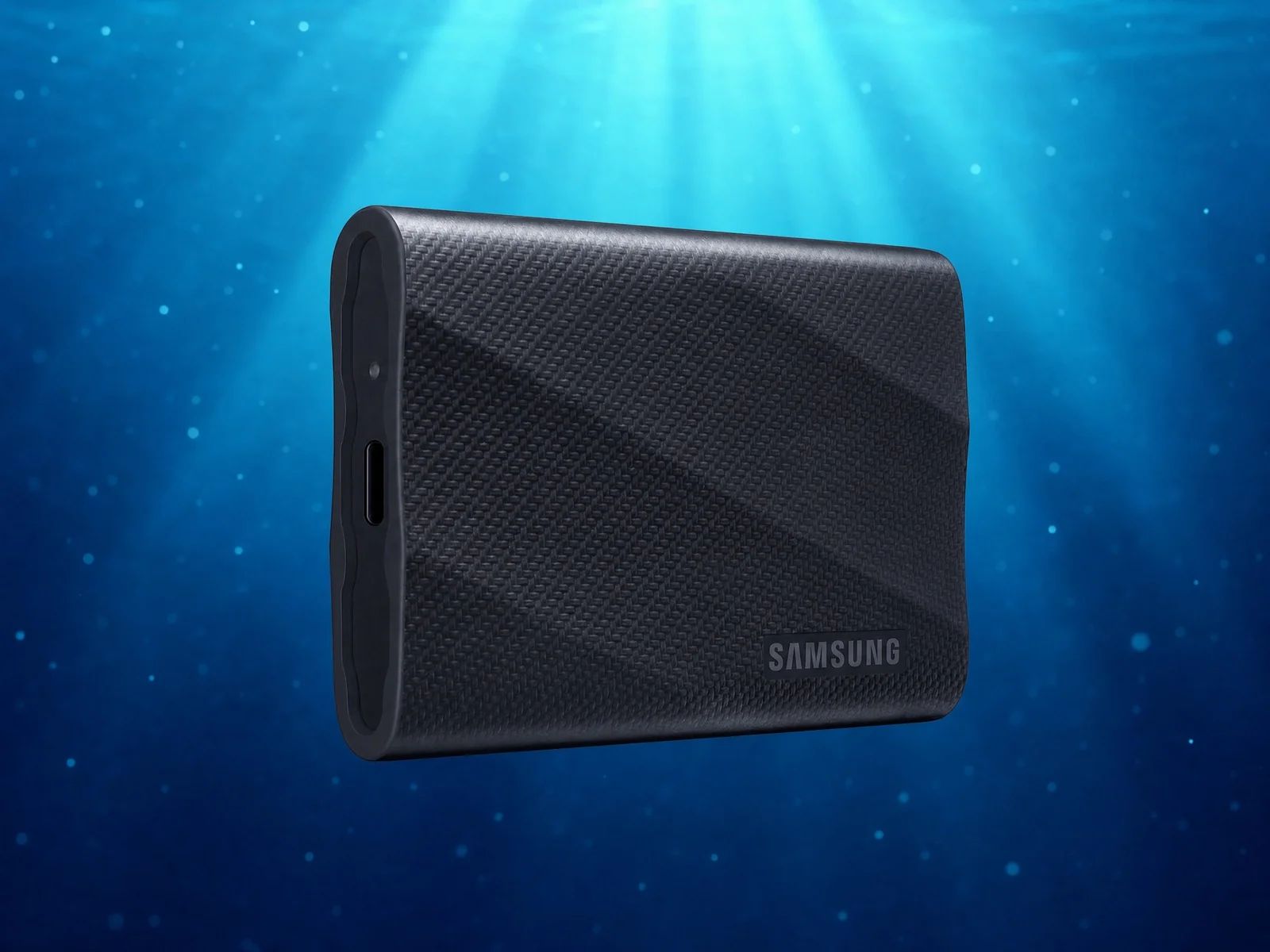
Can the Samsung T9 withstand an accidental drop into the water?
No. Unlike the T7 Shield model, the Samsung T9 does not have any IP certifications. It is not protected against splashes or submersion. If it falls into water, the integrity of your data and the electronic circuitry is at risk.
Why isn't my Samsung T9 reaching the promised 2000 MB/s?
This maximum speed requires a USB 3.2 Gen 2x2 interface. If your computer has a standard USB 3.2 Gen 2 port, the data transfer rate will be limited to approximately 1000 MB/s. Please verify the technical compatibility of your equipment before making a purchase.
Does the rubber coating on the T9 attract dust or salt?
The elastomer texture provides excellent grip and protection against impacts. However, in a marine environment, it can retain micro-particles of salt or sand. A gentle cleaning with a dry cloth is recommended after each dive.
To improve your mastery of your equipment and optimize your procedures while diving, discover our specialized training modules on AquaExposure training.
Returning from a remote expedition often requires a race against time to secure the files produced during the day. Whether it's between dives on a cruise ship or during a quick transfer in a tropical airport, the speed of data storage becomes a crucial factor for the photographer's peace of mind. In this context of intense workflow, the Samsung T9 offers a cutting-edge solution for those who handle large volumes of data.
Samsung T9: Raw power for demanding videographers
Samsung's external storage catalog was expanded in 2023 with the T9. This drive follows a line of products that are appreciated in the imaging world for their reliability. While the T7 Shield focused on all-terrain protection to appeal to travelers, the T9 shifts the focus towards pure performance. It is primarily aimed at users of high-resolution cameras and underwater videographers who no longer want to wait in front of an endless progress bar during transfers.
Performance and thermal stabilityThe main feature of the Samsung T9 is its exceptional transfer speed for a drive of this format. By utilizing the USB 3.2 Gen 2x2 interface, this drive achieves sequential read speeds of 2,000 MB/s and up to 1,950 MB/s in actual write speeds [1]. For an underwater photographer, this means that transferring multiple memory cards filled with RAW files or large video sequences now takes only a few minutes.
This power transforms the management of 4K or 8K video footage. The T9 allows you to quickly transfer files and work directly on the external drive for editing without experiencing any noticeable lag. To maintain these speeds over time, Samsung has integrated Dynamic Thermal Guard technology [1]. This system monitors the temperature of the enclosure to keep it within acceptable limits, which is crucial when working in a tropical climate or in the cabin of a ship.
However, it is important to temper this enthusiasm with a technical requirement. To truly benefit from these speeds, your computer equipment must support the USB 3.2 Gen 2x2 standard. Otherwise, the drive will operate at approximately 1,000 MB/s. This technical detail, related to the architecture of the USB ports, is often overlooked when purchasing and can lead to disappointment if the host hardware is not up to the theoretical capabilities of the SSD.
Design and shock resistanceThe Samsung T9 features a simple design with a robust chassis wrapped in a textured elastomer coating. This finish provides excellent grip, which is useful when handling the drive with wet hands after a dive or in the humid environment of a boat deck. In terms of physical resistance, the drive can withstand drops of up to 3 meters [2].
This is a significant advantage for mobile use, where quick handling in the field increases the risk of accidents. The compact enclosure easily fits into a camera bag, and its lightweight design makes it a discreet companion for travel. The drive comes with two cables, USB-C to USB-C and USB-C to USB-A, ensuring broad compatibility with most computers and tablets on the market.
Security and Software Management
Data security is a major concern for all content creators. The Samsung T9 incorporates AES 256-bit hardware encryption, providing robust protection in the event of loss or theft of the drive. This feature is managed through the Samsung Magician software [1], a utility that also allows you to monitor the drive's health, update the firmware, and optimize the overall performance of the storage system.Beyond software security, the physical durability is supported by a limited 5-year warranty offered by the manufacturer. This choice demonstrates a strong confidence in the longevity of the flash memory components used. For a professional, this warranty provides extra peace of mind when acquiring a critical tool for backing up their images.
Who is the Samsung T9 a good choice for?
The choice of a storage medium always involves a trade-off between pure speed and the level of environmental protection. The Samsung T9 stands out as a top-tier tool for underwater videographers working in high resolution who need to empty their memory cards multiple times a day. It is also suitable for photographers whose workflow includes direct post-processing from the external drive.
For these types of users, the considerable time savings offered by the 2000 MB/s transfer rate fully justifies the investment. The AquaExposure score of 6/10 assigned to this model reflects this marked duality: undeniable technical excellence marred by a relative vulnerability to marine elements. Travelers who prioritize fast backup speeds and who carefully protect their electronic equipment in waterproof bags will find this a valuable asset.
Limitations and precautions in a marine environment.The lack of an IP certification is the main reason why we cannot universally recommend this drive to divers. Unlike rugged models like the SanDisk Professional PRO-G40, the T9 offers no formal protection against dust or water splashes. It will not tolerate an accidental drop into a rinse tank or prolonged exposure to the salty spray that characterizes life at sea.
If you choose this model for your expeditions, it is essential to pair it with a systematic external protection solution. Using a waterproof case or a high-quality sealed pouch is indispensable as soon as you leave the dry area of the boat. Salt remains the sworn enemy of electronic connectors, and the absence of a seal on the T9's USB-C port makes the entire circuit vulnerable to rapid corrosion.
In conclusion, the Samsung T9 is a high-performance device that expresses its full potential in controlled or carefully protected environments. Its speed is a major advantage for professionals who cannot afford to waste hours on tedious transfers. However, its inherent fragility when exposed to water requires a level of care that might deter even the most adventurous divers, who are accustomed to equipment that can withstand the most demanding conditions.As the light fades on the deck of a cruise ship, it often marks the beginning of a second workday for the photographer. At this crucial moment, having a device capable of processing hundreds of gigabytes in an instant allows you to shut down your computer earlier. This is when you can finally look up from the screen and enjoy the view of the sea and the quiet that settles before the next dive.
Image 2: The Samsung T9 is placed inside a small, open, orange waterproof case, resting on the wet deck of a boat. This setup illustrates the need to protect this non-waterproof drive in a marine environment.
Alt text: Samsung T9 SSD protected in a Pelican waterproof case on the deck of a dive boat.
Samsung T9: The raw power of the portable SSD faces the challenge of humidity. | AquaExposure