Table of Contents
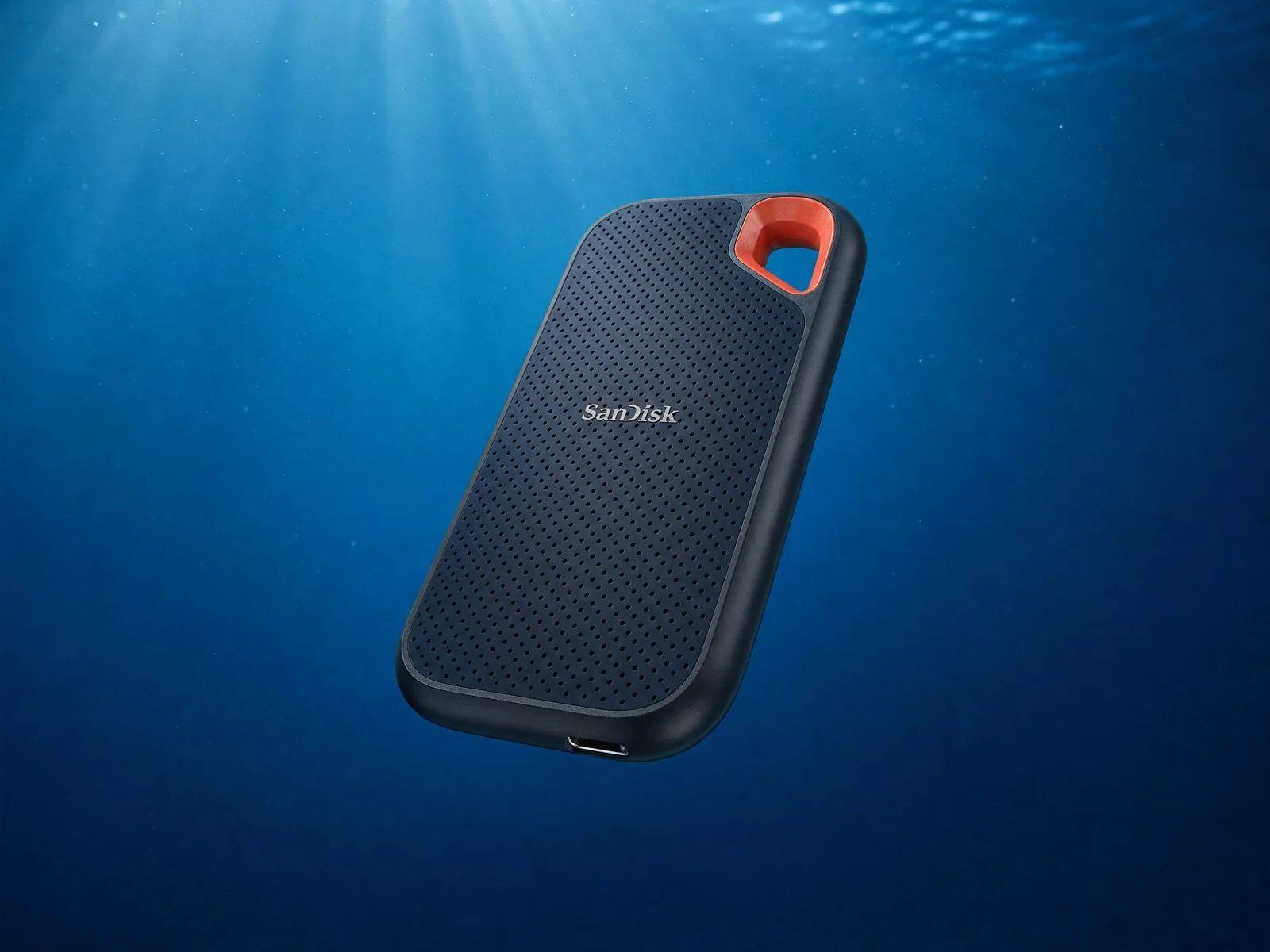
Discover our review of the SanDisk Extreme Portable SSD V2. A rugged, lightweight, and high-performance SSD to protect your dive photos on the go.
Share
/blog/sandisk-extreme-v2-en
Table of Contents
- 01A compact design perfect for a dive bag.When preparing your gear for an expedition, every gram counts. The SanDisk Extreme V2 stands out for its lightness. Weighing only 52 grams, it's barely noticeable. Its compact format allows it to be stored in the narrowest compartments. The durable silicone housing provides a secure grip, even with wet fingers after rinsing the housing. This casing ensures resistance to drops of up to 3 meters on concrete. The integrated carrying loop allows the SSD to be attached with a carabiner, preventing drops during quick handling. The internal forged aluminum chassis acts as a heat sink, a crucial feature in tropical climates.
- 02Balanced performance for underwater photography.The SanDisk Extreme V2 boasts read speeds of up to 1050 MB/s and write speeds of 1000 MB/s [1]. For photographers working in RAW format, these figures ensure a smooth and efficient workflow. Importing hundreds of files after a dive becomes a quick operation, freeing up time for editing. The USB 3.2 Gen 2 interface via USB-C ensures broad compatibility with recent computers, tablets, and iPhones. However, these speeds depend on the quality of your port. For photography, the difference with the PRO version remains imperceptible. This model offers the best value for money for standard use. At a price of 155 euros for 2 TB in August 2026, the investment is reasonable considering the security it provides [2].
- 03Who is this SSD really for?
- 04IP65 Protection and Environmental Limitations
- 05Data Security and Universal CompatibilityDigital security is a crucial aspect. The SanDisk Extreme V2 incorporates 256-bit AES hardware encryption [1]. You can protect access to your files with a password using the SanDisk Security software. If you lose your bag, your photos and documents remain inaccessible to third parties. This is a valuable protection for anyone traveling with sensitive data.
Questions about the Journal
Is the SanDisk Extreme Portable SSD V2 waterproof for diving?
No, its IP65 certification protects it against splashes and dust, but it should never be submerged. For your dives, keep it in a waterproof bag or a dry box.
Can I use it directly with my iPhone?
Yes, it is compatible with iPhones that have a USB-C port. This allows you to quickly transfer your videos or photos taken with your smartphone or connected underwater housing.
What is the actual difference between this model and the PRO version?
The standard version achieves a speed of 1050 MB/s, which is more than sufficient for RAW photography. The PRO version doubles this speed, but requires a USB 3.2 Gen 2x2 port, which is less common on travel laptops.

