What are the maximum student-to-instructor ratios in diving?
Ratios vary by agency and context. PADI recommends a maximum of 8 students per instructor in a pool, 4 in open water for beginner level. FFESSM works with similar ratios. But these figures are maximums: an instructor who puts safety first often works with smaller groups, particularly with children or anxious adults.
How do I know if my diving course is moving too fast?
A few concrete signals: you are not comfortably in control of the skills covered the day before, the group moves to a new site before basic movements are anchored, the instructor does not have time to answer your questions or dismisses your anxiety. If you do not feel ready, say so. A good instructor will adjust the pace, even if that extends the course.
Is PADI less safe than FFESSM?
No. Both systems are built with serious safety protocols. The real difference is not in the written standards but in how each centre applies them. A rigorous PADI centre is safer than an FFESSM club that compresses its courses. What matters is the culture of the centre, not the logo on the card.
What do I do if I do not feel ready to be certified?
Tell your instructor directly. A professional who puts safety first will have no problem postponing or extending your certification. If your instructor dismisses your concern or pushes you to finish regardless, that is a strong signal about the real culture of the centre.
What questions should I ask before choosing a dive centre?
How many students do you actually have per instructor on this course, in practice? What happens if I am not at the required level by the end of the course? How many real hours will we spend in confined water before open water? How do you handle an anxious student or one who progresses slowly? Have you ever postponed a certification for safety reasons? A serious centre will answer all of this without hesitation.
A few weeks ago, news reports covered the death of five Italian divers in the Maldives, during a cave dive on Vaavu Atoll. A marine biology teacher, her daughter, two young researchers and their instructor. Five people lost in a place I myself spent years diving.
I am not writing this article to analyse that specific accident. This is not the place, and it is not my role.
I am writing it because the event pulled me back into debates that have resurfaced, year after year, in professional diving circles. Questions about operator responsibility, about the philosophical differences between agencies, about what DAN (Divers Alert Network) has been documenting since 2011 as the primary cause of recreational diving accidents.
What their research shows is as simple as it is uncomfortable: the majority of accidents involve divers who exceeded the limits of their certification or did not follow the procedures they learned in training.
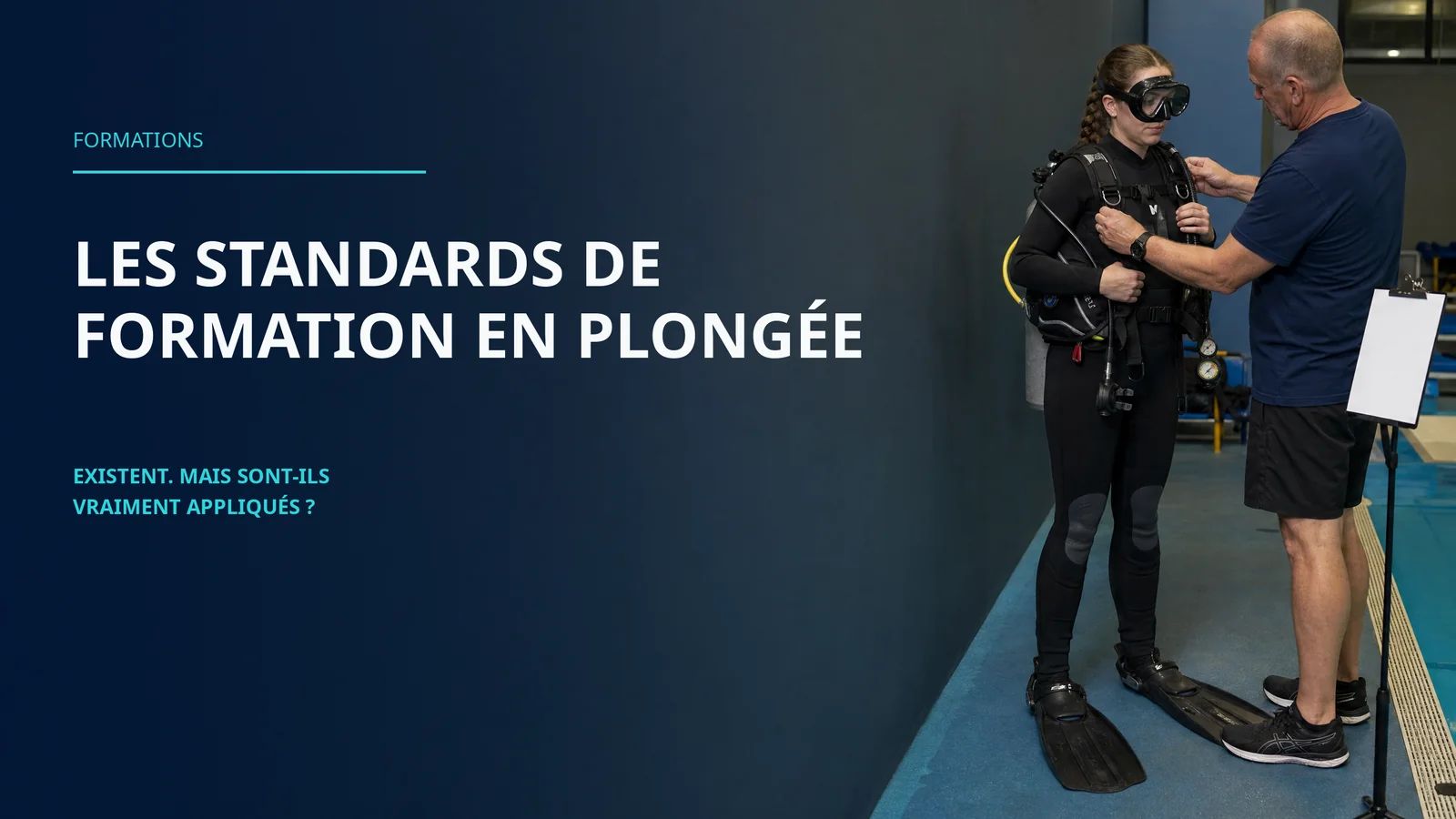
The standards exist. The problem is what happens between the manual and the water.
What training standards actually cover
The major agencies, whether PADI, FFESSM, CMAS, SSI or others, all have detailed reference documents on supervision during training. These standards are not there to look good in an accreditation file.
They frame very concrete points. Maximum student-to-instructor ratios, which range from 4 to 8 depending on the water level and group profile. Minimum progression requirements before any open-water diving.
Explicit recommendations to reduce those ratios in difficult conditions, whether current, cold, poor visibility, or students under stress. And precise pedagogical progressions with a number of skills to master before each progression step.
On paper, these standards form a coherent safety net. In an ideal world, a well-supervised student, with strict adherence to these protocols, comes out of training with ease, confidence and a genuine understanding of their limits.
That ideal world exists. It is just less widespread than it should be.
The tipping point: when profitability overrides protocol
I saw it in the Maldives, in Greece, in Cyprus, in the Seychelles. There is real economic pressure on dive centres, particularly in tourist zones, pushing in one very specific direction: certify fast, certify many.
In practice, this produces courses compressed into two or three days, with the theoretical portion delegated to an e-learning module that nobody actually monitors, and very little effective time spent with an instructor.
Groups close to the permitted maximum, sometimes beyond it when conditions are "presented" as easy. An implicit fast-track culture where the unspoken goal is not to lose the client by extending the course.
The result is operators who permanently function at the boundary of the standards rather than in their spirit.
They respect the number written in the reference document. They forget the deeper intention: giving each student enough time, attention and margin to stay safe if something goes wrong underwater.
And when something does go wrong, time is everything.
This is not about agency: it is about culture
The caricature is tempting. "PADI certifies holiday tourists." "FFESSM trains rigid, stressed divers." It contains a grain of truth from field observation, but its conclusion is wrong.
In some heavily touristy contexts, I have seen freshly certified divers who struggled to inflate their BCD at the surface, because the training had been so compressed that the movements were not anchored. In some European federation clubs, I have met divers who described performance pressure so intense they had been diving for five years with permanent anxiety.
But the reverse is equally true.
PADI centres in Portugal, Malaysia or Mexico offer solid courses with more hours than the minimum required, real ratios well below the maximums, and genuinely individualised teaching. FFESSM and LIFRAS clubs in Belgium and France offer gentle progressions, focused on real enjoyment and genuine autonomy, with time, practice and a culture of constructive debriefs.
The variable that explains this difference is not the logo on the front door. It is the philosophy of the centre, the personal conviction of the trainers and their capacity to resist the pressure to certify faster and faster.
The concrete signals of a real safety culture
When you have trained hundreds of divers in very different contexts, you fairly quickly learn to recognise the operators who have integrated safety as a value rather than a regulatory obligation.
Good centres do not hesitate to extend or postpone a certification when a student is not ready, even when this involves a real commercial cost. They work with ratios often below the written maximums, particularly with children, anxious adults, or in conditions that are evolving.
They treat their agency's standards as a minimum floor, not a target to hit to the millimetre. They are willing to say no to a dive or a skill exercise when conditions are not right.
And above all, they take the wellbeing of students seriously: stress, fatigue, thermal comfort, genuine understanding of instructions, not only the checklist of ticked skills.
This last dimension is often underestimated. A student who is cold, who has not slept, who is in a state of cognitive overload cannot correctly commit a safety exercise to memory. A centre that sends them into open water in that state is playing with something important.
DAN Europe's publications on diving behaviour monitoring are documenting this more and more clearly: it is human decisions, group pressure and real-time stress management that make the difference between a managed incident and an accident. Not just the text of the standard.
How to choose a safety-oriented centre or instructor
If you are about to start training, if you are looking for the right environment to begin diving, or if you are choosing a centre for your child, here are the questions worth more than any label displayed in the window.
"How many students do you actually have per instructor on this course, in practice?" Not just "according to the standards," but in the reality of the centre.
"What happens if I am not at the required level by the end of the course?" The answer to this question, more than any other, reveals the real culture of the centre.
"How many real hours will we spend in confined water before open water?"
"How do you handle an anxious student or one who progresses slowly?"
"Have you ever postponed a certification for safety reasons, and how was that handled with the student?"
A centre that honestly places safety at the top of its list will answer all of this without hesitation, even if that means admitting the course will be a little longer or a little more expensive than the competition.
An operator obsessed with throughput and profitability will tend to minimise these questions, answer vaguely, or hide behind "we comply with our agency's standards" without explaining how, concretely, they ensure each student is genuinely ready before handing over their card.
What this changes for you, or for your child
A few years ago, I would have said that choosing a certification agency was the most important decision before taking up diving. Today, after years of teaching in very different contexts, I would say something different.
Choosing your instructor is the most important decision.
The card that comes out of your training, whether PADI, FFESSM, SSI or another, will open doors for you all over the world. But what determines whether you are a comfortable, competent and safe diver is the time someone took with you, underwater, to make sure each movement was anchored before moving to the next.
Diving training standards are not there to look good in an accreditation file. They are there to protect people who trust someone to take them to explore a world they do not yet know.
Their real value is measured by how an instructor applies them, on the day it truly matters.
Scuba Diving Training Standards Exist. But Are They Really Applied? | AquaExposure