Can I bring my laptop and dive computer in carry-on together?
Yes, BUT: your dive computer is not considered electronic equipment by TSA/DGAC. It is an accessory. You can bring it in carry-on without any issue. Your laptop, yes, carry-on. Charger too.
Lithium battery rules change between airlines, how can I be sure?
IATA rules are universal, BUT some low-cost airlines have additional restrictions. Before travelling: visit your airline's website and search for lithium batteries policy.
How do I protect my housing in checked luggage for maximum safety?
Three layers, minimum: wrap the foam inside the housing plus protected seals, external rigid case (Pelican) OR very thick padded bag, clothing bag padded around it. Place it in the CENTRE of the suitcase.
I will say it straight: packing for a dive-photography trip is like prepping for surgery. One small oversight and it is a disaster, but too much preparation and you end up at the airport with three overweight bags you will never open.
After 15 years between coral reefs and airports, and after living through every type of mishap (battery confiscated in Senegal, housing found with closed eyes in Bali, and a mother-in-law who tried to pack 27 kilos of "safety" for a week in Egypt), I am sharing the system we now use at AquaExposure. No complications, just pragmatism.
The bag is only one piece of the puzzle. If this is your first trip, read the 7 mistakes that ruin a first dive photography trip first, because half the trouble is decided before you ever zip the bag.
Rule #1 - And It Is NON-NEGOTIABLE
Your camera housing and your camera NEVER go in checked luggage.
I know it seems obvious. I know you are thinking: "Well, it's fragile, it has to go in carry-on." You are right. But it is so important I need to say it a second time.
The aircraft hold is chaos. Bags fall, trolleys slam into them, baggage handlers play frisbee with your belongings. I am speaking from experience: I have seen a housing come back dented from a week in the Maldives. The optical glass held, but the body was ruined. 500 euros in damage, loss of crucial photos.
Your photo kit (camera, housing, lenses) goes IN CARRY-ON, in a specialised photo bag that fits under a seat. Done.
Carry-On vs Checked Strategy: The Winning Plan
Now that we have settled that, let us talk about the rest. You need to think like a magician: minimise the visible, maximise the invisible.
In Carry-On (Your Photo Backpack)
Camera + 1 wide-angle lens
Waterproof housing with accessories (dome, shade, plates)
Spare batteries (up to 2 lithium-ion batteries under 100Wh, see IATA section below)
Memory cards (generally 2-3 SD cards of 128 GB minimum)
Small cleaning kit (microfibre cloth, soft paper)
Passport and travel documents
Essential medications
An inflatable pillow (the ultimate luxury on long flights)
Target weight: 5-7 kg max. Beyond that, it is too heavy and your shoulders will suffer. David Doubilet, who has been travelling with his gear for 50 years, has a simple principle: if you cannot carry it alone through an airport, you have too much.
In Checked Luggage (Sturdy Suitcase)
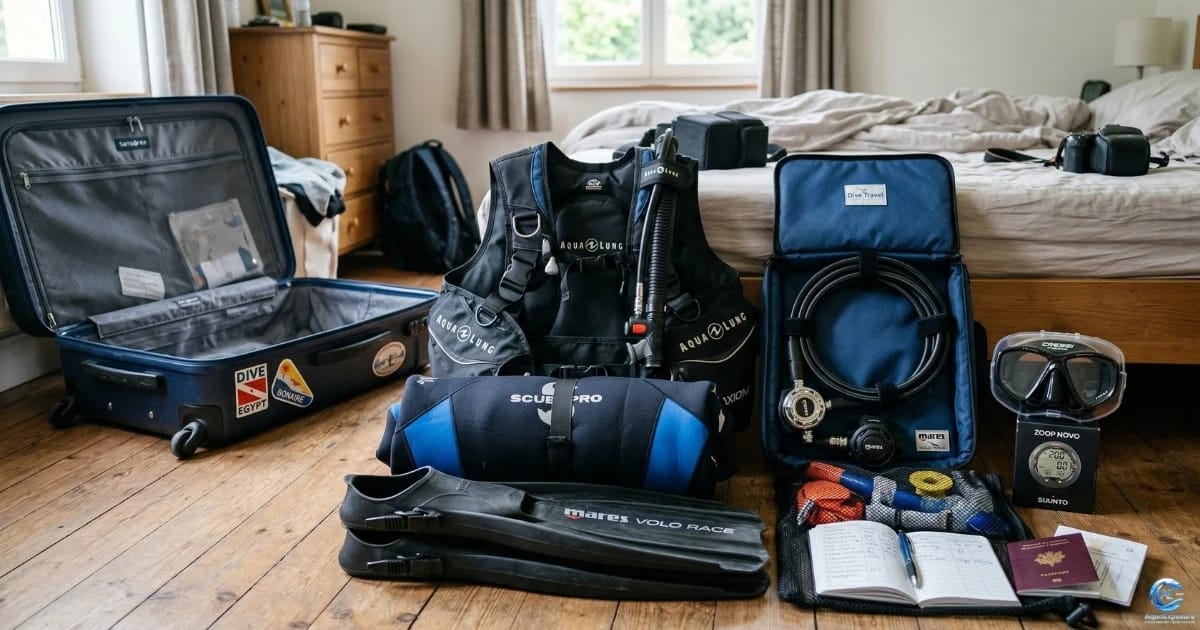
Dive suit + thermal undergarments
Fins, mask, regulator (never free-diving gear in carry-on, strict rules)
Protective cases for additional lenses
Everyday clothing
Hygiene products (except liquids over 100 ml)
Lightweight tripod/monopod
USB cables, adapters
Mosquito repellent, sunscreen (SPF 50+ - you WILL need it)
Target weight: 20-22 kg. Airlines allow 23 kg. Do not be that person who goes over by 0.5 kg.
Lithium Batteries: The Aviation Safety Rule
Let us avoid a disaster. Lithium-ion batteries are restricted on flights for a reason: they can catch fire if short-circuited. This is not an urban legend. It is chemistry.
The IATA (International Air Transport Association) rules:
1In carry-on: maximum 2 lithium-ion batteries under 100 Wh (watt-hours). Most camera batteries are between 50-100 Wh, so you are fine.
1In checked luggage: loose lithium-ion batteries are totally prohibited. FULL STOP.
1How to check your battery capacity? Look at the label. It usually shows "3000 mAh, 7.4V" or directly "80 Wh". To calculate: (mAh x V) / 1000 = Wh. A "3000 mAh / 7.4V" battery = 22.2 Wh.
1What is NEVER permitted:
2- Batteries over 100 Wh
3- Damaged or swollen batteries (remove them from your kit)
4- Loose batteries in your bag without protection
Pro tip: I carry my batteries in a small fire-resistant silicone case. It takes up 5 cm x 5 cm in my bag, and it is worth the peace of mind.
Housing Protection: 3 Levels of Defence
Your housing is your ally. Without it, you are just a diver with a wet camera, good for the bin.
Level 1: The External Case
A rigid case like Pelican or Storm Case. I know, it is heavy and takes up space. But it is 300 euros versus 3000 euros of destroyed housing. The maths is simple.
Lightweight alternative: a padded photo bag 15 cm thick. Less protection than a case, but 80% of the job for 20% of the weight.
Level 2: Internal Packing
Inside your case or bag:
Arrange elements in a honeycomb pattern (custom-cut foam)
Nothing should move. Every centimetre must be optimised.
Housing seals should face upward (less pressure if someone places a bag on top)
Separate housing and optics with 5 cm of foam minimum
Level 3: Shock Prevention
NEVER place the housing at the bottom of the luggage stack
Carry it in the cabin on your lap if possible (not under the seat, flight crew walk on those)
Label it "FRAGILE" in three languages (yes, three)
Honestly? I NEVER travel without my housing in carry-on. The extra three kilos are worth the sleepless-night-free experience.
Batteries, Chargers and Cables: The Electricity Logistics
It sounds trivial, but it is trap number 2 (after housing confiscation). You arrive at your destination with zero battery and an incompatible charger.
Batteries
2-3 spare batteries IN CARRY-ON (protected in a case)
1 extra battery in checked luggage (just in case)
Look for batteries compatible with your camera. For Canon: LP-E6, for Sony: NP-FW50, etc.
Advice: buy batteries before the trip. Airport prices are legalised robbery.
Chargers
Scuba Diving Trip: How to Pack Your Bag Without Going Crazy (The Diver-Photographer's Guide) | AquaExposure
1 charger in your carry-on bag
1 charger in checked luggage (or left at the destination if you revisit)
Check voltage: 110-240V (almost all modern gear does this, but verify)
Appropriate power adapter for the country
I travel with a Nitecore fast-charge system with universal adapters. It costs 30 euros, it is lightweight, and it is compatible with 80% of worldwide destinations.
Memory Cards
1 main card (128 GB minimum)
2-3 backup cards
USB card reader in your carry-on bag
Cloud backups as soon as possible (SD cards do not like seawater, even if waterproof)
Equipment: Rent or Bring?
The classic question. Here is my very simple decision tree:
BRING (You Have No Choice)
Your personal camera
Your housing (the one you know)
Your batteries
Your memory cards
Your dive mask (perception is ultra-personal)
Your regulator (same, very personal and delicate)
RENT ON SITE
Dive suit (too bulky, and you will find them everywhere)
Fins and BCD (dead weight, cheap to rent)
Tank (mandatory, no other option)
Weight belt (50 euros of excess baggage for 5 euros of rental)
Tripods/monopods (if you are not going very deep)
The AquaExposure "Lean Travel" principle: rent 70% of the equipment, bring 30% of the essentials. Your back will thank you, and so will your wallet.
The Art of Protection: Materials and Techniques
Beyond the housing, there are techniques I developed after too many "oh no" moments.
Condensation (The Silent Enemy)
When you take your housing out of the cold hold into tropical heat, condensation forms inside. Catastrophic.
Solution: before descending, place your hermetically sealed housing in the fridge for 2 hours. Then seal it and do NOT open it UNTIL at your destination, in an air-conditioned room. Wait 1-2 hours before the first dive.
Yes, it is tedious. Yes, it equals zero water damage.
Salt and Corrosion
Seawater is aggressive chemistry. Even your "waterproof" gear does not enjoy staying wet.
After every dive: - Rinse with fresh water IMMEDIATELY - Open the housing to let seals dry (at least 2 hours, ideally in a dehydrator) - Apply silicone lubricant to seals before closing
I travel with a small maintenance kit: fresh water spray (200 ml), silicone lubricant, cloth. 15 euros, 300 grams. It prevents 3000 euros of repairs.
The Departure Checklist (Before Closing the Bags)
Print this checklist, use it three times.
Electronics and Photo
[ ] Camera + charged battery
[ ] Waterproof housing + seal checked
[ ] 2-3 lithium batteries (carry-on)
[ ] Formatted memory cards (3 cards min.)
[ ] Charger + cables + adapter
[ ] Card reader
[ ] Dome or optical shade
[ ] Lightweight tripod/monopod
Protection and Maintenance
[ ] Protective case (carry-on)
[ ] Cleaning kit (fresh water, cloth, lubricant)
[ ] Anti-condensation/water spray
[ ] Silicone battery case
Diving
[ ] Personal mask + snorkel
[ ] Regulator (or rented on site)
[ ] Compact dive suit
[ ] Fins (or rented on site)
[ ] BCD (or rented on site)
[ ] Weight belt (or rented on site)
Medical and Safety
[ ] Sunscreen SPF 50+ (at LEAST 200 ml for one week)
[ ] Personal medications
[ ] Antihistamine and anti-inflammatory
[ ] Waterproof wound bandages
[ ] Saline eye wash solution
[ ] Travel insurance (see FAQ section)
Documents
[ ] Passport + digital copies
[ ] Dive certifications
[ ] Insurance contact numbers
[ ] Dive itinerary
Final Weight
[ ] Carry-on bag: max 8 kg
[ ] Checked suitcase: max 23 kg
[ ] Second bag: max 23 kg (if applicable)
FAQ: The 6 Questions You Are Asking
1. Can I bring my laptop and dive computer in carry-on together?
Yes, BUT: your dive computer is not considered "electronic equipment" by TSA/DGAC. It is an accessory. You can bring it in carry-on without any issue, it is just a watch or wristband in the eyes of authorities.
Your laptop, yes, carry-on. Charger too. Make sure the laptop battery is under 100 Wh (almost all modern laptops are).
Pro tip: keep your laptop accessible in carry-on. Security agents will ask you to take it out at the checkpoint.
2. Lithium battery rules change between airlines, how can I be sure?
IATA rules are universal, BUT some low-cost airlines have additional restrictions.
Before travelling: visit your airline's website and search for "lithium batteries policy" or "restricted items". Air France, KLM, Lufthansa, British Airways: all allow 2 lithium-ion batteries under 100 Wh in carry-on.
Low-cost airlines (Ryanair, EasyJet, etc.): sometimes stricter. Check.
If in doubt: call them 48 hours before the flight. They have a dedicated number for these questions.
3. How do I protect my housing in checked luggage for maximum safety?
Three layers, minimum:
1Wrap the foam inside the housing + seals protected
2External rigid case (Pelican) OR very thick padded bag (15+ cm)
3Padded clothing bag around it (use your clothes as shock absorbers)
Place it in the CENTRE of the suitcase, not on the sides. Surround with clothing. This is three-dimensional packing.
Final weight: your housing weighs only 1.5-2 kg, the protection 3-4 kg. You can afford it.
4. Should I rent or bring my fins and dive suit?
Bring your suit if: you are particular about the fit, you dive very often (more than one dive per day), you have an unusual body type.
Rent your suit if: you travel light, it is your first dive trip, you are going to Egypt/Red Sea (very warm, you only need a rashguard).
Fins: rent them. Seriously. They weigh 2 kg, they take up ENORMOUS amounts of space, and you will find them everywhere (200-500 EGP in Sharm el-Sheikh, 10-15 euros in mainland Egypt, 20 euros in the Maldives).
My rule: if you wear XL or XXL, or have very wide feet, bring them. Otherwise, rent.
5. What travel bag to choose for dive photography?
You need THREE bags:
1Carry-on photo backpack (40L): for the housing and electronics. Brands: Peak Design, Lowepro, Manfrotto. Budget: 150-300 euros. Must fit under the seat (56 x 36 x 23 cm max).
1Sturdy checked suitcase (70-80L): for heavy equipment. Brands: Samsonite, Away, Delsey. Budget: 100-250 euros. Must be lightweight (under 3 kg itself).
1Backup clothing bag (20L): to slip inside the checked suitcase. Brands: any durable bag.
Personal advice: invest in a good carry-on photo bag. It is a one-time purchase you will use 20 times. A good checked suitcase, same. It saves stress.
6. Does standard travel insurance cover my photography equipment?
Spoiler: almost never.
Standard travel insurance (Allianz, AXA, etc.) covers luggage, BUT not high-value equipment beyond a certain limit (generally 500-1000 euros). Your camera housing + camera = minimum 2000-5000 euros.
Solutions:
1Specialist photography equipment insurance: Hiscox, Allianz Assistance (photo module). Budget: 150-300 euros/year for full cover (3000-5000 euros of gear).
1Home insurance extension: some comprehensive home policies cover equipment while travelling (ask your insurer).
1Travel insurance + photo extension: adding 20-30 euros to your standard travel insurance.
1Check your credit card insurance: some premium cards cover photography equipment in case of loss or theft.
What I did: I have Hiscox photo insurance at 200 euros/year. It covers all my equipment (housing, camera, lenses, batteries, cards) up to 5000 euros, worldwide, including in flight. Worth every penny.
IMPORTANT: insurance NEVER covers damage due to negligence or water damage (unless you can prove a housing defect). Regular maintenance = insurance savings.
The AquaExposure "Lean Travel" Philosophy
There is a lot of talk about equipment overload on dive-photography trips. It is the classic mistake: thinking you need to bring everything "just in case".
At AquaExposure, we preach the opposite.
Lean Travel = bring 30% of the essentials, rent/adapt 70%. Why?
1Less weight = no excess baggage charges, less back pain, more agility on site
2Less stress = less to lose, less to protect, fewer sleepless hotel nights
3More flexibility = you can change destination without repacking 50 kg of gear
4Better diving = without the mental load of "don't break the 3000-euro thing", you enjoy yourself
We have seen too many diver-photographers miss an entire dive because they had "brought THE housing" and it stayed in the cabin. Shame.
The real skill in dive photography is working within constraints, not bringing 10 solutions for every problem. Your creativity is worth more than your overloaded bag.
Final Tips Before You Leave
1. Test your equipment BEFORE the trip. I know it seems obvious, but you would be surprised how many people take a brand-new housing out for the first time. underwater. Test it in the pool. Multiple times.
2. Take a photo of your packing list before closing the bags. Yes, I am serious. I have found a forgotten battery in the hotel five times. A photo of the final state + a checklist = zero loss.
3. Pre-order silica desiccant sachets before departing. Small 50g silica sachets you can leave in your photo case overnight. They cost 1 euro each.
4. Inform your airline if you are travelling with expensive equipment. Some airlines offer additional insurance for declared equipment. It is free in 80% of cases, useful in 5%.
5. Make sure your phone can receive SMS from your insurer. You need international coverage. Check with your carrier (Orange, SFR, Vodafone, etc.) before departing.
Conclusion: You Are Ready
You now have the complete strategy for boarding with your dive-photography kit without going crazy at the airport.
The real recipe: 30% logistical preparation (checklist, weight, protection) + 70% confidence (you brought the essentials, rent the rest). You dive, you photograph, you bring back stunning images. That is it.
If you follow this strategy, you will never have to live through my sleepless anxiety nights.