AquaExposure
Homepage
Pricing
Menu
Homepage
PricingShopArticles
AquaExposure

Underwater photography excellence, accessible to everyone.

Explore

  • Discover AquaExposure
  • Kai_App
  • Underwater Photo
  • AI Training with SAGE
  • Free Guide
  • All modules
  • Shop
  • Subscriptions
  • Articles
  • Manifest
  • About
  • PDC Simulator
  • Smartphone Housing Comparator
  • Partners
  • Frequently Asked Questions

Diving in Belgium

  • Training from Brussels
  • Training in Belgium
  • Photo in Zealand
  • Careers in Belgium

Stay in touch

Stay informed about our new courses and expeditions.

  • [email protected]
  • Contact
  • New items
  • Support the project
Legal Notices·CGV·Confidentiality·

© 2026 AquaExposure. Ethically preserving the depths.

Everything you need to know about the Bühlmann ZH-L16 ADT MB algorithm (Scubapro): Reviews, safety, and settings.
Table of Contents
  • 01Introduction
  • 02Algorithm ProfileThe basic structure of this algorithm is based on the well-known decompression model developed by Dr. Albert Bühlmann, specifically the ZH-L16 with its sixteen theoretical tissue compartments. However, the engineers at Uwatec, the pioneering Swiss brand later acquired by Scubapro, added two major enhancements: ADT (Adaptive) technology and MB (Micro-Bubble Management). This makes it a highly sophisticated hybrid model.
  • 03Ease of Use and Micro-Bubble Level Settings
  • 04Real-time Safety Adaptation
  • 05Medical Experience and DAN Data
  • 06Strengths and Weaknesses
  • 07Field Performance and Group Diving BehaviorWhen diving with a mixed group, using this algorithm requires some flexibility. If you dive at the standard MB level L0 without a heart rate monitor, your decompression stops will perfectly match those of your companions using Shearwater or Garmin computers. However, if you configure a higher level like L4 with a heart rate monitor during a physically demanding dive, you will almost always be the first to reach your safety stop and impose your stop times on the entire team.
  • 08Conclusion
OUTILS 5 minBenjamin Coste

Everything you need to know about the Bühlmann ZH-L16 ADT MB algorithm (Scubapro): Reviews, safety, and settings.

Comprehensive analysis of the Scubapro Bühlmann ZH-L16 ADT MB adaptive algorithm. Explores the role of heart rate, temperature, and instructor feedback.

To learn how to get the most out of your underwater equipment, discover the AquaExposure training program.

Introduction

During a dive, our bodies react to exertion in unique ways. The cold water that seeps in, the current that forces us to kick vigorously, the stress caused by an unexpected event – all of these factors alter our physiology. Yet, most dive computers calculate our decompression stops based on static mathematical models that ignore what is actually happening inside our wetsuit. Scubapro's adaptive Bühlmann ZH-L16 ADT MB algorithm offers a radically different approach by linking decompression calculations to our own bodies.

During a winter exploration in the dark waters of Zeeland, I was wearing my Galileo dive computer paired with its heart rate monitor. Swimming against a sudden and powerful tidal current caused my heart rate to spike to unusual levels under my drysuit. My computer immediately reacted by adding several minutes of mandatory decompression stops compared to my students who were effortlessly drifting along. This dive provided undeniable proof that an algorithm capable of adapting its calculations to our actual physiology is an invaluable safety net.

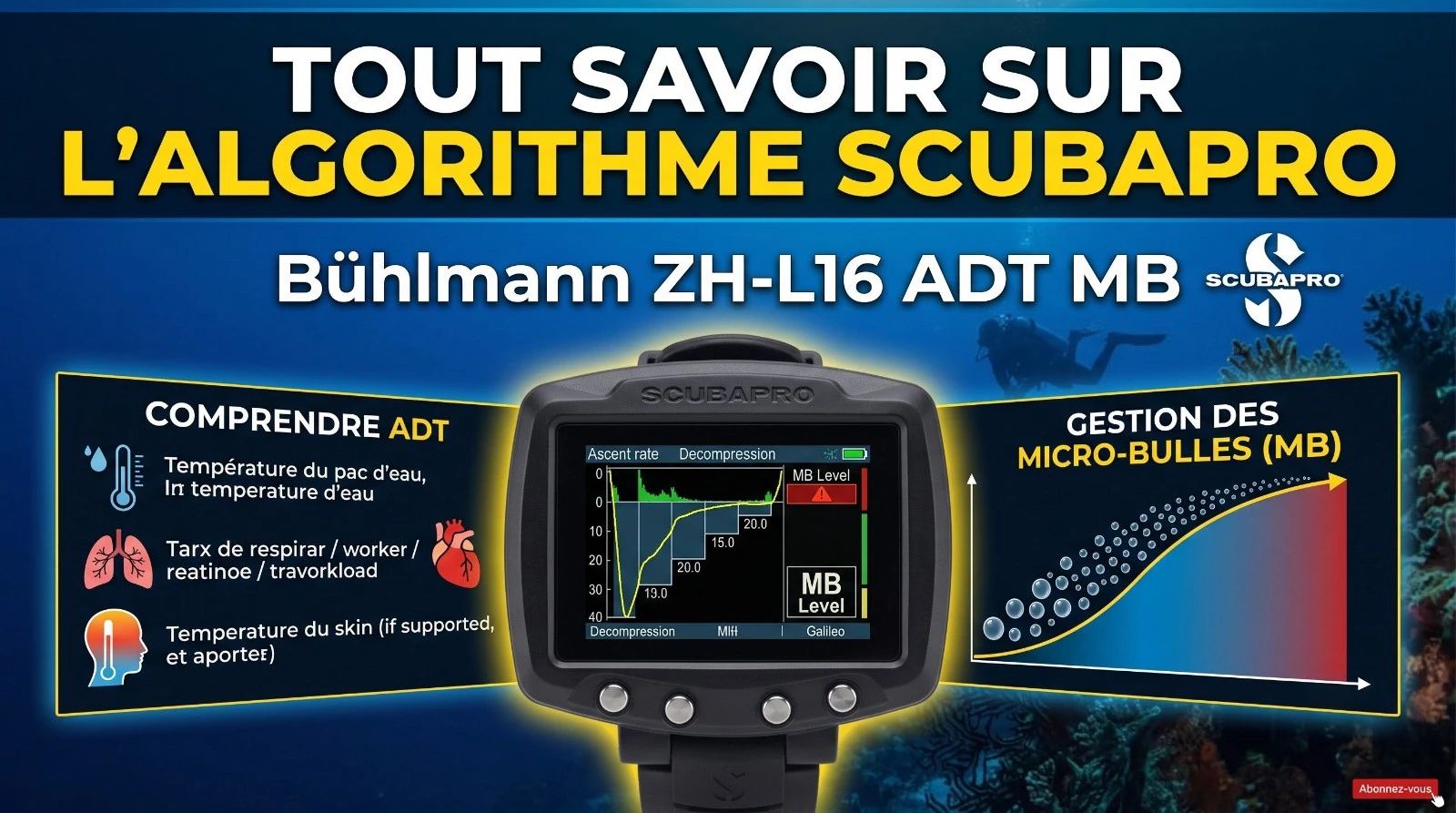
Algorithm ProfileThe basic structure of this algorithm is based on the well-known decompression model developed by Dr. Albert Bühlmann, specifically the ZH-L16 with its sixteen theoretical tissue compartments. However, the engineers at Uwatec, the pioneering Swiss brand later acquired by Scubapro, added two major enhancements: ADT (Adaptive) technology and MB (Micro-Bubble Management). This makes it a highly sophisticated hybrid model.

This algorithm is found exclusively on Scubapro's flagship dive computers, including the Galileo series (G2 and the recent Galileo 3), the HUD head-up display that attaches to the mask, as well as on Aladin computers and watches in the A series (A1 and A2). While the Bühlmann base is publicly available, Scubapro's adaptive implementation and its heart rate management remain a closely guarded proprietary secret.

Ease of Use and Micro-Bubble Level Settings

For recreational divers, setting the conservatism level is very straightforward. Scubapro has replaced the complex Gradient Factors settings with a scale of micro-bubble levels (Micro-Bubble Levels) ranging from L0 to L5.The L0 setting corresponds to the basic Bühlmann algorithm without any additional conservatism. The L1 to L5 settings progressively tighten the algorithm to intercept micro-bubbles during ascent. You simply select your desired level in the menus before the dive, eliminating the need for complex decompression calculations.

For technical divers and cave divers, Scubapro offers the option on its high-end computers to disable the adaptive system and switch to a traditional Bühlmann ZH-L16C mode configured with standard Gradient Factors (GF Low / GF High), providing the best of both worlds. Multi-gas management (PMG) is perfectly integrated for managing switches between Nitrox or Trimix mixtures.

Real-time Safety Adaptation

The true strength of the ADT MB algorithm lies in its biometric adaptation. If the computer is connected to a tank pressure transmitter and a heart rate monitor, it integrates three physiological variables in real time:

The diver's heart rate, skin temperature, and breathing rate.If you experience cold or if your heart rate increases due to intense physical exertion, blood circulation increases and transports more nitrogen to your tissues. The algorithm detects this change and immediately adjusts your decompression profile, requiring you to perform longer or deeper safety stops, thus protecting you from so-called "unjustified" decompression accidents.

The system also offers PDIS (Profile Dependent Intermediate Stops). This dynamic intermediate stop calculates a recommended depth based on the actual nitrogen load accumulated in your various tissue compartments, helping you to safely decompress before reaching the area of standard safety stops.

Medical Experience and DAN Data

Statistics collected by DAN confirm that Scubapro computers have a remarkable safety record. The integration of physiological workload directly addresses individual physiological factors, which are often responsible for inexplicable decompression accidents where the theoretical dive profile had nevertheless been followed.Doppler studies conducted by Uwatec have clinically validated that using the L1 to L5 conservative settings significantly reduces the formation of silent bubbles in the venous system of divers after ascent. Furthermore, the dynamic and optional nature of the PDIS decompression stops remains perfectly aligned with current medical consensus, which favors a continuous ascent and shallow, prolonged decompression stops at the end of the dive.

Strengths and Weaknesses

The main strength is undoubtedly this unique physiological personalization. It's one of the few algorithms on the market that takes into account the actual effort exerted by your body on the day of the dive, underwater.

A major weakness lies in its sometimes overly conservative nature for divers who naturally have a high heart rate or consume air quickly. In these situations, the computer may impose excessively long decompression stops compared to the rest of the group, which can be frustrating.

Field Performance and Group Diving BehaviorWhen diving with a mixed group, using this algorithm requires some flexibility. If you dive at the standard MB level L0 without a heart rate monitor, your decompression stops will perfectly match those of your companions using Shearwater or Garmin computers. However, if you configure a higher level like L4 with a heart rate monitor during a physically demanding dive, you will almost always be the first to reach your safety stop and impose your stop times on the entire team.

For divers who want to compare this model with other technologies, we invite you to consult our AquaExposure diving computer comparison tool to analyze the technical specifications of compatible Scubapro models.

Conclusion

The Bühlmann ZH-L16 ADT MB from Scubapro is a guardian angel for divers who prioritize physiological safety above all else. By adapting its calculations to physical exertion and environmental conditions, it provides individualized protection of great value. It is the ideal choice for regular divers, those concerned with their physical fitness, or explorers braving cold waters. Highly recommended.

Share

/blog/scubapro-adt-mb-decompression-algorithm-guide

Table of Contents

  • 01Introduction
  • 02Algorithm ProfileThe basic structure of this algorithm is based on the well-known decompression model developed by Dr. Albert Bühlmann, specifically the ZH-L16 with its sixteen theoretical tissue compartments. However, the engineers at Uwatec, the pioneering Swiss brand later acquired by Scubapro, added two major enhancements: ADT (Adaptive) technology and MB (Micro-Bubble Management). This makes it a highly sophisticated hybrid model.
  • 03Ease of Use and Micro-Bubble Level Settings
  • 04Real-time Safety Adaptation
  • 05Medical Experience and DAN Data
  • 06Strengths and Weaknesses
  • 07Field Performance and Group Diving BehaviorWhen diving with a mixed group, using this algorithm requires some flexibility. If you dive at the standard MB level L0 without a heart rate monitor, your decompression stops will perfectly match those of your companions using Shearwater or Garmin computers. However, if you configure a higher level like L4 with a heart rate monitor during a physically demanding dive, you will almost always be the first to reach your safety stop and impose your stop times on the entire team.
  • 08Conclusion

Questions about the Journal

What is the ZH-L16 ADT MB algorithm?

It is an adaptive and proprietary version of the 16-compartment Bühlmann model, developed by Uwatec for Scubapro computers. It adjusts decompression based on your actual physiology.

How does biometrics affect decompression?

The system measures your heart rate, skin temperature, and breathing rate. If you exert yourself intensely in cold water, the algorithm will make the decompression stops more conservative to compensate for the increased nitrogen load.

What is the PDIS system from Scubapro?

The Profile Dependent Intermediate Stop (PDIS) calculates a dynamic intermediate stop based on the accumulated nitrogen load, suggesting an optimal safety stop at mid-depth.

Articles in the same category

Everything you need to know about the VPM-B algorithm: Reviews, safety, and settings.

Everything you need to know about the VPM-B algorithm: Reviews, safety, and settings.

Everything you need to know about the historical Suunto RGBM algorithm- reviews, safety, and settings.

Everything you need to know about the historical Suunto RGBM algorithm- reviews, safety, and settings.

Everything you need to know about the Pelagic Z+ algorithm- reviews, safety, and settings.

Everything you need to know about the Pelagic Z+ algorithm- reviews, safety, and settings.