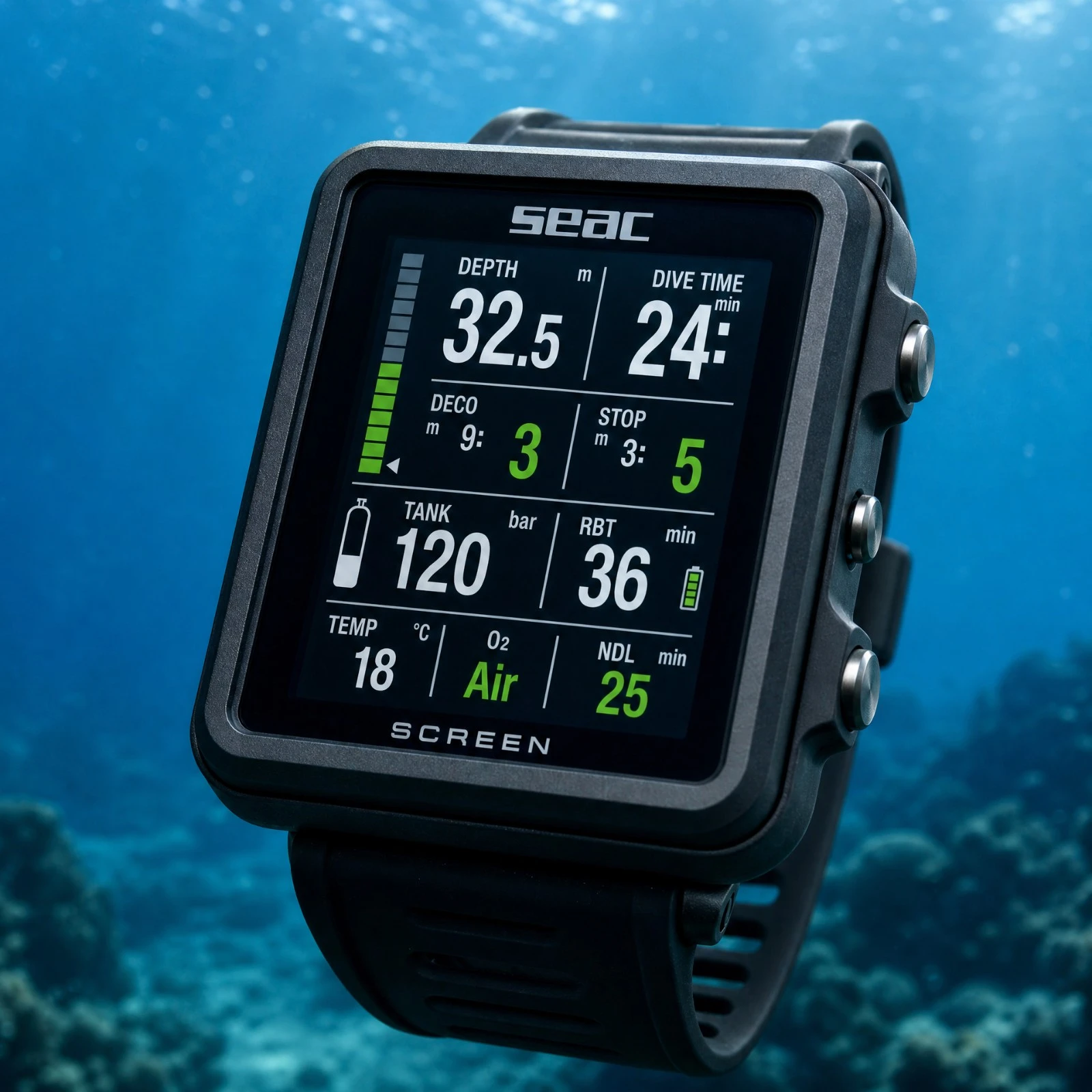
Our comprehensive review of the SEAC Screen dive computer. A large-screen device offering instant data readability without breaking the bank.
To learn how to get the most out of your gear underwater, discover the AquaExposure Training.
1. Introduction
Scuba diving sometimes exposes us to demanding environments where our senses lose their usual bearings.
When visibility decreases in a dark quarry or when fatigue sets in after a long dive, our brain needs clear information that requires no interpretive effort.
It is in these specific moments that equipment must fade into the background, becoming a natural extension of our decision-making process and ensuring our safety.
An overloaded screen filled with tiny pieces of data then becomes a source of unnecessary stress that disrupts our concentration at the very moment we need it most.
The current market trend is towards increasingly complex displays on watch faces the size of coins, which may flatter the ego but make it more difficult to read the time.
This race towards miniaturization often overlooks a fundamental physiological reality that affects many divers over the years.
Presbyopia, or simply the difficulty in focusing underwater while wearing a mask, transforms the task of reading vital parameters into a real daily challenge.
The SEAC Screen adopts a radically different approach by using a large format to prioritize immediate readability, which instantly provides reassurance.
We will explore together the capabilities of this unique device, which makes a conscious choice to prioritize visual simplicity over compactness.
My analysis is based on the technical specifications of the Italian brand and on the constant feedback from divers who use it daily in all conditions.
Let's see if this promise of absolute readability holds up against the demands of our decompression profiles, which require flawless precision.
The goal is to determine whether this bulky case deserves a spot on your forearm during your next underwater adventures.
2. The Verdict in Summary
| Criterion | Score | What it means |
|---|---|---|
| Algorithm & levels | 3.9/5 | Reliable and conservative management based on the proven Bühlmann ZHL-16C standard. |
| Air & multi-gas | 2.2/5 | Perfectly suited for two gases, meeting the needs of recreational diving. |
| Screen & ergonomics | 3.2/5 | A giant display with excellent readability combined with very accessible buttons. |
| Battery life & battery | 3.8/5 | A user-replaceable battery that offers a reassuringly long battery life for travel. |
| Connectivity & app | 3.0/5 | Data transfer via USB cable, which makes you regret the lack of a Bluetooth connection on the surface. |
| Compass & instruments | 3.2/5 | A very complete freediving mode that compensates for the absence of an integrated electronic compass. |
| Resistance & depth | 3.2/5 | A massive case protected by a rubber coating, certified for depths of one hundred meters. |
| Price & customer service | 3.6/5 | A generous design offered at an extremely competitive entry-level price. |
Overall score: 3.2/5
3. Detailed Analysis
Algorithm & Milestones
The SEAC Screen is based on the proven reliability of the original Bühlmann ZHL-16C model, which has been successfully used in millions of dives worldwide.
Professor Albert Bühlmann dedicated his life to modeling the dissolution of gases in our tissues, providing us with a highly reliable mathematical framework.
Its algorithm remains the absolute standard today for calculating our decompression times, with a precision that reassures even the most demanding divers.
The Italian brand has chosen to offer six pre-defined safety levels, ranging from zero to five, which greatly simplify the device's setup.
This approach prevents divers from getting lost in complex settings of free Gradient Factors, which require a solid understanding of physiology.
It is a very, very, very wise decision for the general public, as it guarantees secure levels without requiring a degree in applied mathematics.
Modifying gradient factors without understanding their physiological implications poses a real risk, and this model cleverly helps avoid that danger.
By imposing clear levels of conservatism, SEAC protects divers from configuration errors that could compromise their safety.
The display clearly shows the no-decompression time, ascent time, and mandatory decompression stops that guide your return to the surface.
The audible and visual alarms for rapid ascent and floor breach are perfectly integrated to alert you at the slightest deviation from proper operation.
You benefit from close supervision, which allows for minor lapses in attention during the ascent back to the surface.
The readability of information related to decompression remains the absolute priority of this display, leaving no room for doubt.
Score O1: 3.9/5.
Air & Multi-Gas
This device focuses on the essentials by managing up to two different gases, which covers the vast majority of recreational diving needs.
You can configure the air and a Nitrox mix up to 99% oxygen to optimize your decompression stop times.
This feature allows you to easily perform accelerated decompression procedures during your more demanding dives.
Using a superoxygenated decoration block in the lower layer significantly reduces your exit time while increasing your safety margin.
The switching between gases underwater is done intuitively thanks to the large buttons that make operation easy.
The computer instantly recalculates your decompression profile as soon as you confirm the gas change on the interface.
It is important to keep in mind that this computer is not designed for technical diving using trimix or rebreathers, which require specific algorithms.
Divers equipped for deep-sea exploration using ternary gas mixtures will need to use equipment specifically designed for these extreme practices.
It also doesn't offer wireless air integration, which would allow displaying the block pressure directly on the screen.
The pressure of your system should always be read on a traditional mechanical pressure gauge, which remains a reliable option in terms of dependability.
This lack of wireless air conditioning management helps maintain a particularly affordable price, which will appeal to those on a tight budget.
It's a deliberate technical choice that prioritizes the simplicity and reliability of a high-pressure hose that never suffers from battery failure.
Score O2: 2.2/5.
Screen & Ergonomics
Undoubtedly, the main selling point of this specific model is its focus on providing a comfortable viewing experience for the user.
The segmented LCD screen measures 4 by 4.7 centimeters, while the total casing dimensions are 6.7 by 7 centimeters, making it quite prominent on the wrist.
The data literally jumps out at you with such direct readability that even when wearing thick gloves, reading it remains instantaneous.
The depth and dive time figures are prominently displayed for quick and easy viewing.
The device is controlled via two large buttons on the front, which greatly simplify menu navigation even when your fingers are numb from the cold.
These oversized buttons provide clear tactile feedback, confirming that your action has been registered without needing to look at the screen.
The contrast of the LCD screen provides excellent visibility, even in the turbid waters of our Belgian quarries, which often put equipment to a severe test.
The backlight can be configured from two to sixty seconds, and the brightness remains adjustable according to your visual preferences.
A simple press of a button illuminates the screen during night dives or in dark shipwrecks that require an artificial light source.
This ergonomics, designed for difficult conditions, makes it a formidable and efficient tool that will never let you down underwater.
Score O3: 3.2/5.
Battery Life & Power Source
The SEAC Screen is powered by a standard CR2450 battery, which can be easily found in most local stores.
This design allows you to replace the power source yourself without having to send the device back to the factory.
It's a vital flexibility when you find yourself at the ends of the earth on long cruises that take you far away from any service centers.
You are not dependent on a specific charger or a finicky power outlet on a boat that is sailing far from the coast.
It is still recommended to consult a specialized center to check the condition of the sealing gasket, which ensures the longevity of your instrument.
A professional has the appropriate tools to ensure a perfectly watertight seal of the compartment that houses the electronics.
The overall battery life is very reliable, allowing for long diving seasons without worrying about the battery level.
The battery gauge displayed on the screen provides sufficient advance warning so you can anticipate needing a recharge before your next trip.
You won't risk ending up with a black screen at the moment you launch, which would irrevocably ruin your experience.
Score O4: 3.8/5.
Connectivity & App
The technological approach of this model appears somewhat outdated in this specific area, which contrasts with current market standards.
The device completely omits wireless Bluetooth connectivity, which has become a standard feature on most modern computers.
You will need a USB cable, which is unfortunately often sold separately, to extract the valuable data from your dives.
This cable remains essential for transferring your dive log to your desktop computer, which serves as a centralized repository for all your records.
The synchronization then takes place through the free software SEAC Dive Manager, available on both PC and Mac, which offers a basic analysis interface.
This additional step requires a certain level of discipline to keep your dive log up-to-date after each weekend of exploration.
The lack of a direct mobile application limits the immediate sharing of your profiles with your dive buddies on the boat.
You will need to wait until you get home to analyze your decompression curves on a large screen that will highlight any potential errors.
It's a compromise to accept in order to benefit from such an aggressive price on a computer of this size, which prioritizes the essentials.
Score O5: 3.0/5.
Compass & Instruments
The computer focuses on the essentials and omits the built-in electronic compass that is often found in more expensive models.
Therefore, it will be necessary to include a standard magnetic compass on your wrist (on the opposite wrist) or on your console to ensure your underwater orientation.
This lack of a feature is not necessarily a drawback for those who prefer the reliability of a magnetized needle that never breaks down.
However, it redeems itself by offering very effective alternative methods for independent divers, which allows them to diversify their practices.
The apnea mode displays surface intervals, dive duration, and maximum depth reached, providing precise tracking of your performance.
Divers and freedivers will appreciate the clarity of this information displayed on the surface, which ensures optimal recovery.
A classic depth gauge mode is also available for those who want to manage their profile using traditional dive tables.
This Gauge mode transforms the device into a simple timer and depth gauge with remarkable accuracy, often serving as a backup system.
These additional features expand the scope of this device beyond just scuba diving, which remains its primary target audience.
Score O6: 3.2/5.
Resistance & Depth
This model was designed for durability and to withstand the unpredictable conditions of our underwater environments, which put materials under extreme stress.
The large screen is housed in a massive casing covered with protective rubber that effectively absorbs impacts.
This design creates a very effective shield against the inevitable impacts on the deck of a boat that is pitching and rolling with the waves.
The scratches on the glass are limited by the prominent bezel that surrounds the display area, which helps preserve readability over the years.
The instrument is certified to accompany you up to a maximum depth of one hundred meters, which fully covers the needs of recreational diving.
This safety margin ensures a perfect seal for all your dives, which typically take place in the area around forty meters.
The thirty-six centimeter strap is specially designed to fit around the thickest waterproof suits worn by Nordic divers.
You won't need to add a wetsuit extension for your watch strap to dive into the icy waters of our quarries in the middle of winter.
Score O7: 3.2/5.
Prices & Customer Support
This model is usually priced below two hundred euros in specialized stores that distribute the Italian brand.
It offers an extremely competitive price-to-performance ratio for anyone looking for maximum visibility without having to break the bank.
It's a very relevant investment for presbyopic divers or those who prefer large screens but don't want to pay a premium price.
The observed price typically ranges between 180 and 200 euros, depending on the distributors who apply their own commercial policies.
Sometimes, you may need to add the price of a USB cable if you want to transfer your data to your personal computer.
Despite this potential small additional cost, the pricing remains particularly attractive compared to competitors who are often more expensive.
The financial accessibility of this equipment allows you to get properly equipped without sacrificing your diving budget, which is often quite substantial.
Score O8: 3.6/5.
4. Who is this computer for?
The SEAC Screen is primarily designed for recreational divers who prioritize easy readability of data that ensures their safety.
It perfectly complements the progress of a beginner diver up to the rescuer level, which requires perfect mastery of its settings.
Its large, easily manipulated buttons, which can be operated with waterproof gloves, make it a valuable asset for diving in cold waters that numb the extremities.
He readily accepts decompression stops using oxygen-rich mixtures for those who want to optimize their safety stops after a deep dive.
The font size immediately reassures those who have difficulty reading the small screens that equip most computers in a compact format.
Dive instructors will also appreciate being able to quickly check their students' parameters at a glance in order to anticipate potential problems.
Conversely, this device is not ideal for those who embrace minimalism and seek discreet and lightweight equipment.
It's a real bulky piece that's designed to be worn on your suit, not for everyday use like a dress watch.
Divers should be considered for divers who are looking for a watch that is discreet enough to wear outside of the water and also functions well underwater.
Its bulk can also hinder underwater photographers who need a great deal of freedom of movement in their wrists to operate their housing.
It will be necessary to find the right positioning on the forearm so as not to hinder the operation of the diving chamber, which requires great dexterity.
5. Customer Service and Support
The issue of after-sales service deserves special attention when purchasing your equipment, as it ensures your safety underwater.
The reputation of the SEAC support is proving to be quite average, according to consistent feedback from the community who share their experiences on social media.
Several divers are reporting on online forums about emails they sent to the Italian headquarters that went unanswered, suggesting that the headquarters is sometimes overwhelmed by requests.
It is becoming essential to go through a local reseller and insist on obtaining effective support in case of a breakdown that immobilizes your equipment.
The reseller will serve as an essential intermediary between you and the manufacturer to assert your warranty rights, which protect you against hidden defects.
Take the time to choose a reputable store that will be able to support you if needed and that won't let you down.
A good salesperson will know how to put pressure on the brand to expedite the processing of your equipment, which needs to be returned to the workshop.
This reliance on the local distribution network is a factor that should be considered in your purchasing decision, and it should not be based solely on price.
Do not hesitate to ask your seller about the return policy before finalizing the transaction, especially if it involves a commitment of several years.
6. Nutrition
The option of a user-replaceable battery greatly influences the daily use of this computer, which requires a certain level of autonomy.
This option frees you from the constraint of having to recharge your device between dives, which can sometimes happen very quickly one after another.
You can slip a spare battery into your waterproof bag and set off with peace of mind for a week-long cruise that will disconnect you from the world.
This hardware autonomy comes at the cost of absolute precision when changing the battery, as this exposes the electronics to moisture.
The cleaning of the threads, the careful inspection of the seal, and the light lubrication all require focus and attention to detail, leaving no room for approximations.
It is the price of energy independence that still appeals to many traveling divers who refuse to be slaves to a charging cable.
A failure during the closing of the watertight compartment inevitably leads to the device being flooded, which will mark the end of its operational life.
Take your time to perform this operation carefully on a clean and well-lit surface, which will allow you to spot even the smallest amount of dust on the seal.
Absolutely avoid changing the battery on a boat's deck, as spray can easily seep into the open casing.
To find out which battery to buy for this computer, check out our complete guide on batteries for dive computers. To learn how to replace the battery yourself step by step without risking damage, read our complete tutorial on how to change your own battery.
7. Links to other models from the same brand.
The Italian manufacturer's product line includes other instruments that might meet different needs, moving away from the focus on a large screen.
If you are looking for a more compact design that resembles a classic watch, you can check out our review of the SEAC Action HR.
This previous model offers a different approach to the display while maintaining the brand's menu logic, which remains very intuitive.
It is primarily intended for divers who want to keep their computer on their wrist between dives that punctuate their vacation day.
The philosophy remains the same with a simple interface and a proven algorithm that guarantees safe dives.
The choice between these two formats will largely depend on your visual comfort and your clothing habits, which often dictate your preferences.
8. CTA Comparator
Mastering your buoyancy, understanding your algorithms, and smoothly reading your parameters are the foundation for a peaceful dive.
To compare this computer with other models, see our diving computer comparison tool.
© 2026 AquaExposure. All rights reserved. Reproduction prohibited without authorization.
Share
Table of Contents
- 011. Introduction
- 022. The Verdict in Summary
- 033. Detailed Analysis
- 04Algorithm & Milestones
- 05Air & Multi-Gas
- 06Screen & Ergonomics
- 07Battery Life & Power Source
- 08Connectivity & App
- 09Compass & Instruments
- 10Resistance & Depth
- 11Prices & Customer Support
- 124. Who is this computer for?
- 135. Customer Service and Support
- 146. Nutrition
- 157. Links to other models from the same brand.
- 168. CTA Comparator
Questions about the Journal
Can I use the photographs from this journal?
All images are protected by copyright. For any commercial or editorial use, please contact us via our form.
How can I be notified of new articles?
Follow us on social media or join the Sentinels Circle to receive our immersion stories before anyone else.
Do you offer hands-on workshops?
Yes, we organize masterclasses and field expeditions for members of our school. Check the Training page for details.


