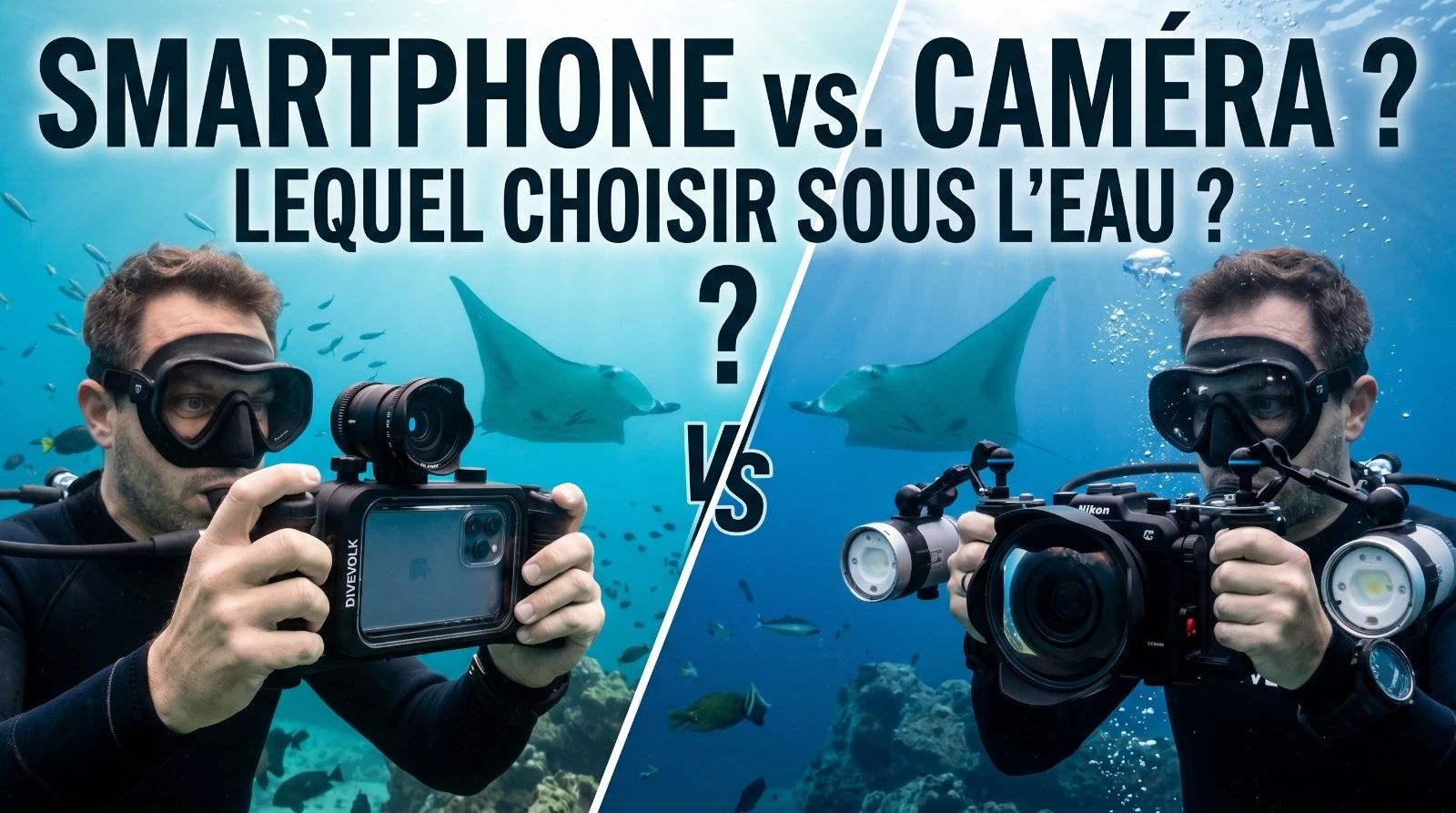
What is the best device for starting underwater photography?
A smartphone in a DiveVolk housing. It is the most accessible entry point in 2026: you already know the interface, the investment is moderate (100 to 300 euros for the housing), and the image quality is sufficient to learn all the basics of composition and underwater light.
What is task loading in underwater photography?
Task loading refers to the cognitive overload from managing multiple tasks simultaneously underwater: buoyancy, air consumption, buddy monitoring, orientation, and camera handling. The more complex the equipment, the more it monopolises your attention at the expense of safety.
When should you switch from smartphone to action camera?
When you regularly hit the limits of your smartphone and understand why you are limited. If you have mastered composition, light and approach with your phone, an action camera will give you more resolution, better low-light performance and advanced video modes.
Is a mirrorless with housing worth the investment for an amateur?
Not at the start. A mirrorless-plus-housing kit costs between 3000 and 15000 euros. It is intended for photographers who have exhausted the possibilities of action cameras and know precisely what they need. Investing too early means paying for capabilities you cannot yet exploit.
Where can I learn to choose and master my underwater gear?
The AquaExposure training dedicates an entire module to choosing equipment based on your level and goals. From smartphone to professional system, each tier is covered with optimal settings and mistakes to avoid.
Smartphone or underwater camera: what to choose in 2026?
There is a question I receive every week, worded more or less the same way by divers who have never yet taken a shot underwater. "Benjamin, I have 1500 euros, what do I buy?" And every time my answer surprises them, because I do not tell them to buy the best possible camera. I tell them to start with the cheapest.
This answer is neither false modesty nor a marketing argument. It rests on a reality I have experienced personally, one I see confirmed every month among my students, and one that 2026 has just validated in spectacular fashion.
The problem nobody explains in the shop
When you descend below the surface with a camera, your brain is not managing one task. It is managing five simultaneously. Your buoyancy, because a body that drifts cannot frame. Your air consumption, because underwater photography increases consumption by 30% on average. Your buddy, because the number one rule of diving does not disappear when you are holding a camera. Your position relative to the subject, because your approach determines whether the animal stays or flees. And finally your settings.
Cognitive psychologists call it task loading. Divers call it stress. I call it the reason why beginners equipped with professional gear often bring back worse images than those who go down with their phone.
Every button you add to your setup is one more button competing with your buoyancy control, your air monitoring and your environmental awareness. A simple setup leaves you brain capacity for what truly matters: being present in the water, stable, attentive. A complex setup turns you into a stressed technician who hovers poorly and breathes too much.
That is why the AquaExposure recommendation is always the same. Start simple. Master the tool. Progress when you understand its limits.
Tier 1: the smartphone in a housing (100 to 300 euros)
2026 is the year the underwater smartphone went from curiosity to a tool recognised by the international community. Three events confirmed this.
The Underwater Photographer of the Year created a dedicated smartphone category for the first time. The inaugural winner, Jack Ho, took the prize with a macro frogfish photo captured at 15 metres in the Lembeh Strait, using an iPhone in a DiveVolk housing. This is not a consolation prize. It is a category judged with the same standards as the others.
Samsung launched Ocean Mode, a photographic mode designed specifically for the underwater environment, which automatically adjusts white balance and exposure for aquatic conditions. Integrating the underwater world directly into the phone's software is a strong signal.
And DiveVolk won the Innovation Award at the Boot trade show in Dusseldorf with the SeaLink, a transmitter enabling real-time video streaming from underwater. The brand is no longer simply making housings. It is building a complete ecosystem.
For a diver just starting out, a smartphone in a DiveVolk housing (compatible with iPhone and Samsung, waterproof to 60 metres) represents the most logical entry. You already know the interface. The touchscreen works underwater. Your phone's computational processing (HDR, stabilisation, RAW mode) compensates for optical limitations. And the investment is limited to the housing, since you already own the sensor.
The compactness argument is decisive. A phone in its housing fits in a BCD pocket. It changes neither your hydrodynamics nor your centre of gravity. You remain a diver who takes photos, not a photographer trying to dive.
Tier 2: action cameras (400 to 600 euros)
The GoPro Mission 1 marks a turning point for the category in 2026. It is the first action cam designed from the ground up as a modular system, with interchangeable lenses and construction built for the underwater environment. The Insta360 Ace Pro 2 pushes on-board artificial intelligence further still with automatic underwater colour correction. And the DJI Action 6 completes the trio with stabilisation and 4K video quality rivalling far more expensive cameras.
These action cameras excel at wide-angle video. For fish schools, pelagics, reef ambiance, they capture an energy that still photography alone does not always convey. Their robustness also allows a certain carefree attitude underwater, and that freedom releases attention for everything else.
The limitation remains pure photography. The sensor is small, low-light handling is average, manual control is restricted. For macro or close-up creature portraits, a smartphone in a good housing often does better.
Tier 3: mirrorless with housing (3000 to 15,000 euros)
Sony, Canon, OM System in a Nauticam or Ikelite housing. This is the territory of large sensors, interchangeable lenses, external strobes mounted on articulated arms. Image quality is objectively superior in difficult conditions (low light, fast large pelagics, very high-resolution macro).
But it is also the territory of weight, complexity and budget. A complete mirrorless setup with housing, lens, arms and strobes represents 4 to 8 kilos in the water. It demands specific technical mastery, rigorous seal maintenance and pre-dive preparation that is anything but trivial.
This gear is made for divers who have already integrated the fundamentals. Who master their buoyancy without thinking. Who manage their air consumption naturally. Who know how to approach a subject without scaring it off. And who have understood, through practice, that their current equipment limits them in a specific area they can name.
How to know when to change tiers
My own path went from a compact camera to a smartphone in a DiveVolk housing. This is not a downgrade. It is the result of reflecting on what truly mattered in my images and in my diving experience.
The right time to invest in more capable gear is not when you feel like it. It is when you can answer two questions with precision. First: what limitation in my current equipment is preventing me from progressing? If the answer is vague ("I want better images"), the limitation is not in the camera. It is in practice, composition, subject approach or light reading.
Second: do I know exactly what the next tier will give me? If you can say "I need a more sensitive sensor because I regularly photograph at 30 metres where light is scarce, and I have exhausted what software correction can do", then yes, it is time.
If you cannot formulate that sentence with that precision, keep practising with what you have. Time spent mastering a simple tool is always time well spent.
Building skills before building a setup
Module 2 of the AquaExposure training covers exactly this path. From choosing the right gear for your level to the settings that make the difference underwater, through pre-dive preparation and mistakes to avoid. Because the most expensive gear in the world will never replace the skills you develop dive after dive.
FAQ
Does a smartphone really take good photos underwater in 2026?
Yes. The most recent proof is Jack Ho's victory at UPY 2026 with an iPhone in a DiveVolk housing, in the competition's first smartphone category. Computational processing in recent phones (HDR, RAW mode, stabilisation) compensates for the small sensor's limitations. For the majority of divers, the result is more than sufficient and often surprising.
Why start with the cheapest rather than the best?
Because underwater photography is first and foremost a question of skills in the water, not gear. Simple equipment leaves more mental resources for buoyancy, air consumption and subject approach. A beginner who masters a smartphone will produce better images than a beginner overwhelmed by the complexity of a professional setup.
Is the GoPro Mission 1 worth it for underwater photography?
The GoPro Mission 1 excels at wide-angle video and offers interchangeable lenses for the first time. In pure photography, the sensor remains small and low-light performance is limited. If your priority is underwater action video (pelagics, reefs, ambiance), it is an excellent choice. If you are after photo quality above all, a smartphone in a housing often does better.
What budget should I plan for starting underwater photography?
A DiveVolk smartphone housing costs between 100 and 300 euros, and your phone does the rest. That is the most accessible entry point. Action cams sit between 400 and 600 euros. The mirrorless-plus-housing setup starts around 3000 euros and can reach 15,000 euros with lenses and lighting. The AquaExposure recommendation is to start at the lowest tier and progress step by step.
When should I invest in a housing and mirrorless body?
When you can precisely identify the technical limitation of your current equipment and explain how the next tier will solve that specific problem. If you cannot name that limitation with precision, your progress still lies in practice, not in purchasing. The moment will come naturally.
Read more
Explore our other articles on gear selection and smartphone underwater photography.