AquaExposure
Homepage
Pricing
Menu
Homepage
PricingShopArticles
AquaExposure

Underwater photography excellence, accessible to everyone.

Explore

  • Discover AquaExposure
  • Kai_App
  • Underwater Photo
  • AI Training with SAGE
  • Free Guide
  • All modules
  • Shop
  • Subscriptions
  • Articles
  • Manifest
  • About
  • PDC Simulator
  • Smartphone Housing Comparator
  • Partners
  • Frequently Asked Questions

Diving in Belgium

  • Training from Brussels
  • Training in Belgium
  • Photo in Zealand
  • Careers in Belgium

Stay in touch

Stay informed about our new courses and expeditions.

  • [email protected]
  • Contact
  • New items
  • Support the project
Legal Notices·CGV·Confidentiality·

© 2026 AquaExposure. Ethically preserving the depths.

Table of Contents
  • 01The a7R VI, a quick recap.
  • 02What each container brings to the table.
  • 03What truly distinguishes the three models, beyond the price.
  • 04Comparison Table
  • 05How to choose between the three.
  • 06To learn more
MATERIEL 5 minBenjamin Coste

Sony a7R VI: Three housings, three philosophies (Nauticam, Marelux, Aquatica).

>-

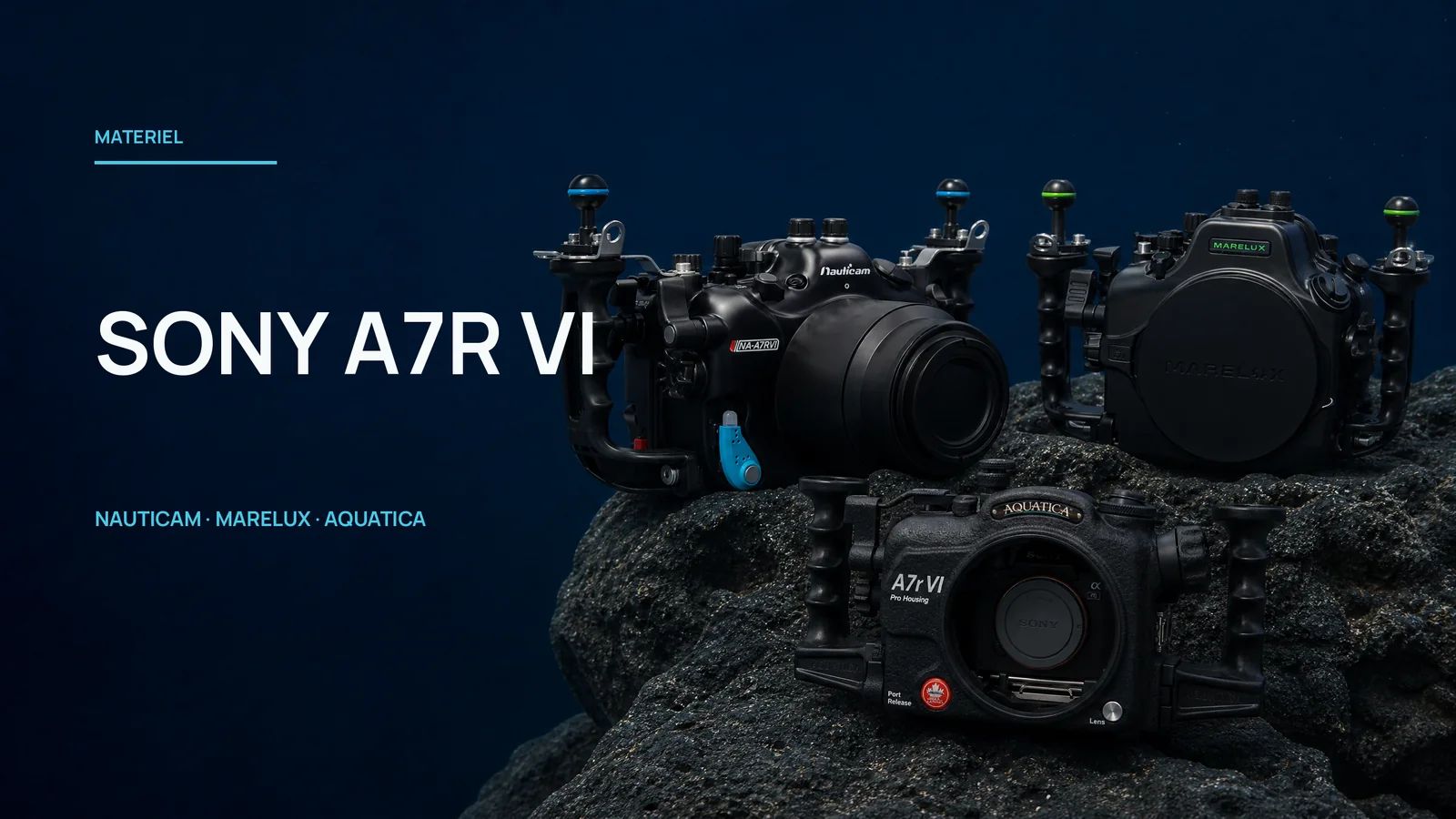
In just over a month, the Sony a7R VI has gone from having no available underwater housings to three options. Nauticam started the trend at the end of June, followed by Marelux at the end of July, and Aquatica has now completed the lineup. For the underwater photographer considering this camera body, the question is no longer whether an underwater housing exists, but rather which of the three best suits their needs.

The a7R VI, a quick recap.

The Sony a7R VI features a stacked Exmor RS sensor with 66.8 megapixels, supported by the Bionz XR2 processor. It can shoot up to 30 frames per second in electronic shutter mode without blackout, and video recording reaches 8K/30p (with a slight 1.2x crop) and 4K/120p at 10 bits with no cropping. The electronic viewfinder displays 9.44 million points. I had already detailed the specific benefits for underwater photography in the article about the NA-A7RVI: faster autofocus in murky water, a useful burst mode for pelagic creatures, and comfortable cropping margin at 66.8 megapixels.

What each container brings to the table.

Nauticam NA-A7RVI, priced at €4,200, emphasizes the longevity and breadth of its N100 ecosystem. If you already own N100 ports or housings from another brand, they can be directly transferred, a silent but decisive advantage for those already invested in the Nauticam system.

Marelux MX-A7RVI, priced at €2,950, focuses on offering a competitive price and the widest port available on the market, with a diameter of 125 mm, which is convenient for large macro lenses and wide-angle domes without extension rings. The optional manual flash trigger boasts 10,000 flashes using only two CR2032 batteries.

Aquatica A7R VI, priced at €3,700, stands out with a feature that neither Nauticam nor Marelux offers as standard on this housing: a 23.75 mm HDMI bulkhead opening for connecting an external monitor, and a choice of four flash connector configurations (none, Nikonos dual, Ikelite single, or optical dual with LED trigger). The Surveyor vacuum system (pump, valve, sensor) is included as standard, not as an optional extra.

What truly distinguishes the three models, beyond the price.

The certified depth varies slightly: 100 meters for Nauticam and Marelux, 90 meters as standard for Aquatica (extendable to 130 meters with an optional reinforced spring kit). For the vast majority of recreational dives, this difference makes no practical difference. It only matters if you practice deep technical diving.

The real point of contention is the port system. None of the three are compatible with each other. Nauticam uses its N100 system, Marelux has its proprietary 125mm system, and Aquatica uses its bayonet mount system inherited from its DSLR housings. Therefore, switching brands means having to repurchase your entire set of ports and lenses, not just the housing itself. This factor is often what ultimately influences a photographer's decision, more so than any technical specifications.

The Aquatica adds a dimension that the other two don't cover natively on this model: external video monitoring via its HDMI port. If your use leans towards video as much as photography, this detail is worth paying attention to.

Comparison Table

Nauticam NA-A7RVIMarelux MX-A7RVIAquatica A7R VI
Price (housing only)€4,200€2,950€3,700
Certified depth100 m100 m90 m (130 m optional)
Port systemN100 (Nauticam ecosystem)Proprietary, 125 mmAquatica reflex bayonet mount
Vacuum and leak alarmIntegratedPre-installed vacuum valve, manual pumpComplete Surveyor system included
External monitor outputNot native on this modelNot native on this model23.75 mm HDMI bulkhead
Flash optionsStandard Nauticam systemOptional manual trigger (10,000 triggers)4 configurations, including optical with LED trigger

How to choose between the three.

If you already own ports or hatches from one of the three brands, the answer is already clear: staying within the ecosystem is always cheaper than switching to a different one.

If you're starting from scratch and budget is a priority, the Marelux at €2,950 opens the door to the a7R VI for €1,200 less than the Nauticam, without sacrificing the aluminum construction or the vacuum valve.

If you're aiming for mixed photo and video use with an external monitor, the Aquatica has the advantage of a native HDMI output and includes a complete vacuum system as standard, at a price point between the other two options.

None of the three are bad choices. The a7R VI remains the same body in all three housings, with the same autofocus and burst shooting capabilities. What changes is the ecosystem you commit to for the following years, which is more important than underwater performance on the day of purchase.
To learn more

  • Nauticam NA-A7RVI: The underwater housing for the Sony a7R VI, aimed at professionals
  • Marelux MX-A7RVI: An underwater housing for the Sony a7R VI priced at €2,950
  • How to choose the right waterproof housing for underwater photography
  • Access the AquaExposure underwater photography training program

Share

/blog/sony-a7r-vi-three-housings-three-philosophies-nauticam-marelux

Table of Contents

  • 01The a7R VI, a quick recap.
  • 02What each container brings to the table.
  • 03What truly distinguishes the three models, beyond the price.
  • 04Comparison Table
  • 05How to choose between the three.
  • 06To learn more

Questions about the Journal

Can I use the photographs from this journal?

All images are protected by copyright. For any commercial or editorial use, please contact us via our form.

How can I be notified of new articles?

Follow us on social media or join the Sentinels Circle to receive our immersion stories before anyone else.

Do you offer hands-on workshops?

Yes, we organize masterclasses and field expeditions for members of our school. Check the Training page for details.

Articles in the same category

Underwater Macro Lenses: Wet Lenses vs Native, Choosing for Your Level and System

Underwater Macro Lenses: Wet Lenses vs Native, Choosing for Your Level and System

GoPro Hero 1, DJI Osmo Action 6, or Insta360 Ace Pro 2: The 2026 underwater camera comparison.

GoPro Hero 1, DJI Osmo Action 6, or Insta360 Ace Pro 2: The 2026 underwater camera comparison.

Insta360 X6 for diving: 1-inch sensor, Invisible Dive Case Pro, and what it changes.

Insta360 X6 for diving: 1-inch sensor, Invisible Dive Case Pro, and what it changes.