AquaExposure
HomepageTrainingToolsArticles
AquaExposure

© 2026 AquaExposure. Ethically preserving the depths.

AquaExposure
Homepage
Pricing
Menu
Homepage
PricingShopArticles
AquaExposure — Explore Beneath, Capture Beyond
Sony SF-G TOUGH: The benchmark for durability in underwater photography.
Table of Contents
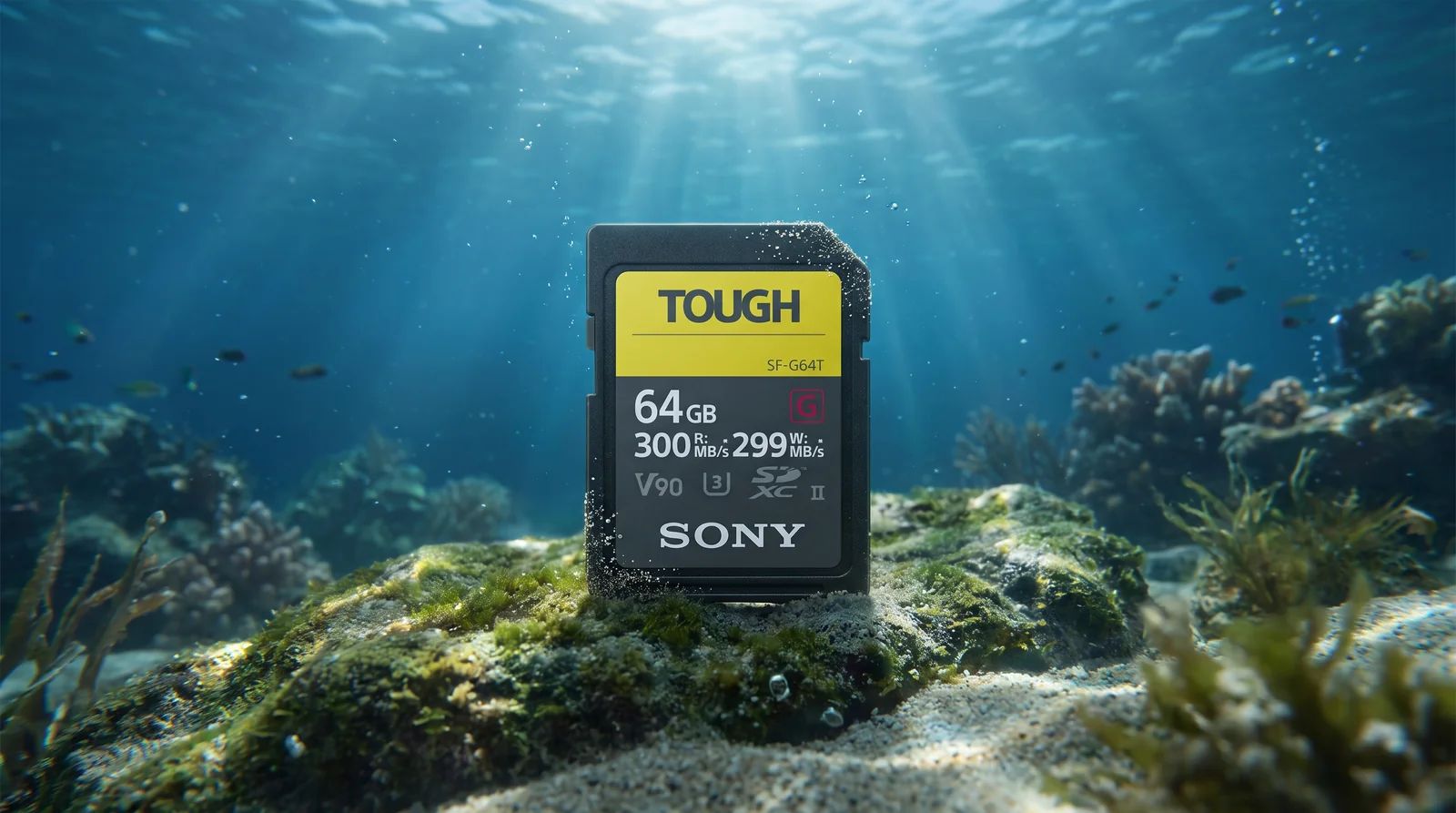
  • 01A single-piece design to withstand the elementsMost SD cards are assembled in two parts that are glued together, revealing fragile ribs and a switch that is often unreliable. Sony broke with this design by offering a single-piece structure made of high-hardness resin [1]. This approach eliminates potential points of failure. The absence of ribs and the elimination of the physical latch are design choices driven by real-world experience. On the deck of a boat, a card could fall or be handled with wet hands. The IP68 certification guarantees complete waterproofing up to 5 meters deep for 72 hours [1]. If the card slips into a rinsing tank, the data remains protected.
  • 02Top-of-the-line speeds for 8K video and RAW.While robustness is the first line of defense, the internal performance justifies its professional positioning. With a read speed of 300 MB/s and a write speed reaching 299 MB/s, it ranks at the top of the UHS-II hierarchy [1]. The V90 certification ensures a constant minimum write speed of 90 MB/s, which is essential for recording high-bitrate 8K or 4K video. On AquaExposure, this card achieves a performance score of 9.9 out of 10 [4]. The smoothness of the workflow depends on its ability to handle large amounts of data without overheating, ensuring that the storage medium never becomes a bottleneck for visual creation.
  • 03Data Security Through Software Diagnostics
  • 04Important Considerations and CompatibilityDespite its strengths, the Sony SF-G TOUGH has limitations that should be known. The range is capped at a capacity of 256 GB for the V90 model [1]. Sony prioritizes reliability and the density of its single-piece construction. A historical point deserves special attention: production series before 2020 were subject to a recall due to a risk of data corruption [3]. Reliable models can be identified by a small star engraved on the back. Finally, to fully utilize the 299 MB/s write speed, the use of a compatible UHS-II enclosure and reader is essential. On a device limited to the UHS-I standard, the card will function, but its performance will be limited by the older interface.
  • 05Conclusion: Safety for the sake of the image.When you're about to close your camera housing, the last thing you want is to have any doubts about the reliability of your memory card. The Sony SF-G TOUGH transforms that worry into technical certainty. By eliminating mechanical weaknesses and offering speeds that never limit your creativity, it stands out as a discreet and tireless tool. It represents the culmination of engineering that understands the realities of the field, where water and impacts are the norm. The technology fades into the background here, allowing the photographer's artistic expression to take center stage.
  • 06References
MATERIEL 7 minBenjamin Coste

Sony SF-G TOUGH: The benchmark for durability in underwater photography.

The Sony SF-G TOUGH is the ultimate SD card for protecting your 8K videos and photos in the most challenging underwater environments.

To improve your mastery of your equipment and optimize your procedures while diving, discover our specialized training modules on AquaExposure training.

Sony SF-G TOUGH: The benchmark for robustness in underwater photography

The constant movement of the boat, the salty humidity, and the rush of changing a storage medium between dives all subject equipment to stresses that standard technical specifications often fail to adequately describe. In this environment, where even a minor failure can mean losing a day of work, choosing a memory card becomes a matter of mechanical reliability. The Sony SF-G TOUGH meets this requirement with a radically different design, prioritizing complete physical integrity where traditional models show their limitations. This approach redefines what a storage medium should be in a harsh environment.

A single-piece design to withstand the elementsMost SD cards are assembled in two parts that are glued together, revealing fragile ribs and a switch that is often unreliable. Sony broke with this design by offering a single-piece structure made of high-hardness resin [1]. This approach eliminates potential points of failure. The absence of ribs and the elimination of the physical latch are design choices driven by real-world experience. On the deck of a boat, a card could fall or be handled with wet hands. The IP68 certification guarantees complete waterproofing up to 5 meters deep for 72 hours [1]. If the card slips into a rinsing tank, the data remains protected.

This robustness is accompanied by the ability to withstand drops from 5 meters [2]. The structural strength is measured by a torsional resistance 18 times greater than the standard SD, which is 180 newtons [1]. For a photographer working in unstable conditions, this robustness provides a safeguard against the unexpected. The sealed enclosure prevents the ingress of moisture that could corrode the internal components. The rigidity of the assembly also prevents micro-cracks that sometimes appear after years of intensive use in readers with powerful springs.

Top-of-the-line speeds for 8K video and RAW.While robustness is the first line of defense, the internal performance justifies its professional positioning. With a read speed of 300 MB/s and a write speed reaching 299 MB/s, it ranks at the top of the UHS-II hierarchy [1]. The V90 certification ensures a constant minimum write speed of 90 MB/s, which is essential for recording high-bitrate 8K or 4K video. On AquaExposure, this card achieves a performance score of 9.9 out of 10 [4]. The smoothness of the workflow depends on its ability to handle large amounts of data without overheating, ensuring that the storage medium never becomes a bottleneck for visual creation.

Data Security Through Software Diagnostics

Reliability extends beyond the resin casing. Sony provides its storage devices with software tools designed to anticipate failures. The Media Scan Utility monitors the wear of the flash memory cells, allowing you to know when the card is nearing the end of its technical lifespan [2]. This proactive approach helps avoid discovering a failure at a critical moment during a photo shoot. In addition, the File Rescue software offers a data recovery solution in case of accidental deletion [2]. The reliability score of 9.9 out of 10 highlights this overall consistency between mechanical resistance and electronic stability [4]. Regularly checking the status of the memory cells ensures that the storage medium is ready for a new expedition.## Why Choose a Card Without a Write-Protection Switch?

One of the distinctive features of the TOUGH line is the elimination of the side latch used to lock the write function. On a standard card, this switch is often the first part to break, rendering the card unusable at the worst possible moment. By removing this moving part, Sony eliminates a major source of frustration [1]. It also enhances the water resistance, as there is one less opening through which moisture could penetrate. The structure becomes a monolithic piece, insensitive to repeated friction in the camera slots. This design choice necessitates greater care in file management, but it is an acceptable compromise to gain increased durability in the chaotic environment of a boat.

Important Considerations and CompatibilityDespite its strengths, the Sony SF-G TOUGH has limitations that should be known. The range is capped at a capacity of 256 GB for the V90 model [1]. Sony prioritizes reliability and the density of its single-piece construction. A historical point deserves special attention: production series before 2020 were subject to a recall due to a risk of data corruption [3]. Reliable models can be identified by a small star engraved on the back. Finally, to fully utilize the 299 MB/s write speed, the use of a compatible UHS-II enclosure and reader is essential. On a device limited to the UHS-I standard, the card will function, but its performance will be limited by the older interface.

FeatureSony SF-G TOUGH ValueBenefit for Diving
StandardSDXC UHS-II V908K and 4K 120 fps capture
Write Speed299 MB/sSmooth RAW burst shooting
WaterproofIP68 (5m / 72h)Protection against seawater
Torsion Resistance180 NewtonsWithstands crushing in a bag
StructureSingle-piece resinNo fragile parts that can break

Conclusion: Safety for the sake of the image.When you're about to close your camera housing, the last thing you want is to have any doubts about the reliability of your memory card. The Sony SF-G TOUGH transforms that worry into technical certainty. By eliminating mechanical weaknesses and offering speeds that never limit your creativity, it stands out as a discreet and tireless tool. It represents the culmination of engineering that understands the realities of the field, where water and impacts are the norm. The technology fades into the background here, allowing the photographer's artistic expression to take center stage.

Investing in a card like this means choosing peace of mind, which becomes evident when your equipment experiences an unexpected impact or submersion. When the technology fades behind such robustness, all that remains is to focus on the essentials: the light and the moment you are about to capture beneath the surface. It is in this silence that the choice of reliable equipment truly makes sense, leaving room for visual emotion. The Sony SF-G TOUGH doesn't just store bytes, it protects the memories of a silent and precious exploration.

References

To compare this model with all the available options on the market, consult our SD and microSD card comparison tool and our complete selection of diving equipment.[1]: https://www.sony.com/en-ao/electronics/sd-cards/sf-gt-series "Sony France, Technical specifications of the SF-G TOUGH series" [2]: https://electronics.sony.com/imaging/imaging-accessories/media/p/sfg256t-t1 "Sony Electronics, Product support and durability" [3]: https://www.sony.com/electronics/support/articles/00246463 "Sony Support, Replacement notice for SF-M and SF-G series SD cards" [4]: /home/ubuntu/upload/01_Cartes_SD_microSD.csv "AquaExposure, Memory card database 2026"

sony-sf-g-tough-en

Table of Contents

  • 01A single-piece design to withstand the elementsMost SD cards are assembled in two parts that are glued together, revealing fragile ribs and a switch that is often unreliable. Sony broke with this design by offering a single-piece structure made of high-hardness resin [1]. This approach eliminates potential points of failure. The absence of ribs and the elimination of the physical latch are design choices driven by real-world experience. On the deck of a boat, a card could fall or be handled with wet hands. The IP68 certification guarantees complete waterproofing up to 5 meters deep for 72 hours [1]. If the card slips into a rinsing tank, the data remains protected.
  • 02Top-of-the-line speeds for 8K video and RAW.While robustness is the first line of defense, the internal performance justifies its professional positioning. With a read speed of 300 MB/s and a write speed reaching 299 MB/s, it ranks at the top of the UHS-II hierarchy [1]. The V90 certification ensures a constant minimum write speed of 90 MB/s, which is essential for recording high-bitrate 8K or 4K video. On AquaExposure, this card achieves a performance score of 9.9 out of 10 [4]. The smoothness of the workflow depends on its ability to handle large amounts of data without overheating, ensuring that the storage medium never becomes a bottleneck for visual creation.
  • 03Data Security Through Software Diagnostics
  • 04Important Considerations and CompatibilityDespite its strengths, the Sony SF-G TOUGH has limitations that should be known. The range is capped at a capacity of 256 GB for the V90 model [1]. Sony prioritizes reliability and the density of its single-piece construction. A historical point deserves special attention: production series before 2020 were subject to a recall due to a risk of data corruption [3]. Reliable models can be identified by a small star engraved on the back. Finally, to fully utilize the 299 MB/s write speed, the use of a compatible UHS-II enclosure and reader is essential. On a device limited to the UHS-I standard, the card will function, but its performance will be limited by the older interface.
  • 05Conclusion: Safety for the sake of the image.When you're about to close your camera housing, the last thing you want is to have any doubts about the reliability of your memory card. The Sony SF-G TOUGH transforms that worry into technical certainty. By eliminating mechanical weaknesses and offering speeds that never limit your creativity, it stands out as a discreet and tireless tool. It represents the culmination of engineering that understands the realities of the field, where water and impacts are the norm. The technology fades into the background here, allowing the photographer's artistic expression to take center stage.
  • 06References

Questions about the Journal

Why doesn't the Sony SF-G TOUGH have a write-protect switch?

Sony removed this physical switch to eliminate a fragile component. This strengthens the single-piece construction and prevents writing errors that could occur due to a latch being accidentally moved on a boat.

How can I find out if my certification card is affected by the 2020 recall?

Reliable models have a small star engraved on the back. If a model lacks this mark and has a serial number that begins with "TR", please check the Sony website to determine if it is eligible for replacement.

Is it compatible with all camera housings?

It uses the UHS-II interface. While backward compatible with UHS-I, it requires a modern UHS-II housing, such as those in the Sony Alpha or Canon EOS R series, to achieve a read/write speed of 299 MB/s.

Articles in the same category

xFROG DSMB Closed 150 cm: Test- Visibility- and Reviews of the xFROG DSMB Parachute (2026)

xFROG DSMB Closed 150 cm: Test- Visibility- and Reviews of the xFROG DSMB Parachute (2026)

XDEEP 130cm SMB Deco Buoy- Test, Visibility, and Review of the DSMB Parachute (2026)

XDEEP 130cm SMB Deco Buoy- Test, Visibility, and Review of the DSMB Parachute (2026)

XDEEP DSMB Closed Narrow 140 cm: Review, Visibility, and Opinions on the XDEEP DSMB Parachute (2026)

XDEEP DSMB Closed Narrow 140 cm: Review, Visibility, and Opinions on the XDEEP DSMB Parachute (2026)

AquaExposure

Underwater photography excellence, accessible to everyone.

Stay in touch

[email protected]

Stay informed about our new courses and expeditions.

Support the project
Legal Notices·CGV·Confidentiality·

© 2026 AquaExposure. Ethically preserving the depths.