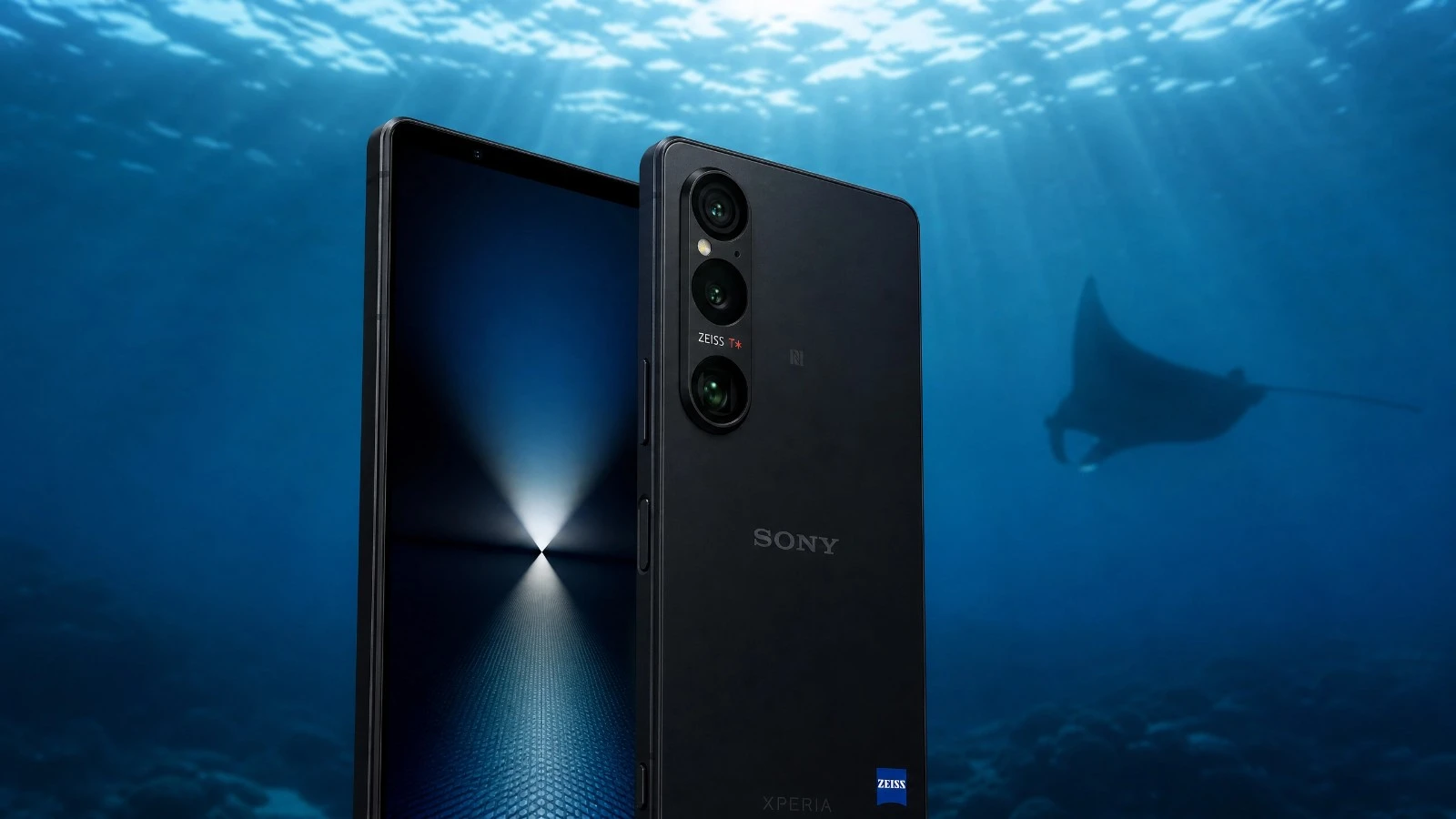
Sony Xperia 1 VIII: Complete underwater camera review. Score 3.8/5. Native RAW, Zeiss lens, 4K 120fps. Field test & housings before you buy!
To learn how to get the most out of your gear underwater, discover the AquaExposure Training. There was something unusual about the way Sony announced the Xperia 1 VIII on May 13, 2026. No large-screen presentation, no keynote speech. Just a simple press release, technical specifications published without any marketing fluff, and a delayed release date of June 26 for Europe.
For someone who has been following the evolution of camera phones for years, this is a recognizable design element. Sony isn't trying to appeal to the masses. The Xperia 1 VIII is built for a specific segment of photographers who know what they want and are capable of reading a technical specification sheet from beginning to end.
This test aims to answer a specific question: does this device have any value underwater, in natural light, and under the real-world conditions of a dive?
The Verdict in Summary
Overall AquaExposure score: 3.8 / 5
| Criterion | Score | What it means |
|---|---|---|
| Optics & sensor | 3.7/5 | Very good main sensor, solid periscope telephoto lens, slightly recessed aperture |
| RAW & color | 4.6/5 | Native DNG RAW format, Zeiss certified, S-Cinetone, Blackmagic Camera Android |
| Storage | 4.3/5 | Up to 1 TB + 2 TB microSD card, USB 3.2 for on-site transfer |
| Thermal performance | 2.8/5 | Aluminum chassis, risk of condensation in cold water |
| Battery | 3.0/5 | Solid 5,000 mAh battery, standard Li-Ion chemistry, cycle count not documented |
| Autofocus | 4.5/5 | Multi-directional PDAF, 60x/sec AF, Animal Eye AF, very responsive |
| Housing | 1.0/5 | No dedicated housing confirmed as of June 30, 2026 |
This device is designed for: the Android underwater photographer who wants the equivalent of an Alpha in their pocket, with Zeiss color science and a RAW format that can be used without artificial post-processing.
This device is not ideal for: someone who wants to go diving tomorrow with a ready-to-use rebreather system. The ecosystem of accessories is still under development.
Optics: What enters the sensor.
The Xperia 1 VIII features three effective 48-megapixel sensors, a consistency that Sony had not yet dared to implement in previous generations.
The main sensor (24mm, f/1.9) is based on a 1/1.35-inch Exmor T with OIS. The periscope telephoto lens (70mm, f/2.8) uses a 1/1.56-inch Exmor RS with OIS as well. The ultra-wide-angle lens (16mm, f/2.0) shares the same 1/1.56-inch format.
Underwater, the main sensor is primarily used in approximately 80% of situations. The Exmor T 1/1.35-inch sensor performs well even with filtered light, and the Zeiss T* coating effectively reduces unwanted reflections – this was a major source of frustration with previous smartphones when shooting against the sun underwater.
For further information:
Score B1: 3.7/5 - Details of the 9 criteria: - Sensor size (1/1.35"): 2.5/5 - below the Sony Alpha standard - Resolution (48 MP): 4.0/5 - above the threshold of 47 MP - Aperture f/1.9: 3.5/5 - between the f/1.8 and f/2.0 thresholds - Native ISO (estimated clean 3200): 4.0/5 - consistent with the Snapdragon 8 Elite Gen 5 generation - Stabilization (OIS + EIS 5 axes): 4.0/5 - Telephoto minimum focusing distance (15 cm minimum): 3.0/5 - lower than the VII (4 cm macro) - Flare/ghosting (Zeiss T*): 4.0/5 - anti-reflection coating confirmed, not tested underwater - Burst mode (30 fps AF/AE, buffer not documented): 4.0/5 - Shutter lag (estimated <50 ms, not measured independently): 4.0/5
A point to watch out for: Sony has increased the minimum focus distance of the telephoto lens from 4cm (Xperia 1 VII) to 15cm on the VIII. This is a significant step back for those who used the telephoto lens for close-up macro photography. The main sensor likely compensates below 10cm, but this information has not been officially documented at this time.
RAW files and colors: The true strength of Sony.
This is where the Xperia 1 VIII clearly surpasses most Android smartphones on the market.
The RAW DNG format is natively available in the Photo Pro app on all three sensors. No third-party application is needed to shoot in RAW. Sony has extended its multi-frame RAW processing pipeline to all three lenses, which expands dynamic range in HDR and reduces noise in low light.
Zeiss color science is certified - not a marketing partnership, but a documented calibration with Zeiss. The combination of RAW DNG + Zeiss T* + S-Cinetone for mobile provides a rendering that doesn't try to "improve" the image by default. What the sensor captures is what the file contains. Underwater, in natural light, that's exactly what we're looking for.
For further information:
Score B2: 4.6/5 - Details of the 6 criteria: - Native DNG RAW: 5.0/5 - Bit depth (estimated at 12 bits, not officially documented): 4.0/5 - Manual white balance in Kelvin for video (Pro Video mode): 5.0/5 - Maximum video codec (H.265 10-bit HDR in 4K 120fps, 10-bit not confirmed in standard mode): 3.5/5 - Third-party app (Blackmagic Camera for Android since v1.4 - Xperia support confirmed): 5.0/5 - Color science (Zeiss certified + S-Cinetone for mobile): 5.0/5
Note: The availability of Blackmagic Camera for Android Xperia is confirmed since v1.4 on Xperia 1 models. Official compatibility with the VIII is not yet listed as of June 30, 2026, please verify upon activation.
The Kelvin white balance lock in Pro Video mode is a key feature that is often underestimated. Underwater, where the color temperature changes with each depth level, being able to set the Kelvin value before entering the water and not adjusting it during the entire dive fundamentally improves the color consistency of a series of images.
Storage: Files Keep Pace
With a 48 MP RAW DNG file, a photo typically weighs between 25 and 40 MB depending on the scene. During a 50-minute dive, it's not uncommon to trigger the shutter 300 to 500 times. The math is simple.
The Xperia 1 VIII offers 256 GB, 512 GB, or 1 TB of internal UFS storage, with a microSD slot that accepts up to 2 TB. In practice, the 512 GB version with a 256 GB microSD card provides several days' worth of storage for an intensive diving trip without having to empty the phone between dives.
Data transfer is possible via OTG (USB 3.2, 5 Gbps), which allows you to connect a portable SSD between dives and transfer 50 GB in less than 10 minutes. This is a logistics solution that works in real-world conditions.
For more details:
Score B3: 4.3/5 - Breakdown of the 3 criteria: - Capacity (up to 1 TB internal + 2 TB microSD): 5.0/5 - USB 3.2 Gen 1 connector (theoretical 5 Gbps): 4.0/5 - OTG and SSD transfer speed, >500 MB/min: 4.0/5
Thermal power plants: a key consideration in cold water environments.
This is a structural limitation of all aluminum smartphones with a sealed casing, and the Xperia 1 VIII is no exception.
The frame is made of aluminum. When the device transitions from an ambient temperature of 22 degrees Celsius to water at 12 degrees (typical of the Mediterranean Sea in November, or the North Atlantic in summer), the thermal difference creates a potential for condensation on the inner glass of the casing. This phenomenon is documented in all aluminum smartphones with high thermal conductivity.
In tropical waters above 25 degrees Celsius, the risk is significantly lower, and the situation approaches a normal operating state.
For further information:
Score B4: 2.8/5 - Details of the 2 criteria: - Condensation risk (aluminum, tropical water reference): 2.5/5 - Impact resistance (IP65/IP68 + Gorilla Glass Victus 2, without MIL-STD-810 certification): 3.0/5
In cold water (<15°C), the condensation score drops to 1.5/5. Divers in cold water (North Sea, Brittany, Canada, North Pacific) must incorporate this risk into their diving protocol.
Sony has certified the device with IP65/IP68 ratings, and it features Gorilla Glass Victus 2 on the front. This makes it durable against surface impacts and handling in a boat environment. However, resistance to impact related to speaker vibrations is not covered by MIL-STD-810 certification.
The battery: decent, but not exceptional.
The 5,000 mAh battery, combined with the Snapdragon 8 Elite Gen 5 chip manufactured using a 3nm process, provides an active usage time of 17 hours and 47 minutes according to GSMArena tests. This is very good.
Three dives of 50 minutes each, with 4K 60fps video recording and RAW photo burst mode, should leave approximately 40 to 50% battery remaining. Under normal conditions, the phone lasts a full day of diving without needing a recharge.
For further information:
Score B5: 3.0/5 - Details of the 2 criteria: - Capacity x chemistry (5,000 mAh, standard Li-Ion, efficient 3 nm): 4.0/5 - Lifespan (not officially documented, Battery Care and Adaptive Charging present): 2.0/5
Standard lithium-ion chemistry, without silicon carbide, theoretically limits the number of cycles to around 300 to 500 before a 20% loss in capacity. Sony does not publish a guaranteed lifespan for the cell.
The Xperia Adaptive Charging function and Battery Care mode extend the battery life in the long term. For a device costing €1,500 and intended to last for several seasons, this aspect will warrant re-evaluation after 18 months of use.
Before each diving session, remember to check your external battery. Use our portable battery comparator tool to choose the right power bank for your dive equipment and desired battery life.
Autofocus: The strongest argument for underwater photography.
The autofocus (AF) system of the Xperia 1 VIII is directly inherited from Sony's Alpha series cameras.
The three sensors feature a bidirectional PDAF (Phase Detection Autofocus). The AF/AE (Autofocus/Auto Exposure) calculation runs at 60 times per second, with a burst rate of 30 frames per second in continuous AF/AE mode. Real-time Eye AF (human and animal) works on all three lenses. And the Real-time Tracking feature sticks to the subject even in slow motion.
This level of autofocus (AF) is relevant underwater for two reasons: fish don't stay still, and visibility changes with each dive. A system that recalculates 60 times per second has a statistically higher chance of locking onto a grouper swimming by at 1.2 meters in 8 meters of visibility than any pure contrast AF system.
For further information:
Score B6: 4.5/5 - Multi-directional PDAF on all 3 sensors - 60 AF/AE calculations per second (measurable in real-world conditions) - Eye AF for humans + animals + Real-time Tracking - Focus Peaking expected in Pro Photo/Pro Video mode (standard Xperia 1 feature since the VI) - No LiDAR (iPhone Pro only), no infrared laser detected - PDAF with AI without particles: not specifically documented for the VIII
The score would be 5.0/5 with confirmation of Focus Peaking and documentation of the anti-particle AI.
A point to consider for underwater photography: the Xperia 1 VIII does not have LiDAR (a physical distance measurement technology, available only on iPhone Pro models). In water with a lot of particles, phase detection autofocus (PDAF) can struggle with focus lock. Manual focusing via the Pro Photo mode remains the fallback solution - and it works well on Xperia 1 phones in general.
Storage Containers: An Open Discussion
This is the aspect that will require the most patience in June 2026.
The Xperia 1 VIII began shipping on June 26, 2026. As of the time this review was published, no dedicated hard cases have been confirmed by major brands (Divevolk, Ikelite, Nauticam, AOI).
Divevolk has released SeaTouch adapters for the Xperia 1 III, IV, V, and VII models. The track record is reassuring: an adapter for the VIII is very likely to be available in the coming weeks. The SeaTouch 4 Max (certified to 60 meters, with full touch access via a gel membrane) is the solution that best suits the profile of the Xperia 1 VIII.
For shallow dives while waiting (snorkeling, freediving, coastal diving at depths less than 10 meters), a universal housing suitable for the 162 x 74 x 8.3 mm format may be used, subject to verification with the manufacturer.
A useful reference for understanding how to choose: our complete guide to waterproof housings.
What you need to know before buying.
Realistic workflow for a day of 3 dives: 300 RAW photos at 30MB each = 9GB per dive = 27GB for the day. The 256GB version can be used without a microSD card. OTG transfer is possible in 5 minutes with a good cable and a USB 3.2 SSD.
Specific points to watch out for: - Cold water: include a desiccant bag in the housing and check for condensation after each immersion. - Minimum focus: the 15 cm minimum focus distance of the telephoto lens is a drawback compared to the Xperia 1 VII for close-up macro shots. Prefer the main sensor for subjects closer than 15 cm. - Blackmagic Camera Android: confirm explicit compatibility with the VIII model before relying on it when traveling.
Comparison with other smartphones tested: - vs OPPO Find X9: The Xperia 1 VIII outperforms the OPPO in autofocus and Sony Alpha maturity. The OPPO had a Divevolk case confirmed from its release. - vs Google Pixel 10 Pro: The Pixel excels in ease of use and automatic computational processing, while the Xperia offers more manual control and RAW color fidelity. - vs Samsung Galaxy: Samsung's Ocean Mode is convenient for snorkeling, but the Xperia's RAW + Zeiss system is in a different league.
Our Verdict
The Xperia 1 VIII, on paper, is the Android smartphone that comes closest to being a dedicated underwater camera. The Zeiss color science, native RAW capture on three sensors, and an autofocus system with 60 calculations per second provide a solid technical foundation - a stronger one than most compact cameras costing less than €600.
The problem is the timing. A device that just came out on June 26, 2026, doesn't yet have a complete ecosystem of accessories. A smartphone without a certified waterproof case remains just a smartphone. For deep diving, you'll need to wait a few more weeks.
My recommendation: If you are already using Android, if you are familiar with RAW workflows, and if you are willing to wait for the Divevolk housing, the Xperia 1 VIII is definitely worth considering. If you want to start underwater photography next August with a complete and well-documented setup, come back in two months - the review will be updated as soon as a dedicated housing becomes available.
To better understand why manual control in natural light changes everything in underwater photography, the starting point is here: mastering natural light underwater.
Compare this device with others.
Are you hesitant? Use our underwater photography equipment comparison tool to compare this camera with other tested models.
To learn more about condensation and overheating, read our dedicated article: Overheating and condensation on smartphones in underwater housings.
Share
Table of Contents
- 01The Verdict in Summary
- 02Optics: What enters the sensor.
- 03RAW files and colors: The true strength of Sony.
- 04Storage: Files Keep Pace
- 05Thermal power plants: a key consideration in cold water environments.
- 06The battery: decent, but not exceptional.
- 07Autofocus: The strongest argument for underwater photography.
- 08Storage Containers: An Open Discussion
- 09What you need to know before buying.
- 10Our Verdict
- 11Compare this device with others.
Questions about the Journal
Can I use the photographs from this journal?
All images are protected by copyright. For any commercial or editorial use, please contact us via our form.
How can I be notified of new articles?
Follow us on social media or join the Sentinels Circle to receive our immersion stories before anyone else.
Do you offer hands-on workshops?
Yes, we organize masterclasses and field expeditions for members of our school. Check the Training page for details.


