Aqualung i300C Review- Bluetooth Connectivity for Recreational Divers.
The Aqualung i300C combines a proven ZHL-16C algorithm, management of 3 Nitrox gas mixes, and native Bluetooth connectivity. Discover our complete review.
What is the main difference between the Aqualung i100 and the i300C?
The i300C provides essential backlighting for low-visibility conditions and a Bluetooth chip for wireless transfer. It also features two navigation buttons instead of just one.
Can I replace the battery in my Aqualung i300C myself without losing any of its data?
Yes. The CR2450 battery is easily replaceable, and the data retention function saves your decompression calculations during the replacement process.
Does the Aqualung i300C support integrated air systems?
No. This model focuses solely on time, depth, and decompression parameters and does not connect to a pressure transmitter.
Scuba diving equipment often embodies our expectations for safety and comfort below the surface. We seek tools that can reliably accompany us during our underwater explorations.
Choosing a first dive computer marks a crucial step in a diver's life. This is the moment when one takes full responsibility for their dive profile and their own safety.
The Aqualung i300C enters this highly competitive market with a clear technical promise. It attempts to combine the simplicity of a classic interface with the connectivity requirements of our digital age.
We will analyze this model in detail, focusing on its recognized algorithmic foundation. My approach is based on a rigorous study of its technical specifications and continuous feedback from divers.
The goal is to understand whether this technical proposition truly meets the needs of a diver who is actively improving their skills. Readability, reliability, and ease of use will be our guiding principles throughout this evaluation.
Mastering your measuring instrument requires effort, repetition, and self-improvement. A good dive computer should facilitate this learning process without ever masking the complexity of saturation phenomena.Understanding decompression requires rigor, patience, and an understanding of the underlying mathematical models. The Aqualung i300C aims to be a faithful translator of these complex equations into simple visual information.
2. Summary Verdict
The Aqualung i300C achieves an overall score of 3.4/5. This result reflects a very consistent positioning for the current recreational market.
Criterion
Score
What it means
Algorithm & decompression stops
4.0/5
Secure Z+ engine with clear alarms, despite conservative settings.
Air & multi-gas
2.3/5
Perfect management of 3 Nitrox gases for recreational diving, but unsuitable for technical dives.
Screen & ergonomics
3.0/5
Classic segmented LCD display made effective by backlighting and two buttons.
Battery life
4.0/5
User-replaceable battery that preserves vital saturation calculations.
Connectivity & app
4.1/5
Native Bluetooth transfer to DiverLog+ which provides exceptional ease of use.
Compass & instruments
3.6/5
Absence of an electronic compass compensated by a particularly comprehensive freediving mode.
Robustness & depth rating
3.0/5
Standard plastic construction certified for dives up to 100 meters.
Price & customer service
4.1/5
3. Detailed Analysis
Algorithm & decompression stopsThe core of a dive computer lies in its ability to accurately model our tissue gas absorption. The Aqualung i300C relies on the Z+ algorithm, which is directly based on the renowned Bühlmann ZHL-16C mathematical model.
This theoretical foundation provides excellent algorithmic reliability for the recreational dive profiles we encounter daily. The system offers adjustable conservatism factors that allow you to adapt the calculations to your fatigue level or environmental conditions.
The device also integrates an optional deep stop feature, which will appeal to divers accustomed to this specific practice. Customizable audible alarms enhance safety during the critical ascent phase.
Adjusting the conservatism is only possible through profiles predefined by the manufacturer. The lack of completely free Gradient Factors limits its use for very demanding dive profiles that require meticulous planning.
This closed approach ensures that a novice diver cannot inadvertently enter dangerous parameters. This justifies a score of 4.0/5, perfectly suited to the target audience for this model.
It is important to understand that this instrument is designed to protect you according to guidelines established by decades of hyperbaric research. The modeling of tissue compartments remains a fascinatingly complex science that this computer simplifies for your daily use.### Air & Multi-Gas
Managing breathing gas mixes determines the long-term versatility of your equipment. This model supports up to three Nitrox gases that can be easily switched underwater during decompression.
The oxygen percentages are adjustable from 21% to 100% for each configured gas. This flexibility allows you to confidently plan dives with pure oxygen stages in your future advanced diver training.
This device does not support Trimix or closed-circuit rebreathers, which require specific algorithms. Air integration is also not available on this version, which focuses on essential data.
Its mathematical score of 2.3/5 is heavily influenced by the limitations inherent to its design. However, for its target market, it comes close to perfection by offering all the functions necessary for a smooth progression.
Transitioning to mixed-gas diving requires absolute rigor in planning your bottom gas and decompression gases. The Aqualung i300C assists you in this transition with an interface so intuitive that even a diver stressed during their first drift dive will find their decompression stops without hesitation.
Display & Ergonomics
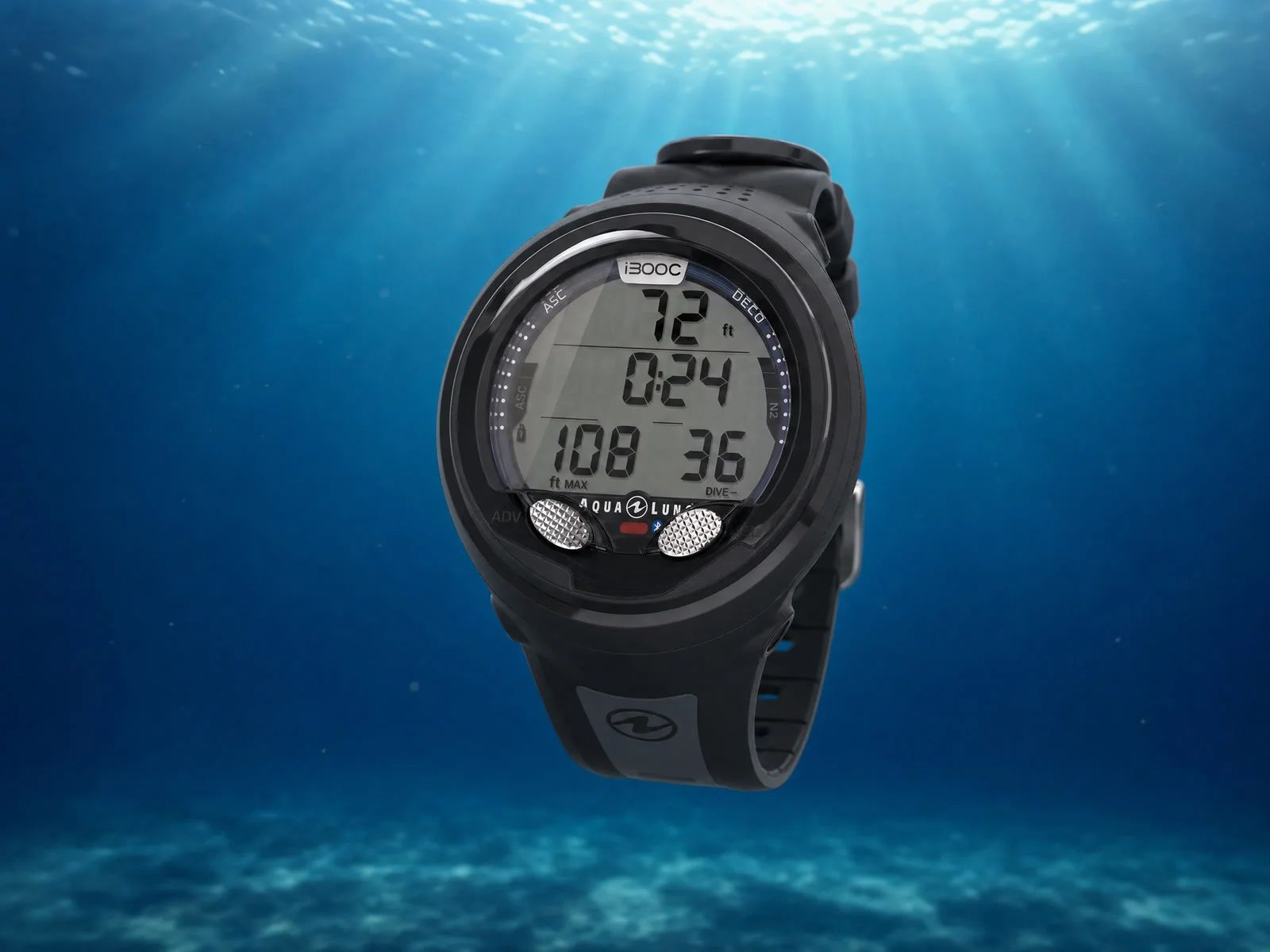
Information transmission must be immediate underwater to ensure quick decision-making. The segmented monochrome LCD screen of the Aqualung i300C remains a very classic design that has proven its effectiveness.Its readability in dark water is ensured by a useful backlight that illuminates all the displayed data. You can activate this built-in light during your night dives or when exploring dark lakes.
The interface is controlled by two distinct physical buttons that naturally fall under your fingers. This configuration makes navigating the Nitrox settings much less cumbersome than a single-button system, which is often frustrating.
The segmented LCD offers less display flexibility than a state-of-the-art color matrix. The score of 3.0/5 reflects this proven but aging technology, which still has the advantage of minimal power consumption.
Critical information is organized hierarchically so that your eye immediately captures the depth and bottom time. This visual structure actively helps to reduce mental load during complex dives.
Battery Life
Power management is a constant concern when traveling or staying in remote locations for extended periods. The Aqualung i300C is powered by a standard 3.0V CR2450 battery, which is readily available.
This battery can be replaced by the user in seconds with a simple tool. The real strength of the system lies in its data retention function, which protects your vital information.The device retains the history of your dives and calculates decompression stops even when the battery is changed. Changing its power source during a week-long cruise without resetting its nitrogen loading is crucial for your safety.
This peace of mind earns it an excellent rating of 4.0/5 in our technical evaluation. You maintain control over the basic maintenance of your equipment safely and without relying on a specialized workshop.
This energy management system provides exceptional reassurance for divers exploring remote atolls. The need for an electrical outlet is completely eliminated by this simple and effective mechanical design.
Connectivity & App
Dive log management has evolved significantly in recent years to become a seamless digital experience. The Aqualung i300C natively integrates a Bluetooth Smart chip that radically transforms the post-dive routine.
This technology allows for wireless synchronization of your dive profiles to your phone or tablet. The DiverLog+ mobile app, available on iOS and Android, centralizes all your data in a clear and detailed interface.
You can also adjust the computer's settings directly from your smartphone before boarding the boat. This ease of use has become essential for many divers who want to analyze their parameters without limitations.It is extremely rare to find such integration at a price point below 300 euros. This excellent product receives a rating of 4.1/5, praising this democratization of connectivity which facilitates learning through the analysis of recorded profiles.
The ability to review your dive profile just minutes after surfacing has immeasurable educational value. You can correlate your physical sensations with the objective data recorded by the pressure sensor.
Compass & Instruments
The equipment focuses on the essentials and concentrates on vital decompression parameters. The Aqualung i300C does not have a built-in electronic compass to guide you underwater.
It includes a precise temperature sensor to analyze your environment and adapt your thermal protection. The device also offers a particularly comprehensive Freedive mode that records your performance during freediving.
This specific mode allows for transitions between scuba diving and freediving on the same day, managing physiological constraints. This versatility will delight multi-disciplinary practitioners who enjoy varying their aquatic activities.
The score of 3.6/5 highlights this pragmatic approach which prioritizes the quality of the functions offered. The absence of a compass simply requires adding an analog instrument to your console or your opposite wrist.Underwater navigation remains an art that requires observation and a good understanding of traditional instruments. Using a standard magnetic compass is often more instructive for divers who are learning.
Durability & Depth
The durability of a dive computer is severely tested on boats and during equipment handling. The plastic casing of the Aqualung i300C is standardized and particularly robust against external impacts.
It is designed to withstand the repeated shocks of regular dives without failure. The device is certified to operate up to 100 meters (330 feet) in depth, which provides a significant safety margin.
This limit of 330 feet perfectly meets the expectations for both recreational and light technical diving categories. A score of 3.0/5 validates a serious construction that prioritizes function over aesthetics.
The overall design inspires immediate confidence for intensive use at dive clubs or during your travels. The elastomer strap is highly resistant to ultraviolet rays and saltwater in the long term.
Price & Customer Service
Investing in a dive computer should be a lasting investment supported by a reliable distribution network. The Aqualung i300C typically sells for around 280 euros, depending on the specialized retailer.This price puts it in a very competitive range considering its advanced connectivity features. Aqualung's after-sales service provides excellent support for its measuring instruments worldwide.
Recent computers are often sealed at the factory to guarantee perfect water tightness from the moment they leave the production line. A standard exchange is easy if a defect is recognized under warranty by the manufacturer.
The quality of support depends largely on your local dealer, who will act as the liaison with the brand. This score of 4.1/5 reflects a very relevant value for money proposition for divers concerned about their budget.
Choosing a brand that has been established in the underwater world offers a significant guarantee of longevity. You will always find a technician capable of advising you on the use of this measuring instrument.
4. Who is this computer for?
The Aqualung i300C is primarily aimed at regular divers who are progressing towards independence. It is ideal for divers from the Open Water level to advanced decompression autonomous divers exploring new horizons.
Its management of three Nitrox gases perfectly complements initial technical training without requiring a new investment. Native Bluetooth transfer greatly simplifies the post-dive routine for those who like to keep their logbook up to date.This computer is not ideal for divers who want to read their tank pressure directly on their wrist. The lack of air integration is a significant limitation of this model, requiring the use of a traditional pressure gauge.
Those who prefer ultra-modern color matrix displays will need to consider other, more expensive options. The i300C remains a practical tool focused on the essential aspects of hyperbaric safety.
Acquiring this equipment often represents a desire to move away from rental gear provided by dive centers. It's a significant step towards a more personal and engaged approach to our shared passion.
5. Service and Support
Aqualung's technical support benefits from a well-established structure within the diving industry. The manufacturer provides excellent after-sales service for its measuring instruments through a dense distribution network.
Recent computers like the i300C are often sealed at the factory to limit unauthorized interventions. This design greatly simplifies standard exchange procedures in case of a confirmed failure under warranty.
The efficiency of this service depends heavily on the quality of your retailer, who acts as your primary point of contact. A specialized store can expedite the process with the manufacturer to get you a functional device.It is recommended to keep your proof of purchase carefully, as it may be needed to assert your rights if necessary. Regular maintenance of the battery compartment helps prevent most technical issues related to oxidation.
Maintaining a trusting relationship with your local dealer remains crucial for effective after-sales service. They will be able to diagnose any potential malfunctions before contacting the manufacturer's technical support.
6. Power Supply
The choice of power source determines your autonomy during travel and your freedom of action. The Aqualung i300C uses a CR2450 battery that can be easily replaced by the user.
This solution offers immense flexibility when staying away from urban centers or on isolated boats. You can carry a spare battery in your emergency kit to prepare for any eventuality.
Replacement is easy with a suitable tool provided in the original packaging. The data retention function ensures continuity of your saturation calculations during this delicate procedure.
This approach contrasts with rechargeable batteries, which require daily access to a reliable power outlet. This is an undeniable advantage for rustic cruises where energy is rationed.Mastering your equipment also involves the ability to perform basic maintenance. Changing the battery becomes a reassuring ritual that connects you intimately with your life support system.
The Aqualung range offers alternatives for every type of diver and every specific budget. If you are looking for a more visual interface, the higher-end model might catch your attention.
You can consult our detailed review of the Aqualung i770R test to discover its bright color screen.
For tighter budgets, the entry-level models offer basic but sufficient functions for beginners. Read our Aqualung i100 test to understand its technical compromises.
Each model caters to a very specific diving philosophy that should be studied before making any purchase.