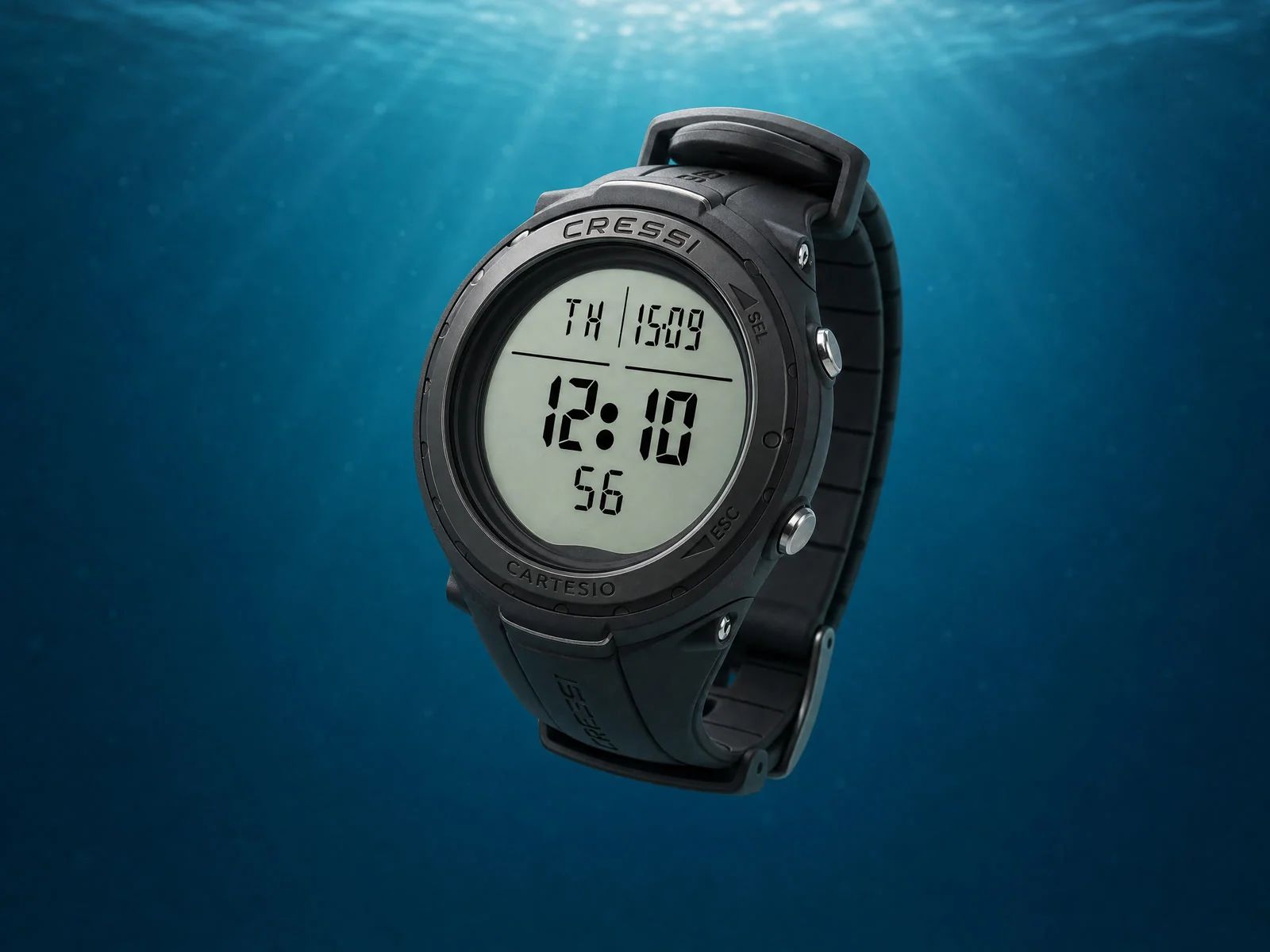
Cressi Cartesio Computer Review: A versatile dive computer for multi-gas diving.
Discover our comprehensive review of the Cressi Cartesio dive computer. Features include dual gas management, freediving mode, and a replaceable battery. Is it worth the price?
What is the difference between the Cressi Goa and the Cartesio?
The main difference lies in gas management. While the Goa is a single-gas computer, the Cartesio manages two gas mixtures (up to 99% oxygen for decompression gas), which allows you to perform a gas switch underwater.
Can I replace the battery in the Cressi Cartesio myself?
Yes, despite its compact watch-like design, the Cartesio uses a CR2450 battery that the user can replace themselves by removing two small screws on the back. This is a major advantage when traveling.
Does the Cressi Cartesio have an integrated compass?
No, the Cartesio focuses on providing essential dive and decompression data- it does not include an electronic compass.
In the world of diving, a dive computer is much more than just an accessory. It's an essential companion, a guarantee of our safety underwater, precisely calculating decompression parameters. Often, the pursuit of a compact form factor involves compromises on advanced features, a reality that many divers know. The Cressi Cartesio represents a notable evolution, retaining the elegant 48 mm case of its predecessor, the Goa, while adding a crucial feature for progressing divers: the ability to manage a second gas for decompression. We will explore whether this model manages to reconcile an ultra-compact design with the real technical requirements of multi-gas diving with accelerated decompression, always remembering that safety, repetition, and self-improvement are the pillars of our practice.
The Verdict in Summary
Overall Score: 3.3/5
Criterion
Score
What it means
Algorithm & decompression stops
4.1/5
The Cressi RGBM algorithm is very conservative and reliable, perfect for safety.
Air & multi-gas
2.2/5
It supports two gases up to 99% oxygen, opening the door to accelerated decompression.
Screen & ergonomics
2.6/5
The screen has good contrast but is inevitably small. Navigation with two buttons can be tedious when wearing thick gloves.
Battery life & power
4.0/5
Excellent battery life and a replaceable CR2450 battery, which is a luxury for this type of device.
Connectivity & app
3.0/5
You need to purchase a separate Bluetooth/USB interface to export your dive logs.
Compass & instruments
3.2/5
No electronic compass, but it has an extremely comprehensive freediving mode.
Robustness & depth rating
3.8/5
Very robust case with a stainless steel crown, mineral glass, and certified to 120 meters.
Price & customer service
4.1/5
Very competitive price for a multi-gas dive computer, backed by Cressi's established customer service.
## Detailed Analysis
Algorithm & Safety Stops (4.1/5)
The Cartesio uses the Cressi RGBM algorithm with 9 tissue types, developed in collaboration with Bruce Wienke. This algorithm is known for its highly conservative nature, penalizing inverted dive profiles and repetitive dives over several days. This approach guarantees a significant safety margin, which is essential for any diver concerned about their well-being. Deep stops are enabled by default, but an option allows users to disable them according to their preferences. The display includes the total ascent time (TTS), mandatory safety stops, and deep stops, providing a clear view of decompression requirements. Visual alerts inform the user about ascent rate and oxygen toxicity (SNC/CNS), vital data for careful dive management.
Air & Multi-Gas (2.2/5)One of the major advancements of the Cartesio compared to the Goa is its ability to manage two distinct gas mixtures. It's possible to program a bottom gas, Gas 1, with an oxygen concentration ranging from 21% to 50%. A second gas, Gas 2, can be configured for decompression stops, with an oxygen content varying from 21% to 99%. This flexibility opens the door to accelerated decompression, a technique that, when mastered, allows you to optimize surface intervals. The integration of air filling systems, although often present on other models, is absent on the Cartesio. This feature, or its absence, is a factual point to consider, but it does not directly impact the score assigned to multi-gas management, which remains an advantage for divers who want to progress to more complex profiles.
Screen & Ergonomics (2.6/5)Designing a multi-gas dive computer within a 48 mm casing, with a usable display of only 35 mm, presents a significant challenge. This compactness, which is highly desirable for everyday use, necessitates compromises in font size. The high-intensity segmented LCD screen offers good contrast and effective backlighting, ensuring adequate readability under most conditions. However, navigating the menus using only two physical stainless steel buttons can be cumbersome, especially when wearing thick gloves. Performing a "Gas Switch" at a depth of 20 meters requires precise memorization of sequences and a certain level of dexterity. This is an area where repetition and pushing your limits are necessary for smooth and safe operation.
Battery Life & Power (4.0/5)The fear of battery failure, especially when traveling, is a reality for users of dive computers. The Cressi Cartesio stands out here with its intelligent design. It uses a CR2450 battery that the user can replace themselves in just a few minutes by simply removing two small screws. This extended battery life, combined with the ease of replacement, is a welcome feature, avoiding costly returns to a service center and guaranteeing peace of mind, even during longer trips. The computer also has an "OFF" mode to conserve energy, further extending battery life. This practical feature makes it a significant advantage for traveling divers.
Connectivity & App (3.0/5)
Connectivity represents an area for improvement in this product line. Bluetooth is not integrated as standard on the Cartesio. To download data from the computer's memory, which can store up to 50 dives or 40 hours of data, to a smartphone, it is necessary to purchase an external connection interface, sold separately. This interface, whether Bluetooth or USB, then allows you to use the Cressi app to analyze and archive your dive log. This is an extra step and an additional cost that may surprise some users who are accustomed to integrated connectivity. It's important to be aware of this before making a purchase to anticipate this investment.### Compass & Instruments (3.2/5)
The Cartesio omits the electronic compass, focusing on essential dive and decompression data. However, it compensates for this by offering a very comprehensive "Free" or apnea mode. This mode is highly valued by freedivers because it accurately records depth, surface times, and includes multiple alarms specific to this discipline. A "Gauge" mode, which transforms the computer into a standard depth gauge, is also available, providing appreciable versatility. This targeted approach allows the Cartesio to excel in specific areas, even without incorporating all possible features.
Durability & Depth (3.8/5)
Durability is a non-negotiable criterion for diving equipment. The Cressi Cartesio has a very streamlined profile, designed to avoid snagging on buoyancy compensators or other pieces of gear. Its scratch-resistant mineral glass, combined with a stainless steel crown and buttons, provides excellent durability and can withstand the rigors of the marine environment. It is certified for use up to 120 meters (394 feet) in depth, attesting to its reliability for the vast majority of recreational and semi-technical dives. This is a computer built to last, a safe investment for years to come.
Price & Customer Service (4.1/5)The Cressi Cartesio enters the market with a price generally around €315 on French-speaking websites. This price represents an excellent value for a dive computer watch capable of managing accelerated decompression. Cressi's customer service, historically well-established in Europe, is a major advantage. The brand benefits from good support, and while some recent computers are factory-sealed, which simplifies standard returns, the quality of service will always depend on the local retailer. Therefore, it is advisable to choose a responsive and competent retailer for any questions or support needs. The availability of customer service is such an important factor that it can influence the purchase decision, and Cressi offers a reassuring level of peace of mind here.
Who is this computer for?The Cressi Cartesio is an excellent choice for regular divers or those at Level 2 (Advanced) who plan to obtain their Nitrox certification. It is designed for those seeking a compact and discreet instrument that can be worn daily, while still offering the flexibility of managing a second gas for decompression. It's a great tool for a Level 1 diver looking for an upgradeable piece of equipment. However, it is not ideal for technical divers using Trimix or CCR systems, nor for those with developing presbyopia who require large screens for optimal readability. It is important to clearly understand your needs so that the device perfectly matches your diving activities.
Service and SupportCressi is known for its good customer support, with a well-established network throughout Europe. The brand is strict about warranty conditions, which means that a malfunction caused by improper use by the diver may result in limited coverage. It is therefore crucial to carefully read the user manual and follow the manufacturer's recommendations. Recent computers are often sealed at the factory, which simplifies standard exchanges in case of problems under warranty. However, as with many brands, the quality and speed of service can depend on the efficiency and responsiveness of the local retailer. Choosing a good retailer is therefore just as important as choosing the computer itself.
Power Supply
The Cressi Cartesio uses a CR2450 battery, a sensible choice for a watch-style computer. The ability to replace this battery yourself is a significant advantage, especially when traveling or on cruises where access to a service center may be limited. This feature eliminates the fear of an irreparable battery failure far from home. It is always recommended to have a spare battery on hand, ensuring continuous operation. This user-managed autonomy is such a valuable asset that it greatly simplifies dive logistics.To find out which battery to buy for this computer, check out our complete guide on dive computer batteries. To learn how to change the battery yourself step by step without risking damage, read our comprehensive tutorial on how to change your own dive computer battery.
Links to other models from the same brand
If the Cartesio has piqued your interest, other Cressi models might also catch your eye. For a simpler approach, the Cressi Goa offers an elegant single-gas solution. For different features, feel free to explore the Cressi Giotto or the Cressi Leonardo, each with its own specific characteristics. Each computer has its own personality, and it's important to find one that best suits your diving style and underwater aspirations.