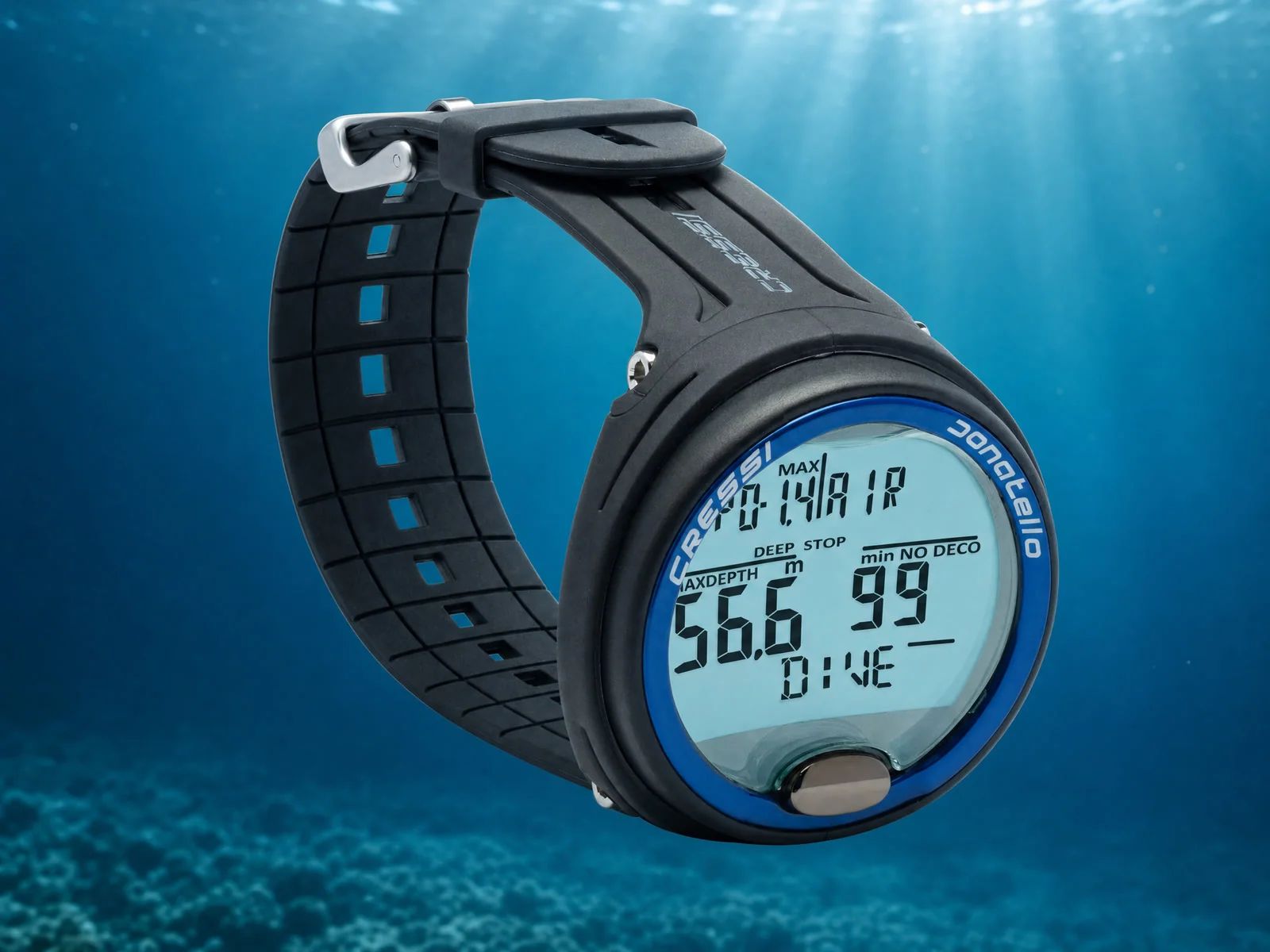
Cressi Donatello Review- The Ultimate Scuba Diving Computer for Recreational Divers.
Discover our comprehensive review of the Cressi Donatello dive computer. We cover its algorithm, ergonomics, battery life, and safety features. Is it worth the price for a beginner?
Can the Cressi Donatello regulator be used with Nitrox?
Yes, the Cressi Donatello regulator is designed for use with a single gas and can handle Nitrox mixtures up to 50% oxygen, which is sufficient for most recreational dives.
Can I change the battery myself?
Yes, one of the major advantages of the Donatello is that its CR2430 battery can be replaced by the user without requiring any special tools.
Is it compatible with technical diving or trimix diving?
No, this computer is strictly designed for recreational diving. It does not support trimix or advanced multi-gas features.
Learning to scuba dive is a process that takes time. We spend hours mastering our buoyancy. We repeatedly practice the same safety procedures.
We learn to read our environment with a new level of attention. In this constant progression, equipment plays a fundamental role. It should fade into the background and allow you to focus on the experience.
It must be reliable, easy to understand, and predictable. Confidence in your gear is key to feeling comfortable underwater. The choice of your first dive computer often marks a crucial step.
This is when you take full responsibility for your decompression. It's an act of autonomy, maturity, and awareness. It's not just a spur-of-the-moment purchase.
On the decks of boats, one model appears with striking regularity. The Cressi Donatello equips thousands of divers around the world. It has the important task of succeeding the famous Leonardo.
It carries on its shoulders the legacy of a historic brand. We will dissect its actual capabilities beyond its attractive price. We will analyze its algorithm, ergonomics, and limitations.
The goal is to determine if it deserves a place on your wrist for your first underwater explorations.
The Verdict in Summary
Overall score: 3.4/5
Criterion
Score
What this means
Algorithm & decompression stops
4.1/5
A very conservative and safe RGBM algorithm, perfect for beginners.
Air & multi-gas
1.8/5
Basic functionality, it handles air and Nitrox up to 50%, nothing more.
Screen & ergonomics
2.9/5
A very readable LCD screen, but the single-button navigation requires patience.
Battery life
4.2/5
Excellent battery life and a battery that you can replace yourself.
Connectivity & app
3.0/5
You need to purchase a Bluetooth interface sold separately, which is unfortunate.
Compass & instruments
2.5/5
It provides the bare minimum with depth, time, and temperature, but without a compass.
Durability & depth rating
4.3/5
Certified to 120m with a solid mineral glass, it withstands impacts very well.
Price & customer service
4.1/5
Cressi offers excellent customer service throughout Europe and the price is very reasonable.
Detailed Analysis
Algorithm & decompression stops (4.1/5)
Decompression management is the core of any dive computer. The Cressi Donatello uses the proprietary Cressi RGBM algorithm. This mathematical model is known for its very conservative approach.
For recreational diving, this caution is excellent news. The algorithm generates profiles that are extremely safe. It is designed to keep you far away from decompression accidents.You won't find any adjustable Gradient Factors here. Cressi has opted for simplicity, with three pre-set conservatism levels. You can switch between the SF0, SF1, and SF2 modes depending on your fatigue level.
The display during dives focuses on the essentials. The total ascent time and the main decompression stop are clearly indicated. Rapid ascent alerts are both visual and audible.
The tissue saturation graph allows you to quickly visualize your state. This is a valuable aid for understanding the impact of your successive dives. The reliability of this system has been proven.
To date, no manufacturer recalls have been issued for this model. This provides invaluable peace of mind. You can trust it with your safety without hesitation.
The transparency of this algorithm is a major advantage for training. Instructors particularly appreciate the clarity of the information displayed during ascents. It's an excellent educational tool for explaining decompression.
Air & Multi-Gas (1.8/5)
Here, we have a recreational dive computer in its purest form. The Donatello is designed to manage only one gas at a time. It will perfectly accompany you on your air dives.If you decide to get certified as an enriched air diver, it will meet your needs. It handles Nitrox mixtures with an oxygen percentage ranging from 21% to 50%. This is more than enough to extend your bottom times.
However, its capabilities stop there. You won't be able to configure a separate decompression stage to speed up your safety stops. Diving with complex mixes like Trimix is completely excluded from its program.
Users of closed-circuit rebreathers will also need to look elsewhere. Wireless air integration is not included in this model. You will have to keep using your traditional mechanical pressure gauge.
As required by our evaluation guidelines, this lack of air integration does not affect the score. The Donatello targets entry-level divers and fully embraces its limitations. It doesn't do much, but it does what it does well.
This deliberate limitation avoids errors in handling underwater. A beginner diver doesn't need to get lost in complex gas selection menus. Simplicity is often the best ally of diving safety.
Screen & Ergonomics (2.9/5)
The visual interface is the constant point of contact between the device and the diver. Cressi has opted for a basic but remarkably effective segmented LCD screen. The contrast is maximized.Underwater, the large numbers stand out clearly from the background. The information is so easy to read that even in murky water, it's immediately visible. This provides undeniable visual comfort.
Unfortunately, problems arise once you return to the surface. Navigation through the menus relies on a single physical button. A short click scrolls through the options. A long click confirms your selection.
This system requires infinite patience to adjust even the simplest settings. Changing the percentage of oxygen in your Nitrox mix quickly becomes tedious. The ergonomics are so outdated that even with thin gloves, frustration sets in.
This is an inevitable compromise to maintain such a low price. It's easier to guarantee water tightness with a single button that passes through the casing. However, on a daily basis, this interface highlights the limitations of an entry-level product.
The absence of multiple buttons also reduces the risk of leaks. Each opening in the casing is a potential weak point under pressure. This technical choice enhances the overall reliability of the instrument over the long term.
Battery Life (4.2/5)
Battery life is often a weakness of modern dive computers. Color screens consume a lot of power, requiring frequent recharges. The Donatello completely defies this trend.This is the major strength of this display technology. The battery offers an impressive lifespan, measured in months or even years. This depends on your diving frequency and the use of the backlight feature.
The battery indicator takes the form of a simple gauge on the main screen. You always know exactly how much power you have left before entering the water. No unpleasant surprises when preparing your scuba gear.
The ultimate advantage lies in the type of power source used. The Donatello uses a standard CR2430 button cell battery. You can find these at virtually any supermarket or convenience store worldwide.
Replacing the battery is designed to be done by the user themselves. You don't need to send the device back to a service center. This provides invaluable freedom when you are in a remote location just before a dive trip.
It is always recommended to keep a spare battery in your dive bag. The compact size of the CR2430 allows it to be easily stored in a first aid kit. This ensures you are prepared for any eventuality during your travels.
Connectivity & App (3.0/5)
In this digital age, dive log management has evolved significantly. The Donatello has the internal capabilities to record your dive profiles. The internal memory stores your data accurately.The frustration arises when you want to utilize this valuable information. The computer does not have a built-in Bluetooth chip as standard equipment. You absolutely must purchase a communication interface that is sold separately.
This optional module connects to the back of the device. It then allows synchronization via a USB cable to a desktop computer. It also provides a Bluetooth connection to your smartphone or tablet.
The dedicated application, simply named Cressi App, performs its function adequately. It allows you to view your depth and temperature profiles. It facilitates keeping a digital dive log.
It is truly unfortunate that you have to spend more money for a feature that has become standard. Without this additional purchase, your data remains trapped within the housing. This is a significant psychological barrier.
However, analyzing your own dives on a large screen can be very educational. It allows you to identify buoyancy variations and improve your technique. Therefore, this extra investment is highly recommended for making progress.
Compass & Instruments (2.5/5)
The onboard instrumentation focuses on the essentials. The pressure sensor provides a highly accurate depth reading. The dive timer automatically starts when submerged.A basic integrated thermal sensor displays the water temperature. These three essential data points occupy the main part of the screen. The Donatello also offers a Gauge mode for use as a depth gauge.
Freedivers will find a basic freediving mode. It allows you to record dive times and surface intervals. This is a useful feature for adding variety during your vacation.
However, you won't find an electronic compass in the menus. Underwater navigation will have to be done the traditional way. You should definitely add a magnetic compass to your opposite wrist or to your console.
This omission is logical given the device's price point. Integrating a reliable digital compass is expensive in terms of development. Cressi has chosen to focus on the reliability of essential functions.
Using a separate compass actually offers educational benefits. It forces the diver to separate their decompression management from their orientation. This is an excellent habit to develop from your first dives.
Durability & Depth Rating (4.3/5)
The marine environment is a harsh one for precision electronics. Saltwater, sunlight, and impacts on the boat's ladder are all part of the daily life of our equipment. The Donatello is built to withstand these stresses.Its robust housing immediately inspires confidence when held. A prominent bezel effectively protects the screen from accidental scratches. The mineral glass used offers superior resistance compared to plastics.
The build quality is impeccable, consistent with the reputation of the brand's Italian factories. The computer is certified for dives down to an impressive depth of one hundred and twenty meters.
This structural safety margin guarantees exceptional longevity for the device. It will easily withstand the rough handling common in the early years of diving practice. It is a solid, reliable, and durable tool.
The original elastomer strap provided is particularly resistant. It fits comfortably on both bare wrists and over thick wetsuits. Its flexibility ensures a perfect fit throughout the dive.
Price & Customer Service (4.1/5)
Often, the deciding factor remains the budget allocated to equipment. Cressi makes a significant impact with a price of around one hundred and ninety euros. This represents an unbeatable value for money ratio for beginners.
The investment is minimal considering the safety it provides underwater. However, the true strength of the Italian brand lies in its customer service. The distribution network is established and widespread throughout Europe.Whether you are in Belgium, France, or Switzerland, you will always find an authorized dealer. The European customer support service, based between Italy and Spain, is known for its professionalism. Processing times are short.
However, it is important to remember that Cressi strictly adheres to its warranty terms. If the malfunction is due to user error, tolerance will be limited. Strict adherence to maintenance procedures is essential for your equipment.
This level of rigor is understandable and justified. By following the manufacturer's recommendations, you can ensure years of diving without any technical issues. It is a relationship of trust between the brand and the diver.
Peace of mind is priceless, but it does come at a cost. With this model, Cressi makes high-quality safety equipment more accessible. It is an excellent introduction to the fascinating world of underwater exploration.
Who is this computer for?
The ideal user profile for the Cressi Donatello is easy to define. This computer is specifically designed for divers at Level 1 or Open Water certification. It will also be a perfect fit for a Level 2 diver who does not need to manage multiple gas mixtures.
It is the perfect tool for those who prioritize simplicity above all else. If you dive only a few weeks each year during your vacations, it will meet all your needs. Its readability and price make it an undeniably logical choice.However, this computer is not suitable for technical diving profiles. If you are planning to take an advanced training course in the coming months, look elsewhere. The lack of multi-gas management will quickly become a significant limitation.
Divers who dislike archaic interfaces should also consider other options. Navigating with a single button can drive even the most patient instructors crazy. If you prefer intuitive menus, explore different models.
Service and Support
After-sales service is a fundamental consideration when purchasing safety equipment. Cressi has a well-established European customer support network. This location ensures quick and efficient communication with retailers.
The brand is known for providing good long-term product support. Spare parts, such as straps or screen protectors, are readily available. You will never be left without assistance in the event of minor damage.
However, it is crucial to understand the company's warranty policy. Cressi is particularly strict about the conditions for applying its coverage. A malfunction caused by improperly replacing a battery will not be covered.
User-caused failures result in virtually no tolerance from service centers. Therefore, it is essential to read the manual and pay attention to rinsing procedures. By following these simple rules, Cressi's support system will prove to be a valuable asset.
Power SupplyThe choice of power source often dictates a diver's routine when traveling. The Donatello uses a replaceable CR2430 button battery. This technical design offers significant advantages for managing your equipment.
On a long cruise, access to an electrical outlet can sometimes be a luxury. You will never have to worry about recharging your dive computer between dives. A new battery before you leave guarantees extended peace of mind.
Replacing the battery takes only a few minutes with a simple coin. Just unscrew the back cover, replace the O-ring, and insert the new battery. This is an operation that everyone can perform.
This energy independence provides absolute convenience in everyday use. You take the computer out of your bag, check the gauge, and you are ready to dive. This is the very definition of ease of use that we expect.
Links to other models from the same brandThe Cressi range offers interesting alternatives if the Donatello doesn't meet your needs. If you are looking for a more compact watch-style format to wear every day, the Cressi Neon is worth considering.
It uses the same algorithmic foundation but in a much thinner casing. For divers who want a richer interface and multi-gas management, you will need to choose a higher-end model.
The Cressi Michelangelo offers a larger screen and extended features. It's the logical next step to support your technical progress over the years.
Comparison Tool
Mastering your decompression is the first step towards true underwater autonomy. Take the time to understand the limitations of your device in order to safely push your own limits.