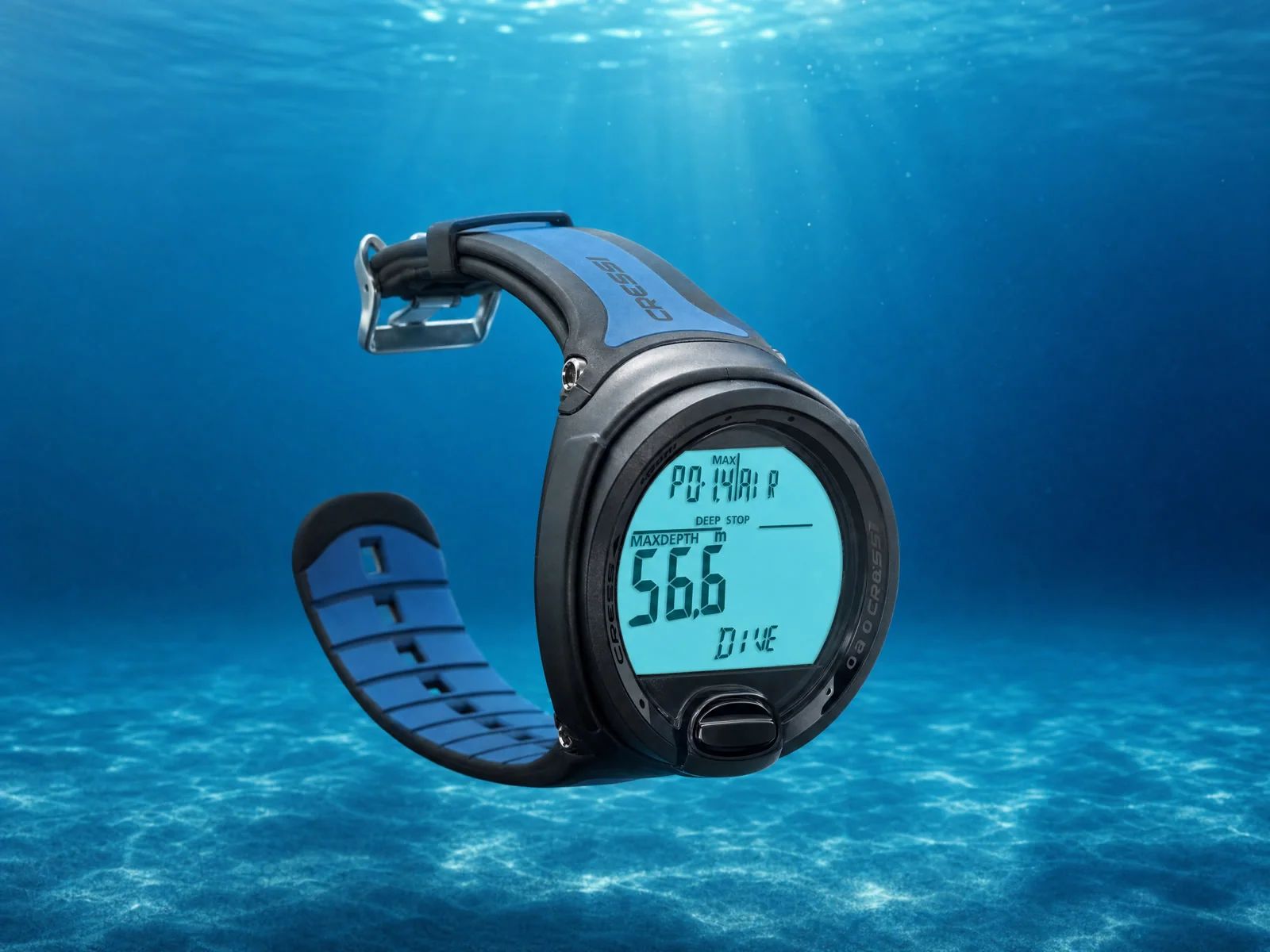
What is the difference between the Cressi Leonardo and the Donatello?
The Donatello is the direct successor to the Leonardo. It offers a slightly more readable screen, a refined housing, and optional Bluetooth connectivity, whereas the Leonardo is limited to an older infrared or USB connection.
Can the Cressi Leonardo handle Nitrox?
Yes, it manages a single gas supply with an adjustable oxygen percentage- from 21% for air to 50% for Nitrox- and allows adjustment of the partial pressure of oxygen between 1.2 and 1.6 bar.
Can I replace the battery in the Cressi Leonardo myself?
Yes, the dive computer uses a standard CR2430 button battery. The user can easily replace it themselves using a simple coin.
Learning to scuba dive is an adventure that challenges our terrestrial perspectives. During initial dives, a beginner's brain is flooded with new information.
They must manage their buoyancy, monitor their breathing, and adapt to a liquid environment that doesn't tolerate inattention. In this intense learning context, the equipment should fade into the background.
It is precisely with this goal of extreme simplification in mind that certain instruments have earned their legendary status over the decades. You can find them attached to the buoyancy compensators of students at training centers.
They provide reassurance through their familiar presence, basic design, and ability to withstand the handling errors inherent in a beginner's first experiences underwater.
The Cressi Leonardo undoubtedly belongs to this category of historical instruments. It defined the very concept of a starter product for an entire generation of enthusiasts.
Although now replaced by the Donatello in the main catalog of the Italian manufacturer, it continues to flood the second-hand market and clearance bins.
This test aims to objectively analyze its current capabilities. We will determine whether this older design with a single button still deserves a place on your wrist.The rapid technological advancements of recent years have redefined industry standards. High-definition color displays and customizable algorithms are now commonplace.
Faced with this wave of innovations, a basic monochrome computer may seem outdated. However, the reliability of a proven system still holds undeniable appeal for many divers.
Safety always takes precedence over equipment. A dive computer is an aid to decision-making, never an absolute guarantee. Its algorithm is a mathematical model, not an exact reflection of your physiology.
We will examine each aspect of this device to understand whether it still meets contemporary safety requirements.
Summary Verdict
Overall Score: 3.0/5
Criterion
Score
What it means
Algorithm & decompression stops
3.4/5
The classic Cressi RGBM offers a very, very safe approach for recreational profiles.
Air & multi-gas
1.7/5
The bare minimum with the management of only one gas, either air or Nitrox up to 50%.
Screen & ergonomics
2.6/5
The display is so straightforward that the information is immediately visible, but the single button can be frustrating for navigation.
Battery life
3.7/5
Excellent power management combined with a CR2430 battery that the user can replace themselves.
Connectivity & app
2.6/5
An aging infrared interface to USB that requires the purchase of a specific cable sold separately.
Compass & instruments
2.1/5
The essential data for depth and time are present, but there is no compass or advanced freediving mode.
Durability & depth rating
3.5/5
A robust housing certified to 120 meters that can withstand the typical impacts found in training centers.
Detailed Analysis
Algorithm & decompression stops (3.4/5)
Decompression management is the core function of any dive computer. The Leonardo uses the proprietary Cressi RGBM algorithm.
This mathematical model was developed in collaboration with researcher Bruce Wienke and is known for its conservative approach.This algorithmic caution is a major asset for preventing decompression sickness in recreational divers who make multiple dives during a trip.
The Gradient Factors are not manually adjustable on this device. However, the system offers three configurable safety factors to adjust the calculations based on your level of fatigue.
The SF0 setting corresponds to the standard configuration for optimal conditions. The SF1 setting adds a margin of safety for more demanding dives or slight fatigue.
The SF2 setting is the most restrictive and is ideal for cold water or inverted dive profiles. The display focuses on essential information, showing the time until ascent and the depth of the mandatory decompression stop.
Alerts are both audible and visual for ascents that are too fast, exceeding ten meters per minute. A graphical alert also warns of oxygen toxicity.
This provides a solid, proven, and protective foundation for recreational dive profiles. However, the lack of fine-grained control over microbubble formation limits its use for technical divers.
Air & Multi-Gas (1.7/5)
Simplicity has its limitations when it comes to advanced planning. This device is a single-gas computer. You must configure it for either Air or Nitrox before entering the water.The oxygen percentage is adjustable from 21% to 50%. The partial pressure of oxygen adjusts between 1.2 and 1.6 bar. It is technically impossible to change gas underwater.
This limitation restricts its use to dives without gas changes. Trimix or rebreather modes are logically absent in this price range.
Air transmitter integration is also not available. This lack of integration does not affect our rating according to our reference framework for this entry-level category.
You must absolutely keep a classic analog pressure gauge on your regulator to monitor your gas supply.
For a beginner diver, this single-gas restriction is actually an added safety feature. It prevents complex handling errors underwater during initial explorations.
However, as soon as you want to optimize your decompression with a high-oxygen bailout cylinder, this computer will reveal its insurmountable limitations.
Screen & Ergonomics (2.6/5)
The visual interface uses a monochrome segmented LCD screen. The display intelligently organizes vital information with large numbers.
The readability is so straightforward that even with reduced visibility, essential data remains perfectly decipherable at a glance.A temporary backlight assists with visibility during night dives or in dark environments. However, the physical ergonomics are a major weakness of this model.
Navigation relies on a single mechanical button. A short press scrolls through the menus sequentially in one direction only.
A long press confirms a selection. If you miss the desired setting, you have to start the entire menu sequence over from the beginning.
This navigation logic requires patience, method, and understanding. It can be frustrating for those accustomed to modern touch interfaces.
Wearing thick gloves in cold water further complicates the operation of this single button. The pressure required to activate it demands a certain amount of force, which can become tedious.
Battery Life (3.7/5)
The basic electronics offer a clear advantage in terms of energy consumption. The Leonardo is a digital workhorse.
Its battery life is estimated at approximately two years or around fifty dives, depending on the use of the backlight and audible alarms.
A clearly visible battery gauge on the main screen allows you to anticipate the end of the power source's lifespan before traveling.
The device uses a standard CR2430 button cell battery. The waterproof compartment is designed to be opened by the user without requiring any special tools.A simple coin is all that's needed to unscrew the cover and perform the replacement. This technical independence provides immense relief for traveling divers.
It is no longer necessary to send the computer back to a service center for a simple maintenance task. This significantly reduces long-term operating costs.
However, it is crucial to strictly follow the cleaning instructions when changing the battery to prevent any destructive water ingress.
Connectivity & App (2.6/5)
The internal memory of the computer stores the history of approximately sixty dives or seventy hours of dive time.
Extracting this valuable data to a digital logbook reveals the age of the design. There is no native Bluetooth chip integrated into the housing.
To synchronize your profiles, you must acquire a specific interface sold separately. This base uses an infrared connection to the computer.
The transfer via Cressi's proprietary software is slow and has limited interoperability with modern third-party dive logbooks.
This is an outdated procedure at a time when wireless synchronization to a smartphone has become the absolute standard on cruise ships.
Analyzing your dive profiles therefore requires you to sit in front of a desktop computer with a cumbersome cable.Maintaining a digital dive log is an excellent practice for tracking your progress and analyzing your gas consumption over time.
This hardware limitation often discourages divers from keeping their digital dive logs updated regularly.
Compass & Instruments (2.1/5)
The instrumentation focuses exclusively on the primary function of decompression calculation. There is no integrated electronic compass to help you navigate the reef.
Freedivers will also not find a dedicated mode with ultra-fast depth sampling.
The device offers three operating modes: Air, Nitrox, and Gauge. The Gauge mode transforms the computer into a simple depth gauge coupled with a timer.
This mode is useful for technical divers who calculate their decompression using dive tables or as a backup system.
A temperature sensor displays the water temperature continuously throughout the dive to monitor your thermal comfort.
Underwater orientation is a fundamental skill that requires regular practice. Using a traditional analog compass remains the most reliable method for learning the basics of navigation.
The absence of a digital compass will require you to invest in a separate analog compass for your underwater orientation exercises.
Durability & Depth Rating (3.5/5)The housing, made of a high-tech polymer, is incredibly robust. It's thick, solid, and designed to withstand harsh conditions.
The marine environment is particularly challenging for precision electronics. Saltwater, sand, sunlight, and thermal shocks put materials under extreme stress.
Dive centers appreciate its ability to survive impacts against boat ladders and accidental drops on the deck.
The maximum operating depth is certified at 120 meters. This provides a huge safety margin for an instrument intended for recreational diving.
The LCD screen is protected by the housing structure, but the glass can still be scratched if it's not covered with its transparent plastic protector.
It is strongly recommended to keep this removable protector in place to preserve the long-term readability of your investment.
The elastomer strap is strong and long enough to fit comfortably over a thick drysuit without requiring an extension.
Price & Customer Service (4.1/5)
The price point is a major selling point for this model, which is nearing the end of its commercial life. It's often found at discounted prices, typically around 150 to 180 euros new.
The used market offers even lower prices. This makes it an unbeatable financial entry point for equipping yourself with a personal safety device.Cressi's after-sales service is a long-standing European company with local presence in Italy and Spain. The support is good, and spare parts are readily available.
However, the manufacturer applies strict warranty conditions. A malfunction caused by user error will receive very little tolerance from the after-sales department.
The availability of spare parts such as straps or screen protectors is guaranteed for many years to come.
Who is this computer for?
The Cressi Leonardo is primarily aimed at recreational divers at level 1 with a very limited budget. It's the typical instrument for beginner divers.
Choosing your first dive computer often influences a diver's progress. It's crucial to define your medium-term goals before making a purchase.
It's perfect for those who are looking for a basic, durable tool and who are content with diving on air or simple Nitrox during their annual vacations.
Conversely, this model is not ideal for regular divers who want to progress towards multi-gas decompression dives.
Those who enjoy analyzing their dive profiles on their smartphone as soon as they return to the boat will be deeply frustrated by the lack of Bluetooth connectivity.
Finally, if you are impatient with digital interfaces, the single-button navigation may quickly become frustrating.
After-Sales Service and SupportThe longevity of a material investment largely depends on the quality of technical support provided by the manufacturer. Cressi has a well-established European after-sales service.
This geographical proximity from Italy and Spain allows for generally reasonable processing times for repairs and servicing.
However, it is important to remember that the brand applies strict policies regarding warranty conditions.
The technicians show little tolerance for failures resulting from user negligence.
Water damage caused by improperly replacing a battery or due to a dry O-ring will always be charged.
This rigor requires the owner to be meticulous, attentive, and cautious during routine maintenance procedures.
The network of authorized dealers is extensive, which facilitates initial support for your equipment in case of proven malfunctions.
Power Supply
Power management is a key factor for peace of mind during extended trips. The choice of a user-replaceable CR2430 button battery is a very relevant technical decision.
Battery life is often underestimated when purchasing. However, a battery failure in the middle of a dive trip can ruin your vacation if you do not have an immediate replacement solution.You are not dependent on a proprietary charger or an available power outlet on a cruise ship.
Simply slip one or two spare batteries into your dive bag to ensure your instrument functions even in the most remote locations.
Replacement takes only a few minutes with a simple coin.
It is important to work in a dry, clean, and well-lit environment to ensure that no grains of sand compromise the seal of the O-ring.
Applying a tiny amount of silicone grease to the new O-ring is recommended to ensure a perfect seal when closing the compartment.
If you are attracted to the philosophy of this Italian brand but the limitations of the Leonardo hold you back, other options are available within the catalog.
The direct successor is the Donatello, which modernizes the display and finally introduces the long-awaited Bluetooth connectivity.You can find our detailed review of this model on our Cressi Donatello test page.
For those who absolutely refuse to use a single-button system, the manufacturer offers more ergonomic alternatives.
The Giotto, for example, features three buttons for smooth navigation through menus, while still incorporating the secure RGBM algorithm.
Feel free to consult our Cressi Giotto test page to see if this ease of use justifies the additional cost.
Dive Computer Comparison Tool
Understanding decompression is far more important than knowing which button to press. Mastering your dives requires knowledge, practice, and continuous self-evaluation.