AquaExposure
Homepage
Pricing
Menu
Homepage
PricingShopArticles
AquaExposure

Underwater photography excellence, accessible to everyone.

Explore

  • Discover AquaExposure
  • Kai_App
  • Underwater Photo
  • AI Training with SAGE
  • Free Guide
  • All modules
  • Shop
  • Subscriptions
  • Articles
  • Manifest
  • About
  • PDC Simulator
  • Smartphone Housing Comparator
  • Partners
  • Frequently Asked Questions

Diving in Belgium

  • Training from Brussels
  • Training in Belgium
  • Photo in Zealand
  • Careers in Belgium

Stay in touch

Stay informed about our new courses and expeditions.

  • [email protected]
  • Contact
  • New items
  • Support the project
Legal Notices·CGV·Confidentiality·

© 2026 AquaExposure. Ethically preserving the depths.

Cressi Michelangelo Review: Is This a Budget-Friendly Multi-Gas Option?
Table of Contents
  • 01Introduction
  • 02The Verdict in Summary
  • 03Detailed Analysis
  • 04Algorithm & decompression stops (4.1/5)
  • 05Air & multi-gas (2.2/5)This is a key feature of this model: the ability to record two gas mixtures. You can dive with air at depth and switch to a richer Nitrox mix at shallower depths, and the Michelangelo will recalculate your decompression in real time. Air integration is not offered on this unit.
  • 06Screen & Ergonomics (2.9/5)
  • 07Battery Life (3.8/5)
  • 08Connectivity & App (3.4/5)
  • 09Compass & Instruments (3.2/5)
  • 010Durability & Depth Rating (3.7/5)The Michelangelo inspires confidence. Its housing incorporates a chrome-plated brass ring. This is not just for aesthetics- it provides significant protection against impacts from the blocks or the boat's ladder.
  • 011Price & Customer Service (4.2/5)
  • 012Who is this computer for?
  • 013Customer Service & Support
  • 014Power SupplyAutonomy is a crucial factor for any diver. The Cressi Michelangelo uses a CR2450 battery, which can be easily replaced by the user. This feature is a major advantage, especially during extended cruises where access to an electrical outlet to recharge a built-in battery may be limited. The ability to change the battery yourself, without special tools, provides peace of mind and great flexibility for long trips or consecutive dives. It's always wise to have a spare battery in your equipment kit- a small precaution that can prevent many inconveniences underwater.
  • 015Links to other models from the same brandIf the Michelangelo has caught your attention, it is worth exploring other offerings from Cressi. Each model in the Cressi range is designed with its own philosophy, meeting specific needs. For a simpler approach, the [Cressi Donatello](/blog/test-cressi-donatello) could be an excellent starting point. If your ambitions lead you towards more technical horizons, other Cressi computers offer advanced features for even the most demanding dives. Do not hesitate to consult our detailed product pages to find the ideal companion for your underwater explorations.
  • 016Learn More
Gear 6 minBenjamin Coste

Cressi Michelangelo Review: Is This a Budget-Friendly Multi-Gas Option?

Complete review of the Cressi Michelangelo dive computer. Analysis of the Cressi RGBM algorithm, dual-gas management, screen features, and its replaceable battery.

To learn how to get the most out of your underwater equipment, discover the AquaExposure training program.

Introduction

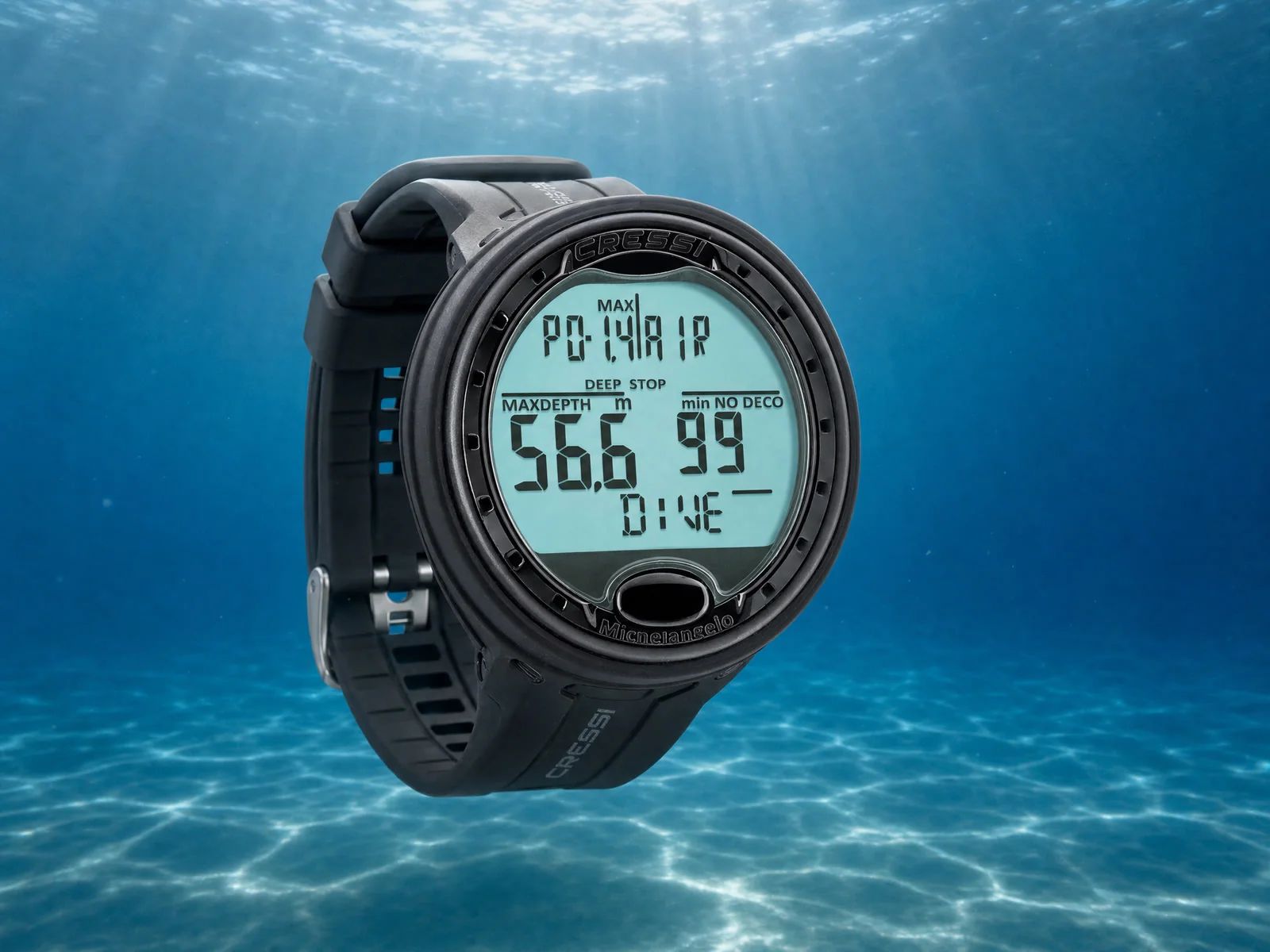
Often, after completing their initial certification and purchasing an entry-level dive computer, divers find themselves limited when they want to begin a "Certified Nitrox" course that requires a decompression block. The Cressi Michelangelo aims to overcome this limitation. Keep in mind the fundamental principle: a dive computer is not just a timer for your dives, it's the tool that manages your decompression safety. A direct evolution of the Donatello platform, the Michelangelo retains a very robust round casing but hides a more powerful processor under its screen, and most importantly, the ability to manage a second gas. This test aims to determine if this model is a coherent and safe choice for recreational divers who are beginning to explore accelerated decompression.

The Verdict in Summary

Overall Score: 3.3/5CriterionScoreWhat it means
Algorithm & decompression stops4.1/5Cressi RGBM algorithm, a safe but non-adjustable Gradient Factors model.
Air & multi-gas2.2/5Management of two switchable gases, but no Trimix, CCR, or air management features.
Screen & ergonomics2.9/5Large and readable screen, but single-button navigation can sometimes be cumbersome.
Battery life3.8/5User-replaceable CR2450 battery offering long battery life.
Connectivity & app3.4/5Bluetooth connection possible via an external paid interface.
Compass & instruments3.2/5No integrated electronic compass, but a complete freediving mode is available.
Robustness & depth rating3.7/5Solid housing protected by a resistant metal bezel.
Price & customer service4.2/5Excellent entry-level price for multi-gas functionality with reliable customer service.

Detailed Analysis

Algorithm & decompression stops (4.1/5)

The Michelangelo is based on the Cressi RGBM algorithm, a two-phase model based on the classic Wienke RGBM. Known for penalizing inverted profiles and excessively fast ascents, it provides a safety guarantee for successive dives. The conservatism levels allow you to adapt the decompression stops to your physical condition.

Air & multi-gas (2.2/5)This is a key feature of this model: the ability to record two gas mixtures. You can dive with air at depth and switch to a richer Nitrox mix at shallower depths, and the Michelangelo will recalculate your decompression in real time. Air integration is not offered on this unit.

Screen & Ergonomics (2.9/5)

Underwater, the information is perfectly segmented and readable thanks to the large, high-contrast screen. However, switching between gases at 20 meters depth using a long press / short press on the single stainless steel button requires dexterity and practice.

Battery Life (3.8/5)

Cressi has optimized the processor to minimize battery consumption of the CR2450 battery. You should be able to get through a year of intensive diving, and replacement is quick, taking only a few minutes with a simple coin.

Connectivity & App (3.4/5)

As with the rest of this Cressi range, synchronization with your smartphone is not native. The computer has the necessary connectors, but you need to purchase a separate Bluetooth interface to download your digital dive log.

Compass & Instruments (3.2/5)

The absence of an electronic compass keeps the price low, so you will need to keep a compass on your console or wrist. However, the Free/Apnea mode is very comprehensive and appreciated by those who alternate between disciplines.

Durability & Depth Rating (3.7/5)The Michelangelo inspires confidence. Its housing incorporates a chrome-plated brass ring. This is not just for aesthetics- it provides significant protection against impacts from the blocks or the boat's ladder.

Price & Customer Service (4.2/5)

At this price, it's one of the few high-quality multi-gas dive computers that doesn't require you to mortgage your regulator. Add to that a customer service department known for its efficiency in Europe, and the investment becomes very reasonable.

Who is this computer for?

This model is aimed at a specific audience- those who value a balance between performance and affordability. It's essential to understand your needs before making an informed choice.

Customer Service & Support

Regarding customer service, Cressi has a solid reputation. Good European local support (Italy/Spain). They are strict about warranty conditions (user-caused failures = little tolerance).

Power SupplyAutonomy is a crucial factor for any diver. The Cressi Michelangelo uses a CR2450 battery, which can be easily replaced by the user. This feature is a major advantage, especially during extended cruises where access to an electrical outlet to recharge a built-in battery may be limited. The ability to change the battery yourself, without special tools, provides peace of mind and great flexibility for long trips or consecutive dives. It's always wise to have a spare battery in your equipment kit- a small precaution that can prevent many inconveniences underwater.

To find out which battery to buy for this computer, check out our complete guide on dive computer batteries. To learn how to change the battery yourself step by step without risking damage, read our complete tutorial on how to change your own battery.

Links to other models from the same brandIf the Michelangelo has caught your attention, it is worth exploring other offerings from Cressi. Each model in the Cressi range is designed with its own philosophy, meeting specific needs. For a simpler approach, the Cressi Donatello could be an excellent starting point. If your ambitions lead you towards more technical horizons, other Cressi computers offer advanced features for even the most demanding dives. Do not hesitate to consult our detailed product pages to find the ideal companion for your underwater explorations.

Learn More

To compare this computer with other models, visit our dive computer comparison tool.

© 2026 AquaExposure. All rights reserved. Reproduction prohibited without authorization.

Share

/blog/test-cressi-michelangelo-en

Table of Contents

  • 01Introduction
  • 02The Verdict in Summary
  • 03Detailed Analysis
  • 04Algorithm & decompression stops (4.1/5)
  • 05Air & multi-gas (2.2/5)This is a key feature of this model: the ability to record two gas mixtures. You can dive with air at depth and switch to a richer Nitrox mix at shallower depths, and the Michelangelo will recalculate your decompression in real time. Air integration is not offered on this unit.
  • 06Screen & Ergonomics (2.9/5)
  • 07Battery Life (3.8/5)
  • 08Connectivity & App (3.4/5)
  • 09Compass & Instruments (3.2/5)
  • 10Durability & Depth Rating (3.7/5)The Michelangelo inspires confidence. Its housing incorporates a chrome-plated brass ring. This is not just for aesthetics- it provides significant protection against impacts from the blocks or the boat's ladder.
  • 11Price & Customer Service (4.2/5)
  • 12Who is this computer for?
  • 13Customer Service & Support
  • 14Power SupplyAutonomy is a crucial factor for any diver. The Cressi Michelangelo uses a CR2450 battery, which can be easily replaced by the user. This feature is a major advantage, especially during extended cruises where access to an electrical outlet to recharge a built-in battery may be limited. The ability to change the battery yourself, without special tools, provides peace of mind and great flexibility for long trips or consecutive dives. It's always wise to have a spare battery in your equipment kit- a small precaution that can prevent many inconveniences underwater.
  • 15Links to other models from the same brandIf the Michelangelo has caught your attention, it is worth exploring other offerings from Cressi. Each model in the Cressi range is designed with its own philosophy, meeting specific needs. For a simpler approach, the [Cressi Donatello](/blog/test-cressi-donatello) could be an excellent starting point. If your ambitions lead you towards more technical horizons, other Cressi computers offer advanced features for even the most demanding dives. Do not hesitate to consult our detailed product pages to find the ideal companion for your underwater explorations.
  • 16Learn More

Questions about the Journal

Can the Cressi Michelangelo regulator be used with Nitrox?

Yes, it allows you to configure and use up to two different Nitrox mixes (from 21% to 99% oxygen) during dives, with real-time switching.

How do I change the battery in a Cressi Michelangelo?

It uses a CR2450 button battery, which you can easily replace yourself using a simple coin to open the compartment.

Does the Michelangelo have Bluetooth connectivity?

Bluetooth connectivity is available, but it requires the purchase of an external hardware interface sold separately by Cressi.

Can the Cressi Michelangelo be used for freediving?

Yes, it offers a comprehensive dedicated Freediving mode for tracking freedives, in addition to its Air, Nitrox, and deep dive modes.