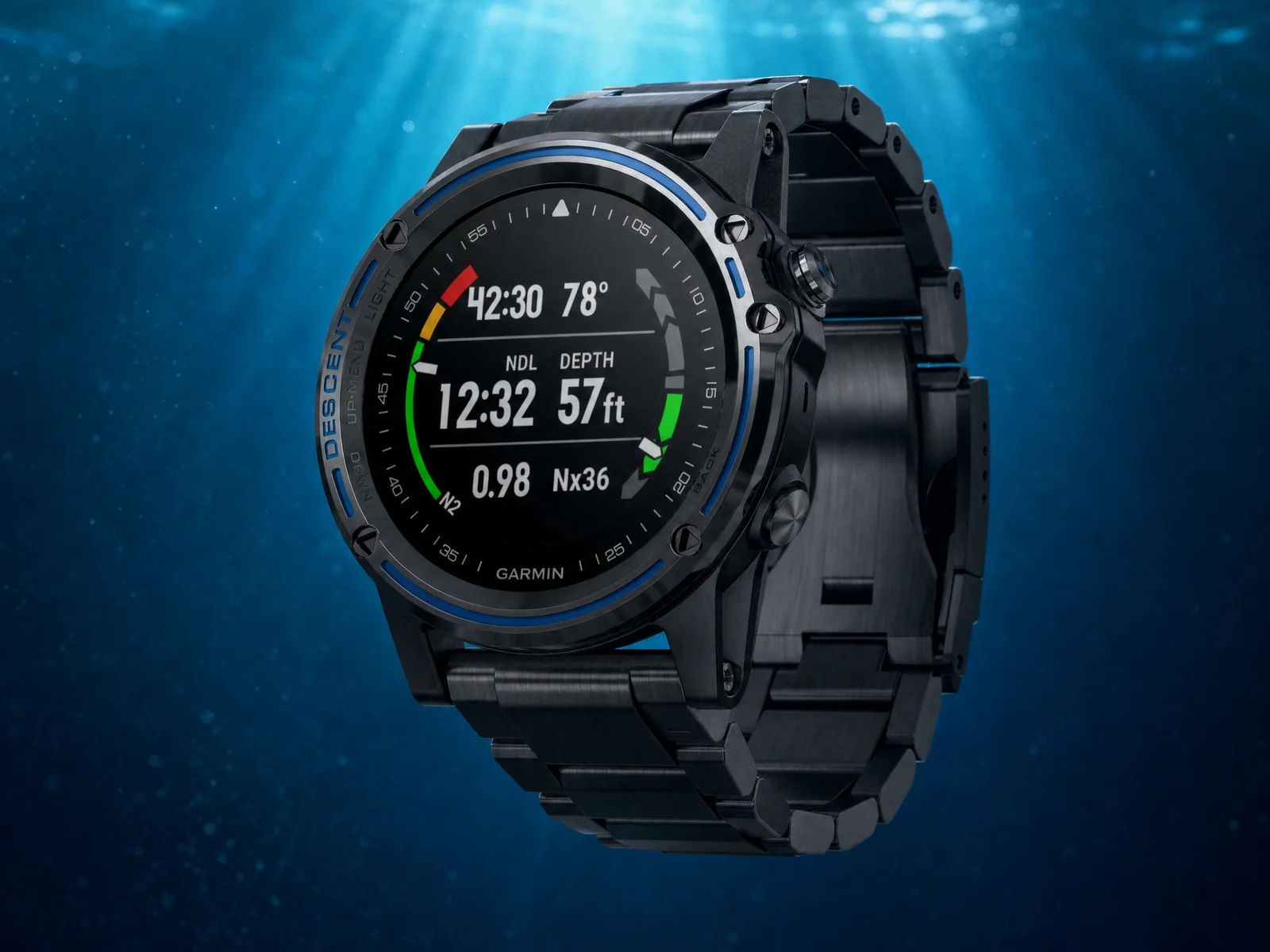
Garmin Descent Mk1 Review- The pioneering dive computer now available on the used market.
Our technical review of the Garmin Descent Mk1. Find out if this first-generation Trimix dive computer remains a relevant option on the used market compared to newer models.
Does the Garmin Descent Mk1 have integrated air integration?
No, this first generation of the Descent series does not have the hardware technology to connect to a wireless pressure transmitter.
Is it risky to buy this used computer?
The main risk concerns the lithium-ion battery. Since it cannot be replaced by the user, a model that is several years old and has undergone many charging cycles will have lost some of its battery life.
Can the software of the Mk1 be updated?
Yes. Although Garmin no longer releases major new features for this model, previous stability updates are still available for download through the Garmin Express application.
Does the glass scratch easily?
It all depends on the edition. The Titanium version features a sapphire crystal that is almost scratch-proof, while the standard Silver version has a domed mineral glass which is much more susceptible to scratches, especially when diving on wrecks.
Time inevitably changes our perception of the technological devices that accompany us below the surface.
We often tend to chase after the latest novelty that promises to transform our dives with ever more features.
However, a dive computer is not just an electronic gadget that we replace according to trends or seasons.
It is the silent guardian of our safety, calculating our tissue saturation at every moment of our dive.
It is a critical tool that demands rigor, consistency, and self-control.
The Garmin Descent Mk1 marked a significant turning point when it appeared on the market in 2017.
It proved that an everyday watch could house a real algorithmic engine designed for the most demanding technical divers.
Today, largely replaced by the Mk2 and Mk3 series, this model floods the second-hand platforms at particularly attractive prices.
It then becomes legitimate to wonder whether this pioneer still retains its relevance in the face of current demands of our underwater practice.
We will dissect its technical characteristics to understand what it still has to offer today's divers.The goal is to determine whether purchasing this used equipment represents a great opportunity or an unnecessary risk to your safety.
The Verdict: A Summary
Here is our overall assessment based on the AquaExposure analysis framework.
The overall score achieved is 4.5/5.
Criterion
Score
What it means
O1 Algorithm
5.0/5
The unlocked Bühlmann ZHL-16C engine with Gradient Factors offers timeless safety.
O2 Air & Multi-Gas
4.6/5
Complete management of six gases, including Trimix, and a very efficient native CCR mode.
O3 Screen & Ergonomics
3.9/5
A 1.2-inch color MIP display controlled by five highly effective physical buttons.
O4 Battery Life
4.6/5
A rechargeable battery that claims to offer forty hours of theoretical use, requiring careful monitoring when purchased used.
O5 Connectivity & App
4.5/5
Perfect Bluetooth and Wi-Fi synchronization with the current Garmin Dive ecosystem.
O6 Compass & Instruments
5.0/5
Sensors of remarkable precision, including a three-dimensional electronic compass.
O7 Robustness & Depth Rating
4.5/5
Certified to one hundred meters, with a choice between mineral glass and sapphire crystal depending on the edition.
O8 Price & Customer Support
Detailed Analysis
O1 Algorithm and Decompression StopsThe software power of this model was already present from its initial design by the brand's engineers.
The Garmin Descent Mk1 relies on the well-known Bühlmann ZHL-16C algorithm, which has proven itself for decades.
This mathematical model simulates the saturation and desaturation of sixteen theoretical tissue compartments in our body.
It offers Gradient Factors that are fully adjustable by the diver to adjust the conservatism of decompression.
The low Gradient Factor allows forcing deep stops to control the growth of microbubbles.
The high Gradient Factor defines the safety margin when reaching the surface.
This complete openness allows you to adapt the decompression profile to your physiology and the specific conditions of your dive.
The live display of the decompression ceiling and the Time To Surface is perfectly clear underwater.
Alerts are configurable to notify you of each stop with a proven reliability that needs no further demonstration.
It's such a precise calculation engine that even the most demanding technical divers place complete trust in it.
The transparency of the algorithm allows you to plan your dives with remarkable mathematical precision.
Logically, it receives the maximum score of 5.0/5 on this fundamental criterion for our safety.
O2 Air and multi-gasThe gas versatility of this instrument remains impressive, even several years after its initial release.
It can manage up to six different gases, including Air, Nitrox, and Trimix blends for deep dives.
This capability allows you to carry a bottom gas, travel gases, and multiple hyper-oxygenated decompression gases.
Divers using closed-circuit systems will appreciate the presence of a native CCR mode that is perfectly integrated into the system.
You can configure your partial pressure oxygen setpoints and plan your open-circuit bailout scenarios.
However, it's important to note the complete lack of air integration in this first generation of wrist-mounted computers.
The device is physically unable to communicate with a wireless pressure transmitter attached to your first stage regulator.
Therefore, you will absolutely need to keep a traditional mechanical pressure gauge to monitor your gas supply.
This technical limitation prevents real-time consumption calculations and estimations of remaining dive time based on gas usage.
This explains the score of 4.6/5 for this aspect of our evaluation.
O3 Screen and Ergonomics
The visual interface relies on a transflective Memory In Pixel color screen with a diameter of 1.2 inches.
This technology uses ambient light to illuminate the pixels of the display.
It offers very good readability near the surface and under strong tropical sunlight.The major advantage of this technology is its very low energy consumption compared to traditional backlit displays.
Navigation through the menus is done via five physical buttons that respond perfectly under water pressure.
Garmin has also integrated a tap-to-screen function for changing data pages during dives.
This feature is so convenient that even with thick gloves, you can navigate without any difficulty.
The data fields are fully configurable to display exactly the information you need.
The screen doesn't have the brightness of modern AMOLED panels but it compensates with excellent reflection management.
This technological compromise justifies the overall ergonomics score of 3.9/5.
O4 Battery Life
Power management relies on a rechargeable lithium-ion battery integrated directly into the housing.
The manufacturer announced a battery life of forty hours in dive mode when the device was released.
The gauge displayed as a percentage allows you to precisely track the remaining power before each dive.
The resistance to cold is excellent, and the battery does not suddenly fail in the icy waters of quarries.
However, wear and tear over time remains a critical factor that must be carefully evaluated, especially for used models.A battery that has undergone many charge cycles will inevitably lose some of its initial capacity.
Unlike computers powered by user-replaceable batteries, you are dependent on the health of this sealed accumulator.
This criterion receives a score of 4.6/5, which reflects its theoretical capabilities when it leaves the factory.
O5 Connectivity and Application
Integration into the modern digital ecosystem is an undeniable strength of this device.
The device has Bluetooth and Wi-Fi protocols for seamless communication with your other devices.
Synchronization with the Garmin Dive application is completely transparent as soon as you surface.
Software updates are easily installed via a computer or smartphone connected to the network.
Exporting your dive profiles allows for detailed analysis of your immersion parameters.
You can review your depth profile and analyze your ascent rates with great precision.
The application also centralizes physiological data collected outside of the water, providing a comprehensive view of your physical condition.
This flawless connectivity earns it a very good score of 4.5/5 in our evaluation grid.
O6 Compass and Instruments
The onboard sensors demonstrate the brand's historical expertise in land and marine navigation.The three-axis compensated electronic compass offers exceptional fluidity underwater.
A traditional compass will lock if you don't keep it perfectly horizontal.
This three-dimensional model guides you with surgical precision, even if your wrist is tilted while finning.
The barometric altimeter and temperature sensor significantly enhance the data in your dive profile.
The optical heart rate sensor complements this array of physiological measurements, providing readings directly on your wrist.
The dedicated freediving mode fully utilizes this advanced instrumentation to analyze your performance when holding your breath.
It's a flawless technological achievement that thoroughly deserves its 5.0/5 rating.
O7 Durability and Depth Rating
The physical construction of the device inspires immediate confidence from the moment you hold it.
It is certified for dives up to one hundred meters in depth, according to the European standard EN13319.
This standard guarantees the accuracy of depth and time measurements under extreme pressure conditions.
The choice of materials varies depending on the editions available on the second-hand market.
You will find versions with a domed mineral glass or a much more scratch-resistant sapphire crystal.
The overall robustness of the casing easily withstands the impacts inherent in our activity, especially when working on boats.The buttons are designed to withstand the accumulation of salt and sediment over time.
This robust and durable design is reflected in a rating of 4.5/5.
Price and Customer Support
The current price point significantly changes how you might perceive this instrument.
Originally launched around one thousand euros, it now sells for between four hundred and six hundred euros online.
This represents an extremely attractive value proposition for accessing the advanced Trimix features.
Garmin's customer support continues to monitor these older models in case of technical issues.
However, this is a support system for a large consumer electronics multinational that handles millions of devices.
Replacement under warranty is possible if a fault is recognized by their service department.
The process can often be frustrating, with representatives who are not specialized in scuba diving.
Processing times and return shipping costs, which are your responsibility, should also be considered.
The original two-year warranties have generally expired on the used market.
These factual points justify the rating of 3.6/5 for this particular evaluation criterion.
Who is this computer for?
This model is primarily intended for technical divers or recreational divers who want to advance their skills.It is perfectly suited for those with a limited budget but who absolutely refuse to compromise on algorithmic performance.
This is the ideal tool for divers who are willing to use a traditional mechanical pressure gauge without feeling frustrated.
Here, you will find an ultra-complete computer capable of supporting your progression towards deep diving using mixed gases.
However, this device is not intended for users who require state-of-the-art wireless air management features.
It will also disappoint those seeking a large screen with vibrant colors to compensate for near vision problems.
Divers who want the absolute peace of mind that comes with a brand new battery under warranty should look elsewhere.
Service and Support
The manufacturer's technical support deserves special attention when purchasing on the used market.
Garmin operates according to the standards of a multinational consumer electronics company on a global scale.
The support network is vast, but often lacks specialization in our field of activity.
The representatives are not always experts in the specific constraints related to hydrostatic pressure.
Return procedures can be lengthy and often require you to pay for shipping costs to their centers.
Keep in mind that first-generation models no longer have any legal warranty coverage.Any repairs not covered by the warranty will be subject to a quote, which can sometimes exceed the actual value of the item itself.
This is a factual consideration to keep in mind before finalizing a transaction between private individuals.
Power Supply
The issue of power is crucial when considering buying used electronic equipment.
The Garmin Descent Mk1 has a lithium-ion battery sealed inside its waterproof housing by the factory.
This design prevents users from replacing the battery if it fails or loses capacity.
A battery that has undergone hundreds of charge cycles over several years will inevitably lose some of its storage capacity.
The initial battery life of forty hours can decrease significantly over time and with repeated dives.
This requires increased vigilance during liveaboard trips, where recharging is frequent and sometimes complicated.
You may be forced to plug the device in between dives during an intensive training day.
Always ask the seller for visual proof of the remaining battery life before committing to a purchase.
A simple test involves checking the percentage lost after one hour of GPS activity on land in running mode.
Links to other models from the same brand
Technological advancements never stop, and the manufacturer's product line has continued to expand over the years.If you are looking for air integration and a larger screen, you can check out our review of the next generation models.
Discover our detailed test of the Garmin Descent Mk2, which addresses several shortcomings of the initial model.
For those who want the ultimate in current technology with an ultra-bright AMOLED screen, the latest version is fascinating.
Read our complete review of the Garmin Descent Mk3 to understand the progress made by the engineers.