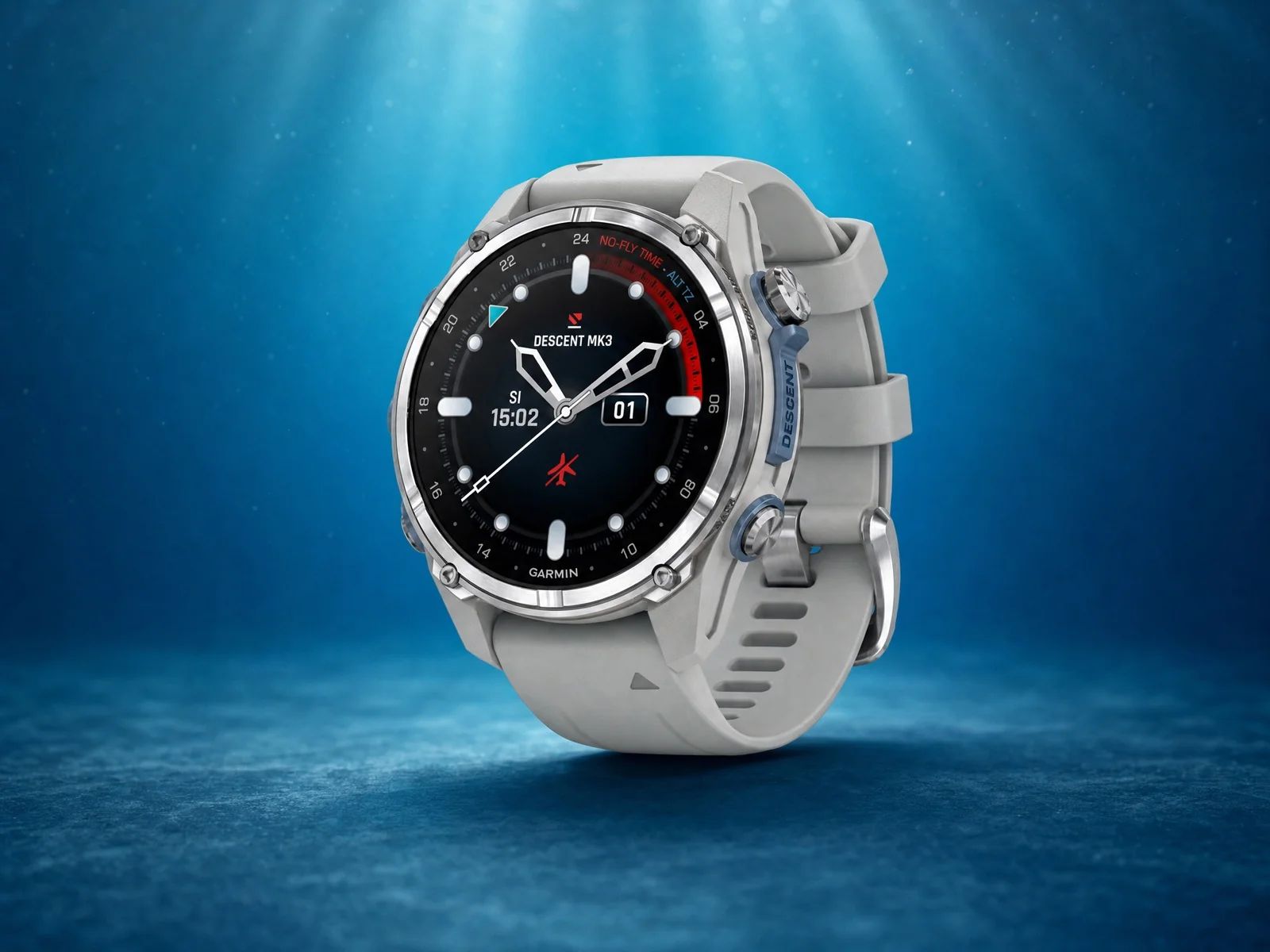
Garmin Descent Mk3 Review- The Perfect Compromise Without Air Integration?
Technical review of the Garmin Descent Mk3 (43mm). A Trimix dive computer with a super-bright AMOLED screen, certified to 200m, that doesn't include integrated air integration.
No. The standard Mk3 model does not include the SubWave antenna. If you want integrated air functionality, you must choose the Mk3i version when purchasing.
Is the 43mm screen large enough to read the dive profile?
The display size of 1.2 inches is objectively small. However, the AMOLED technology offers absolute contrast, which largely compensates for this reduced size in dark underwater environments.
Observing divers preparing for a deep dive often reveals difficult choices. Do you sacrifice readability for compactness (and consider the weight), or pay for air management features that you may never use? The Garmin Descent Mk3 attempts to address this dilemma. Within this compact 43-millimeter case, the manufacturer has packed its most powerful software engine and a vibrant AMOLED screen, while deliberately removing wireless sensor technology. A dive computer is the tool that manages decompression safety on every dive. This review aims to determine whether this model, which is lighter in electronics but certified for depths of 200 meters, represents the ideal compromise for traditional technical divers.
2. The Verdict: Summary
Overall Score: 4.6/5
Criterion
Score
What it means
Algorithm & decompression stops
5.0/5
The unlocked Bühlmann ZHL-16C engine, the current standard.
Air & multi-gas
5.0/5
From basic nitrox to heavy trimix, it handles everything.
Screen & ergonomics
4.6/5
The 1.2-inch AMOLED screen is amazing at night.
Battery life
4.6/5
The promised 30 hours ensures it will last for a long technical diving weekend.
Connectivity & app
4.5/5
Ultra-sophisticated smartphone app and instant synchronization.
Compass & instruments
5.0/5
The integrated 3-axis compass is incredibly smooth.
Robustness & depth rating
5.0/5
Sapphire glass and a manufacturer's certification to 200 meters.
Price & customer service
3.8/5
Nearly €1150, a premium price for a device without integrated air integration.
3. Detailed Analysis
Algorithm & decompression stops: Total control
Like the entire Descent series, the Mk3 incorporates the Bühlmann ZHL-16C algorithm. This maximum score guarantees that you are not locked into a black box. The ability to adjust Gradient Factors gives you complete control over your decompression profile, a non-negotiable feature for serious diving. The full display of TTS (Time To Surface), deep stops, and ceiling is continuous and extremely accurate.
Update, August 24, 2026: Garmin rolled out firmware 27.16 across the whole Mk3 and Mk3i line. It adjusts two secondary safety thresholds based on Divers Alert Network guidance and a 2025 study (Hoyt et al.): the central nervous system toxicity threshold is raised between 1.20 and 1.30 PO2, and in-dive alert popups are removed in favor of a data field you can check on demand. Oxygen toxicity unit limits are recalculated to account for consecutive diving days. The Bühlmann engine and its score are unchanged.
Air, multi-gas, and the lack of wireless connectivityThis model handles all gas mixtures, from Nitrox to Trimix, and includes a dedicated mode for rebreathers (CCR). The key feature of the standard Mk3 is the absence of an air inlet module. This means it cannot be connected to a probe. This is a deliberate design choice to reduce costs.
Screen & Ergonomics: AMOLED in 43 millimeters
The switch to AMOLED technology dramatically changes the underwater experience. The 30.4-millimeter (1.2-inch) display is small, but the deep blacks and vibrant colors boost contrast significantly. The readability is so clear that even with thick gloves, the information is easily visible. The touchscreen is complemented by 5 physical buttons for flawless operation.
Battery Life: Long-lasting Performance
The rechargeable lithium-ion battery offers an advertised runtime of 30 hours in dive mode. This is enough to cover a long weekend of technical diving without having to search for a power outlet between each dive. The percentage-based battery indicator is reliable, even in the cold waters of Belgian quarries.
Connectivity & App: The Garmin Ecosystem
Bluetooth and Wi-Fi connectivity enable over-the-air (OTA) updates and seamless synchronization with the Garmin ecosystem. The smartphone app is extremely comprehensive, allowing you to review your dive profiles with surgical precision.
Compass & Instruments: Smooth NavigationThe full-featured sensors include a barometric altimeter, a 3-axis compass (compensated 3D compass), and a heart rate sensor. The compass is incredibly smooth, making navigation easier on complex wrecks.
Robustness & Depth: A Subtle Evolution
Although its appearance resembles a dress watch, Garmin has significantly strengthened the design. This polymer chassis with a stainless steel bezel can withstand immense pressure, boasting a certified water resistance to a depth of 200 meters. The ultra-scratch-resistant sapphire glass protects the screen from inevitable scratches in confined environments.
Price & Customer Service: The Cost of Technology
Priced around €1150, this is a significant investment for a dive computer without air integration. The customer service offered by a large electronics company like Garmin provides a replacement if a failure is recognized under warranty. However, the process can often be frustrating due to interactions with non-diving specialists, lengthy delays, and potential out-of-pocket expenses. This doesn't affect the overall rating, but it's an important factor to consider.
4. Who is this computer for?
This computer is designed for technical divers who demand a bright display, a compact form factor, and who exclusively dive with mechanical gauges. It is ideal for those who value precision, repetition, and self-improvement in their diving practice.This computer is not ideal for divers looking for air integration or those who need a large console-style display. If you have difficulty with close-up vision, the 1.2-inch screen may be limiting.
5. Customer Service and Support
Garmin's customer support relies on the resources of a multinational corporation. In case of a recognized defect covered by warranty, replacement with a new unit is standard procedure. However, the process can sometimes be cumbersome. The initial customer service representatives are not always diving specialists, which can prolong the diagnostic process. Return shipping costs are typically borne by the customer. This is a structured service but sometimes lacks the personalized attention offered by brands exclusively dedicated to diving.
6. Power Supply
The Garmin Descent Mk3 is powered by a rechargeable lithium-ion battery. This technical choice requires proactive energy management. During extended dive trips, you will need to recharge it every two or three days, depending on the intensity of your dives. For daily use, recharging via the proprietary cable is quick and easily integrates into your equipment preparation routine.
7. Links to other models from the same brandIf you are drawn to the Garmin ecosystem but integrated air integration is a non-negotiable requirement for you, it's wise to consider the higher-end version. You can read our detailed review of the model with air management on the page Test Garmin Descent Mk3i: The AMOLED screen at the service of decompression. For those who prefer a larger format, the Mk2i model remains a relevant option to explore on >-.