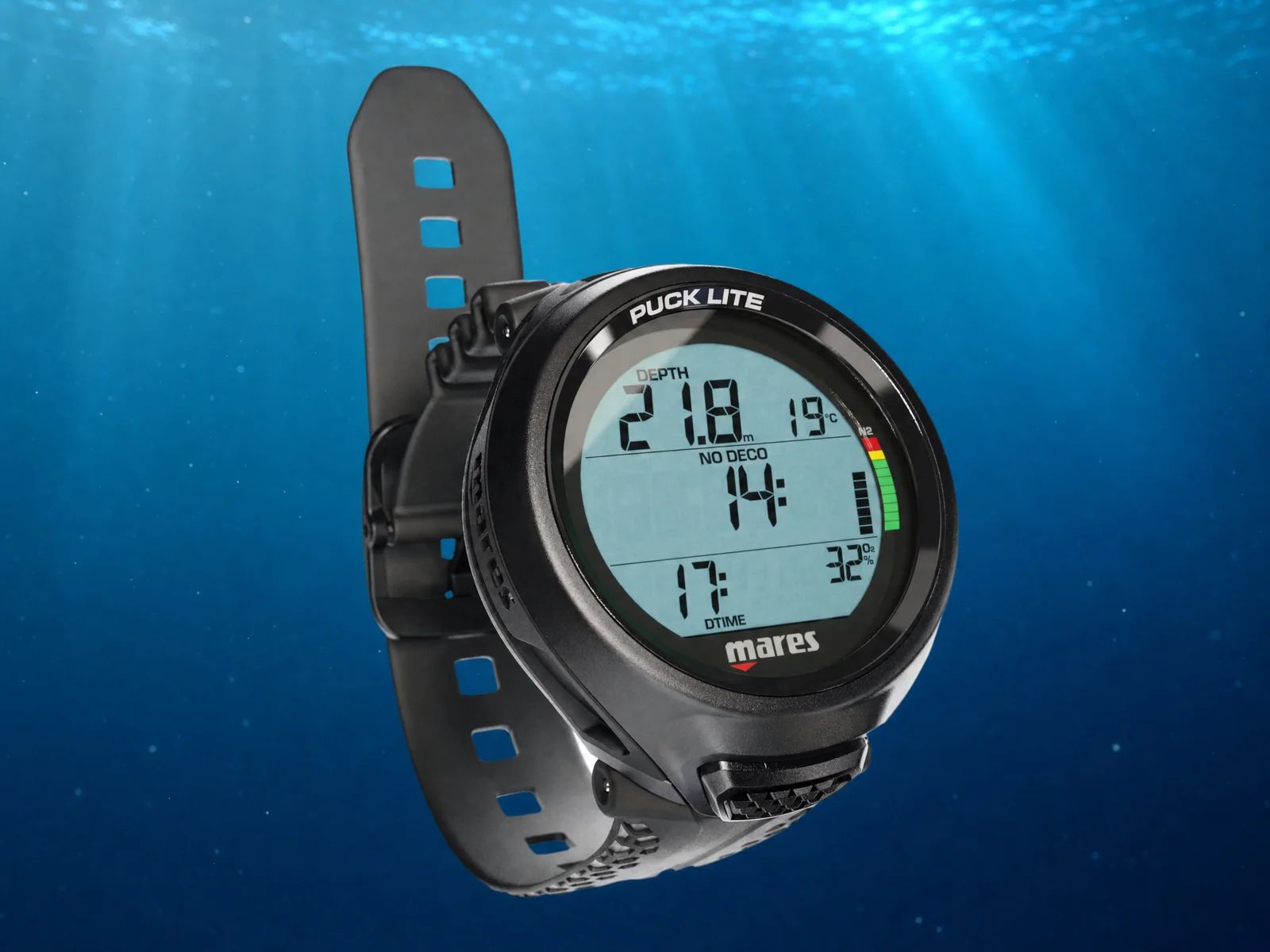
Yes, it handles Nitrox mixtures from 21% to 50% oxygen, which is ideal for standard recreational diving.
Can I change the battery myself?
Absolutely. It uses a standard CR2450 button cell battery that you can easily replace yourself.
How do I transfer my dive data to my phone?
The Puck Lite has built-in Bluetooth functionality. Simply use the Mares or SSI app on your smartphone to synchronize your dive log without any cables.
Choosing your first dive computer is often a pivotal moment in a diver's life. You look for simplicity, hope for reliability, and inevitably consider the price. The Mares Puck Lite enters the market with a clear promise: to offer essential safety features, along with modern connectivity, without breaking the bank. I have seen countless entry-level models come and go over the years, some too complex, others too limited. This model positions itself in a very specific niche: immediate accessibility. It doesn't aim to impress the technical diver, but rather appeals directly to those who want to get in the water with peace of mind. Let's analyze together what this small device truly offers, beyond its specifications.
2. The verdict in summary| Criterion | Score | What this means |
| :--- | :---: | :--- | | Algorithm & Decompression Stops | 4.1/5 | Reliable Bühlmann ZH-L16C model, but with only two pre-set Gradient Factor settings. | | Air & Multi-Gas | 1.5/5 | Strictly single-gas (Air or Nitrox up to 50%), no multi-gas or Trimix functions. | | Display & Ergonomics | 2.4/5 | Basic segmented monochrome LCD display, navigable via a single central button. | | Battery Life | 3.4/5 | CR2450 battery that is easy to replace yourself, rated for approximately one hundred dives. | | Connectivity & App | 5.0/5 | Native Bluetooth, a rare luxury at this price point for wirelessly syncing your dive log. | | Compass & Instruments | 2.5/5 | No electronic compass, focuses on essential data and a classic depth gauge mode. | | Durability & Depth Rating | 3.6/5 | Compact and reliable housing, certified to operate up to 150 meters. | | Price & Customer Support | 4.5/5 | An extremely aggressive price-to-performance ratio for beginners, supported by the Mares network in Europe. |
Overall Score: 3.3/5
3. Detailed Analysis
Algorithm and Decompression Stops
Decompression is handled by a modern engine, although it has been intentionally simplified to avoid overwhelming beginners with complex settings.
To learn more:The Puck Lite uses the Bühlmann ZH-L16C algorithm. Unlike the Puck 4, which offers more flexibility, it limits the user to two pre-set gradient factor options. However, it provides all essential functions for recreational safety with its ascent alerts.
Air and Multi-Gas
Designed specifically for basic recreational diving, it does not support advanced training requiring changes between decompression stages.
For more information:
This is a strictly single-gas computer. It manages air and Nitrox mixtures ranging from 21% to 50% oxygen, but does not allow configuration of a second gas. It does not support Trimix or wireless air pressure transmitters.
Display and Ergonomics
The segmented display remains a simple design. It offers excellent contrast in sunlight, at the expense of the visual clarity found in higher-end models.
For more information:
The LCD screen uses "chip-on-glass" technology with 800 segments for display. The interface is controlled entirely via a single button, which requires some getting used to with the "short click" and "long click" system, especially if you are diving with thick neoprene gloves.
Battery Life
This is a standard format that ensures you will never be caught without power far from an electrical outlet on a cruise ship.
For more information:Powered by a replaceable CR2450 button battery, Mares claims a lifespan of approximately 100 dives. The monochrome LCD screen, which consumes very little power, contributes to this longevity.
Connectivity and App
This entry-level device's real strength lies in its connectivity: it communicates with your phone instantly, without requiring any additional accessories.
For more information:
The Bluetooth module is standard. It synchronizes directly with the Mares or SSI app to transfer your dive log (with a capacity of 100 dives) and perform software updates (firmware) easily.
Compass and Instruments
It focuses on its primary mission of decompression calculation and leaves navigation to traditional analog instruments.
For more information:
It does not have an electronic compass. However, it includes a traditional depth gauge mode in addition to the Air and Nitrox modes.
Durability and Depth Rating
Don't be fooled by its "Lite" designation, its housing can withstand pressure like a professional model.
For more information:
The housing is certified for water resistance up to 150 meters. A very appreciated detail: the straps can be easily removed to adapt it to an elastic attachment (bungee), which is very practical on a drysuit.
Price and Customer SupportBy consistently keeping its price below €180-€200, Mares offers one of the most affordable ways to get a dive computer with native Bluetooth connectivity. The brand's customer service covers the entire European territory in a particularly effective manner.
4. Who is this computer for?
The ideal user: A beginner or recreational diver (Level 1) who wants a simple, affordable, and smartphone-connected piece of equipment.
Avoid if: You are a diver looking to quickly advance to accelerated multi-gas decompression (confirmed Nitrox), technical diving, or someone seeking the comfort of a large color screen.
5. Customer Service and Support
The issue of after-sales service is crucial when investing in safety equipment. Regarding Mares, feedback is sometimes mixed. Some divers report quick exchanges within eight days, while others mention delays or some rigidity regarding shipping costs. The retailer plays a significant role in this process. Therefore, it's wise to go through a trusted store that can support your case if needed.
6. Power SupplyThe power source is a CR2450 button cell battery, a standard and reliable format. The main advantage is the ability to replace it yourself, a simple operation that ensures you won't be caught off guard far from a power outlet, especially on a cruise ship. Mares claims an autonomy of approximately one hundred dives, a lifespan made possible by the energy-efficient monochrome LCD screen.
If you are looking for a color screen or more advanced features from the same manufacturer, you can consult our review of the Mares Sirius or discover the Mares Quad Ci for integrated air management.