What is the difference between the Mares Smart and the Smart Air?
The standard Mares Smart dive computer does not have a wireless air integration feature, unlike the Smart Air model. It focuses on precise calculations of dive time and decompression requirements.
Is the Mares Smart dive computer suitable for freediving?
Yes, it includes a dedicated freediving mode with specific alarms, which is very popular among spearfishers and freedivers.
Can I replace the battery in my Mares Smart myself?
Yes, it uses a standard CR2430 button cell battery that the user can easily replace without needing to go to a specialized workshop.
Can the Mares Smart manage multiple gases for decompression?
Yes, it allows you to configure two different gas mixtures- from air up to pure Nitrox (99% oxygen)- in order to optimize your decompression stops.
Choosing your first dive computer in a watch format often involves a compromise between aesthetics for use on the surface and readability underwater. It's easy to forget that a dive computer is more than just an accessory you wear at the office. It's a critical device that manages the diver's decompression safety during each dive.
With the Mares Smart, the manufacturer aimed to condense the successful display of its previous models into a compact housing with two buttons. This model aims to be versatile, targeting both recreational scuba divers and freediving enthusiasts.
This review seeks to determine whether this classic model, featuring a segmented display and an RGBM algorithm, remains relevant for the modern diver who wants to equip themselves without breaking the bank. We will analyze its actual capabilities, moving beyond marketing claims, to understand what it truly offers.
The verdict in summary| Criterion | Score | What it means |
| :--- | :--- | :--- | | Algorithm & Decompression Stops | 3.4/5 | Mares-Wienke's proprietary RGBM algorithm, reliable but lacking advanced Gradient Factor settings. | | Air & Multi-Gas | 2.5/5 | Limited to 2 Nitrox gases (up to 99%), no air or Trimix integration. | | Screen & Ergonomics | 2.7/5 | Segmented LCD watch-style display, protected by a mineral glass, operated via 2 buttons. | | Battery Life | 4.5/5 | Excellent battery life, providing 200 to 300 dives with a CR2430 battery that is easy to replace. | | Connectivity & App | 3.0/5 | No native Bluetooth connectivity, requires an optional cable or interface to download dive logs. | | Compass & Instruments | 3.1/5 | No electronic compass, but features a very good freediving mode and depth gauge. | | Robustness & Depth Rating | 4.1/5 | Certified to 150 meters with a highly scratch-resistant mineral glass. | | Price & Customer Service | 4.0/5 | An excellent starting price for a versatile watch (suitable for scuba and freediving), backed by Mares' reliable customer service. |
Overall Score: 3.3/5
Detailed Analysis
Algorithm and Decompression Stops
Saturation is calculated using a closed-loop system that has been rigorously tested and has accompanied millions of dives without incident. The Smart uses the RGBM algorithm, which takes deep stops into account.It allows you to adjust the level of conservatism using a "P Factor" (from the standard P0 to the very conservative P2). However, it does not allow for the free adjustment of Gradient Factors offered by the Bühlmann ZH-L16C model, which is included in newer generations. This is a technical choice that prioritizes ease of use over extreme customization.
Air and Multi-Gas
It is perfectly calibrated for the logical progression of recreational divers, from their initial level to confirmed Nitrox certification. The device supports two different gases.
It manages both Air and Nitrox with oxygen percentages ranging from 21% to 99%, allowing for underwater gas changes to shorten decompression stops. The Smart does not support Trimix, has no CCR mode, and does not have any wireless air integration. It is a tool focused on the essentials, without unnecessary features for most divers.
Screen and Ergonomics
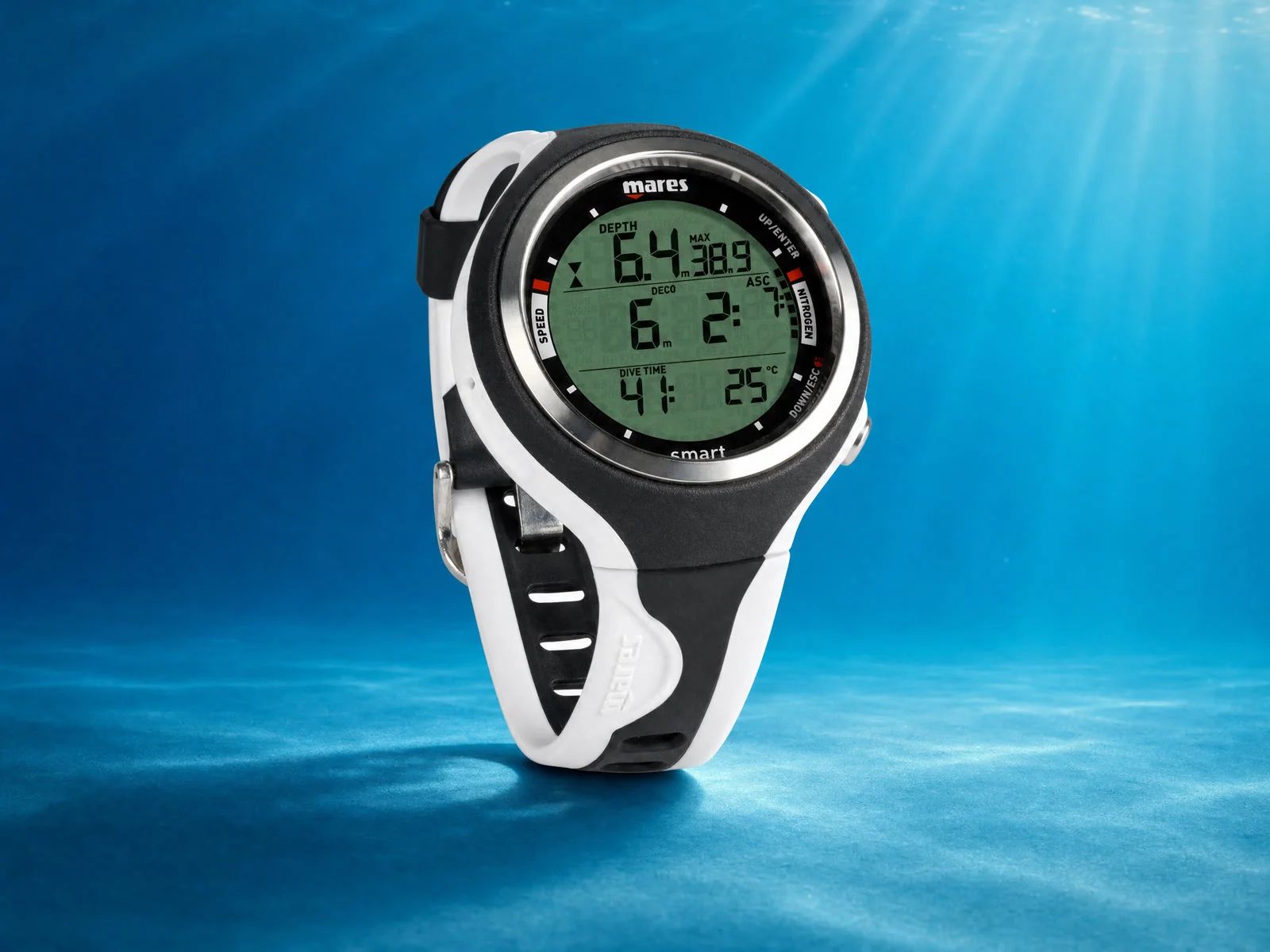
The screen format inevitably requires smaller fonts, but the monochrome display benefits from excellent contrast. The segmented (LCD) display is protected by tempered mineral glass, which significantly reduces the risk of scratches.
The computer is controlled via two metal side buttons, allowing you to alternate between information fields (maximum depth, temperature, etc.) located on the bottom line of the screen. Its readability is so direct that even with thick gloves, navigation remains intuitive.### Battery Life
This is a major advantage compared to rechargeable smartwatches. With this device, you don't need to carry a USB charger when traveling. The Smart watch is powered by a CR2430 battery, which can be replaced directly by the user (although care must be taken with the O-ring).
Mares claims an impressive battery life of 200 to 300 dives, lasting approximately 3 years depending on usage. This provides invaluable peace of mind during expeditions to remote locations where access to electricity is not guaranteed.
Connectivity and App
Unfortunately, transferring your dive log isn't straightforward out of the box. The integrated dive log (Logbook) can record up to 40 hours (or 35 hours) of profile data with a sampling rate of 5 seconds.
To synchronize the device with a PC, Mac, or smartphone, you must purchase the PC interface (cable) or Bluelink separately. Therefore, some extra effort is required to digitize your underwater memories.
Compass and Instruments
This model omits electronic navigation in favor of alternative features that are very well-executed for this price range. It does not have a built-in compass.Despite this, it features an excellent depth timer function that includes a stopwatch and a resettable average depth display, as well as a very comprehensive freediving mode with dedicated depth alarms. This is a real asset for enthusiasts who alternate between scuba diving and freediving.
Durability and Depth Rating
The case, which is relatively discreet for everyday use, is nonetheless a true protective shell for the electronics. It is certified to a maximum display depth of 150 meters (492 feet).
Its design allows it to be worn daily while withstanding even the most demanding diving conditions. It's an extremely robust companion that won't let you down underwater.
Price and Customer Service
This is often the first watch that divers purchase. At this price point, the freediving/scuba versatility is a major selling point, strongly supported by Mares' customer service network, which is well-established in France, Belgium, and Switzerland. It's a sensible investment for a primary safety device.
Who is this computer for?
The Mares Smart is primarily aimed at recreational divers or travelers, and freedivers who are looking for a durable watch for everyday use, with good battery life and gas switching capabilities. It's the ideal tool for those who value functionality, reliability, and self-improvement without being burdened by superfluous features.Conversely, this computer is not ideal for technical divers using trimix, closed-circuit rebreather (CCR) divers, or those who require a color display with integrated air pressure readings. If your diving activities focus on deep technical diving, you will need to consider more specialized models.
Service and Support
Mares' after-sales service elicits mixed opinions within the diving community. Some divers report quick turnaround times of around eight days, while others mention delays or inflexibility regarding shipping costs.
The retailer plays a significant role in this process. Therefore, it is crucial to choose a reputable distributor who will advocate for your interests in case of any issues. However, Mares has a strong presence throughout Europe, which greatly simplifies the process compared to more obscure brands.
Power Supply
The choice of a user-replaceable CR2430 battery is a major advantage for travelers. On liveaboard dive trips where electrical outlets are scarce and highly contested, not having to recharge your computer every evening is a welcome convenience.
This autonomy of 200 to 300 dives allows you to consider entire seasons without worrying about the power supply. Simply carrying a spare battery in your dive bag provides peace of mind, ensuring you never miss a dive due to a dead battery – a simple precaution that guarantees you won't have to interrupt a dive.To find out which battery to buy for this computer, check out our complete guide on dive computer batteries. To learn how to change the battery yourself step by step without risking damage, read our comprehensive tutorial on how to change your own dive computer battery.
Links to other models from the same brand
If you appreciate the Mares ecosystem but feel the need for a wireless air integration system, the Mares Smart Air might be the logical next step for your equipment.
For those who prefer a larger color screen and advanced features, the Mares Sirius offers a superior visual experience while maintaining the brand's reliability.
Finally, if you are looking for a computer in the classic console format, the Mares Puck Pro remains an essential reference for beginners.