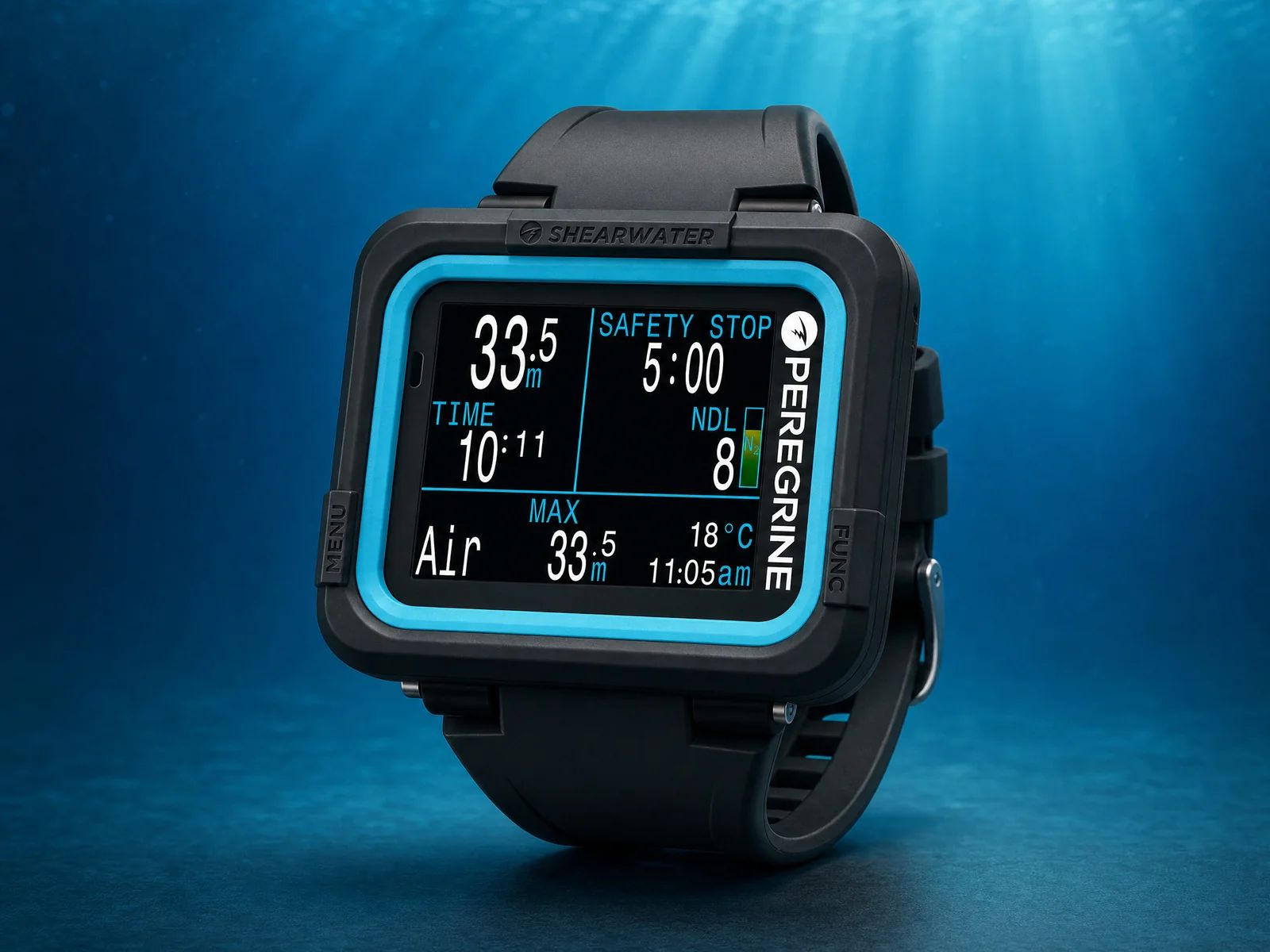
Shearwater Peregrine Review- The Leading Recreational Dive Computer?
Full review of the Shearwater Peregrine dive computer. Color screen, Bühlmann ZHL-16C algorithm, and flawless ergonomics: is it worth the price for recreational divers?
Does the Shearwater Peregrine support air integration?
No, the standard version of the Peregrine does not have integrated air balancing. You need to choose the Peregrine TX model to benefit from this feature.
Can the Peregrine be used for technical diving?
It supports up to 3 gases- including Nitrox up to 100%- which allows for advanced decompression procedures. However, it does not support Trimix or rebreathers.
What is the recommended skill level for the Shearwater Peregrine?
It is accessible from Level 1/Open Water thanks to its streamlined recreational mode- and will reveal its full potential for a diver at Level 3 or Advanced Nitrox, who is managing a decompression tank.
Each dive is a promise- an exploration of the depths where safety and clear information are our best allies. It's essential to understand that the dive computer isn't just an accessory, but a vital instrument that orchestrates our ascent, precisely managing decompression parameters and guiding us through the intermediate stops. It's a key piece of equipment, and its reliability and ergonomics can make all the difference between a smooth dive and a complex situation.
For many years, the Shearwater brand was synonymous with technical diving, reserved for cave explorers and rebreather users- demanding profiles that never compromise on performance. With the launch of the Peregrine, the Canadian manufacturer made a strategic shift, offering its advanced algorithm and renowned color screen in a format designed for recreational and light technical diving. The purpose of this analysis is to determine whether the adjustments made to make this device more accessible in terms of price have compromised its performance, or if it represents a relevant option compared to more traditional entry-level models.
The verdict in summary| Criterion | Score | What it means |
| :--------------------- | :------ | :---------------------------------------------------------------------------------------------------------------------------------------- | | Algorithm & Decompression Stops | 5.0/5 | Complete transparency and optimal safety with the customizable Bühlmann model, offering very precise decompression stop management. | | Air & Multi-Gas | 3.6/5 | Perfect for air and confirmed Nitrox, but its capabilities are limited for advanced technical diving, particularly the lack of Trimix support. | | Screen & Ergonomics | 4.8/5 | One of the most readable screens on the market, even in bright sunlight or low visibility conditions- a true benchmark. | | Battery Life & Power | 4.6/5 | A very durable rechargeable battery with a convenient wireless charging base, ensuring reliable power for multiple dives. | | Connectivity & App | 5.0/5 | The Shearwater Cloud app is a model of stability and clarity, making it easy to manage dive profiles and logs. | | Compass & Instruments | 3.0/5 | The absence of an integrated compass on this model means using an analog instrument, something to consider for some users. | | Robustness & Depth | 3.8/5 | Solidly built and certified to 120 meters, with a scratch-resistant glass, it is designed to withstand the rigors of the marine environment. | | Price & Customer Support | 4.1/5 | A significant investment, but justified by legendary customer service and recognized reliability in the diving world. |
Overall Score: 4.4/5
Detailed Analysis
O1 Algorithm & Decompression Stops
The Peregrine doesn't hide any of its calculations- a philosophy that Shearwater values highly. It clearly shows you what is happening in your tissues and allows you to visualize your decompression with a level of clarity rarely seen on the recreational market. This transparency builds trust, allowing divers to better understand their physiological state underwater.
The Peregrine uses the Bühlmann ZHL-16C decompression model with Gradient Factors (GF) that are fully adjustable by the user. Unlike many recreational dive computers that use proprietary algorithms, often referred to as "black boxes" and not modifiable, Shearwater gives you control over these crucial parameters so you can precisely adjust your conservatism. The real-time display of TTS (Time To Surface) and the "ceiling" is a major safety feature, providing an immediate understanding of the decompression situation.
O2 Air & Multi-Gas
This computer will meet the needs of 95% of recreational divers and even some light technical divers. You can plan a dive using air and configure a deco bottle with a high-oxygen mixture to accelerate your decompression stops- a valuable flexibility for optimizing decompression times.The standard Peregrine model tested here does not have any air integration capabilities, either wired or wireless. The device manages up to 3 switchable gases underwater (Air and Nitrox up to 100%). It lacks Trimix and CCR (rebreather) functions. This is a deliberate design choice by Shearwater, aimed at positioning the Peregrine in a specific market segment without cannibalizing the rest of their product line, which justifies our weighted score for this section.
O3 Screen & Ergonomics
This is undoubtedly one of the most notable strengths of this model. The 2.2-inch LCD screen is vibrant, large, and has excellent contrast. Readability is outstanding, even in direct sunlight or in waters with a high concentration of particles. The menus are navigated using two large stainless steel buttons, whose size and responsiveness are designed for use with thick gloves.
The screen is not AMOLED like the Teric's, but rather a high-resolution LCD that offers excellent brightness and remarkable visual clarity. Navigation using the two buttons (left to scroll, right to confirm) is intuitive and can be used without any problems even with 5mm waterproof gloves. The display is partially customizable, particularly the bottom line, allowing you to adapt the displayed information to your preferences.
O4 Battery LifeSay goodbye to the anxiety of unexpected battery changes before a dive trip- a common concern for many divers. The Peregrine recharges simply by placing it on its provided base, an elegant and practical solution that greatly simplifies logistics both before and after your dives.
The non-replaceable lithium-ion battery offers approximately 30 hours of dive time at medium brightness. Wireless charging (standard Qi) is a significant advantage for the device's water resistance, as there is no exposed USB port in contact with seawater, eliminating a potential weak point. This extended battery life is extremely valuable for travel and consecutive dives.
O5 Connectivity & App
Synchronization of your dive logs occurs via Bluetooth in seconds to your phone, using a well-designed application. This ease of data transfer is a major advantage for tracking and analyzing your dives, allowing you to maintain an accurate and detailed record.The Shearwater Cloud is available on both mobile and desktop, providing a comprehensive platform for managing your dives. Firmware updates via OTA (Over The Air) are performed seamlessly using Bluetooth, ensuring that your device always benefits from the latest improvements and bug fixes. Data export is standard, allowing the use of third-party software like Subsurface, a flexibility appreciated by advanced divers.
O6 Compass & Instruments
On this point, the Peregrine makes a clear choice. The absence of an integrated compass in this model is a feature to consider. You will then need to use an analog instrument or another computer equipped with a digital compass, a decision that depends on the preferences and specific needs of each diver.
Although the compass is absent, the Peregrine incorporates precise temperature measurement and offers a gauge mode, useful for divers who prefer to use traditional decompression tables. This design choice helps maintain a more affordable price while still offering essential features for safety and dive tracking.
O7 Robustness & DepthThe robustness of a dive computer is crucial because it is subjected to significant stresses in the marine environment. The Peregrine is designed to withstand these challenges. It is certified for a depth of 120 meters, making it suitable for a wide range of dives, from recreational to certain forms of light technical diving.
The aluminosilicate glass protects the screen from scratches and impacts- a detail that is not insignificant for a device that will be handled in sometimes difficult conditions. The CE manufacturer certification confirms its compliance with European safety standards, providing assurance of quality and reliability for the user.
O8 Price & Customer Support
The Shearwater Peregrine represents a significant investment for a recreational dive computer, with prices observed around 550 EUR to 580 EUR (prices recorded in July 2026). However, this investment is often justified by the quality of construction, the reliability of the algorithm, and above all, by legendary customer support.Shearwater's customer service is a benchmark in the industry. The brand has regional centers staffed by experts who can handle repairs with remarkable efficiency. Procedures for out-of-warranty replacements are clearly documented, and there are no known weaknesses regarding their customer support. This peace of mind is a key factor for many divers, who know they can rely on quality support when needed. The standard warranty period is 2 years, but the reputation of the customer service extends far beyond that timeframe.
Who is this computer for?
The Shearwater Peregrine is the ideal tool for the discerning recreational diver- the one who seeks impeccable readability and transparent decompression management, without needing the advanced features of a Trimix or rebreather computer. It will also be perfectly suited to the light technical diver, especially those using enriched air nitrox (Nitrox) and managing a decompression cylinder, who prioritize clear information and the reliability of the algorithm. It is a diving companion that will support its user's progress, offering a solid platform for learning and mastering techniques.However, this computer is not ideal for divers who absolutely need an integrated digital compass for underwater navigation, or for those who rely on wireless air integration to manage their air consumption. In these specific cases, you should consider more specialized models within the Shearwater range, such as the Peregrine TX or the Perdix, which offer these features. It is essential to carefully evaluate your needs before making a choice, as each computer has its strengths and limitations.
Customer Service and Support
Customer service is often an underestimated factor when purchasing diving equipment, but it becomes very important in case of any problems. For Shearwater, customer service is a real strength- a key component of the brand's value proposition. It is universally recognized as a benchmark in the industry, a claim that is based on concrete facts.The company relies on a network of regional expert centers, which ensures prompt and efficient support for the equipment. Replacement procedures, even outside of the warranty period, are documented and transparent, providing reassuring predictability for the user. There are no known weaknesses regarding Shearwater's customer support, a rare achievement in the industry. This excellence in after-sales service greatly contributes to the reputation of Shearwater products for reliability and durability, transforming the purchase into a long-term investment.
Power Supply
The power supply is crucial for a dive computer because it directly affects the practicality and reliability of the device, especially during travel or cruises. The Shearwater Peregrine uses a rechargeable battery, a modern solution that eliminates the inconvenience of frequent battery changes, which can sometimes be difficult.Wireless charging, via a dedicated base, is a significant advantage. It not only simplifies the charging process but also enhances the device's water resistance by eliminating any external ports that could potentially allow water to enter. For divers on cruises, it's wise to have a small portable power bank, ensuring a constant source of energy even when far from a wall outlet. This approach provides great peace of mind, allowing you to focus fully on diving without worrying about the battery life of your equipment.
Links to other models from the same brand
If the Peregrine has caught your attention, it's worth exploring the other gems in the Shearwater range, each designed to meet specific requirements. For wireless air integration and even more advanced features, the Shearwater Peregrine TX might be an option to consider. If your diving takes you towards advanced technical diving, with Trimix management and extreme customization options, the Shearwater Perdix 2 or the Shearwater Teric are essential references that deserve special attention.