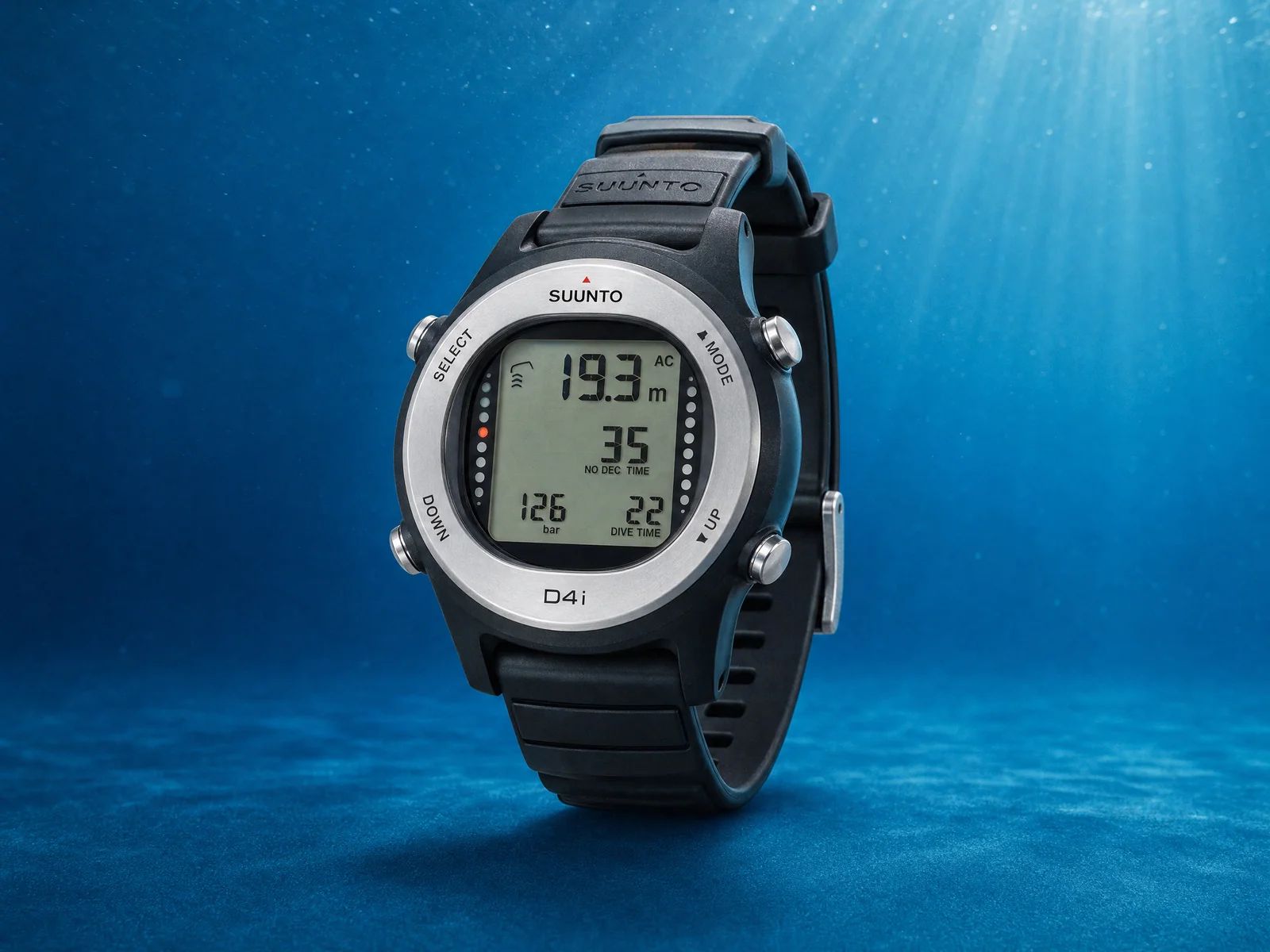
Suunto D4i Review- The Original Watch Design Stands the Test of Time.
Comprehensive review of the classic Suunto D4i dive computer. Find out if this dive computer, with its RGBM algorithm and integrated air integration, is still a relevant choice today.
What is the difference between the Suunto D4i and the D4i Novo?
Regarding software, both models are identical. The difference is purely physical. The original D4i features plastic buttons and an elastomer strap. The Novo uses metal buttons and a silicone strap.
Does the Suunto D4i have a built-in compass?
No. Just like its successor, the standard Suunto D4i does not have an electronic compass. You must rely on a separate analog compass.
Does the dive computer manage Nitrox?
Yes. It features a Nitrox mode that allows you to set a single gas mixture with an oxygen percentage ranging from 21% to 50%.
Can I use a wireless probe with the standard D4i?
Yes. Wireless air integration is fully supported by adding a compatible Suunto pressure transmitter.
Time is a harsh judge for electronic equipment used underwater. Trends change, screens get bigger, and algorithms become more complex every year. Yet, some devices refuse to disappear from our boats and wrists.
They cling to divers with a fascinating tenacity that commands respect. The original Suunto D4i undoubtedly belongs to this category of familiar instruments. It has been replaced in the catalog by the Novo version for many years now.
But this small watch-style computer continues to circulate widely on the second-hand market. It attracts many freedivers and recreational divers due to its lightness and ease of use. Visually, it stands out from the current generation with very specific material choices.
Its plastic buttons and textured elastomer strap betray its design age. But a dive computer is more than just a simple freediving timer or a vintage watch. It's the critical tool that manages decompression safety for every dive into the blue.Is the software of this device outdated compared to current market standards? Is its RGBM algorithm still sufficient to guarantee perfectly safe dives? We applied our rigorous technical evaluation criteria to this classic piece of diving equipment. The goal is to determine if it still represents a worthwhile purchase on the second-hand market for equipping yourself.
2. Summary Verdict
Overall Score: 3.1/5
Criterion
Score
What it means
Algorithm & Decompression Stops
3.4/5
The Suunto RGBM model is safe and readable, but lacks Gradient Factor adjustment.
Air & Multi-Gas
1.6/5
Only one gas can be switched underwater, with a limit of Nitrox 50%.
Display & Ergonomics
2.0/5
Basic matrix LCD screen with plastic buttons that can sometimes feel stiff underwater.
Battery Life
3.5/5
Standard CR2450 battery offering good autonomy but requiring a visit to a service center for replacement.
Connectivity & App
3.0/5
Synchronization via a proprietary USB cable to a computer, with no Bluetooth options.
Compass & Instruments
3.6/5
No electronic compass, but a very good and responsive freediving mode.
Durability & Depth Rating
4.3/5
Certified to 100 meters with a mineral glass and a very robust composite casing.
Price & Customer Service
3.8/5
An excellent choice when purchased used, with Suunto customer service ensuring parts availability and updates.
3. Detailed Analysis
Algorithm & Decompression Stops (3.4/5)Decompression management is the core function of any dive computer.
The Suunto D4i relies on the same algorithm as the Novo model. This is the Suunto RGBM continuous decompression model.
It's a proven mathematical model, extremely precise in its calculations of micro-bubbles. The Reduced Gradient Bubble Model takes into account the behavior of dissolved gases. It anticipates the formation of silent bubbles within the diver's tissues.
This anticipation modifies the ascent profile to maximize safety. The effort, repetition, and self-improvement required in diving demand this level of precision. It does not offer any free adjustment of Gradient Factors for technical divers.
However, it allows for personal adjustments on three distinct levels. You can choose between levels 0, 1, and 2 depending on your fatigue or the conditions. Level 0 corresponds to the standard profile for a diver in excellent condition.
Level 1 adds a margin of safety for cold water or intense exertion. Level 2 significantly tightens the calculations for high-risk profiles. The display of critical information is a success in visual ergonomics.
The decompression ceiling, called "Ceiling," is clearly indicated in meters. The total ascent time, or ASC TIME, is displayed continuously on the screen. This data is framed by highly recognizable visual and audible alarms.The information is presented so clearly that even with the onset of nitrogen narcosis, it remains understandable. The diver knows exactly where to stop and for how long. This pedagogical approach to decompression immediately provides reassurance.
The algorithm is unforgiving of rapid ascents, which encourages excellent discipline. It firmly penalizes inverted profiles and ascents that are too close together.
Air & Multi-Gas (1.6/5)
Gas management is the key step towards technical diving. In this area, the D4i clearly shows its limitations in software design. It is a single-gas computer designed for classic recreational diving.
It handles air or basic Nitrox dives without any problems. The oxygen setting ranges from 21% to 50%, with great simplicity. The maximum partial pressure of oxygen is adjustable from 1.2 to 1.6 bar.
These settings cover the vast majority of needs for a recreational diver. The alarm for neurological oxygen toxicity monitors your nervous system. However, the inability to record an additional decompression gas is a drawback.
You cannot switch to a deco block during the dive. This limitation prevents any progression towards advanced technical diving. If you are considering training that involves changing gases, this device will be insufficient.However, it hides an advanced feature that is very valuable for its category. The wireless air integration is perfectly managed via a radio frequency transmitter. This optional sensor screws onto the first stage of your regulator.
It transmits the pressure from your tank directly to the watch display. The computer then calculates your air consumption in real time. It displays the remaining air time based on your current breathing rate.
The integration is so seamless that even beginners can instantly understand their dive time. However, be aware that this electronic reading never replaces mechanical redundancy. Always keep a traditional pressure gauge attached to your equipment to compensate for any failure.
Screen & Ergonomics (2.0/5)
The visual interface takes us back to an era before ultra-bright OLED screens. The matrix display offers a modest resolution of 49 by 22 pixels. It is a classic segmented LCD display in black and white.
It is supported by an adjustable electroluminescent backlight. Readability remains excellent even in bright sunlight or clear water. The contrasts are sharp, and the main numbers occupy a good amount of space.
Navigation is performed using four buttons located on the sides of the case. This is where the main difference lies compared to the newer Novo version. The original D4i uses plastic pushers instead of metal ones.Over time, these plastic buttons can become slightly more rigid. They tend to accumulate deposits if they are not rinsed with meticulous care. Salt and limescale penetrate the crevices and block the mechanism.
The pressure required is so high that even with thin gloves, operation becomes tedious. Rinsing, drying, and regular handling in freshwater are essential. This is the price to pay to maintain smooth navigation within the menus.
The software structure requires a short period of adaptation to master. The abbreviations displayed on the matrix screen require careful reading of the manual.
Battery Life (3.5/5)
Power management is a constant concern during diving trips. This model is powered by a standard CR2450 button cell battery. The advertised battery life is approximately one and a half years for about a hundred dives.
This is a very good performance for a housing of this reduced size. While a skilled individual could theoretically replace the battery themselves. It is officially recommended by the manufacturer to use an authorized service center.
This procedure guarantees the watch's water resistance at 100 meters after opening. The technician replaces the battery, the O-ring, and performs a complete cleaning. Testing in a hyperbaric chamber is a crucial step in the workshop overhaul process.Failing to perform this step risks water damage to the electronics on the first dive. The peace of mind, safety, and longevity of the equipment justify this cost. A visit to a service center also allows for a general inspection of the housing.
This is preventative maintenance that significantly extends the life of the instrument. The low battery indicator on the screen is reliable and provides sufficient advance warning. It gives you time to schedule this service before complete failure.
Anticipation, preparation, and proper care of equipment are the cornerstones of our practice.
Connectivity & App (3.0/5)
Extracting dive data has become an essential standard for improving your skills. Like all models in this generation, the D4i does not have a Bluetooth chip. The internal memory stores approximately 140 hours of detailed dive profiles.
This volume is calculated with a sampling rate set to 20 seconds. To extract this dive log, the method is purely wired and mechanical. You must use the proprietary USB cable provided by Suunto.
This cable connects via metal pins on the back of the watch. It then connects to the Suunto DM5 software on a PC or Mac computer. This procedure requires some patience upon returning from the dive site.The lack of wireless synchronization to a smartphone is a significant drawback these days. Divers who are accustomed to sharing their dive profiles instantly on social media will be disappointed. However, the wired connection remains absolutely reliable for data transfer.
The information extracted is comprehensive and allows for a detailed analysis of decompression. You can view your depth profile, temperature variations, and air consumption. Studying these graphs is an incredibly powerful educational tool.
It helps to correct buoyancy errors and optimize breathing techniques.
Compass & Instruments (3.6/5)
Underwater orientation requires reliable and precise instruments. This device completely omits the integrated electronic compass. Therefore, you need to plan for a traditional magnetic compass, either on a console or on your wrist.
This design choice allows for a very compact housing. However, the absence of a compass is largely compensated by an exceptional freediving mode. The Freedive mode remains extremely relevant for enthusiasts of this discipline.
It allows for very rapid depth sampling, up to 1 or 2 seconds. This high frequency is ideal for precisely analyzing the curve of a fast descent. Such responsiveness means that even minute variations in buoyancy are recorded.The freediver can analyze their freefall with surgical precision using the computer. The screen displays surface time in a very readable format for managing recovery. Sequential depth alarms guide the descent without having to look at the screen.
This feature explains the enduring popularity of this model among spearfishers. It excels in this specific area despite its relatively old technical design. The versatility between scuba diving and freediving is a real strength of this device.
Durability & Depth Rating (4.3/5)
Protecting the electronics from pressure is a complex engineering challenge. The original D4i uses a composite housing with excellent structural integrity. It features a steel bezel that effectively protects the screen from direct impacts.
The entire assembly guarantees a certified water resistance to a depth of 100 meters. The device meets the stringent ISO 6425 and EN 13319 standards for dive watches. Its mineral glass offers excellent optical clarity but remains susceptible to scratches.
It is recommended to install protective plastic films from the very first dives. These scratch guards are essential consumables for preserving the readability of the screen. Note that the original elastomer strap tends to crack over time.Unlike modern silicone, this material deteriorates poorly in the presence of salt and sunlight. Ultraviolet rays harden the plastic, which eventually cracks under stress. When purchasing used equipment, this often necessitates an immediate replacement of the strap.
This is a minor hardware issue that does not compromise the integrity of the housing itself. However, losing your dive computer underwater due to a worn-out strap is an avoidable mistake. A thorough inspection of the equipment before entering the water is a golden rule.
Price & Customer Service (3.8/5)
The used market offers a second life for these reliable and proven instruments. Today, the D4i can be found at very attractive prices on resale platforms. This provides an affordable entry point to dive computers in a watch format.
The support provided by the manufacturer is a significant advantage for this purchase of pre-owned equipment. Suunto continues to release software updates applicable to this older model. Firmware version 1.5.9 demonstrates this long-term commitment to users.
Spare parts such as batteries and straps are common with the Novo model. This logistical availability makes it a particularly secure purchase of used equipment. The initial investment is low, which allows you to allocate budget for dives.This is a rational approach to equipping yourself without compromising underwater safety. The resale value remains stable if the device is carefully and regularly maintained.
4. Who is this computer for?
Identifying the target user profile is key to making a truly successful and long-lasting equipment purchase. This computer is the ideal housing for Open Water divers or those at Level 1 in training. It perfectly complements progress towards recreational Level 2 and the acquisition of independence.
It's also an excellent choice for freedivers looking for a dedicated, lightweight, and highly responsive tool. Its compact size allows it to be worn comfortably on a daily basis during diving trips without being cumbersome. It easily fits under the sleeve of a thick neoprene wetsuit or waterproof garment.
This is an excellent backup computer that can be slipped into the pocket of your buoyancy compensator vest when traveling. Redundancy in calculation instruments is a practice that we strongly encourage at AquaExposure. If your goal is deep diving with mixed gases, this device is definitely not for you.
Divers aiming for Nitrox certification or Trimix will quickly find its software limitations restrictive. Tech-savvy users expecting immediate Bluetooth synchronization on the boat will also be disappointed. This is a pragmatic tool, designed for ease of use underwater above all else.It requires accepting a software interface from a previous technological generation, which is less intuitive. However, it offers absolute reliability, proven by hundreds of thousands of dives worldwide.
5. After-Sales Service and Support
After-sales service is an essential safety net for any serious investment in diving equipment. Suunto's after-sales service is generally good and structured to respond to the needs of divers around the world. There are many authorized repair centers, well distributed throughout Europe.
They perform battery replacements and pressure testing with great care. However, managing the firmware requires your careful and proactive attention. The internal software of these computers is a critical factor for the safety of decompression calculations.
You must consistently update the device before every dive or any long trip. This procedure is performed via the proprietary USB cable and the Suunto DM5 software installed on your computer. Take the time to regularly check the version of your firmware on the official website of the Finnish manufacturer.A missed update can lead to annoying display bugs or potentially serious calculation errors. The manufacturer clearly communicates the fixes included in each new software version. This is a fundamental responsibility that rests with the diver to ensure their equipment functions correctly.
Customer service inquiries often go through your local retailer, who acts as an administrative intermediary. Good communication with your regular dive shop greatly simplifies warranty claims.
6. Power Supply
The power source often dictates the logistical organization of a remote diving trip or cruise. Choosing a replaceable CR2450 battery offers great independence from sometimes unreliable electrical grids. You don't need to search for an available power outlet between successive dives on the boat.
This is a major advantage during cruises in isolated areas or on small boats with limited equipment. A new battery provides complete peace of mind for an entire season of regular diving. The low battery indicator on the screen is very reliable and warns you early enough of impending danger.It allows ample time to plan a visit to a service center before the instrument completely fails underwater. This is a very different energy management system compared to modern rechargeable models that require a proprietary charging base. The absence of a lithium-ion battery also avoids the inevitable chemical degradation issues associated with time.
The computer can remain stored in a closet for several months without losing its initial charge capacity. If the storage period is expected to be particularly long, it's simply necessary to have the battery removed by a qualified technician. This is a mechanical approach to power that has proven itself over decades in the industry.
The range offered by the Finnish manufacturer has expanded considerably over the years through innovation. If the format of this dive computer appeals to you but you are looking for more noble and durable materials, you can consult our analysis of the direct successor to this iconic model.Discover our comprehensive review of the Suunto D4i Novo Test: The ideal dive watch for recreational diving and freediving. For divers looking for a large color screen and a battery that can be recharged wirelessly. The brand offers console models that are much more modern and connected.