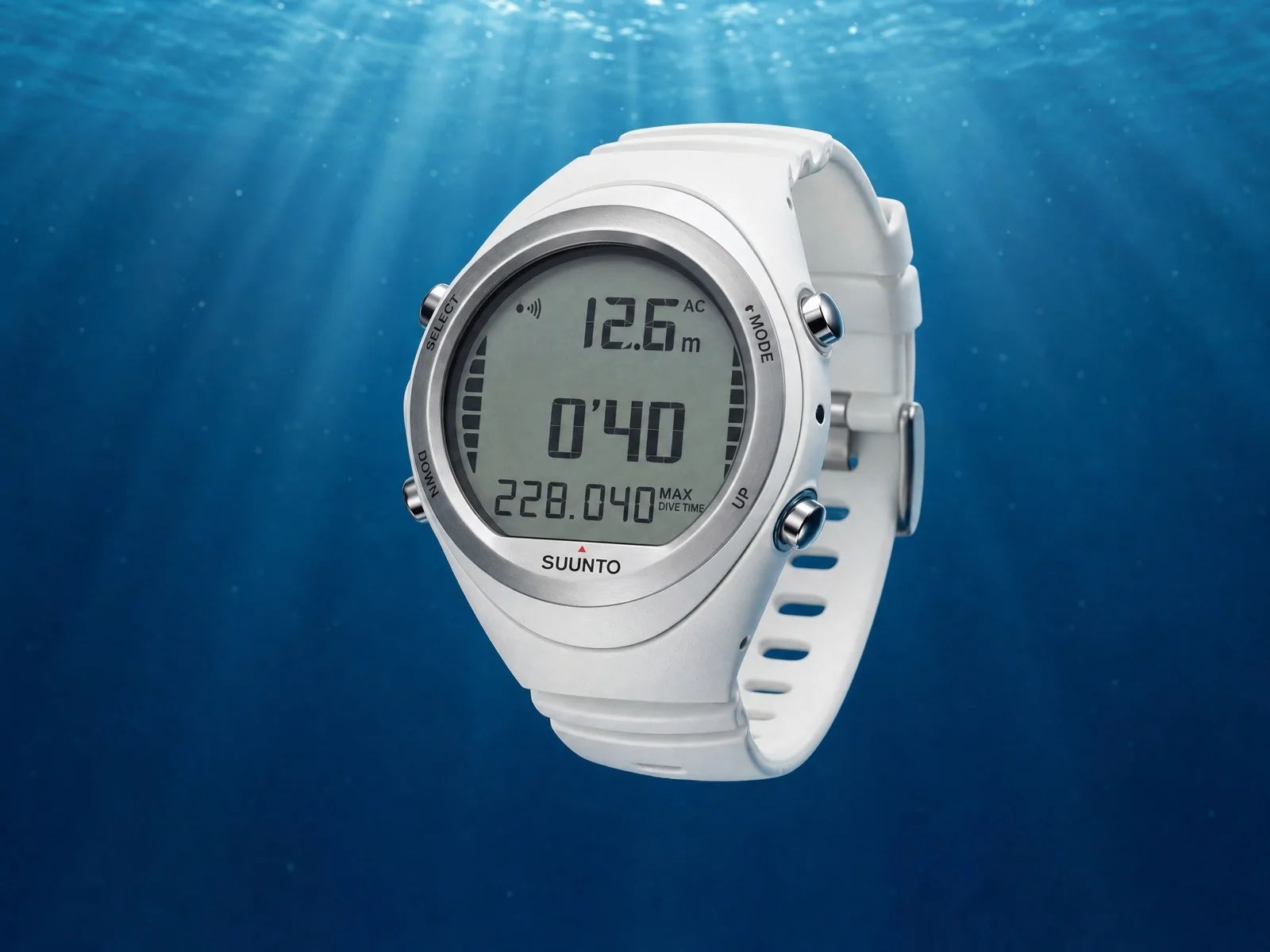
No, unlike models such as the D6i or the Vyper Novo, the Suunto D4i Novo does not have an electronic compass.
Does the dive computer manage Nitrox?
Yes, it has a Nitrox mode that allows you to set a single gas mixture with an oxygen percentage ranging from 21% to 50%.
Is it possible to integrate a wireless air system with this model?
Yes, the D4i Novo is compatible with the optional wireless Suunto pressure transmitter, which allows you to display your tank pressure directly on the watch.
How do I transfer my dive data to my computer?
It is necessary to use the proprietary USB cable supplied with the Suunto D series for synchronizing your dive log with the Suunto DM5 software on a Mac or PC. There is no Bluetooth connectivity.
In the silence that precedes the first dive of the day, the choice of our dive computer often dictates the serenity of our exploration.
We entrust our safety to complex algorithms that monitor our tissues while we observe the variations in light in the deep blue.
The Suunto D4i Novo is part of this lineage of instruments that have accompanied divers for many years, spanning trends and technological advancements.
With its 92 grams and soft silicone strap, it becomes almost unnoticeable on the wrist, whether underwater or when we return to life on land.
It is an object that creates a constant link between our lives on land and our passion for the underwater world.
In the face of the proliferation of color screens and Bluetooth chips, it is legitimate to question the relevance of a monochrome LCD display today.
Does its dedicated freediving mode and RGBM algorithm still justify its acquisition for enthusiasts who regularly explore the underwater world?
Our analysis relies on the technical data of this model to assess its current place in the equipment of recreational divers.We will examine its capabilities, limitations, and ergonomics to provide you with a clear understanding of what it can offer your diving experience.
This is not about judging an outdated technology, but rather understanding how it meets modern safety requirements.
Diving requires rigor, preparation, and awareness of your equipment.
2. The Verdict: Summary
Overall Score: 3.1/5
Criterion
Score
What this means
Algorithm & decompression stops
3.4/5
The classic Suunto RGBM model offers clear display but maintains a very conservative approach.
Air & multi-gas
1.6/5
The device is limited to a single gas, either air or Nitrox up to 50%, with no possibility of underwater gas switching.
Screen & ergonomics
2.1/5
The basic LCD screen with backlight remains very readable, but the four-button navigation feels dated.
Battery life
3.5/5
The CR2450 battery provides approximately one and a half years of use, with replacement recommended by an authorized service center.
Connectivity & app
3.0/5
Synchronization is mandatory via a USB cable to the Suunto DM5 device, as there is no Bluetooth chip.
Compass & instruments
3.6/5
The lack of a compass is offset by an excellent freediving mode with very fast sampling.
Durability & depth rating
4.3/5
3. Detailed Analysis
Algorithm & decompression stops (3.4/5)
The device relies on the Suunto RGBM continuous decompression model, a mathematical foundation that has guided thousands of divers to the surface.This model takes into account the formation of micro-bubbles in tissues, offering a preventative approach to decompression sickness.
Unlike modern technical diving computers that are prevalent on the market, it does not offer any Gradient Factor adjustments to fine-tune the ascent profile.
However, it allows for personal adjustment of conservatism across three distinct levels, named P0, P+1, and P+2, to adapt to your physiology.
This flexibility enables you to increase the safety margin if you are tired, dehydrated, or performing multiple dives in a row during a cruise.
The decompression limit and optimal ascent time are displayed clearly during the return to the surface.
This clarity of display is so evident that even a beginner diver immediately understands their responsibilities.
It's an extremely conservative algorithm that prioritizes absolute safety over extended bottom times.
We appreciate this approach for recreational diving, where the margin of safety should always be prioritized over pure performance.
The readability of the mandatory decompression stops avoids any confusion during critical moments of ascent in the three-meter zone.
You must accept that your no-decompression limits will decrease more quickly than those of your dive buddies using more permissive algorithms.This is the price to pay for a conservative approach that has proven itself in millions of dives worldwide.
Air & Multi-Gas (1.6/5)
The D4i Novo is a purely single-gas computer, designed for simple and straightforward dive profiles.
It perfectly handles air or Nitrox diving with an oxygen fraction setting ranging from 21% to 50%.
The maximum partial pressure of oxygen, or pO2, is adjustable between 1.2 and 1.6 bar according to your safety preferences.
This adjustment range covers the vast majority of needs for a recreational diver exploring coral reefs or shallow wrecks.
However, the inability to configure multiple gases and the complete lack of Trimix support will drastically limit its use.
Divers planning complex decompression dives or specific bottom mixes will need to consider other instruments.
It does not allow for any gas switching underwater, which locks in your dive plan from the moment you enter the water.
This is a deliberate choice by the manufacturer to maintain a clean interface, but it restricts the technical evolution of the diver.
If you plan to use an over-oxygenated deco block to speed up your decompression stops, this computer will not be able to calculate that change.
Therefore, it's important to carefully evaluate your future ambitions before deciding on this specific model.The simplicity of its single-gas approach avoids handling errors underwater, a definite advantage for less experienced divers.
You will never have to worry about confirming a gas switch during your ascent, the computer manages everything autonomously.
Screen & Ergonomics (2.1/5)
The central matrix display with 49 x 22 pixels is remarkably effective in bright light, such as under the tropical sun.
The natural contrast of the liquid crystals provides clear reading of vital parameters without suffering from unwanted reflections.
An electroluminescent backlight, whose duration can be set from 5 to 60 seconds, allows for correct reading at night.
This illumination is also valuable in waters with a high concentration of particles where visibility drops sharply.
However, navigating the four buttons on the steel bezel requires some initial learning.
This mechanical interface shows its age, especially when compared to current touchscreen graphical interfaces.
You need to memorize the button sequences to access the deeper menus, which requires focus, patience, and memorization.
Once this "gymnastics" is mastered, the use becomes instinctive, although less fluid than on newer models.
The metal buttons offer clear tactile feedback, a reassuring feature when wearing thick neoprene gloves.The overall design remains functional, focusing on the essentials without unnecessary embellishments or menus that could distract the diver.
Information is displayed in a logical hierarchy, placing depth and remaining dive time at the center of your attention.
This interface gets straight to the point, eliminating anything superfluous to focus on the critical data for your dive.
Battery Life (3.5/5)
Powered by a standard CR2450 battery, the manufacturer claims a reassuring battery life of approximately one and a half years.
This estimate is based on an average of about 100 dives per year, which comfortably covers the needs of a regular diver.
This longevity allows you to approach an entire season without worrying about running out of power underwater.
Although a low-battery indicator is displayed on the screen to prevent sudden failures, battery replacement requires caution.
The battery for the D series should officially be replaced by a reseller or authorized service center.
This procedure is essential to ensure the watertightness of the composite housing and maintain the manufacturer's warranty.
This logistical constraint should be anticipated before traveling, so you don't find yourself unprepared when facing the ocean.
The cost of this periodic maintenance should be included in your overall diving equipment budget.The reliability of the seal after a battery change performed in a specialized workshop is a guarantee of safety that justifies this approach.
We always prefer to entrust this task to a professional equipped with a pressure testing chamber to validate the procedure.
A watch that fails due to a poorly positioned gasket is an unpleasant experience that we want to help you avoid at all costs.
Connectivity & App (3.0/5)
The internal dive log stores approximately 140 hours of profile data, sampled every 20 seconds.
This generous memory allows you to keep track of many expeditions before needing to clear the logbook.
To export your dives to the Suunto DM5 software on your desktop computer, you must use the specific USB cable.
The complete absence of a Bluetooth chip makes wireless synchronization with a smartphone technically impossible.
In a world where data transmission is instantaneous, this hardware limitation is painfully noticeable.
You have to physically connect your watch to your computer, a process that recalls the early days of dive computers.
It's a reliable and proven method, but it lacks the spontaneity we now expect from our electronic devices.
The analysis of profiles in the DM5 software remains very comprehensive, offering detailed graphs of your dives.You can use it to study your ascent rates, decompression stops, and air consumption if you are using a transmitter.
Keeping a detailed digital dive log is an excellent habit for analyzing your progress and identifying any mistakes.
It's a powerful educational tool that extends the diving experience long after returning to shore.
Compass & Instruments (3.6/5)
It omits the electronic compass, which makes sense to reduce its overall thickness and bulk.
This omission is still regrettable for underwater navigation, requiring the diver to equip themselves with a separate analog compass.
Underwater orientation requires reliable references, and adding an extra instrument to the wrist or console is inevitable.
However, the D4i Novo compensates for this shortcoming with a freediving mode that is extremely advanced.
This mode has a dedicated timer and allows you to string together training sessions with extremely precise surface recovery times.
The depth sampling in freediving mode goes down to one, two, or five seconds, capturing the fleeting moment of freefall.
It's a precision tool that will delight enthusiasts of the open ocean who want to analyze their performance millisecond by millisecond.
The responsiveness of the pressure sensor in this specific mode demonstrates the brand's expertise in measuring rapid changes.For freedivers, this housing serves as a true training partner, capable of recording even the smallest details of their dives.
The readability of the information in freediving mode is optimized for quick glances during the descent phase.
Durability & Depth Rating (4.3/5)
The construction of this instrument inspires immediate confidence from the moment you hold it.
The composite housing is protected by a stainless steel bezel and a mineral crystal lens with excellent clarity.
The instrument is certified for use up to 100 meters in depth, complying with ISO 6425 and EN 13319 standards.
This certification confirms resistance to pressure that far exceeds the limits of standard recreational diving.
Scratch-resistant protective films, often called scratch guards, are included in the original packaging.
These small plastic shields extend the lifespan of the screen by protecting it from damage caused by rocks and coral.
The assembly is so robust that even after years of intensive use, it retains its structural integrity.
The silicone strap withstands temperature variations and prolonged exposure to ultraviolet light without losing its flexibility.
The metal buckle on the strap ensures a secure fit on the wrist, preventing accidental loss during entry into the water.This equipment is designed to last- to withstand the marine environment season after season without failing in its mission.
Price & Customer Service (3.8/5)
Its market price suffers a bit when compared to new Bluetooth watches that are flooding store shelves.
Competitors often offer color screens and connected interfaces for a similar or slightly higher price.
However, its versatility for freediving and the possibility of adding an air transmitter justify the initial investment for a mixed profile diver.
Suunto's strength remains its European and global customer service, which allows you to safely replace the battery almost everywhere.
This provides invaluable peace of mind when traveling to remote areas where spare parts are scarce.
The availability of replacement straps and accessories in most dive centers is a major logistical advantage.
Investing in a dive computer should always be considered as a long-term investment, including the cost of maintenance.
The reputation of the Finnish brand on the second-hand market also allows for easy resale if you decide to upgrade.
4. Who is this computer for?
This computer is primarily aimed at recreational divers, whether they are Level 1 or Open Water certified, who are looking for a lightweight watch-style device.It will also appeal to freedivers who want to analyze their dives with remarkable precision.
The option to read the air pressure on your wrist via the transmitter will attract those who like to consolidate their visual information.
However, it is not an ideal instrument for divers aiming for decompression using multiple gas mixes.
Those who refuse to use a USB cable to manage their dive log will also find this interface frustrating.
If you are planning a rapid transition to technical diving, its algorithmic limitations will hinder your progress.
It should be seen as a reliable travel companion- discreet on the surface and protective underwater - rather than an evolving platform.
5. After-Sales Service and Support
Suunto's after-sales service is generally acceptable and relies on a very extensive global distribution network.
It is possible to find an authorized center for the maintenance of your equipment in most diving destinations.
However, special attention should be paid to firmware updates, which can be critical.
We recommend systematically updating the internal software before every dive or trip.
This software precaution will prevent unexpected malfunctions at a time when you need your instrument the most.Replacing the battery with a certified technician remains the best way to ensure the water resistance of your equipment.
The Finnish brand provides thorough support for its products, even for models that have been on the market for several years.
6. Power Supply
The power supply relies on a CR2450 button cell battery, a standard in the electronics industry that offers excellent energy density.
This technical choice means periodic replacement, unlike the rechargeable batteries found in newer models.
For a week-long diving trip, this long battery life is a definite advantage.
You don't have to worry about finding an electrical outlet or bringing a specific charger on board the boat.
In everyday use, the watch remains active continuously without requiring a nightly charging routine.
You simply need to keep in mind the replacement schedule and take it to an authorized service center to avoid interrupting your diving season.
Each model meets specific requirements, and it is crucial to compare the specifications before finalizing your choice.
8. A Note on Decompression
Mastering decompression isn't achieved with a stainless steel housing- it comes from study, practice, and humility in the face of the ocean.To compare this computer with other models, see our diving computer comparison tool.