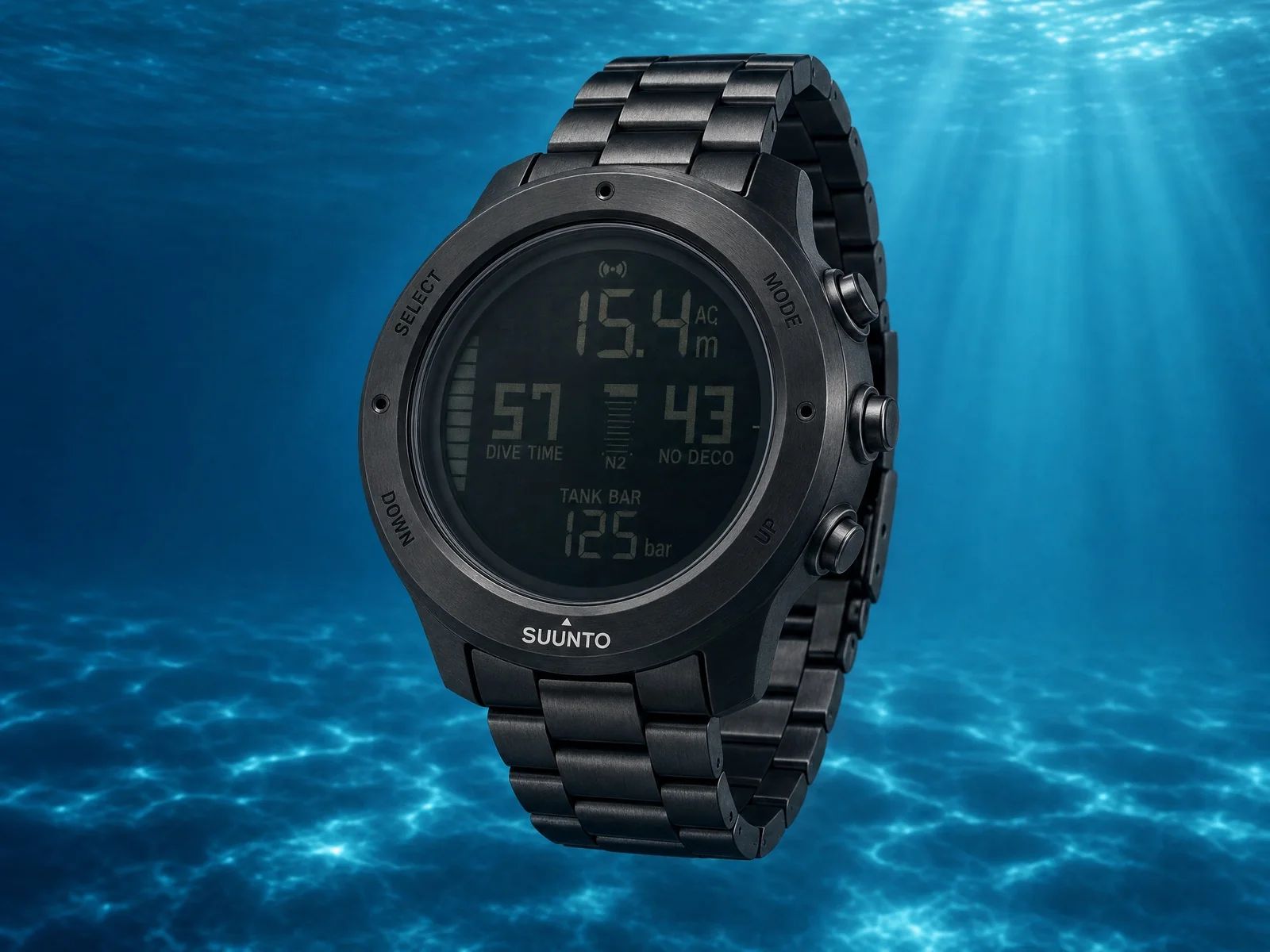
Is the Suunto DX designed for rebreather (CCR) diving?
Yes, that is its primary function. It features a dedicated CCR mode with setpoint management, manual or automatic switching, and bailout gas management.
Does the Suunto DX support diving with trimix?
Absolutely. It supports up to 8 gases in open-circuit configuration, including oxygen and helium for complete hypoxic trimix profiles.
What material is the Suunto DX housing made of?
The housing is machined from Grade 5 titanium and features a sapphire crystal window, making it both extremely lightweight and virtually scratch-proof.
Can I read the pressure of my tank on the Suunto DX?
Yes, it is compatible with the wireless pressure transmitter from Suunto, although its use in a rebreather primarily focuses on displaying bailout pressure.
Arriving on the deck of a technical diving boat with just a simple watch on your wrist often attracts curious glances. Historically, deep dives using Trimix or closed-circuit rebreathers (CCR) required massive computers, strapped to the forearm by thick elastic straps. The Suunto DX was designed to break this rule. Machined from a block of titanium, it conceals a powerful decompression engine beneath its city watch appearance, intended for extreme divers.
But a dive computer is more than just a luxury timepiece, it's the critical tool that manages the diver's decompression safety on every dive. Faced with technically advanced competitors that rely on giant color OLED screens, does the Suunto DX and its LCD screen still offer operational advantages in the 100-meter range? This test aims to determine whether this exceptional technical watch still justifies its price point.
The Verdict: Summary
Overall Score: 4.0/5
Criterion
Score
What it means
Algorithm & decompression stops
3.5/5
Suunto Fused RGBM algorithm. Handles very deep profiles, but without adjustable gradient factors.
Air & multi-gas
5.0/5
Hypoxic trimix and full CCR mode with setpoints. Maximum capabilities.
Screen & ergonomics
2.5/5
Segmented LCD matrix. Very readable but austere, complex navigation for technical diving.
Battery life
3.5/5
Standard CR2450 battery. Service by an authorized workshop is almost mandatory.
Connectivity & app
3.0/5
Wired synchronization via USB cable.
Compass & instruments
5.0/5
Electronic 3D compass with tilt compensation, essential for deep dives.
Robustness & depth rating
5.0/5
Titanium and sapphire. Certified water resistance to 200m. Indestructible.
Price & customer service
3.5/5
Very high price (titanium), offset by the excellent availability of Suunto's global customer service.
This computer is designed for: The rebreather (CCR) or trimix diver who wants to have a redundant backup to their primary technical equipment with a complete and indestructible computer in a watch format. This computer is not ideal for: Recreational divers (too complex) or technicians who require a customizable color screen.
Detailed Analysis
Algorithm & decompression stops (3.5/5)The DX relies on the Suunto Fused RGBM, a proprietary algorithm designed specifically to merge decompression for recreational dives with that of deep technical profiles. While extremely reliable, it does not offer the free adjustment of Gradient Factors (Bühlmann), which has become the standard in modern technical diving. However, the display of the ceiling and No-Decompression Time (NDT) remains clear.
Air & Multi-Gas (5.0/5)
This is the core of the device. The DX manages up to 8 gases in open circuit (Oxygen and Helium for full Trimix). More importantly, it features a highly advanced native CCR mode. You can configure up to 3 different diluents, set high and low setpoints, and instantly switch to open circuit (Bailout) in case of recycler failure. This is an undeniable 5/5 rating for its capabilities.
Screen & Ergonomics (2.5/5)
The display uses a mineral matrix LCD (49 x 22 pixels) with backlighting. The contrast is good, but managing 8 gases and CCR setpoints with only 4 buttons and traditional menus requires significant learning effort. In this area, modern color computers with intuitive menus have made great strides.
Battery Life (3.5/5)The device is powered by a CR2450 button battery, offering approximately one to one and a half years of dive time. While it is technically possible to replace the battery yourself, this is strongly discouraged. Opening a titanium housing certified for 200 meters requires a rigorous pressure testing procedure that can only be performed by an authorized Suunto service center.
Connectivity & App (3.0/5)
Like the models in the D6i series, the lack of Bluetooth is a drawback. Transferring your decompression profiles (up to 140 hours of internal logging) is done via a proprietary USB cable to the Suunto DM5 desktop software (PC/Mac).
Compass & Instruments (5.0/5)
The integrated 3D digital compass offers excellent tilt compensation. In enclosed environments like wrecks or caves, which are often frequented by technical divers, being able to accurately orient yourself while reading your decompression time is a major safety advantage.
Robustness & Depth (5.0/5)
The construction is completely robust. Machined from titanium (Grade 5), the housing is resistant to corrosion and extremely lightweight on the wrist compared to steel. The protective glass is made of pure sapphire, which is highly resistant to scratches. The maximum operating depth certification is 200 meters, covering all underwater exploration needs.
Price & Customer Service (3.5/5)Positioned in the high-end market segment, the price of the titanium casing and the CCR software is noticeable. The list price is high, but it reflects the quality of the materials and the impressive support network offered by Suunto.
Who is this computer for?
The Suunto DX is designed for experienced rebreather or Trimix divers who are looking for a reliable and discreet redundant computer that can perform in even the most demanding environments. Its robustness and versatility make it a suitable choice for those who prioritize durability and technical performance in a watch format. However, it will not be ideal for recreational divers who may find its features too complex and its interface less intuitive than models designed specifically for recreational diving. Similarly, technicians who require a customizable color display and more flexible Gradient Factor management might consider alternative options.
Service and Support
Suunto's customer service is adequate, but it is crucial to note that the device's firmware is critical. It is essential to update it regularly before each dive to ensure optimal performance and diver safety. Suunto's global network provides good availability for maintenance and repairs, although battery replacement requires a visit to an authorized workshop for a thorough water-tightness test.
Power SupplyThe Suunto DX is powered by a CR2450 button cell battery. This provides an impressive battery life of approximately one to one and a half years. However, while technically possible for the user to replace, doing so is strongly discouraged. Opening the titanium casing, which is certified to 200 meters, requires a pressure testing procedure, an operation that can only be performed by an authorized Suunto service center. This means you need to plan for maintenance, especially if you are on a cruise or far from a service center.
To discover other innovations from Suunto, you can check out our reviews of the Suunto D5 or the Suunto EON Steel, which offer different approaches to diving, from recreational to technical exploration.