Which route should I choose for a first Maldives liveaboard?
The Centre Atolls is the most suitable choice for a first trip. It offers the greatest diversity of photographic subjects (pelagics, reefs, macro, wrecks) and accessible diving conditions. Manta ray cleaning stations make encounters predictable, which is ideal for practising your technique without pressure.
Can you see manta rays on all OK Maldives routes?
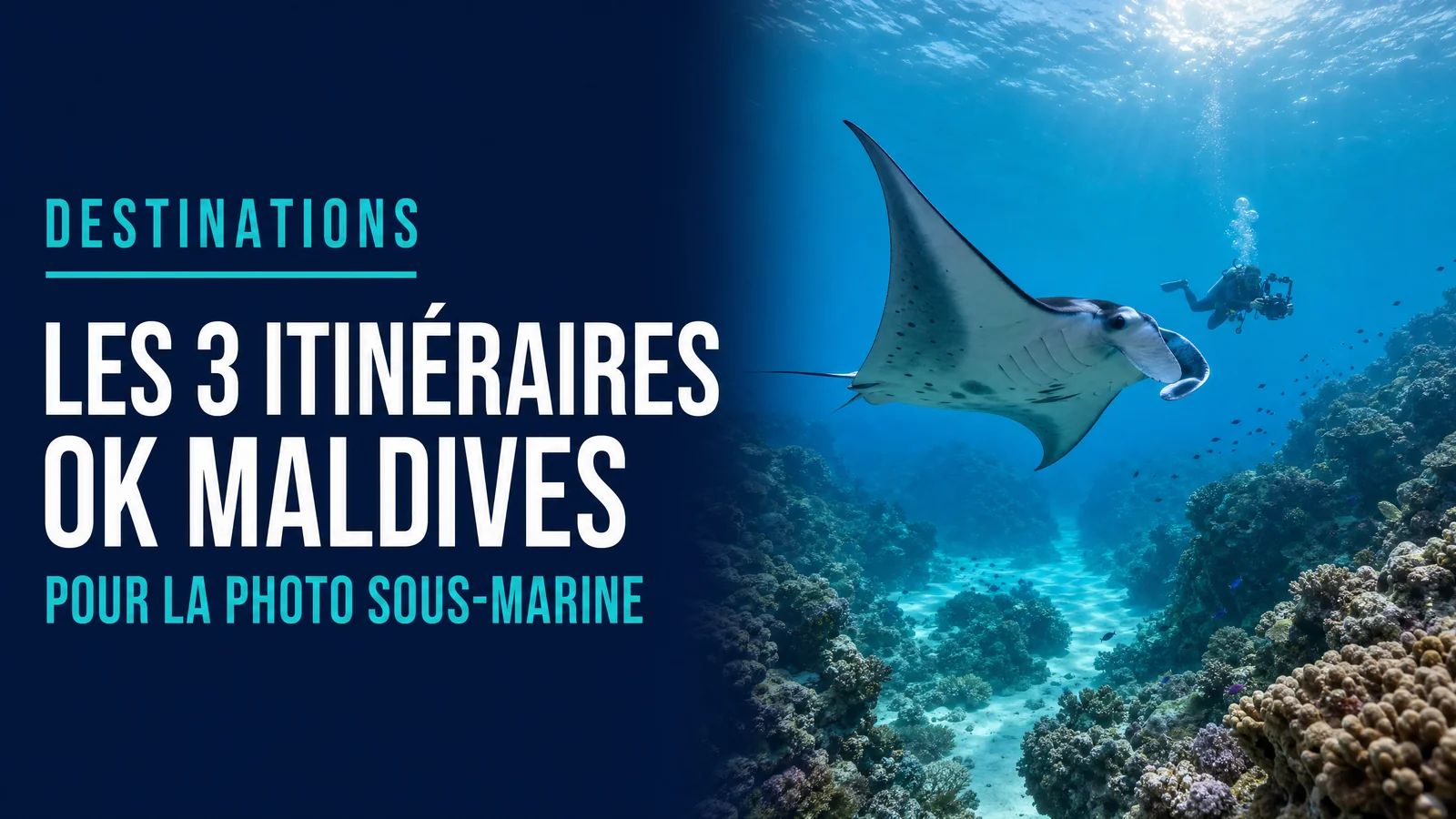
Manta rays are present on all three routes, but their concentration varies. The Centre Atolls offers the most regular encounters at cleaning stations. The Grand South allows you to observe oceanic manta rays (Mobula birostris), larger and rarer. The Grand North offers less frequent but often more intimate encounters, with animals not accustomed to divers.
Which OK Maldives circuit is best for underwater photography?
Each circuit has its photographic strengths. The Centre Atolls suits the versatile photographer who wants to work across all genres. The Grand North is ideal for the photographer seeking exclusivity and pristine reefs. The Grand South is the terrain of the wide-angle photographer, specialising in pelagics and large-scale scenes.
What is the difference between the Grand North and Grand South in the Maldives?
The Grand North explores the rarely visited northern atolls, with pristine reefs and wildlife relaxed around divers. The Grand South crosses the atolls beyond the equator, where ocean currents concentrate large marine life (whale sharks, oceanic manta rays). The North favours intimacy and authenticity, the South the power of pelagic encounters.
When planning a photo cruise to the Maldives, the choice of itinerary is probably the most important decision after choosing the boat. Each itinerary traverses different atolls, with varying currents, visibility, and marine life. This means that the photographic potential is not the same from one itinerary to another.
OK Maldives, with its 40 years of experience and intimate knowledge of the archipelago, offers three major circuits that cover the entire Maldives, from the extreme north to the extreme south. I had the opportunity to dive in the Maldives long enough to get to know these different regions, and I can provide you with a specifically photographic insight into each of these routes.
The Far North: The 3 Uninhabited Atolls (Haa Dhaal)
The circuit
This is the most adventurous itinerary in the OK Maldives catalog. Completely off the beaten path, it explores the northern atolls, which the vast majority of cruises never visit. The reason is simple: it takes time to get there, and you need to know the sites. This is where the experience of the OK Maldives team makes a decisive difference.
The Photographic Potential
The Grand North is the circuit of exclusivity. The reefs there are among the least dived in the entire archipelago, which means a fauna that is not accustomed to divers and often virgin visibility conditions. No bubbles from other groups in your images, no fins that create clouds of sand before your arrival.
The pelagic fauna is abundant in the atoll passes of the north. Sharks (reef, white tip, black tip) are present in large numbers, and their behavior in these relatively unvisited waters is noticeably more relaxed than on the heavily dived sites in the center. For the photographer, this translates into shorter shooting distances and more natural compositions.
The coral reefs themselves are in remarkable condition. Hard coral gardens, formations of table-like acropora, giant gorgonians: the wide-angle lens finds subjects on every dive.
Recommended Season
The Grand Nord is ideally suited for diving from November to March, during the northeast monsoon. The currents are then favorable in the channels, visibility is optimal, and the morning light illuminates the reefs with exceptional quality.
The Ideal Photographer
The adventurous underwater photographer, who seeks images that no one else has. The one who prefers exclusivity over the guarantee of a "big encounter". The one who knows that the best images are not always those of the most spectacular subjects, but those of the most authentic scenes.
Centre Atolls: The Classic Route
The circuit
If the North is adventure, the Central Atolls are the benchmark. This is the route that OK Maldives describes as "the most diverse in the Maldives", and this description is perfectly justified. It traverses the central atolls (North Male, South Male, Ari, Vaavu, Meemu) where the greatest variety of dive sites in the archipelago are concentrated.
The Photographic Potential
The Atolls Center is the circuit for the versatile photographer. In one week of cruising, you visit coral reefs with strong currents and sharks, cleaning stations with manta rays, soft coral gardens and shipwrecks, dramatic drop-offs and shallow reefs teeming with light.
Cleaning stations are one of the photographic highlights of this route. Manta rays regularly come to be cleaned by cleaner wrasse, and this activity makes them predictable and accessible. The photographer can position themselves upstream of the station, lie on the seabed, and wait for the manta to pass overhead. In natural light, with the surface in the background, the silhouette of the manta gliding through the water column is one of the most powerful images that diving can offer.
The central atoll passes also offer frequent pelagic encounters. Grey sharks, white-tipped sharks, tuna, and barracuda. The current brings in the predators, and the photographer positions themselves on the reef downstream to see them pass in front of the lens.
For macro photography, the reefs of the Centre Atolls are home to an incredible variety of fauna. Tropical nudibranchs, commensal shrimp, frogfish, and ghost fish. Night dives (or twilight dives) reveal a completely different fauna than that of the day.
Recommended Season
The Atolls Center operates throughout the season (November to April for the best conditions). Manta rays are present year-round, but their concentration varies depending on the atolls and the season. The OK Maldives team adapts the itinerary in real time to maximize encounters.
The Ideal Photographer
The photographer who wants to see and try everything. This is the ideal option for someone who enjoys alternating wide-angle and macro shots, pelagic and reef photography, and capturing both the environment and animal portraits. It's also the best option for a first photography trip to the Maldives, as the diversity of subjects allows you to practice all your photographic skills in a single trip.
Grand Sud and Integral South: Beyond the Equator
The route
The Grand South takes divers beyond the equator, into the South Maldivas region. This is a vast, wild territory, where atolls stretch over considerable distances, and encounters with abundant wildlife are the most likely.
The Intégral Sud goes even further, combining the north-south crossing of the archipelago into a single trip. This is the most comprehensive route, but also the longest and most demanding.
The Photographic Potential
The "Grand Sud" is the photographer's wide-angle route. The passages between the southern atolls, swept by oceanic currents, concentrate an impressive biomass. The sharks are larger, more numerous, and encounters with whale sharks are not uncommon.
Oceanic manta rays (Mobula birostris), distinct from reef manta rays from the Central Atolls, frequent the waters of the south. Larger (up to 7 meters wingspan), and less frequently observed, they offer photographers encounters of intensity that few destinations in the world can match.
OK Maldives describes certain areas of the Grand South as "breathtaking". For the photographer, this means large-scale marine life scenes: walls of fish in the current, sharks patrolling in groups, and rays gliding in the deep blue. These are images that require a wide-angle lens, quick reflexes, and perfect buoyancy control in the current.
Recommended Season
The Grand South experiences its primary diving season from January to April, when the currents and visibility conditions are most favorable in the southern atolls.
The Ideal Photographer
The experienced photographer, comfortable in strong currents, who seeks out large pelagic encounters. The one who has already returned from a first trip to the Maldives and who wants to go further, see more, and capture images that classic tours cannot.
Which route to choose
If this is your first photo cruise to the Maldives, the Atolls Center is the natural recommendation. The diversity of subjects, the predictability of encounters (especially manta rays at cleaning stations), and the variety of diving conditions make it the best learning ground.
If you return to the Maldives and are looking for adventure, the North and South offer complementary experiences. The North for exclusivity and pristine reefs, the South for abundant wildlife and spectacular passages.
In all cases, the AquaExposure support is the same: training in natural light photography, personalized advice, and daily review of images on board. Regardless of the itinerary, photographic progress is at the heart of the cruise.
To learn more and book: https://okmaldives.com/
Frequently Asked Questions
Which itinerary to choose for a first cruise to the Maldives?
The Atolls Center is the best choice for a first diving trip. It offers the greatest diversity of photographic subjects (pelagic, reef, macro, wrecks) and accessible diving conditions. The manta ray cleaning stations make encounters predictable, which is ideal for practicing your technique without pressure.
Can you see manta rays on all the OK Maldives routes?
Manta rays are present on all three routes, but their concentration varies. The Atolls Center offers the most frequent encounters at cleaning stations. The Grand South allows you to observe oceanic manta rays (Mobula birostris), which are larger and rarer. The Grand North offers less frequent, but often more intimate, encounters with animals that are less accustomed to divers.
Which OK Maldives circuit is the most suitable for underwater photography?
Each dive site has its own photographic strengths. The Atolls Center is ideal for the versatile photographer who wants to work in all genres. The Grand Nord is perfect for the photographer looking for exclusivity and pristine reefs. The Grand Sud is the territory of the wide-angle photographer, specializing in pelagic and large-scale scenes.
What is the difference between the North and the South at the Maldives?
The Grand North explores the northern, less-frequented atolls, with preserved reefs and relaxed marine life facing divers. The Grand South traverses the atolls beyond the equator, where oceanic currents concentrate abundant marine life (whale sharks, oceanic manta rays). The North prioritizes intimacy and authenticity, while the South emphasizes the power of pelagic encounters.
Ready to capture the Maldives from a different perspective?
Each OK Maldives itinerary offers an opportunity to improve your composition and framing underwater. Discover Module 5 of the AquaExposure training to master stability, framing, and composition before your departure.