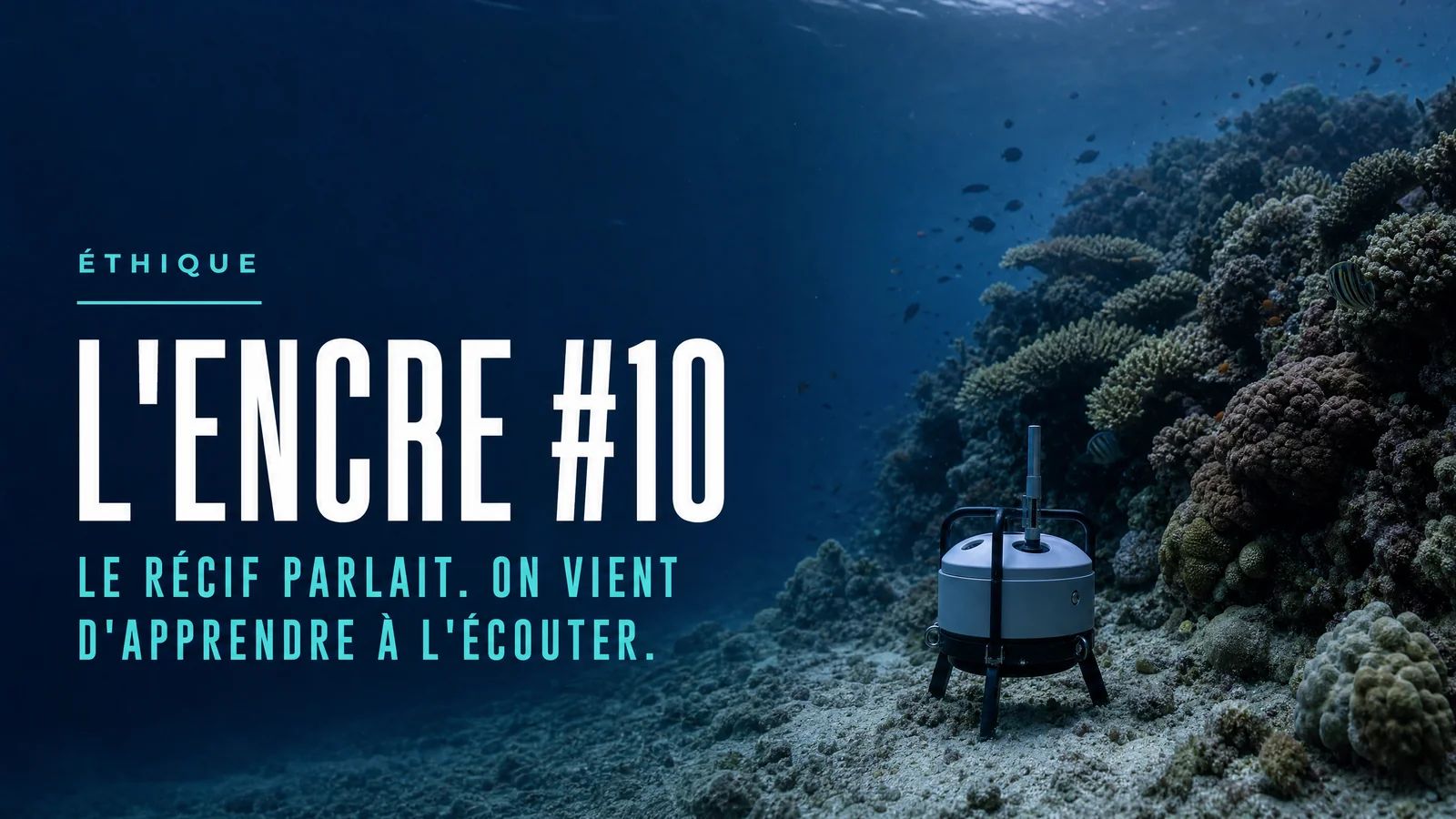
The Ink #10 - The Reef Was Talking. We Just Learned to Listen.
A WHOI robot maps acoustic biodiversity hotspots on coral reefs, a bioluminescent coral discovered in a Japanese cave at 385m, a 900km reef off Argentina. The Ink #10.
What is CUREE and how does it find biodiversity hotspots on coral reefs?
CUREE (Curious Underwater Robot for Ecosystem Exploration) is an autonomous underwater robot developed by the Woods Hole Oceanographic Institution (WHOI). It combines four hydrophones and cameras to analyze acoustic and visual signals in real time on a coral reef. Published in Science Robotics in May 2026, it identifies areas where fish density is up to 25 times higher than the rest of the reef, can track sentinel species like barracuda, and maps hotspots at centimeter resolution. Its principle: passive acoustics gives it a range of 80 meters, and vision gives it short-range precision. Combined, they allow it to triangulate where life concentrates, even behind coral, even when animals are camouflaged.
What is Corallizoanthus aureus and why is its bioluminescence exceptional?
Corallizoanthus aureus is a new species of zoantharian coral discovered in underwater karst caves off Minamidaito Island (Okinawa, Japan), at depths of 245-400 meters. Described in Royal Society Open Science in November 2025, it only emits green light in response to physical contact. Scientists believe this mechanism serves as a biological alarm: by revealing a predator's presence in total darkness, the light forces it to expose itself.
How could a 900km reef remain unknown until 2025?
The Argentine reef lies about 1,000 meters deep along a 900-kilometer stretch of the Patagonian continental shelf. At that depth, divers cannot reach it, and surface vessels see nothing. Deep-sea scientific expeditions in this area are rare: Argentina has not had the resources to map its own deep seabed. The Schmidt Ocean Institute and biologist Erik Cordes's team conducted the first systematic expeditions in July 2025, then in December 2025 and January 2026, aboard the Falkor (too).
Can underwater sounds guide a photographer toward the most life-rich zones of a reef?
Yes, and this is exactly what CUREE demonstrates at the robotic scale. Biodiversity hotspots are also acoustic hotspots: snapping shrimp, vocalizing fish, predatory activity. A diver who stays still for a few seconds, listening carefully to the ambient sound of the reef, can begin to perceive these variations. The noisiest zones on a reef are often the densest in life, and therefore the richest in photographic subjects. Listening, before looking, is starting to carry precise technical meaning.
The Ink is a weekly series on recent marine discoveries. The ink of writing. The anchor of the seabed. One issue, a few stories, and what they change when you dive with a camera.
"The ocean is a wilderness reaching round the globe, wilder than a Bengal jungle, and fuller of monsters." Henry David Thoreau, Cape Cod, 1865
It is July 2026, and three pieces of news have arrived this week, from three places that seem to have nothing in common.
The first comes from a robotics laboratory in Massachusetts.
The second comes from an underwater cave off a Japanese island, at 385 meters depth.
The third comes from the deep bottom of the Argentine continental shelf, somewhere along 900 kilometers of coral that nobody knew was there.
What they share is simple. All three are about what the eye alone cannot see.
A robot learns to listen to the reef. And it finds places that divers have been missing all along.
For decades, marine biologists have known that biodiversity on a coral reef is not uniform.
It clusters in specific zones, a few square meters of intense activity surrounded by much quieter areas. The problem is that finding them takes considerable time, and even then it is not guaranteed.
On May 13, 2026, the Woods Hole Oceanographic Institution (WHOI) published in Science Robotics the result of ten years of work: an autonomous underwater robot capable of identifying these biodiversity hotspots without human intervention.
It is called CUREE, for Curious Underwater Robot for Ecosystem Exploration. Its defining feature: it does not search with cameras alone. It listens.
Four hydrophones mounted on its extended arms capture the continuous ambient sound of the reef. Snapping shrimp, vocalizing fish, predatory activity. Acoustics gives it a range of 80 meters. Vision gives it precision at short range.
Combined, these two signals allow it to triangulate where life concentrates, even behind a coral head, even when animals are camouflaged.
In field trials conducted between 2022 and 2024 in the U.S. Virgin Islands, CUREE consistently identified the same spot as the hotspot: a large pillar coral structure, with fish densities twenty-five times higher than the rest of the reef.
It also tracked a barracuda, a sentinel species that often marks zones of high activity, and documented its repeated routes.
"Passive acoustics gives you a broad sense of the environment. Vision is short range but an information-rich data stream. In some sense they are almost a perfect complement for each other." The words are those of Seth McCammon, a WHOI roboticist and lead author of the study.
The vision of the researchers is straightforward. Fleets of these robots could eventually map reefs that have never been explored, guide conservation efforts toward the zones that need it most, and track ecosystem health in real time in a warming ocean.
The reef was talking. We just needed to learn to listen.
In a Japanese cave at 385 meters, a coral lit up when touched.
The story of Corallizoanthus aureus begins in complete darkness.
Researchers are exploring the entrances of underwater karst caves off Minamidaito Island, in Okinawa Prefecture, at depths of 245 to 400 meters. They bring an instrument close to the substrate. Something glows.
The species was described in Royal Society Open Science in November 2025. It lives attached to colonies of red coral Pleurocorallium, at the thresholds of cavities that sunlight never reaches.
What sets it apart is not its size or morphology, it has between 24 and 26 tentacles, like many other zoantharians. It is its behavior.
Corallizoanthus aureus does not glow continuously. It only emits light in response to physical contact. A brush, a mechanical disturbance, and a green glow passes through the tissue.
Scientists interpret this mechanism as a biological alarm. A way of signaling to a predator that it is no longer discreet, by revealing its presence in total darkness.
It is an inverted logic. The light here does not attract. It exposes.
Bioluminescence is present in a large proportion of marine organisms, especially in the deep sea, where it plays varied roles: communication, camouflage, predation, defense. Corallizoanthus aureus adds a mechanism to this list, and confirms that even well-studied groups, the zoantharian corals, can still hide behaviors that nobody had documented.
It may have glowed in Japanese caves for millions of years.
We just saw it for the first time.
Off Argentina, a 900-kilometer reef was waiting in the dark at 1,000 meters depth.
The third story is a question of scale.
In July 2025, then again in December 2025 and January 2026, biologist Erik Cordes of Temple University and his team sailed aboard the Falkor (too), the Schmidt Ocean Institute research vessel. Destination: the Argentine continental shelf, in Patagonia.
What they were looking for were cold methane seeps on the seafloor. What they found was far larger.
A cold-water coral reef system, dominated by the species Bathelia candida, a rare coral whose tissues appear pink, orange, or white. Most cold-water reefs in the Atlantic are dominated by Lophelia pertusa. This one is different.
The mapped formations extend across 900 kilometers of Argentina's territorial waters, at roughly 1,000 meters depth. A single structure measured by the team covered 0.4 square kilometers, approximately the area of Vatican City.
Santiago Herrera, a deep-sea biologist at Lehigh University, told Mongabay: "I would say that it is one of the most vibrant and lush environments in the deep sea that I have ever seen."
Around the corals, the team documented basket stars, glass squid, squat lobsters, skates, brooding octopuses. And around 40 new species that scientists have not yet formally described.
They also found fishing nets tangled in coral branches, and marks that may correspond to trawl damage.
In response, the team began installing 3D-printed artificial structures made of cement and coral sand, to give larvae a surface to attach to and restart restoration in damaged areas.
A reef that takes thousands of years to form. A trawl line that can cross it in a few minutes.
It took two expeditions to find this system. It will probably take decades to understand it.
What this changes for us, underwater
These three stories do not share the same scale or the same geography.
But they all describe the same problem. We have been looking at reefs for decades. We have learned a great deal. And yet, what CUREE detects by ear, what Corallizoanthus aureus reveals only to the touch, and what 1,000 meters of depth conceals in Patagonia, is enormous.
For an underwater photographer, the first lesson is acoustic. The reef produces sound, and that sound says something about where life clusters. A diver who stays still for a few seconds, listening to the ambient sound of the reef, can start to perceive those differences. The noisier zones are often the richer ones. Listening comes before looking.
The second lesson is about light, or rather darkness. Bioluminescence surrounds us on night dives, in organisms that only express it under certain conditions. An accidental brush, a shift in total darkness. What Corallizoanthus aureus illustrates is that a night dive gives access to a layer of marine life that daylight makes completely invisible.
The third lesson is a matter of humility. If a 900-kilometer reef could remain unknown until 2025, in the territorial waters of a country that is not small, then what we believe we know about the ecosystem where we dive at 30 meters may be more partial than we think.
This kind of attention, to sounds, to light, to what our eyes miss out of habit, is exactly what AquaExposure training has worked on from the start. To go further in person, the Belgium workshop resumes in autumn. All the teaching is also AquaExposure training.
What is CUREE and how does it find biodiversity hotspots on coral reefs?
CUREE (Curious Underwater Robot for Ecosystem Exploration) is an autonomous underwater robot developed by the Woods Hole Oceanographic Institution (WHOI). It combines four hydrophones and cameras to analyze acoustic and visual signals in real time on a coral reef. Published in Science Robotics in May 2026, it identifies areas where fish density is up to 25 times higher than the rest of the reef. Its principle: passive acoustics gives it a range of 80 meters, and vision gives precision at short range. Combined, they allow it to triangulate where life concentrates, even behind coral.
What is Corallizoanthus aureus and why is its bioluminescence exceptional?
Corallizoanthus aureus is a new species of zoantharian coral discovered in underwater karst caves off Okinawa (Japan), at 245-400 meters depth. Described in Royal Society Open Science in November 2025, it only emits green light in response to physical contact. Scientists believe this mechanism acts as a biological alarm: by revealing a predator's presence in total darkness, the light forces it to expose itself.
How could a 900km reef remain unknown until 2025?
The Argentine reef lies about 1,000 meters deep along a 900-kilometer stretch of the Patagonian continental shelf. At that depth, divers cannot reach it, and surface vessels see nothing. Deep-sea scientific expeditions in this area are rare, as Argentina has not had the resources to map its own deep seabed. The Schmidt Ocean Institute and biologist Erik Cordes's team conducted the first systematic expeditions in July 2025, then in December 2025 and January 2026, aboard the Falkor (too).
Can underwater sounds guide a photographer toward the most life-rich zones of a reef?
Yes, and this is exactly what CUREE demonstrates at the robotic scale. Biodiversity hotspots are also acoustic hotspots: snapping shrimp, vocalizing fish, predatory activity. A diver who stays still for a few seconds, listening carefully to the ambient sound of the reef, can begin to perceive these variations. The noisiest zones on a reef are often the densest in life. Listening, before looking, is starting to carry precise technical meaning.
Reefs have always been speaking, with their snapping shrimp, their singing fish, their corals that light up in total darkness when something brushes past them.
We had our eyes wide open.
We are learning, very slowly, to have ears.
The Ink #10 - The Reef Was Talking. We Just Learned to Listen. | AquaExposure