What is the midwater zone where the 31 species were discovered?
The midwater zone is the column of water between the sunlit surface and the seafloor. It is the largest habitat on the planet by volume, but also the least explored. The Schmidt Ocean Institute expedition off Brazil discovered 31 new species there in June 2026, including jellyfish, siphonophores and ctenophores, using the DeepPIV and EyeRIS instruments mounted on the ROV SuBastian.
What does the mapping of 165,000 km² of climate-resistant reefs mean?
The 50 Reefs+ study published in June 2026 by the Wildlife Conservation Society and Macquarie University identified 165,922 km² of coral reefs capable of withstanding warming, across 71 countries. That is three times more than previous estimates. These reefs operate through three mechanisms: avoidance, resistance and recovery.
Why do coral reefs interest medical research?
Researchers at ETH Zurich discovered that the microbes living in and around coral reefs contain more potential for producing natural molecules than all of the open ocean combined. These compounds are being explored for new antibiotics, antivirals and immune treatments.
How can underwater photographers contribute to this research?
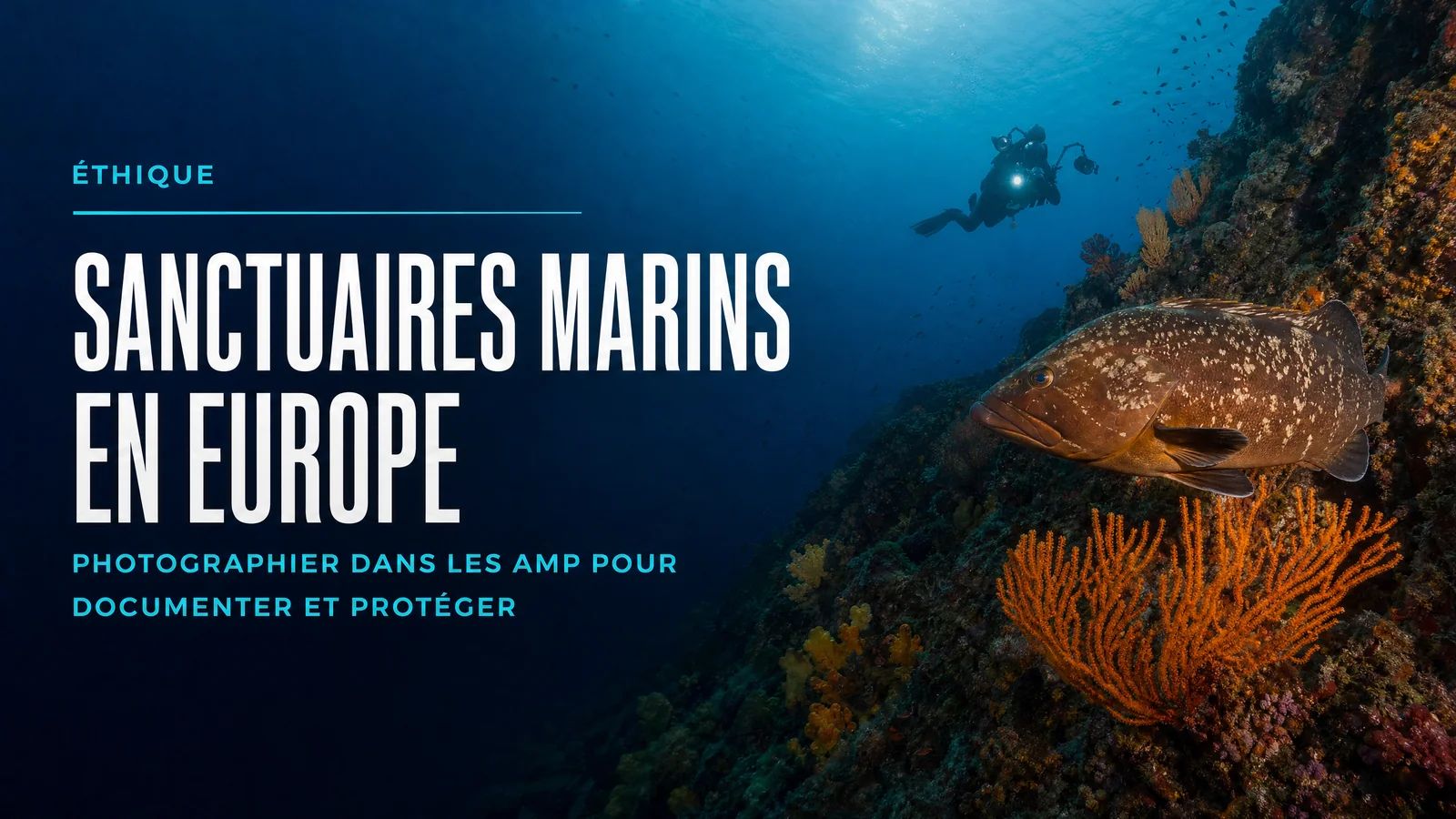
Geolocated and dated images of reefs and little-known species constitute biodiversity data. They feed the databases used by biologists and the monitoring of marine protected areas. The mesophotic zone (30-200 m) remains particularly lacking in visual documentation.
The Ink is a weekly series on recent marine discoveries. The ink of writing. The anchor of the seabed. One issue, a few findings, and what they change when you dive with a camera.
"How inappropriate to call this planet Earth when it is quite clearly Ocean." Arthur C. Clarke
We are in mid-June 2026. Three research results arrived within a few days, from three different continents, on three subjects that look nothing alike.
An oceanographic vessel off the coast of Brazil. An international consortium mapping the surviving reefs. A Swiss laboratory sequencing the DNA of coral microbes.
None of the three groups was working with the others. None expected to find so much.
The common thread is that all three looked where, normally, nobody looks.
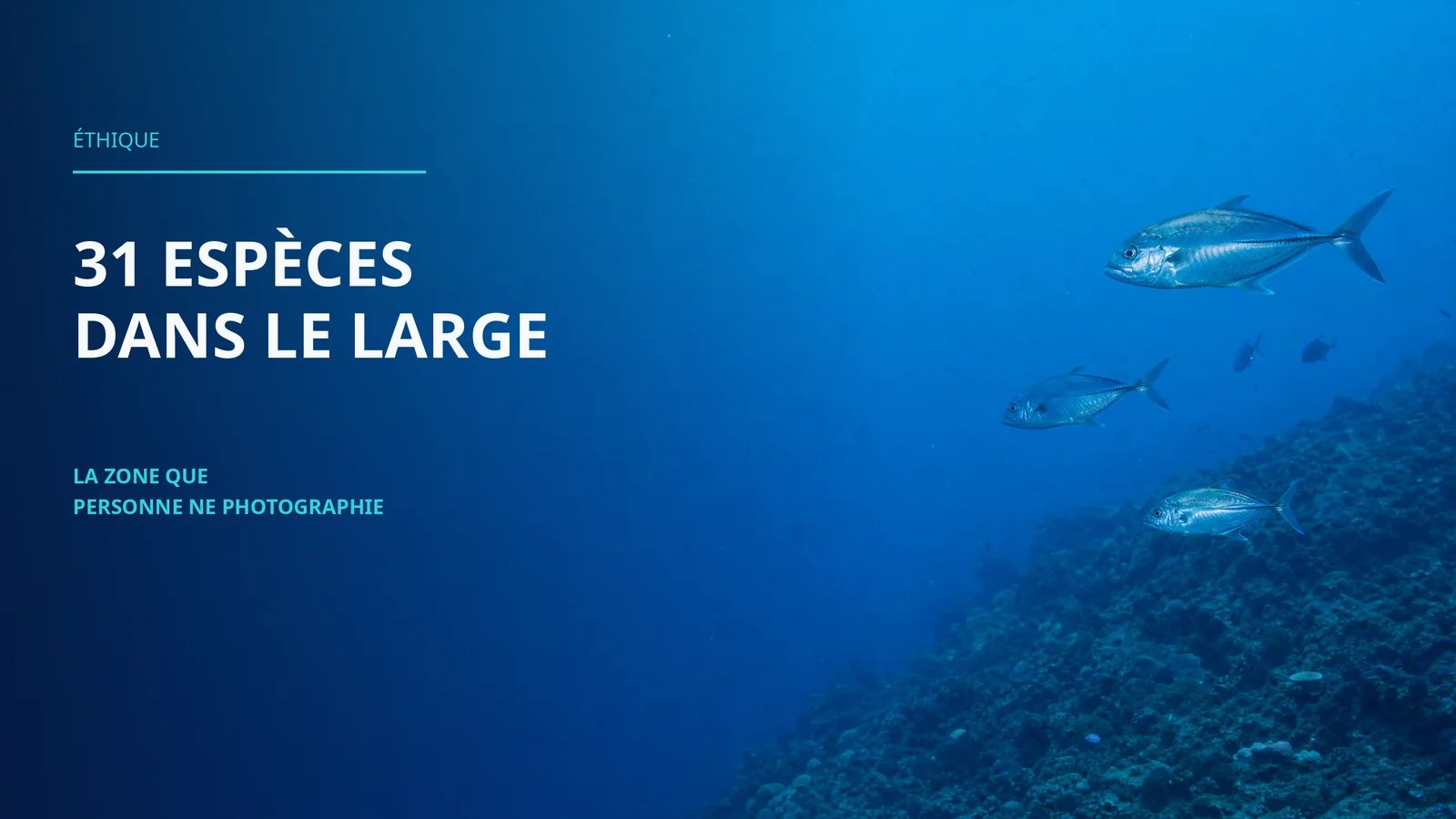
31 species in the water column nobody watches
Between the sunlit surface and the seafloor, there is a space that oceanographers call the midwater zone.
In volume, it is the largest habitat on the planet. Larger than all the forests, all the deserts, all the grasslands combined.
And it is probably the least explored of all.
The Schmidt Ocean Institute sent its research vessel Falkor (too) off the coast of Fortaleza, Brazil, in June 2026.
The goal was to explore this water column in the tropical South Atlantic using instruments that almost nobody else deploys at these depths.
The instruments are called DeepPIV and EyeRIS. They are imaging systems developed by the MBARI Bioinspiration Lab, mounted on the ROV SuBastian.
DeepPIV projects a laser sheet into the water and films the particles passing through it. EyeRIS captures high-resolution images of organisms in motion, without capturing or retrieving them.
In a matter of weeks, the team identified 31 species new to science.
Jellyfish. Ctenophores, those translucent organisms also called sea gooseberries. Siphonophores, floating colonies made up of thousands of specialised individuals connected into a single structure.
Larvaceans, small tadpole-shaped animals that secrete a mucus house to filter particles. A transparent worm. An amphipod.
What struck the researchers was not only the number. It was the speed of confirmation.
Usually, identifying and formally describing a new species takes years, sometimes decades. Here, the combination of in situ imaging and onboard expertise allowed species to be confirmed within days.
The expedition also achieved a world first: imaging the 3D cellular structure of a microbe at sea, in real time.
What is hard to grasp in this discovery is the scale of the ignorance. The midwater zone is the largest habitable volume on Earth.
We just found 31 unknown species there in a single campaign of a few weeks. If you extrapolate, the vertigo is immediate.
165,000 km² of reefs that refuse to die
While the Falkor was lowering its instruments into the Brazilian darkness, another result landed on the other side of the world.
The Wildlife Conservation Society and Macquarie University had just published the 50 Reefs+ study. It is the most comprehensive global mapping of coral reefs resistant to climate change.
The headline figure: 165,922 km² of reefs identified as capable of holding out against warming, spread across 71 countries and 100 territories.
That is three times more than previous estimates.
It is not that the reefs are doing better. It is that we had underestimated their resilience, because we had not yet looked everywhere.
The team analysed more than 45,000 coral surveys, cross-referenced with decades of climate and ocean data. The mapping, carried out by SkyTruth using satellite imagery and artificial intelligence, covers zones that had never been assessed before.
What makes the study useful beyond the headline number is its classification into three types of resilience.
Avoidance reefs: located in naturally cool ocean pockets, shielded from thermal stress by geography and currents.
Resistance reefs: inhabited by corals that have developed adaptations allowing them to survive bleaching events where others die.
Recovery reefs: capable of reconstituting themselves rapidly after a shock, thanks to a combination of larval connectivity, genetic diversity and favourable local conditions.
61% of these resilient reefs are found in five countries: the Bahamas, Cuba, Australia, Indonesia and the Philippines.
Significant zones were also identified in the Caribbean (Belize, Panama, Turks and Caicos), in places where previous assessments had not looked.
The counterpoint to the good news: fewer than 30% of these resilient reefs are located inside marine protected areas.
We now know where they are. The question is whether we will protect them before the information becomes a memory.
The third result comes from ETH Zurich, in Switzerland, and it shifts the angle on reefs in a way nobody expected.
Researchers sequenced the genomes of hundreds of microbial species living in and around corals. Bacteria, fungi, microscopic organisms that nobody looks at when talking about reefs.
Because everyone looks at the corals themselves.
What they found is remarkable in its proportion.
The potential for producing natural molecules in the genomes of coral micro-organisms exceeds that of the entire open ocean.
This is not an imprecision. Coral reefs cover less than 1% of the ocean surface. The microbes living in them contain more genes coding for bioactive compounds than all the microbes in the rest of the sea.
These compounds are being explored for new antibiotics, antivirals, and immunological treatments. NOAA researchers have identified a molecule capable of breaking the shield that certain bacteria use to resist antibiotics.
What is hard to absorb in this discovery is the timing.
The reefs are disappearing. We covered it in The Ink #5: more than half the world's reefs bleached during the last global event. And in The Ink #6, we talked about the alkaline tiles attempting to save them.
Inside those declining reefs, there are molecules that medicine has not yet had time to explore.
It is a library burning before we have finished reading it. Not as metaphor. As biochemistry.
What this changes for us, underwater
Three results, three continents, three angles on the same observation: the ocean hides more than what we look for.
For underwater photographers, there is a practical consequence in each of these results.
The midwater zone, this in-between space that the Falkor has just explored, is also a photographic in-between. We photograph the surface. We photograph the seafloor. What floats between the two, those translucent organisms, those gelatinous colonies, those mucus architectures, is rarely documented in images.
It is a vast and almost untouched subject.
The resilient reefs identified by the 50 Reefs+ study pose another question. We now know where they are. Knowing where to point a lens to produce images that matter is already a considerable advantage.
And the pharmacy hidden in the corals reminds us of what AquaExposure training often drives home: a reef is not a backdrop. It is a living system where every invisible component is potentially irreplaceable.
What is the midwater zone where the 31 species were discovered?
The midwater zone is the column of water between the sunlit surface and the seafloor. It is the largest habitat on the planet by volume, but also the least explored. The Schmidt Ocean Institute expedition off Brazil discovered 31 new species there in June 2026, including jellyfish, siphonophores and ctenophores, using the DeepPIV and EyeRIS instruments mounted on the ROV SuBastian.
What does the mapping of 165,000 km² of climate-resistant reefs mean?
The 50 Reefs+ study published in June 2026 by the Wildlife Conservation Society and Macquarie University identified 165,922 km² of coral reefs capable of withstanding warming, across 71 countries. That is three times more than previous estimates. These reefs operate through three mechanisms: avoidance (naturally cool zones), resistance (adaptations to thermal stress) and recovery (capacity to bounce back after bleaching).
Why do coral reefs interest medical research?
Researchers at ETH Zurich discovered that the microbes living in coral reefs contain more potential for producing natural molecules than all of the open ocean combined. These compounds are being explored for new antibiotics, antivirals and immune treatments, even as the reefs that host them are in rapid decline.
How can underwater photographers contribute to this research?
Geolocated and dated images of reefs and little-known species constitute biodiversity data. They feed the databases used by biologists and the monitoring of marine protected areas. The mesophotic zone (30-200 m) remains particularly lacking in visual documentation.
Somewhere between the surface and the seafloor, in that black water divers pass through while looking elsewhere, unnamed jellyfish keep pulsing in the current.
They do not know they have just been counted. They do not need to.
We were the ones who needed it.
The Ink #7 - 31 Species in the Zone Nobody Photographs | AquaExposure