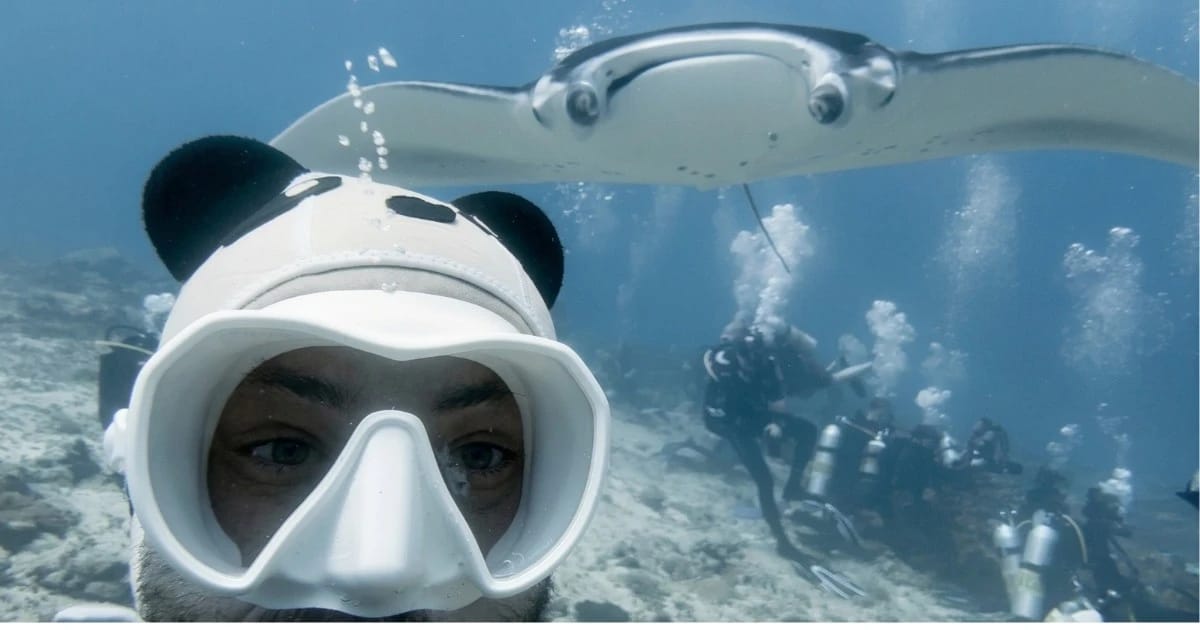
What is the Scenography of Erasure in underwater photography?
The Scenography of Erasure is a method developed by AquaExposure based on 5 pillars: tangential trajectory (never swimming straight at the animal), strategic stillness, controlled breathing, passive lighting (no flash), and conscious shutter release. The goal is to become invisible to marine life.
How do you approach marine animals without scaring them away?
The key is the tangential trajectory: swim in an arc around the animal, never in a straight line towards it. Stabilise yourself and stop all movement. Slow your breathing to reduce bubble noise. By adopting this approach, animals reclassify you as a curiosity rather than a threat.
When I was a diving instructor in the Maldives, I spent half my days around manta cleaning stations.
If you do not know what that is: picture a specific spot on the reef where small cleaner fish live permanently. Manta rays come there regularly to have their parasites removed. It is an appointment. They arrive, they position themselves in the current, they open their gills, and the little wrasses do their work. It is one of the most incredible spectacles in the ocean, and it is predictable. You know where they will be. You roughly know when.
And that is where the circus begins.
Every morning, boats drop off 15, 20, sometimes 30 divers. And the moment the first manta appears, it is all-out war. People throw themselves at it. Literally. Frantic finning in every direction. Fins smacking the person next to them in the face. Flashes firing like lightning strikes. GoPros brandished at arm's length like weapons. I have seen divers shoving each other underwater to "get the best spot". I have seen someone grab another diver's fin to pull them back and get ahead.
To photograph a manta ray.
One that asked for nothing and is just trying to get its parasites cleaned.
And you know what happens when 20 people rush at a manta at the same time? She leaves. She interrupts her cleaning, a cleaning she biologically needs, and she goes. Sometimes she comes back 20 minutes later. Sometimes she does not come back for the rest of the day. And the 20 divers surface with blurry photos of a fleeing animal, telling themselves "bad luck, she left too fast".
No. She did not leave too fast. You scared her off.
Me, during all that, I was settled on the sand at 15 metres from the station. Motionless. For an hour.
What nobody sees (because everyone is looking in the wrong place)
When you understand the behaviour of a manta ray around a cleaning station, you know something that 99% of divers do not:
the manta does not simply pass through. She makes circuits.
She arrives from one side. She positions herself facing the current. She gets cleaned. She leaves. And 5 to 15 minutes later, she comes back. Along the same path. Again and again, sometimes for hours.
When you understand this circuit, when you observe instead of charging, you can position yourself on the return trajectory. Not on the station itself (where everyone is fighting), but on the path she takes to come back.
And then you stop moving. You breathe slowly. You wait.
The first time I did this, a manta with a 4-metre wingspan passed 50 centimetres from my mask. Not because I chased her. Because I was on her path, motionless, and she reclassified me from "threat" to "weird rock".
She looked at me. She slowed down. And she passed again.
While the 20 other divers were flapping their fins 30 metres away trying to catch up with her, I was lying on the sand and the manta was coming to see me of her own choice. My photos from that day? Sharp. Head-on. With a relaxed manta, gills open, eyes looking straight into the lens.
Not because I had a better camera. Because I had understood that the secret is not to run faster. It is to not run at all.
The problem you have (and that I had too before the Maldives)
Look at your last 10 underwater photos of animals. Be honest. How many show a relaxed animal, calm, in natural behaviour? How many show a gaze turned towards you out of curiosity?
And how many show an animal from behind, in profile, or swimming away?
If the majority falls into the last category, welcome to the club. The club of people who chase animals and cannot understand why they flee. I was its president before going to the Maldives.
The problem is not your gear. Not your diving technique. Not "bad luck". The problem is your presence.
Put yourself in the fish's position: an 80-kilo thing shows up in your house, makes explosion sounds every 4 seconds, waves appendages in every direction, and charges straight at you with a shiny metallic object. What do you do?
Exactly. You leave. And that is what every marine animal you chase does.
The worst part is that these moments do not replay. The manta passing the cleaning station, she might come back. But the whale shark emerging from the blue? The octopus changing colours in front of you? That is a chance. One chance. And if your presence ruins it, there is no replay button.
What I learned from training hundreds of divers (and watching the same mistakes on repeat)
When I taught in the Maldives, I gave briefings before every dive. "Don't rush the mantas. Stay at a distance. Let them come to you." I said it hundreds of times. With conviction. With diagrams. With examples.
And every time, every single time, the moment the manta appeared, everyone forgot everything and finned like mad towards the animal.
The euphoria of the moment erases every briefing in the world. I know this because I used to do exactly the same thing before I understood. The brain sees "MANTA" and short-circuits all rationality. It is stronger than us. It is a primate reflex.
That is why I stopped giving "tips" and built a method. Because a tip, you forget it underwater. A method integrated into the body, you do not.
The Scenography of Erasure: 5 pillars (because "stay still" is not enough)
At AquaExposure, we formalised everything I learned over years of diving and instruction into a structured, reproducible, teachable method. We called it the Scenography of Erasure.
Pillar 1 - Tangential Trajectory
Never swim in a straight line towards an animal. Never. Underwater, something heading straight for you is a predator. Something passing beside you is a harmless neighbour.
At cleaning stations, the divers who get the best interactions are those who arrive from the side, slowly, in an arc, as if the manta did not interest them at all. The animal watches you. It evaluates. And when your trajectory says "I'm not coming for you", it relaxes.
Pillar 2 - Strategic Stillness
This is what changed everything for me in the Maldives. Settle down. Stop moving. For an hour if necessary.
I know, it is counter-intuitive. You paid for a dive, you want to "explore", "see things", "optimise your time underwater". But time spent motionless at the right spot is worth ten times the time spent finning from one end of the reef to the other.
The manta making her circuit does not come towards divers who move. She comes towards rocks. Become a rock. A patient rock, with a mask.
Pillar 3 - Controlled Breathing
Every exhalation in scuba diving produces a noisy curtain of bubbles. To a fish, it is a recurring explosion. Imagine a neighbour setting off a firecracker every 4 seconds next to your head while you are trying to get a massage. You would change spas.
Slow your breathing. Exhale slowly, steadily, without jolts. Animals interpret a slow rhythm as a signal of calm. In the Maldives, the divers with the slowest breathing rate were systematically the ones the mantas approached first. Not a coincidence, just biology.
Pillar 4 - Passive Lighting
Flash triggers a flight response in the majority of marine wildlife. At cleaning stations, I have seen mantas interrupt their cleaning and leave because of a single flash fired from 5 metres away. One flash. Just one. And the manta would not return for 30 minutes. For everyone.
Work in ambient light. Raise your ISO if needed. Accept a little grain rather than losing an interaction that 20 divers were waiting for. I prefer a photo at ISO 1600 of a manta looking me in the eye to a photo at ISO 100 of an empty space where a manta was 3 seconds ago.
Pillar 5 - Conscious Shutter Release
No burst mode. No "spray and pray, I'll sort later". Observe the animal's movement. Anticipate its trajectory. And release once, at the exact moment when framing, light and behaviour converge.
In the Maldives, my best photos were never from the manta's first pass. They were from the third, the fourth pass, when I had understood her circuit, chosen my angle, and was waiting for the precise moment. Patience produces images that haste never will.
What science confirms (and what I discovered by accident)
What I learned through field observation, science measured in the lab. A study published in Marine Ecology Progress Series (Stankowich & Blumstein, 2005) demonstrated that the flight distance of a marine animal is directly correlated to the speed and trajectory of the approach. An object heading straight on triggers flight at maximum distance. An object moving tangentially reduces that flight distance by 40 to 60%.
Laurent Ballesta, the underwater photographer who spent 28 days at -120 metres during the Gombessa expedition, captures this philosophy perfectly. Everything in Module 3 of AquaExposure rests on that conviction that patience is not a quality of the underwater photographer but rather the primary technique.
And Sylvia Earle, legendary oceanographer and founder of Mission Blue, adds a dimension I wish I had understood earlier: observe before shooting, understand before capturing. That is exactly what we teach.
What it changes (the real difference, not marketing)
The before-and-after of AquaExposure learners who integrate the Scenography of Erasure is always the same:
Before: "I chase animals and miss everything." After: "Animals come to me and I choose my framing."
The first time it happens to you, the first time a wild animal approaches you on its own, out of curiosity, it is a moment you do not forget. I have seen divers crying in their masks on the ascent (it is possible, and it is not elegant with the fogging, but who cares).
This is not magic. It is what I have observed over hundreds of dives in the field: when you stop being a threat, you become a curiosity. And when animals are curious, they come closer than you would ever dare go yourself.
That is where the images you see in documentaries are born. Not with a 5,000-euro telephoto lens and a production boat. With a solo diver, motionless, who understood that the secret is doing nothing in the right place.
The full training
The Scenography of Erasure is Module 3 of AquaExposure. But its philosophy runs through the entire course, from Module 1 (Fundamentals) to Module 9 (Neptune AI, our automatic colour correction tool).
10 progressive modules. Interactive exercises in a Duolingo style. A progression system with XP and streaks. And Kai, our manta ray mascot, who makes a proud face when you succeed and a worried face when you lose your streak. (Kai motivates me more than I will ever publicly admit.)
Pricing:
Free - previews of each module. Test, watch, decide. Zero commitment.
480 euros - lifetime - all current and future modules, Neptune AI beta, Gold badge.
To put that in perspective: a single dive in the Maldives with the mantas costs between 80 and 130 euros. For the price of 2 dives, you get a full year of training that transforms all your future dives. And unlike a botched dive where you scared off the manta, this training ensures that next time, she will come to see you.
My guarantee
If after your first 3 post-training dives, you do not observe a change in how animals behave around you, send me your images. Not to a support desk. To me. Benjamin. I will look at them and we will work on it together.
I spent years training divers in the Maldives. I know how to spot what is off in an approach, and above all, I know how frustrating it is to miss those moments. Because the manta coming back to the cleaning station, she does not know this is your first encounter. For her, it is an ordinary Tuesday. For you, it might be the memory of a lifetime. And that memory deserves better than a blurry photo from behind.
Stop running. Settle down. And let the ocean come to you.
FAQ - Frequently asked questions about the Scenography of Erasure
What is the Scenography of Erasure in underwater photography?
The Scenography of Erasure is a method developed by AquaExposure based on 5 pillars: tangential trajectory (never swimming straight at the animal), strategic stillness, controlled breathing, passive lighting (no flash), and conscious shutter release. The goal is to become invisible to marine wildlife so that animals approach on their own.
How do you approach a marine animal without scaring it off?
The key is the tangential trajectory: swim in an arc around the animal, never in a straight line towards it. Stabilise yourself, stop all movement, and slow your breathing. A predator charges in a straight line. A harmless being passes beside you. By adopting this approach, animals reclassify you as a curiosity rather than a threat.
Does camera flash really frighten underwater animals?
Yes. Flash triggers a flight response in the majority of marine wildlife. In the Maldives, I have seen mantas interrupt their cleaning and flee because of a single flash from 5 metres away. AquaExposure teaches natural-light photography: raise your ISO rather than sacrificing an interaction.
How long does it take to master this method?
Most AquaExposure learners observe a change in animal behaviour from their first 3 post-training dives. The tangential trajectory and stillness integrate quickly. Controlled breathing and conscious shutter release require more practice, roughly 10 to 15 dives for it to become second nature.
Does this method work with all marine animals?
It works with the vast majority of megafauna (manta rays, sharks, turtles, dolphins) and macrofauna (groupers, octopuses, moray eels). Fast pelagic species (tuna, barracudas) are more unpredictable, but the tangential trajectory significantly increases your chances of interaction even with them.
Do you need specific equipment to practise the Scenography of Erasure?
No. That is precisely the advantage: the method relies on your behaviour, not your gear. A smartphone in a DiveVolk housing is enough. What matters is your ability to stay still and not fire a flash. One of my beginner students, who had never dived before retirement, gets extraordinary results with a simple waterproofed iPhone.
Benjamin Coste
Founder of AquaExposure. Former diving instructor in the Maldives. Specialist in the Scenography of Erasure and ethical underwater photography.