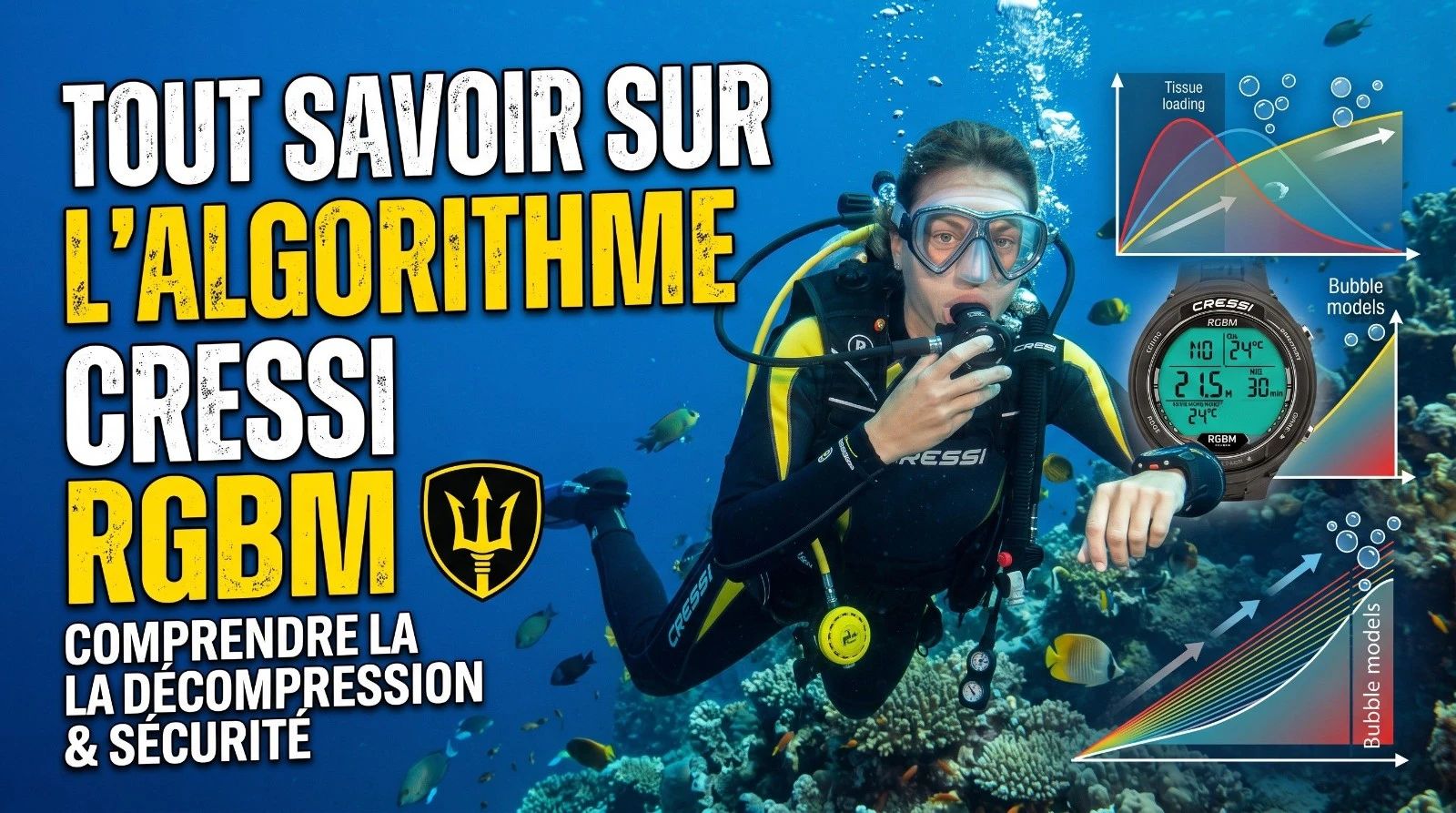
Understanding the Cressi RGBM Algorithm: Review, Safety, and Settings
Complete analysis of the Cressi RGBM decompression algorithm. How it works, conservatism (Safety Factor), deep stops, and instructor review.
Introduction
If I had to look back at my early days as an instructor in the warm waters of the Red Sea, I would surely see the bright sun beating down on the boat deck.
That is where I first saw a student show me a yellow, robust housing, the famous Cressi Leonardo, which would become the companion of his very first bubbles.
It is a proprietary version of Bruce Wienke's Reduced Gradient Bubble Model (RGBM) algorithm, adapted specifically for Cressi dive computers (Leonardo, Giotto, Michelangelo...) for recreational diving.
What are the Safety Factors (SF0, SF1, SF2) on Cressi computers?
Safety Factors are predefined conservatism levels. SF0 is the standard setting, SF1 increases safety margins, and SF2 applies maximum conservatism for tired or older divers.
Why is the Cressi RGBM so restrictive on repetitive dives?
The algorithm accumulates heavy penalties to limit microbubble growth after multiple consecutive dives, which significantly reduces the available no-decompression limit (NDL).
The student who had chosen me to guide him had bought this computer on a seller's advice. Under water, I immediately understood that this instrument would make no presents for our small buoyancy errors.
Every slightly too fast ascent was instantly paid for in additional minutes of decompression stops. That was my concrete encounter with the Cressi RGBM algorithm, an adapted version of a famous model that forgives nothing but protects the diver above all.
Profile of the Algorithm
The original RGBM (Reduced Gradient Bubble Model) was designed by the American physicist and diver, Dr. Bruce Wienke. Cressi collaborated closely with him to integrate a specific version into its own dive computers.
Unlike purely Haldanian models like the Bühlmann ZHL-16C which focus solely on the tension of dissolved gases in our tissues, the RGBM is a bubble model, or a dual-phase model.
The calculation takes into account both dissolved gas and the physical dynamics of circulating microbubbles. The goal is to prevent the formation and growth of these silent microbubbles before they even cause problems.
Although the mathematical foundations of the Classic Wienke RGBM are public, the version implemented by Cressi with its own adjustments and safety limits is proprietary and remains locked away as an industrial secret.
Ease of Use and Conservatism Settings
The brand designed its computers for the general public. Adjusting the conservatism is generally done via simple one or two-button navigation in the main menu, often under the "DIVE" or "SET" tab.
This is extremely accessible for divers. There are no complex Gradient Factors to calculate. The diver chooses a predefined "Safety Factor" from three levels.
The SF0 level represents the standard setting, which is already inherently conservative. The SF1 level provides increased safety. The SF2 level offers maximum conservatism, often recommended for tired or aging divers.
Recent computers allow managing 2 to 3 gases (Air and Nitrox). Switching during the dive is designed to be intuitive by long-pressing a button at the gas switch depth, thought out for advanced recreational diving without the complexity of the technical world.
Real-Time Diver Safety Adaptation
The classic Cressi RGBM does not take into account heart rate, breathing, or skin temperature. It relies strictly on a mathematical algorithm crossing depth, time, and the history of previous dives.
It is in the management of risky profiles that the algorithm reveals its character. It is extremely punishing when facing dangerous behaviors like yoyo profiles or rapid ascents.
If you perform a reverse profile or a sudden ascent, the algorithm applies an instant and drastic penalty on your no-decompression limit (NDL) or significantly increases your stops, particularly for repetitive dives.
The bubble model naturally implies the use of deep stops. On most computers, Deep Stops are enabled by default and can be disabled by the diver, although it is recommended to leave them active within the logic of the RGBM.
Medical Feedback and DAN Data
Wienke's original RGBM model relies on a massive database from the Los Alamos National Laboratory (LANL) including thousands of real dives. However, the specific variant for Cressi is validated internally, without recent independent clinical publications on this precise model.
Global statistics from DAN show that recreational RGBM algorithms are among the safest for the general public. Rates of unexplained decompression sickness are extremely low, precisely because of this high level of conservatism.
However, a controversy exists in hyperbaric medicine. A study by the NEDU (US Navy) showed that for deep air decompression dives, models favoring deep stops generated more decompression stress than classic Haldanian models.
Although this mostly impacts committed diving, the current consensus tends to move away from purely bubble models and back towards dissolved gas models for technical dives.
Strengths and Weaknesses
The major strength lies in its exceptional passive safety for the recreational diver. The algorithm takes care of inattention errors by locking the profile of the next dive, thus reducing the risk of an accident.
The main weakness is its ultra-punitive side on repetitive dives. During a busy weekend or a cruise with 3 to 4 dives per day, the algorithm accumulates penalties and bottom time melts like snow in the sun.
This can be very frustrating compared to divers equipped with other less conservative computers.
Field Verdict (Dive Group Behavior)
If you dive with a buddy equipped with a Suunto using the Suunto RGBM or a Mares, your decompression profiles will be synchronized.
However, if your buddy dives with a Bühlmann algorithm or a more permissive model like the Suunto Fused RGBM 2, you will be the diver who calls the end of the dive by reaching your limits long before they do.
Its surface desaturation is slow and cautious. For a fast-paced dive cruise, it is strongly advised to dive with Nitrox to counteract the algorithm's penalties, otherwise you may see your dive times reduced to 20 or 30 minutes by the end of the trip.
To learn how to manage your decompression profiles under water and optimize your safety, you can check our AquaExposure training dedicated to dive preparation.
Conclusion
The Cressi RGBM is the ideal choice for the beginner to intermediate recreational diver who performs one to two dives per day and who places absolute safety above bottom time optimization. It forgives buoyancy approximations by imposing strict limits.
On the other hand, it is not intended for the technical diver, nor for the underwater photographer performing atypical profiles, nor for the intensive cruise diver. With stars in their eyes.
Understanding the Cressi RGBM Algorithm: Review, Safety, and Settings | AquaExposure