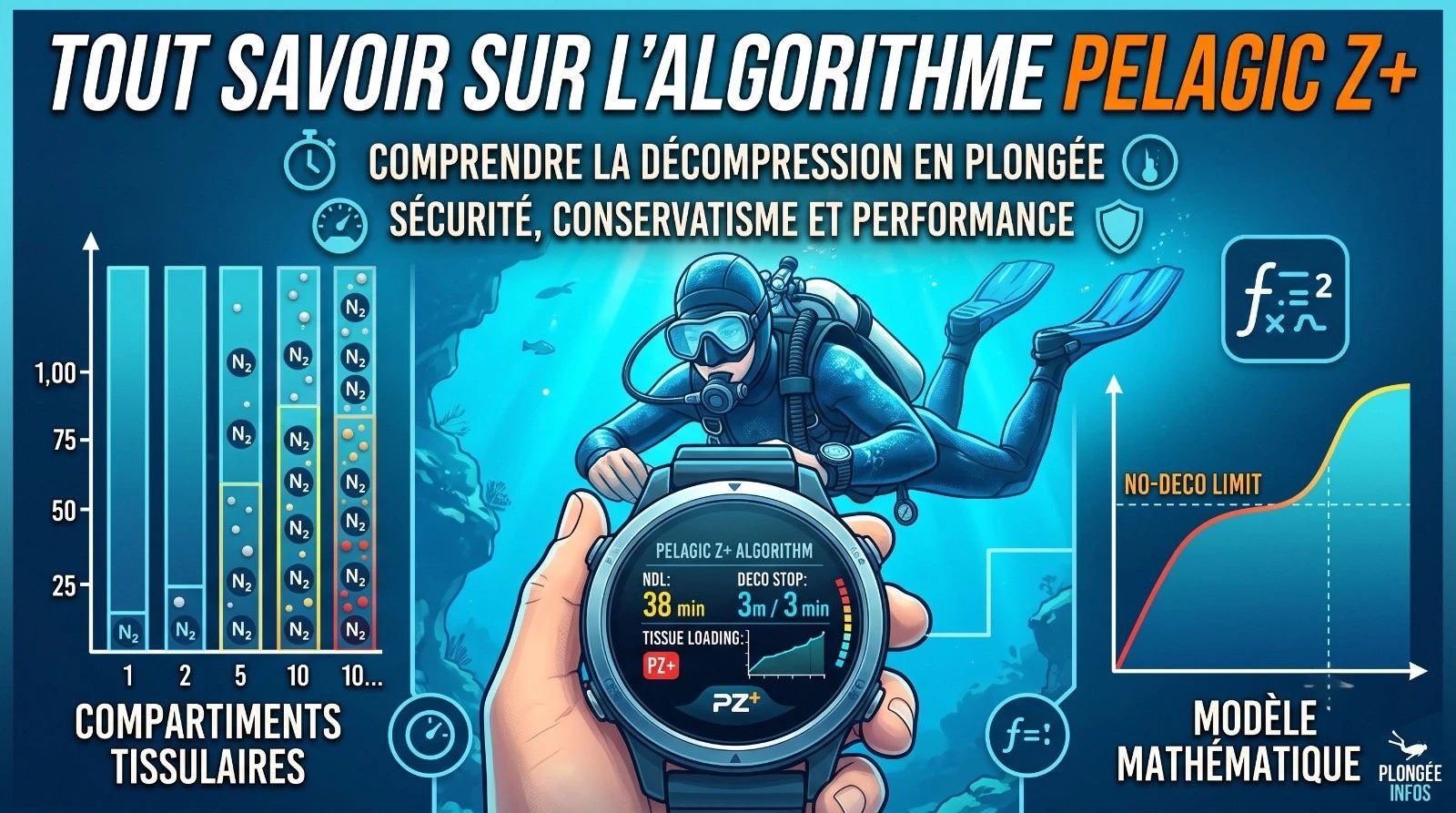
Everything you need to know about the Pelagic Z+ algorithm- reviews, safety, and settings.
Comprehensive analysis of the Pelagic Z+ decompression algorithm used by Aqualung and Oceanic. Functionality, safety, settings, and instructor reviews.
It is a proprietary and closed-source implementation of the Bühlmann ZHL-16C decompression algorithm, developed by Pelagic Pressure Systems for Aqualung and Oceanic dive computers.
What is the difference between the Pelagic DSAT and the Pelagic Z+?
PADI is quite lenient regarding recreational diving without decompression stops in warm waters. In contrast, the Z+ algorithm is more conservative and robust for managing deep dives that approach decompression limits.
Does the Pelagic Z+ allow you to adjust gradient factors?
No, on standard computers from Aqualung and Oceanic, the calculations for gradient factors are hidden behind simplified safety settings (On/Off) to make them easier to use.
In the tranquility of a deep dive, the dive computer is the silent arbiter that determines our ascent time. For regular divers who explore drop-offs or wrecks, choosing a robust algorithm is an essential guarantee of peace of mind. With this in mind, the Pelagic Z+ algorithm was designed, translating the scientific rigor of the Bühlmann model into a simplified interface for the general public.
I remember a spring exploration dive on the steep drop-offs off the French Catalan coast. The water was still cool, and I was testing an Aqualung computer configured with the Pelagic Z+ algorithm. As we explored narrow crevices in search of red coral at a depth of thirty-five meters, the predictable and reassuring behavior of this algorithm allowed me to manage my decompression stops calmly. This experience demonstrated the value of a robust mathematical model that knows how to fade into the background while ensuring optimal safety.
Algorithm ProfileThe Pelagic Z+ was developed by Pelagic Pressure Systems, a software engineering company specializing in dive instrumentation that was acquired by the Aqualung group. The design of this chip was overseen by Dr. John E. Lewis, a renowned physicist who adapted the famous data from Dr. Albert Bühlmann to integrate it into consumer-grade computer processors.
Mathematically, it is a classic Haldanian model based on dissolved gas, using the Bühlmann ZHL-16C algorithm with sixteen theoretical tissue compartments. Therefore, it is not a bubble model (like RGBM or VPM-B). It is found in the entire range of Aqualung instruments (including the i100, i200C, i300C, i330R, i470TC, and i770R) as well as in Oceanic computers. The latter offer a dual algorithm system, allowing divers to choose between the Pelagic DSAT and the Pelagic Z+. The exact calculation code for this algorithm remains proprietary and confidential.
Ease of Use and Conservative Settings
The strength of the Pelagic Z+ is that it makes a technical decompression model accessible without requiring complex mathematical knowledge. It is not necessary to configure complex Gradient Factors (GF Low / GF High) yourself.Manufacturers have hidden this complexity behind a simple safety option called the "Conservative Factor," which is available in the computer's settings. Activating this option adds an overall safety margin by reducing theoretical bottom times and extending decompression stops.
For advanced recreational divers and autonomous level 3 divers, multi-gas management is seamlessly integrated. The algorithm calculates the decompression profile for each programmed gas mixture (Nitrox or air) and instantly updates the total ascent time as soon as the diver confirms a switch to a different tank underwater.
Adapting to Diver Safety in Real Time
The Pelagic Z+ pure is a mathematical algorithm based solely on time, depth, and breathing gas. It does not incorporate real-time biometric sensors such as heart rate or respiratory effort from the diver to modify decompression stops. However, if the diver performs excessively rapid ascents or "yo-yos," the computer immediately detects saturation in short tissue compartments and applies a penalty in the form of a drastic reduction in no-decompression time (NDT).Like the classic Halden model it is inspired by, the Pelagic Z+ does not require mandatory deep decompression stops, instead favoring a continuous ascent to the surface interval zone. The computer consistently suggests a three-minute safety stop at five meters. It also offers an optional feature for dynamic deep stops, calculated at mid-depth, which the diver can choose to ignore without risking locking out the dive computer.
Medical Experience and DAN Data
DAN statistics demonstrate that the Pelagic Z+ has an excellent level of clinical safety. Based on the proven Bühlmann ZHL-16C database, it benefits from decades of positive medical feedback in hyperbaric environments and during thousands of exploratory dives worldwide.
Modern medical consensus, supported by studies from the Navy Experimental Diving Unit (NEDU) which highlighted the physical limitations of deep stops, validates the decompression philosophy of the Pelagic Z+. By promoting a gradual and prolonged decompression near the surface (Shallow Stops), this algorithm aligns with current scientific recommendations to minimize the risk of unexplained desaturation accidents.
Strengths and WeaknessesThe major strength of this algorithm is its mathematical robustness for deep or repetitive dives. It offers a safe and consistent decompression profile, ideal for dives in cold water or wreck explorations.
A potential weakness lies in the fact that it can sometimes be perceived as overly conservative for recreational diving compared to its counterpart, the Pelagic DSAT. If you are diving in warm water without mandatory decompression stops, the Z+ will reduce your no-decompression limit (NDL) more quickly, requiring you to surface a bit earlier.
Field Performance and Behavior in Group Dives
In group dives, the Pelagic Z+ is perfectly calibrated. Its stop times and desaturation times are well-matched with the computers of dive buddies using Shearwater or Garmin devices configured with moderate gradient factors.
During successive dives on cruises (3 to 4 dives per day), it manages the accumulation of residual nitrogen rigorously but fairly, without applying disproportionate penalties at the end of the trip, as long as surface intervals are respected.
If you want to compare Aqualung or Oceanic models equipped with this chip to other products, we suggest using our AquaExposure dive computer comparator as well as our complete catalog of diving tools which groups together all the detailed technical specifications.
Conclusion
The Pelagic Z+ algorithm is a reliable option for experienced scuba divers who seek the proven safety of the Bühlmann model without being burdened by complex theoretical settings. Combining ease of use with mathematical rigor, it is a dependable companion for all your exploration dives. It's sure to bring a sparkle to your eyes.
Everything you need to know about the Pelagic Z+ algorithm- reviews, safety, and settings. | AquaExposure