Underwater Animal Interactions Guide: How to Become Invisible for Better Photographs
How to approach marine animals without disturbing them? Vibration signature, distance psychology, 4 golden rules. The ethical photographer's guide.
To learn how to get the most out of your gear underwater, discover the AquaExposure training.
The first time a guitarfish came to rest thirty centimeters from me, I had done nothing to earn it. Literally nothing. I had been motionless on a sandy bottom in the Maldives for eight minutes, photographing a group of gobies sharing their burrow with pistol shrimp. I was not even looking in the ray's direction.
It arrived from the left, slowly, and settled as if I were just another rock. Not a hesitation. Not a swerve. Just an animal that had decided I was part of the landscape.
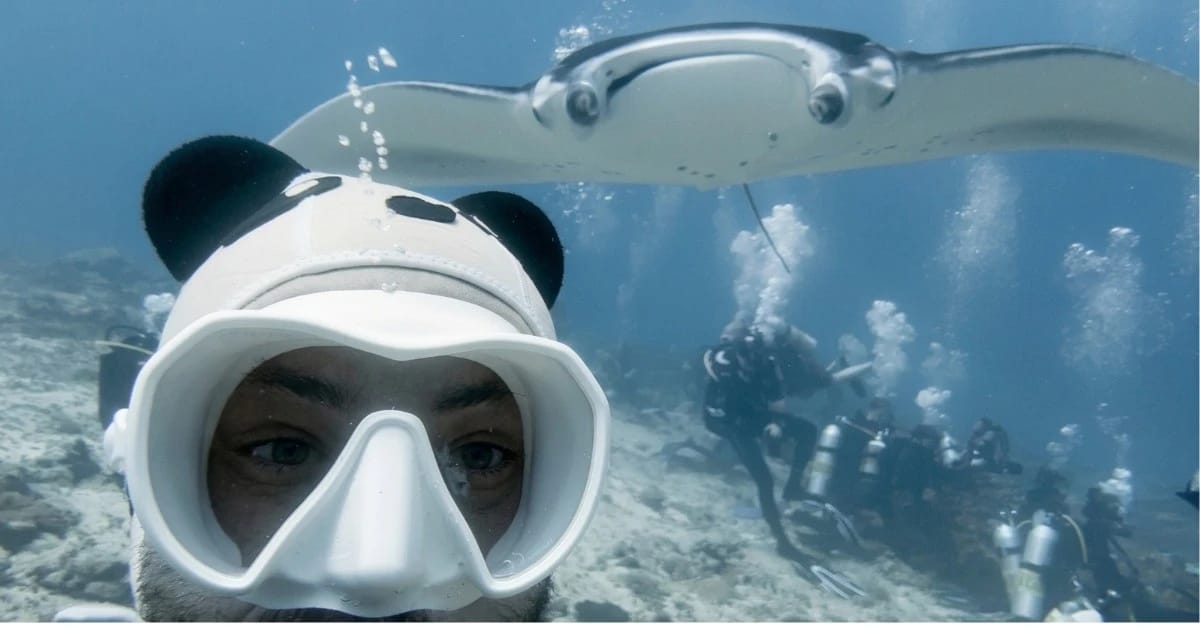
This is the worst-kept secret of ethical underwater photography: the animal comes to you when you stop going to it.
Every species has its own codes. A shark that lowers its pectorals, an octopus that suddenly changes color, a ray that buries itself in sand. We teach this in detail in Module 3.21.
Can I use a mirror to attract fish?
No. It is a forced interaction that can trigger territorial aggression. Favor stillness instead.
Underwater, you are loud. Much louder than you think.
Every exhale produces a torrent of bubbles that resonates over several meters. Every fin kick creates a pressure wave that fish perceive through their lateral line (a sensory organ we do not have, one that functions like a continuous passive sonar). Every sudden movement sends an alert signal across the entire neighborhood.
For marine life, you are the equivalent of a truck driving through a forest with the radio blasting. Even with the best intentions in the world.
The first step toward becoming invisible is therefore not technical. It is respiratory. Slowing the exhale, lengthening the cycles, reducing the volume of each bubble. Some advanced photographers switch to "skip-breathing" (one inhale followed by a few seconds of breath hold before a slow, controlled exhale). This is not freediving. It is noise management.
The result is measurable. A diver breathing normally (12 to 16 cycles per minute) generates ambient noise that drives most reef fish away within a two-meter radius. A diver breathing slowly (6 to 8 cycles) reduces that radius to less than one meter. And a perfectly still diver, in controlled breathing, on a stable bottom, becomes acoustically transparent in less than five minutes.
Five minutes. That is how long it takes for the reef to forget you.
The psychology of distance
Every marine species possesses what ethologists call a tolerance threshold. It is the minimum distance below which your presence triggers a flight response (or, in some species, aggression).
This threshold is not fixed. It varies by species, individual, context, time of day, season, presence of predators, and your own behavior.
A green turtle feeding on a seagrass bed has a much wider tolerance threshold than a green turtle rising to breathe. A Nassau grouper that knows you (because you have been diving the same site for three days) will let you approach to one meter. The same grouper, on the first day, will leave at four meters.
The ethical photographer never crosses the threshold. They read it. They evaluate it in real time. And they adjust their position accordingly.
How to read the threshold? Three universal signals that work for the vast majority of species.
The first is a change in breathing rate (in fish, the acceleration of opercular movements). If the gills are beating faster, you are too close.
The second is orientation. An animal facing you is in assessment mode. An animal showing you its flank is relaxed. An animal turning to present its tail is preparing to flee.
The third is the most subtle: social silence. If the other animals around your subject stop their normal activity (cleaning, feeding, playing), your presence is disturbing the entire micro-ecosystem, not just your target.
The four golden rules
After fifteen years of diving and thousands of animal interactions observed (my own and those of my students), I distilled the ethical approach into four rules that fit in a safety-stop conversation.
Rule number one: no physical contact. Ever. Under no circumstances. Not to "guide" a fish toward the light. Not to flip a starfish "for the photo." Not to touch a manta ray "because it looked like it wanted to." The skin of most marine animals is covered in a protective mucus that human contact destroys. This mucus is their first line of defense against infection. A touch, even brief, even "gentle," is a biological assault.
Rule number two: no feeding. Shark feeding and fish feeding are tourist practices that profoundly alter animal behavior. A fish that associates divers with food loses its natural foraging instincts. It becomes dependent. And when the divers stop coming, it no longer knows how to feed itself. This is documented, measured, and irreversible in some species.
Rule number three: the animal always has right of way. If you block a passage (overhang, cave, coral corridor), you create a trap. The animal that wants to flee cannot. Its stress rises. Its behavior changes. And you get a photo of a trapped animal, which has no aesthetic, scientific, or ethical value. Always position yourself so that an escape route remains clear.
Rule number four: the art of stepping back. This is the hardest to apply, because it demands resisting the photographer's instinct. When an exceptional encounter presents itself (a sleeping leopard shark, a cuttlefish laying eggs, a group of dolphins hunting), the temptation is to stay as long as possible. To take "one more photo." To change the angle. To get "just a little closer." Stepping back means deciding that you have enough. That three minutes is sufficient. That the animal deserves to regain its peace. It is the most counterintuitive rule, and it is the one that produces the best images, because you leave before the animal becomes nervous.
Stillness as a superpower
Everything above converges toward a single skill: the ability to remain motionless.
Not motionless as in "I do not move for ten seconds." Motionless as in "I have found my position, I have stabilized my buoyancy, I have slowed my breathing, and I am ready to wait as long as it takes."
The best underwater photographers I know spend between 30 and 70% of their dive perfectly still. Not because they have nothing to photograph. On the contrary. Because stillness is their search method.
A diver motionless on a reef for ten minutes will see animals appear that a moving diver will never see. The cleaner shrimp come out. The gobies resume their dance. The nudibranchs, which nobody notices because they move at the speed of a growing fingernail, suddenly become visible by contrast with your own stillness.
The animal does not come to you because you are kind. It comes because you have stopped being a threat. That is more prosaic, less romantic, and infinitely more reliable than any approach technique.
The turning point
There comes a moment, in the practice of ethical underwater photography, where something shifts. It is not a spectacular moment. It is the moment when you realize you no longer want to chase anything.
Not out of weariness. Out of understanding.
You have internalized that patience produces better images than speed. That respect produces more authentic encounters than persistence. That the animal that chooses to stay near you offers an image incomparably more powerful than one you cornered against a reef.
This shift cannot be taught directly. But it can be accompanied. And it arrives much faster when you understand why the rules exist, not just which ones to follow.
The reef forgets nothing. But it forgives quickly. Five minutes of stillness, and everything starts again.
Underwater Animal Interactions Guide: How to Become Invisible for Better Photographs | AquaExposure