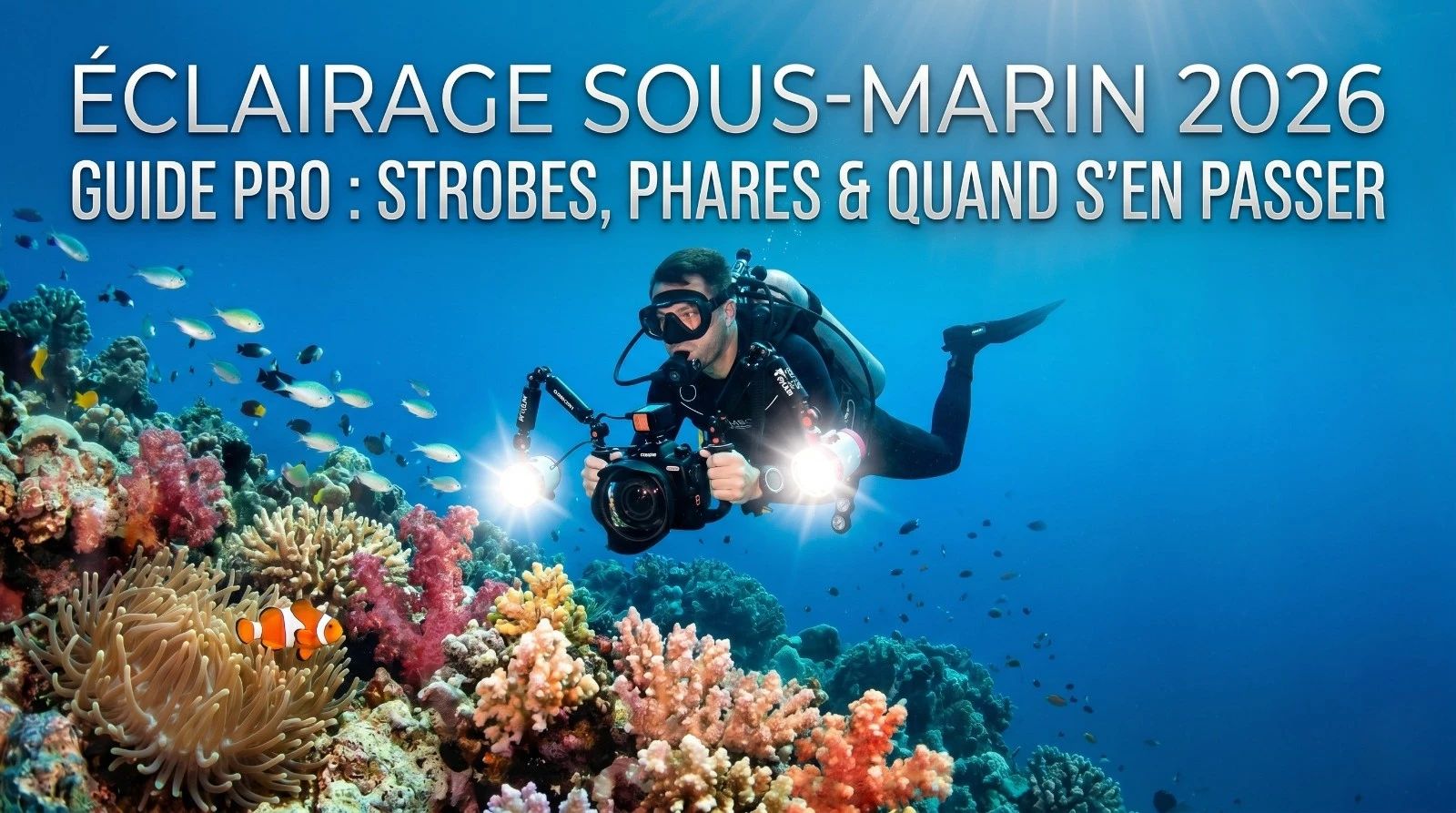
Do I need a strobe or a video light for underwater photography?
It depends on your practice. A strobe freezes motion and restores colors in a short flash. A video light provides continuous illumination and is better suited for video and focusing. Natural light remains the first option to consider.
When can you do without artificial lighting underwater?
Down to 10 to 15 meters depth in clear water with sunshine, natural light is more than sufficient. Wide-angle at close range and post-production color correction recover colors without flash or light.
What is the budget for underwater lighting in 2026?
A basic safety light costs 50 to 80 euros. A decent video light (2,000 plus lumens) between 150 and 300 euros. An entry-level strobe starts at 400 euros. Before investing, make sure you actually need artificial light.
Underwater Lighting 2026: Strobes, Lights and When to Avoid Them
A few weeks ago, one of my clients sent me a message with a very simple question. He had just purchased a case for his smartphone, he was quickly progressing in natural light, and he wanted to know which video light to buy to "take it to the next level". My answer surprised him. I asked him why he thought he needed one.
Light, underwater, is everything. It's what gives the colors, the volumes, the textures. Without it, there is no image. The problem is that the sea progressively absorbs each wavelength as the depth increases. Red disappears first, then orange, then yellow. At 20 meters, only a monochrome blue remains, which flattens everything.
The temptation is then immediate: to add artificial light to regain what the water has stolen. And that's where the paradox begins. Because the light you add, however useful it may be in very specific situations, creates a problem that many underwater photographers prefer to ignore.
At AquaExposure, the position is clear, and I have defended it from the beginning. Artificial light disturbs marine life. This is not just an opinion, it is an observation based on hundreds of dives.
A strobe that fires at a nudibranch causes immediate retraction of the rhinophores. A video light aimed at a mandarin fish during its mating ritual interrupts reproduction. A 20,000-lumen beam pointed at a reef at night transforms the natural hunting of nocturnal predators into artificial chaos. The animals don't complain, but their behavior speaks for them.
That being said, I'm not a dogmatist. There are situations where artificial light is fully justified, and in some cases, even indispensable. Close-range macro photography, caves and private shipwrecks without sunlight, night dives, and video documentaries that require an accurate color reproduction. In these specific cases, artificial lighting becomes a surgical tool in service of the image.
The honest approach, which I teach in the AquaExposure training, involves first mastering natural light (really mastering it, not just "using it") before adding an artificial source with full knowledge. Knowing when to turn on. Knowing when to turn off. Knowing when to leave the equipment in the bag.
The 3 Types of Underwater Lighting
Not all lighting has the same impact on wildlife, and this distinction is worth understanding before choosing anything.
Strobes (flashes)
The strobe produces a brief flash, a fraction of a second, that freezes the movement and restores lost colors. Its main advantage from an ethical point of view is precisely this brevity. The light exposure is minimal compared to continuous lighting. The animal receives a flash, not a permanent spotlight. The return of colors to their full spectrum occurs on a single image, which limits disturbances in time.
In macro photography, the strobe remains the preferred tool for photographers who accept artificial light. The required power is low, the distance to the subject is short, and the flash is short enough not to permanently alter the animal's behavior.
Video lights (continuous lighting)
The video light works continuously. It's a powerful underwater torch that constantly illuminates the field of vision. There is no alternative for video. You cannot film with flash. The continuous light reproduces colors in real time, allows for smooth transitions, and gives the videographer the ability to compose their lighting as they film.
But this constant light has a direct impact on marine life. Constant light means constant disturbance. Fish flee, shrimp hide, octopuses change texture and color under stress. That's why the underwater videographer's responsibility is even greater than that of a strobe photographer. Turn on, film, turn off. No exploratory sweep of the reef to "see what's there".
UV Lights
Underwater fluorescence is a unique world, fascinating and still poorly understood. UV lamps reveal patterns invisible to the naked eye, corals that glow green, anemones that explode in orange, and translucent shrimp that become luminous jewels.
The advantage of UV light is that its impact on wildlife seems significantly less than that of white light. Ultraviolet wavelengths are naturally present in the marine environment. Animals react to them less strongly than to a direct beam of white light. This is a fascinating technical niche for those who want to explore lighting without the usual noise.
Strobes 2026: Worth Checking Out
For photographers who have already mastered natural light and who want to add flash as a complementary tool (not as a substitute), here are the models that stand out this year.
Ikelite DS165
The Ikelite DS165 remains the benchmark in its price range. 160 watt-seconds of power, a 120-degree coverage angle, a color temperature of 5000K that accurately reproduces the spectrum, and a recycle time of approximately one second. The polycarbonate housing is resistant to everything, including use in difficult conditions. Expect to pay around €570.
What I like about the Ikelite is its robustness. It's not a display strobe, it's a field tool. The polycarbonate construction makes it lighter than aluminum housings and also more resistant to everyday impacts (diving boats, transport bags, accidental collisions with cave walls).
Sea&Sea YS-D3
A compact alternative for those who travel light. The YS-D3 offers an excellent power-to-size ratio and an intuitive control system. For a photographer who uses a strobe intermittently (e.g., macro photography while traveling), it's a solid choice without overpaying for raw power.
I want to state this clearly. These strobes are intended for intermediate or advanced photographers who have already spent time understanding the available light, working their settings in ambient conditions, and who add the flash as a layer of precision on an already solid base.
If you want to push the comparison further than these two picks, Backscatter published a comprehensive comparative test in September 2026 covering nearly every strobe on the market (Retra, Inon, Ikelite, Sea&Sea, Kraken, Isotta, SEACAM), using an identical protocol for each model: power, beam pattern, recycle time, color temperature. A useful resource for refining a technical choice, once the ethical question from the next section is settled in your mind.
Video Lights 2026: Power and Responsibility
The market for video lights has exploded in recent years. The power available today would have been unthinkable five years ago. And that's precisely what concerns me a little. The more powerful the beam, the greater the temptation to use it without discernment.
Big Blue 20 000 lumens Pro Mini
The Big Blue Pro Mini delivers 20,000 lumens in a compact format, with a 160-degree beam angle and the ability to switch between warm and cool white. It's a powerhouse designed for professional videographers working in challenging lighting conditions (depth, turbidity, caves).
With this level of power, responsibility increases proportionally. 20,000 lumens on a night reef is equivalent to a stadium spotlight in a garden. It is important to know how to control, aim, and most importantly, turn off when the sequence has been captured.
Orcatorch D710V MK2
The Orcatorch D710V MK2 offers a more nuanced approach with its triple light source: white, red, and UV. 2300 lumens in white, a 120-degree angle, and the ability to switch to red light for less intrusive illumination during nighttime observation. The UV mode allows you to switch to fluorescence without changing the lamp.
For a videographer who wants a versatile tool without having to carry three different lights, it's a smart compromise. The power remains reasonable, which is almost an advantage in this category where the increase in lumens has lost all meaning.
Keldan
Keldan lights remain the absolute benchmark for color rendition. The CRI (color rendition index) of Keldan regularly exceeds 95 out of 100, which means that the colors captured under their illumination are almost identical to what the human eye perceives on the surface. For the documentary filmmaker who demands impeccable color fidelity, Keldan is the natural choice (although it comes at a high price, to be clear).
When to use lighting (and when not to)
This is the most important section of this article. Because the equipment, no matter how good it is, is only worth what its use is.
Use artificial light in these situations
Close-up macro photography justifies the use of strobes. A few centimeters from the subject, natural light is no longer sufficient to reveal the chromatic details of a nudibranch or the patterns of a pygmy seahorse. A brief, properly dosed, and well-aimed flash makes the difference between a flat image and a vibrant image.
Caves and wrecks leave no choice. Without natural light, there is no image. The lighthouse then becomes indispensable, and its use in a mineral environment (without any fauna attached to each wall) raises fewer ethical questions than on a reef teeming with life.
Night dives require a light source by definition. And documentary video, which requires long shots with accurate color reproduction, cannot do without continuous lighting.
Leave the equipment off in these situations
A wide-angle shot in clear, well-lit water does not require a strobe. Natural light, at a depth of 5 or 10 meters on a sunny day, provides conditions that artificial lighting can only spoil. Backscatter (these suspended particles that reflect the flash and speckle the image with white dots) ruins more wide-angle photos than a lack of light.
Approaching animals requires discretion. Shining a strobe at a manta ray approaching out of curiosity will cause it to flee. Triggering a strobe on a parrotfish during grooming will interrupt a fascinating behavior that you could have observed for ten minutes.
Wide-angle shots of reefs, these expansive views that show the coral structure in its entirety, benefit from all the ambient light. The natural depth of field, the nuances of blue, the silhouettes of divers against the backlighting: all of this is lost under artificial lighting.
The AquaExposure position
First, master natural light. Not as a preliminary step that you go through in fast forward to get to the "real" equipment. As a complete and demanding discipline that will teach you more about underwater photography than any €570 strobe.
Then, if your practice requires it (macro, caves, video), add artificial lighting as a precise tool in service of a clear intention. Not as a reflex that you turn on when entering the water.
Module 4 of the AquaExposure training deals in depth with the mastery of light, both natural and artificial, with practical exercises for each situation. This is where nuance is created, not in a catalog of equipment.
Frequently Asked Questions
Is a flash needed for underwater photography?
No, not always. The majority of recreational diving photography situations are managed with natural light, with the right settings. Flash becomes relevant for macro, in caves, or beyond 25 meters of depth, where warm colors have completely disappeared. The AquaExposure training teaches you to use the available light first, before considering an investment in artificial lighting.
Which video light should I choose to start underwater?
The Orcatorch D710V MK2 offers a good compromise for beginner videographers thanks to its triple light source and reasonable power. Avoid starting with a 20,000-lumen spotlight that you won't know how to control. It's better to have modest, well-controlled lighting than a powerful spotlight that blinds the entire reef.
Does underwater lighting disturb the animals?
Yes, and this is documented. Continuous light disrupts hunting, reproductive, and nocturnal rest behaviors. Flash has a more brief impact but causes measurable stress responses (gill retraction in nudibranchs, escape in cephalopods). The photographer's responsibility is to limit light exposure to the absolute minimum.
What is the difference between a strobe and a video light?
The strobe emits a brief flash (a few milliseconds) synchronized with the photo's trigger. The video light illuminates continuously. The strobe is suitable for photography, while the video light is for video. In terms of impact on wildlife, the strobe is less disruptive due to the short exposure time. The continuous light is more disturbing but remains essential for filming.
To Go Further
If this article has piqued your interest, several resources complement the discussion.
Mastering Natural Underwater Light explains in detail how to work without artificial lighting and achieve results that most beginners believe are impossible without flash.
Macro photography of nudibranchs addresses the issue of lighting in macro photography using the zero-contact philosophy that guides the entire AquaExposure approach.
Why I Stopped Using Red Filters tells the story of a technical choice evolving into a more precise software-based correction.
And if you are still hesitating between turning on or off the light, ask yourself this simple question: does the animal I am about to photograph need this light to exist in my image, or do I need it to reassure myself?
The answer, most often, lies in the blue.
Underwater Lighting 2026: Strobes, Lights, and When to Avoid Them | AquaExposure