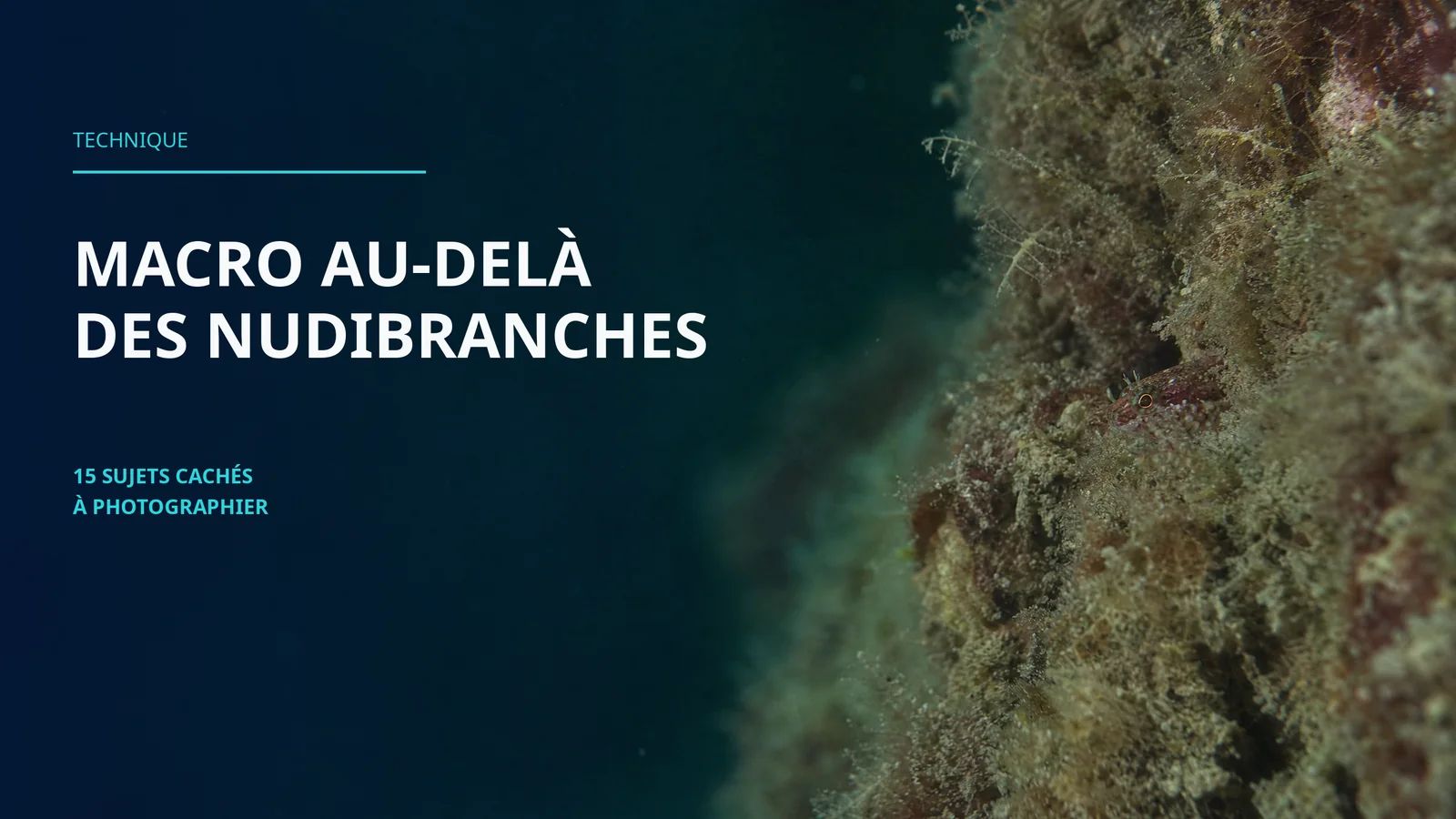
15 overlooked underwater macro subjects: where to find them, how to frame them, their difficulty. Renew your inspiration on the same reefs everyone swims past.
What macro subjects can I shoot when I am tired of nudibranchs?
Mantis shrimp eyes, coral polyps open at night, flatworms, bryozoans, porcelain crabs on anemones, feather duster worms, hydroids and sponge textures offer huge variety. Most of them live on the same sites as the nudibranchs, only nobody is looking at them.
Do I need expensive gear to photograph these original macro subjects?
No. A close-up wet lens fitted to a smartphone or a GoPro handles most of these subjects. The difference comes from stability and patience, not from the price of the camera body.
What is the easiest macro subject to start with beyond nudibranchs?
Sessile life: sponges, bryozoans, feather duster worms. These subjects never flee and never stress, and they offer extraordinary shapes and colours. It is the ideal ground to work on composition with zero ethical impact.
Can I photograph mantis shrimp eyes without disturbing it?
Yes, as long as you keep your distance and never block the entrance of its burrow. The mantis shrimp lifts its head when it feels safe. Move slowly and wait, and it will come to you.
Is night diving mandatory for these subjects?
No, but some subjects only reveal themselves after dark. Coral polyps open in the black, shrimps come out, behaviours change. Night is not a requirement, it is a second library of subjects.
How do I know whether a macro subject is worth the shot?
Ask a simple question: does this subject tell a story? An eye, a texture, a behaviour, an improbable colour. If the answer is yes, it is worth the shot, even at two millimetres.
Do I need a flash for these macro subjects?
Not always. In daylight between five and fifteen metres, natural light is often enough. Flash becomes useful in the dark or to freeze a precise detail. At AquaExposure it stays a last resort, never a reflex.
To learn how to get the most out of your gear underwater, discover the AquaExposure training.
Everyone photographs nudibranchs. Beyond those sea slugs, a whole world of macro subjects lives on the same walls, ignored by nearly all: mantis shrimp eyes, night polyps, fluorescent bryozoans, sponge textures. This guide shows you fifteen of these hidden subjects, where to find them and how to frame them.
I remember a dive on the Catalan coast, near Banyuls, where I was guiding a student obsessed with nudibranchs. He had been hunting one for twenty minutes with no luck, and during that time, thirty centimetres from his mask, a mantis shrimp was watching him from the mouth of its burrow with the strangest eyes in the animal kingdom. He never saw it. That is the day I understood that the problem is never a lack of subjects, but the way we look.
Why leaving the nudibranchs behind changes everything
Nudibranchs are beautiful, and there is a complete guide to nudibranch macro photography on this site for anyone who wants to elevate them. But when a subject becomes the obligatory stop for every photographer, two things happen. First, your images look like thousands of others. Second, and worse, you stop seeing the rest.
The reef is a theatre of detail. On a single five-metre wall there are often more macro subjects than you could photograph in a whole dive. Talent is not about hunting the rare species, it is about noticing what lives right under your eyes. That is exactly the skill I work on with my students, and it is also the subject of the article on the art of spotting and patience in macro.
Hidden subjects on coral and anemones
Coral polyps open at night
By day, many hard corals keep their polyps retracted. At night they open to feed and unfold tentacles of incredible delicacy. It is a subject of pure texture and pure light. The difficulty lies in stability, because you work in the dark with shallow depth of field.
Porcelain crabs on anemones
Tiny, translucent, clinging to the base of anemones, porcelain crabs filter the water with fan-shaped appendages. They do not flee as long as you leave their host alone. It is a behaviour subject as much as a portrait. Look for them at the base of large anemones, often in pairs.
Clownfish eggs
When a clownfish pair guards its clutch, the eggs attached to the substrate shift from orange to silver as the embryos develop their eyes. Photographing that progression takes tact, because the parents actively defend the nest. Keep your distance, let the adults settle, and frame without ever imposing.
The crustaceans nobody looks at
Mantis shrimp eyes
This is my favourite subject on the list. The mantis shrimp owns the most complex visual system known, with sixteen types of photoreceptor where a human has three. Photographing its eyes, mounted on mobile stalks, gives almost alien images. Approach from the front, slowly, without blocking the burrow, and let it emerge on its own.
Squat lobsters and commensal shrimps
In crinoids, soft corals and anemones live shrimps and squat lobsters perfectly camouflaged. Their colour copies their host. The game is to spot them, then isolate the subject from the clutter around it. It is a fearsome exercise in composition.
Parasitic isopods
Less glamorous but fascinating, the isopod clinging to a fish head tells a story of parasitism visible to the naked eye. That kind of image has real documentary and scientific value, especially if you contribute to observation databases, as covered in the article on ethical underwater photography and citizen science.
Worms, soft life and colonies
Flatworms
They are often mistaken for nudibranchs, but flatworms are thinner, faster, and sometimes swim with a rippling, veil-like motion. Their patterns are spectacular. The difficulty comes from their movement, which demands a responsive autofocus and good anticipation.
Feather duster and fan worms
These tube worms unfold a spiralling branchial crown of hypnotic regularity. At the slightest passing shadow they snap back in an instant. The subject tests your approach: too brusque and the crown vanishes. The reward is a perfect piece of natural geometry.
Bryozoans and hydroids
Tiny colonies clinging to the walls, bryozoans form lacework, and some turn fluorescent under blue light. Hydroids look like feathers. These are subjects of texture and abstraction, perfect for working with raking light.
Sponge textures in the abstract
A sponge is not one subject, it is a thousand. Get close enough and its pores, fibres and colours become an abstract composition. No animal stress, no fleeing, just you and the matter. This is what I always recommend for starting macro calmly, in the spirit of the scenography of erasure.
The fifteen, recapped
So you can keep the list in mind on your next immersion, here are the fifteen subjects: mantis shrimp eyes, night coral polyps, flatworms, bryozoans, porcelain crabs, clownfish eggs, parasitic isopods, feather duster worms, hydroids, sponge textures, squat lobsters, commensal shrimps, gobies on coral, fan worms, and colonial sea squirts. Each lives near you, or near your next destination, if you know which wall to set your eyes on. The Catalan coast concentrates a good share of them, as detailed in the article on the marine wildlife of the Catalan coast.
How to frame each of these subjects
The basic rule never changes: focus on the eye when there is one, on the point of strongest contrast otherwise. Work at close range, stabilise yourself through buoyancy and never by resting a hand on the reef. In daylight between five and fifteen metres, natural light is enough for most of these subjects. Gear is not the obstacle, and the article on macro with a smartphone and a GoPro using a wet lens shows how to get these images without an overpriced body.
The AquaExposure stance on flash in macro
I have to be clear, because this question comes up at every course. At AquaExposure, natural light comes first. Flash is not banned, it is framed. In the dark of a night dive, on a coral polyp, yes, light becomes necessary. But we are talking minimum power, an indirect angle, and one to two firings maximum on a given animal. Burst flash, aimed straight into a subject's eyes, is exactly what I refuse to teach. A good macro subject deserves better than a blast of light.
"The question is not what you look at, but what you see." Henry David Thoreau
Going further
Macro is probably the discipline that turns a diver into a photographer fastest, because it forces you to slow down, observe and respect. If you want to learn to find, frame and elevate these subjects in natural light, the AquaExposure underwater photography course builds that skill step by step, from spotting to editing.
Next time you cross a photographer who has been hunting his nudibranch for twenty minutes, look around him. There is probably a mantis shrimp watching.