What is the best season for a dive cruise in the Maldives?
The ideal season runs from November to April, during the northeast monsoon (Iruvai). This is when visibility is best and currents favor pelagic encounters. OK Maldives operates from September to June, which also allows you to enjoy the southwest monsoon for different photographic conditions and increased manta ray concentrations on certain sites.
What dive level is needed for a cruise in the Maldives?
A Level 2 (FFESSM) or Advanced Open Water (PADI) is necessary to fully enjoy OK Maldives cruises. Most dives are between 15 and 20 meters, but the most spectacular sites require descending to 30 meters, the legal limit in the Maldives. This level must be obtained before departure. The OK Maldives team adapts dives to the group profile, and Nitrox available on board extends bottom times for photographers.
Can you do underwater photography without flash in the Maldives?
Absolutely. This is the AquaExposure philosophy. Natural light in the Maldives is of exceptional quality thanks to the water clarity and tropical brightness. Between the surface and 15 meters, there is enough light to work without any artificial lighting. This simplifies equipment, reduces luggage weight, and lets you focus on framing and composition.
How much does a dive cruise in the Maldives with OK Maldives cost?
Rates vary depending on the itinerary, duration, and type of cabin chosen. The full schedule and prices are available on the OK Maldives website (okmaldives.com). For cruises with AquaExposure photo training, dates and rates are coordinated directly with the OK Maldives team. Contact us for a personalized quote.
What sets an AquaExposure photo cruise apart from a standard cruise?
Photographic coaching is integrated into every day of the cruise. Image review between dives, personalized advice, post-processing exercises in the evening on board. The training is centered on natural light, ethical approach, and individual progression. It is not a photo workshop added to a cruise, but an experience designed so that every dive is also a photography lesson.
To learn how to get the most out of your gear underwater, discover the AquaExposure training. There are destinations that change your perspective on underwater photography. The Maldives are one of them. I taught scuba diving there, spent hundreds of hours underwater, and each dive reminded me why I chose this profession. The visibility, the light, the abundance of life, the pelagic encounters that leave you breathless, even after the thousandth dive.
When the opportunity to work with OK Maldives arose, the decision was natural. OK Maldives is a pioneer in diving cruises in the archipelago, having been present since 1983, with knowledge of sites and conditions that cannot be improvised. Combining this expertise with the photographic philosophy of AquaExposure (natural light, ethical approach, personalized training), is exactly the type of project that excites me.
OK Maldives: Over 40 years of experience
OK Maldives (Ola Kala Maldives pvt ltd) is not a cruise line like the others. When you travel with a team that has been exploring the waters of the Maldives from north to south for four decades, you gain access to sites that many classic cruises do not know. The team themselves discovered many of the now-famous dive sites in the Maldives. Some may even remain secret.
This on-location experience makes all the difference for the underwater photographer. Being in the right place, at the right time, with the right current and light conditions, is what separates a pleasant dive from a photographically exceptional dive. And that knowledge doesn't come from guides, it's learned through experience, from dive to dive, year after year.
The Equator and the dhoni
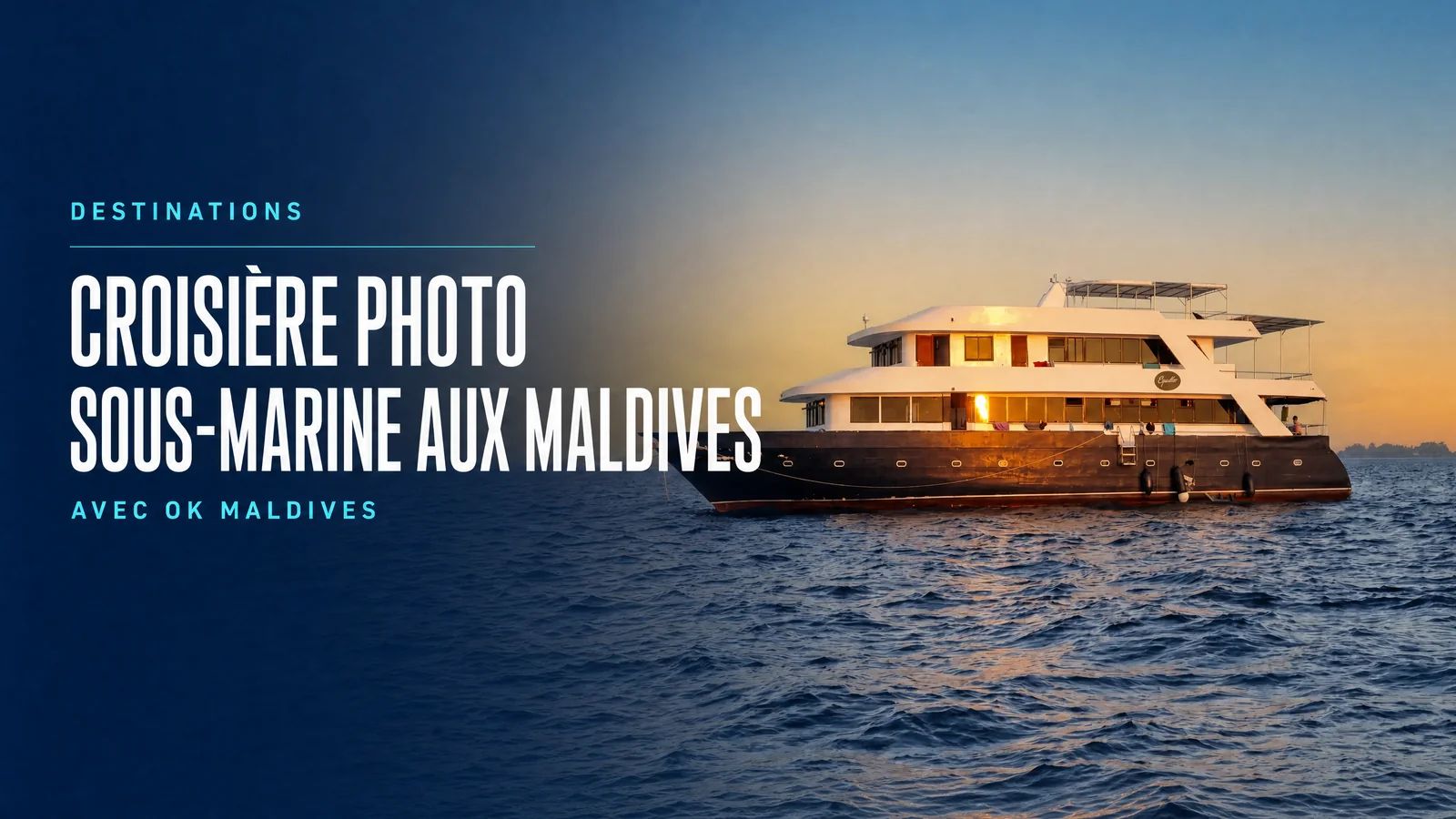
The boat is your floating home during the entire cruise. The Equator measures 30 meters in length and 9 meters in width, with two decks and a cruising speed of 9 knots. Ten double air-conditioned cabins (including three suites), each with a private bathroom. An interior lounge, two shaded outdoor lounges, a sun deck, a bar, and a library.
For the photographer, practical details are extremely important. Each cabin has a continuous 220V supply (two generators, 24 hours a day), which solves the problem of battery charging. The boat is self-sufficient in fresh water thanks to a desalination system, which allows you to rinse the photographic equipment after each dive without counting.
The dhoni, this rigid diving support boat built in the Maldivian tradition, is the everyday work tool. It can accommodate up to 24 divers simultaneously, and it is equipped with air compressors and Nitrox, as well as diving equipment. Nitrox is particularly interesting for the photographer: by allowing for longer bottom times, it provides the margin needed to wait for the right moment, the right composition, and the right encounter.
The Maldives as seen by a photographer
1 200 small islands scattered, all surrounded by coral reefs, forming atolls over hundreds of kilometers in the middle of the Indian Ocean. Currents that circulate nutrients and attract large marine life year-round. This is what makes the Maldives a unique location for underwater photography.
The diversity of subjects is astounding. Coral reefs of such health that they are rarely found elsewhere. Cleaning stations where manta rays come to have parasites removed, offering patient photographers close encounters of intense intensity that are difficult to describe. Current-swept passages where sharks patrol in large numbers. Soft coral reefs of unprecedented delicacy. Gardens of giant gorgonians. Turtles peacefully grazing on plate corals.
And the light. The water in the Maldives, warm (28 to 30 degrees) and with remarkable clarity, allows light to penetrate with a generosity that the Mediterranean only offers in summer. For a photographer working in natural light, this is the ideal environment. There is no need for extra equipment, no need for flash, no need for lights. The tropical light does the job, and it does it beautifully.
Three routes, three photographic experiences
OK Maldives offers three major itineraries, each planned according to the best local season. I have dedicated a detailed article, but here is the essential information from the photographer's perspective.
The Arctic: The 3 Wild Atolls
The most adventurous route. Haa Dhaal and the northern atolls, completely off the beaten path. Pristine reefs, abundant pelagic fauna, and above all, a unique underwater solitude that classic tours no longer offer. For the photographer, it's an opportunity to capture scenes that very few divers have seen.
Centre Atolls
The classic route, and for good reason. It's the most diverse route in the Maldives. Channels, reefs, cleaning stations, wrecks, and coral gardens. The versatile photographer will find everything they need to fill memory cards, from wide-angle pelagic shots to macro shots on soft corals.
Grand Sud and Integral Sud
Beyond the equator, in the South Maldivas region. Pelagic encounters are the most spectacular there: sharks, oceanic manta rays, and passages described as "breathtaking" by divers who have crossed them. This is the itinerary for the wide-angle photographer, the one who seeks silhouettes in the blue and face-to-face encounters with the pelagic.
AquaExposure Photo Training on Board
What sets an AquaExposure cruise apart from a standard cruise, is the photographic accompaniment throughout the journey. Not a photo workshop added to a diving cruise, but a genuine, integrated training program that follows the rhythm of the cruise.
Each day is structured around two to four dives. Between dives, the time on board is dedicated to reviewing images, personalized advice, and post-processing exercises. The interior lounge of the Equator, with its video and computer equipment, serves as a classroom.
The philosophy is the same as for all AquaExposure courses. Natural light as the first tool. An ethical approach as a prerequisite. Patience as the first setting on the camera. And a particular attention to ensuring that each participant progresses at their own pace, regardless of their starting level.
The Maldives are the ideal location for this approach. The light is abundant, the subjects are accessible, and the diving conditions (warm water, good visibility, moderate currents on most sites) allow the photographer to focus on the image rather than on the diving technique.
Season and Planning
The ideal season for diving cruises in the Maldives is from November to April. This is the northeast monsoon (Iruvai), which brings the best visibility and the most favorable currents for pelagic encounters.
OK Maldives is present in the Maldives from September to June, which also allows for diving during the southwest monsoon (Hulhangu), which brings its own advantages: manta rays are more present on certain sites, and the lighting conditions create different photographic atmospheres.
The 2026-2027 and 2027-2028 cruise schedules are available on the OK Maldives website. For cruises with AquaExposure training, the dates are coordinated with the OK Maldives team to ensure the best possible photographic conditions.
To learn more and book: https://okmaldives.com/
From the Mediterranean to the Maldives
There is a common thread between the courses we offer on the Cote Vermeille in partnership with Aquatile and the photo cruises to the Maldives with OK Maldives. It is the same philosophy, the same approach, the same conviction that underwater photography is primarily a matter of vision, before being a matter of equipment.
A photographer who has learned to work in the Mediterranean, with its more demanding conditions and directional light, arrives in the Maldives with a trained eye, acquired patience, and proven technique. The tropical light then opens up possibilities that he did not have in the Mediterranean, and the images he brings back bear the mark of this dual training.
This is exactly the itinerary that I offer: starting with the fundamentals on the waters of the Catalan coast or the Belgian coast, then going to the Maldives to discover what this training allows when the conditions are optimal.
Frequently Asked Questions
What is the best season for a diving cruise in the Maldives?
The ideal season is from November to April, during the northeast monsoon (Iruvai). This is the time when visibility is best and when currents facilitate pelagic encounters. OK Maldives is available from September to June, which also allows you to take advantage of the southwest monsoon for different photographic atmospheres and a higher concentration of manta rays in certain locations.
What level of diving is required for a cruise to the Maldives?
A Level 2 (FFESSM) or Advanced Open Water (PADI) certification is required to fully enjoy the OK Maldives cruises. Most dives are conducted between 15 and 20 meters, but the most spectacular sites require descending to 30 meters, which is the legal limit in the Maldives. This level must be obtained before departure. The OK Maldives team adapts the dives to the group's profile, and the Nitrox available on board allows for longer bottom times for photographers.
Can you take underwater photos without flash in the Maldives?
Absolutely. This is actually the philosophy of AquaExposure. The natural light in the Maldives is of exceptional quality, thanks to the transparency of the water and the tropical brightness. Between the surface and 15 meters, the light is sufficient to work without any artificial lighting. This simplifies the equipment, reduces the weight of luggage, and allows you to focus on composition and framing.
How much does a diving cruise in the Maldives with OK Maldives cost?
Prices vary depending on the itinerary, duration, and type of cabin chosen. The complete calendar and prices are available on the OK Maldives website (okmaldives.com). For cruises with AquaExposure photo training, dates and prices are coordinated directly with the OK Maldives team. Contact us for a personalized quote.
What distinguishes an AquaExposure photo cruise from a regular cruise?
Photographic support is integrated into every cruise. Image review between dives, personalized advice, and evening post-processing exercises on board. The training focuses on natural light, ethical approach, and individual progress. This is not a photography course added to a cruise, it is an experience designed so that each dive is also a photography lesson.
Want to improve your underwater photography?
The AquaExposure training program guides you from theory to practice, using natural light and an ethical approach. Whether you are preparing for your first cruise to the Maldives or simply want to consolidate your skills, discover our underwater photography training.