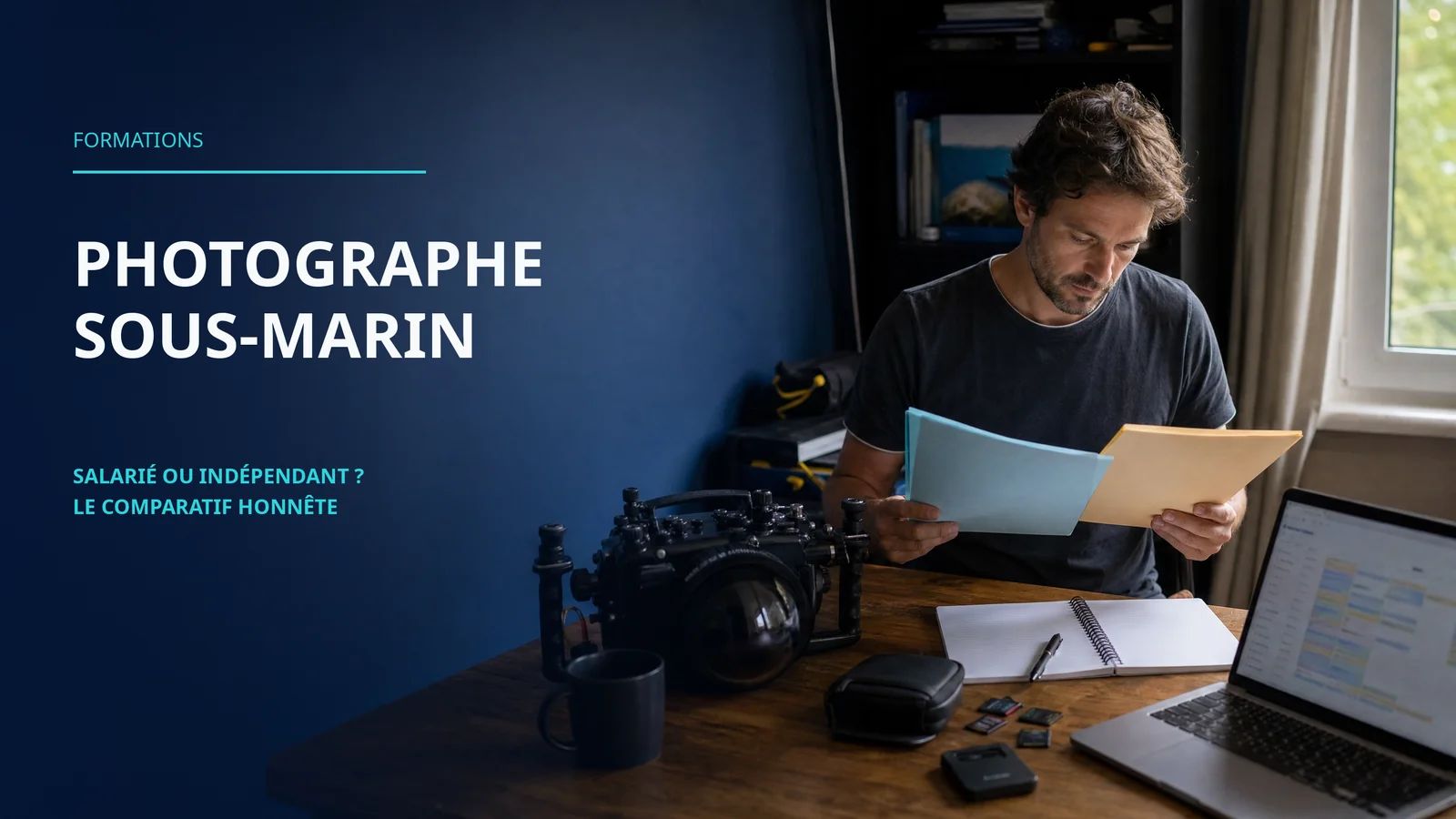
Underwater Photographer: Employee or Freelancer? The Honest Comparison
Employed positions- resort contracts- freelance or NGOs: Compare the status of the underwater photographer and find the one that suits your situation and goals.
Can you transition gradually from employment to freelancing in underwater photography?
Yes, and it is actually the most recommended path. Start with occasional contracts alongside a salaried position, build your portfolio and first clients, then switch progressively when the freelance activity generates enough to cover expenses.
What legal status for a freelance underwater photographer in France?
Micro-enterprise is often the first status, for its simplicity. It has a revenue cap of 83,600 euros in service provision in 2026 (threshold valid until 2028). Beyond that, an EURL or SASU becomes relevant. An accountant specialising in artist-author status can guide this choice.
Are there salaried positions in underwater photography in France and Belgium?
Permanent positions are extremely rare in France and nearly non-existent in Belgium. Opportunities mainly come from one-off missions for audiovisual productions or research organisations. Most photographers build their activity as freelancers with contracts in foreign destinations.
Does a resort contract count as experience for a freelance career?
Yes, and it is often underestimated. A 6 or 12-month resort contract yields a large volume of images, knowledge of local subjects, and most importantly, contacts in the industry. Many freelance photographers started exactly that way.
To learn how to get the most out of your gear underwater, discover the AquaExposure training.
Underwater Photographer: Employee or Independent? A Honest Comparison
When we talk about the profession of underwater photography, the question of status always comes second, just after the question of income. And it's a question that deserves more than a generic answer, because both paths are not really aimed at the same profile, nor at the same stage of a career.
I have experienced both. The first contracts in resorts, where someone else set the hours and the subjects. Then the gradual development of an independent activity, with the freedom that it entails and the instability that comes with it. What I can tell you is that neither is superior in itself. What matters is choosing the right status at the right time.
What "employee" really means in this fieldUnderwater photography positions do exist. They are rare, highly competitive, and often misunderstood by outsiders.
Premium diving operators and liveaboards offer the most common contracts in this category. The on-board photographer documents the clients' trips, the sites visited, and the species encountered. In return, the package typically includes accommodation, dives, and a monthly salary ranging from €1,500 to €3,000 net, depending on the destination and the operator's reputation.
Audiovisual productions (documentaries, advertisements, institutional films for brands or NGOs) employ underwater photographers and videographers on a temporary or project basis. These assignments are among the best-paid, with daily rates that reflect production budgets. However, they are temporary, not permanent.
Marine research institutes, universities, and organizations like Ifremer occasionally employ scientific photographers. The compensation is more modest, but the work has a dimension that extends far beyond the commercial, and the diving conditions are often exceptional.
Some NGOs (WWF, Oceana, SeaLegacy) have resident or annual contract photographers. These positions are highly sought after and are almost exclusively obtained through networking, after years of voluntary or semi-voluntary collaboration.
What the salaried position offers: A stable income, a clear framework, access to sites and equipment that one would not be able to finance on their own, and sometimes a solid social security package. It is a concrete entry point into the industry, with less financial risk in the short term.
What it costs: Artistic freedom is often limited. One photographs what the client wants, within the timeframes they set, with the angles they approve. For someone who is still developing their eye and style, this is not necessarily a problem. For someone who already has a well-defined vision, it can quickly become frustrating.
What "independent" really means in this fieldMore than 90% of professional underwater photographers work as freelancers. This figure alone speaks volumes about the realities of the market.
The freelancer builds their business around several sources of income combined: one-off contracts with resorts, image licenses to stock agencies, corporate or NGO missions, and training and workshops. Each of these sources has its own rhythm, seasonality, and payment terms.
Daily rates for freelance work range from €300 to €800 for local services. They can exceed €1,500 to €2,000 for technical missions in difficult environments or with specialized equipment. Images licensed to stock agencies sell for between €50 and €500 each, depending on exclusivity and usage duration. Annual contracts with tourist destinations typically range from €8,000 to €25,000. Projects with brands or foundations can go far beyond this.
What being a freelancer provides: the freedom to choose your subjects, clients, and destinations. The ability to build a personal brand, a recognizable visual identity, and a community around your name. And ultimately, income that is not capped by a fixed salary.
What it costs: real instability in the first few years. Months with no work, clients who pay late, and projects that fall through. The administrative management of a freelance business (accounting, invoicing, social security contributions) which takes time and energy. And sometimes, the loneliness of building without a safety net.
Head-to-Head ComparisonStable Income
The employee receives a fixed income each month. The freelancer has irregular income, with peaks and troughs that require a safety cash reserve (at least 3-6 months of expenses recommended before starting).
Artistic Freedom The employee works within a framework defined by the employer. The freelancer decides on their subjects, angles, and refus. They are also responsible for the consequences if a project is not well received by the client.
Potential Long-Term Income The employee is limited by their salary scale or contract. An experienced freelancer with multiple active income streams regularly exceeds this limit, but only after 3-5 years of building their business.
Access to Equipment and Sites The employee often benefits from the equipment and access provided by the employer. The freelancer finances everything, which represents a significant initial investment but also gives them complete control over their tools.
Administrative Burden The employee delegates social and tax management to their employer. The freelancer manages everything themselves, or delegates it to an accountant (cost: 800-2000 euros per year depending on the structure).
Visibility and Reputation The employee builds a reputation linked to their employer. The freelancer builds a personal brand, transferable from one project to another, which increases in value over time.
Which one is right for you?This isn't a matter of abstract preference. It's a matter of concrete situation.
If you're a beginner, have limited savings, and are primarily looking to gain practical experience: a salaried position (at a resort, liveaboard, or production) is an excellent starting point. You'll be diving, learning, meeting industry professionals, and someone else will cover the expenses.
If you already have a strong portfolio, an initial client base, and 6 months of savings: transitioning to self-employment becomes feasible. Not by abandoning a fixed income overnight, but by gradually building the first alternative sources of income, until self-employment represents 50% then 70% of your revenue.
The third option, which many experienced underwater photographers have found, is a long-term contract with one or two regular clients, negotiated independently. A resort that pays you €1,500 per month for the rights to your images in their area. A brand that commissions three missions per year. This hybrid model combines the predictability of employment with the freedom of freelancing, and it's often the natural path that people take after a few years.
Frequently Asked QuestionsCan you transition from employment to independence gradually?
Yes, and this is actually the most recommended approach. Start with temporary contracts alongside a regular job, build your portfolio and acquire your first clients, and then gradually transition when your independent work generates enough income to cover your expenses.
What legal status is suitable for an independent underwater photographer in France?
The micro-entreprise is often the first option, due to its simplicity. It has a revenue limit of €83,600 for service provision in 2026 (this limit is valid until 2028). Beyond that, or if you have significant expenses to deduct, an EURL or SASU becomes relevant. A specialized accountant can guide you.
Does a resort contract count as experience for an independent career?
Yes, and this is often underestimated. A 6 or 12-month contract at a resort gives you a significant volume of images, knowledge of local subjects, and most importantly, contacts within the industry. Many independent underwater photographers started exactly this way.
Are there any permanent positions in underwater photography in France and Belgium?
Permanent positions are very rare in France and almost non-existent in Belgium. Opportunities mainly come from temporary contracts for audiovisual productions, coastal local authorities, or research organizations. Most French and Belgian underwater photographers build their business as independents, with contracts in foreign destinations.