What is the difference between a rigid housing and a built-in waterproof camera?
A rigid housing is an external enclosure that protects a standard camera. A built-in waterproof camera is a device designed to be natively waterproof (like the Olympus TG-7). Built-in waterproof cameras are more practical and less expensive, but their sensors are often smaller. Rigid housings allow the use of a camera with better optical quality, but require rigorous maintenance.
To what depth is an underwater photo housing waterproof?
The guaranteed depth varies by model. Common smartphone housings are rated between 40 and 60 meters. Housings for compact and mirrorless cameras generally range from 60 to 100 meters. Recreational diving goes to a maximum of 40 meters. A housing rated for 60 meters is therefore more than sufficient for the vast majority of divers.
How much does a quality waterproof housing cost to get started?
For a smartphone: between 300 and 400 euros for a housing with a vacuum system and good compatibility. For a dedicated compact (Olympus TG-7 with housing): between 900 and 1,200 euros all included. Below these budgets, you enter the zone of serious compromises on reliability or image quality.
Can a housing be used for both freediving and scuba diving?
Yes. Waterproof housings are designed for both practices. The main difference is the duration of use (longer with scuba) and the maximum depth reached. A housing rated for 60 meters covers all recreational freediving and scuba diving.
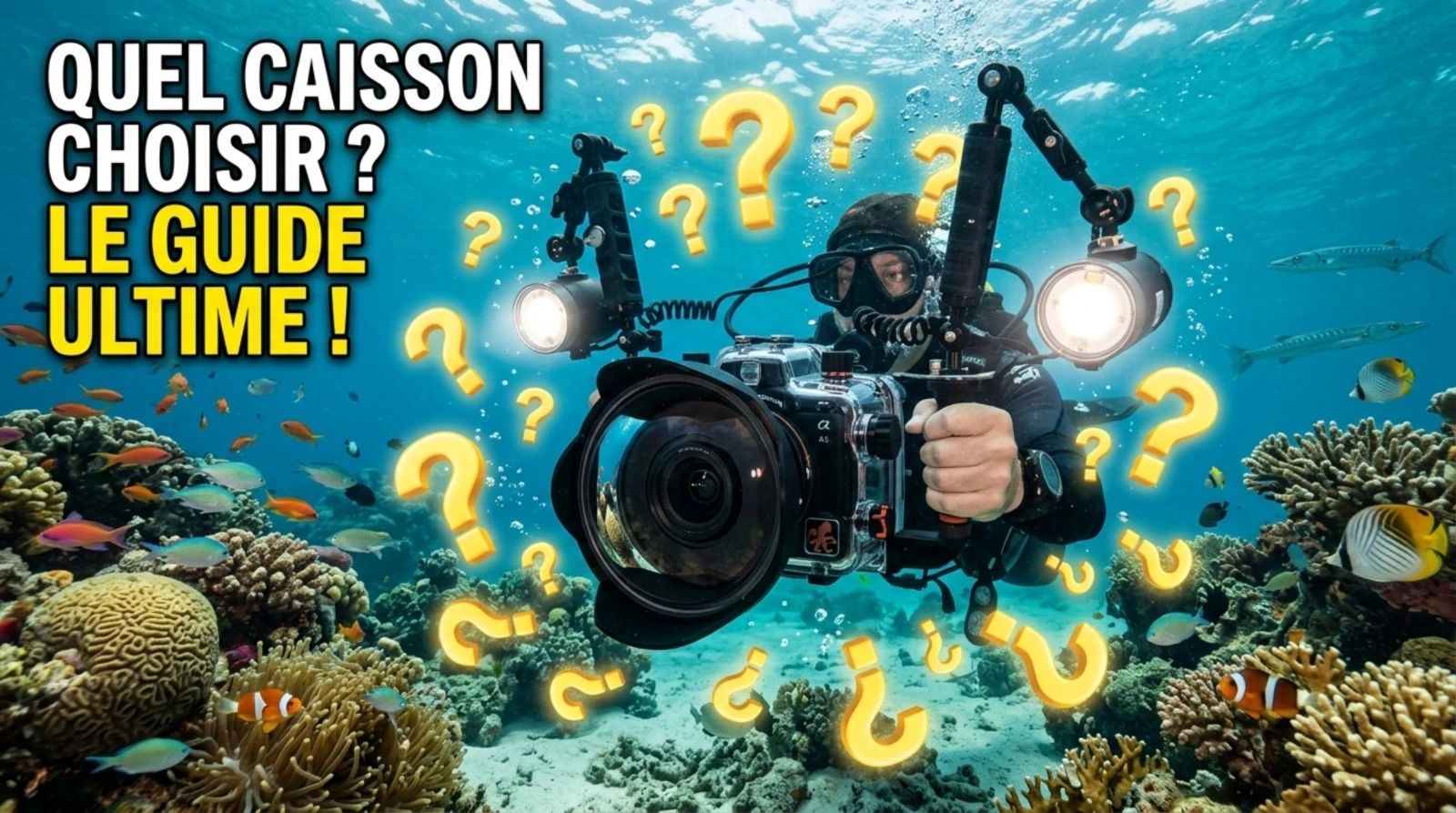
The underwater housing is the purchase that every underwater photographer makes at least once. I have done so. Many people I know have done so. You buy the wrong type, for the wrong budget, for the wrong camera, and you end up with either water inside, or an unusable housing, or a bad image due to an unsuitable port.
This guide doesn't tell you "what exists". It tells you what you should choose, depending on your specific situation, and why.
Soft Case vs. Rigid Case: End the Debate
The flexible waterproof pouch (made of transparent PVC, with a double zipper and Velcro straps) is often presented as an economical alternative to the rigid case. It is not.
Here's what it can do: protect your phone from rain, splashes of water, and surface immersion (beach, swimming pool, shallow river). That's its area of expertise.
Here's what it can't do: withstand the pressure of the water column during a real dive. At 3 to 5 meters, the most basic pouches compress, and the sealing of the joints is no longer guaranteed. The touchscreen becomes unusable underwater, the shooting is random, and you have no control over the settings.
For any activity that involves regularly submerging the head (scuba diving, freediving, snorkeling), a rigid hard case is required.
The two types of rigid chambers
There are two main categories, depending on the equipment you want to protect.
Smartphone Cases: Designed for a specific phone model (or a range of sizes), they allow access to physical buttons or the screen via a conductive gel system (DiveVolk) or mechanical buttons. Depth typically guaranteed up to 60 or 100 meters. Budget: 150 to 500 euros.
Dedicated Camera Housings: Rigid housings made of polycarbonate or machined aluminum, designed for a specific camera model (compact, hybrid, DSLR). Each button and dial on the camera has a corresponding mechanical equivalent on the housing. Depth guaranteed up to 60 or 100 meters depending on the brand. Budget: 300 euros for entry-level compact housings, up to 3000 euros for expert-grade aluminum housings for full-frame cameras.
The Seal System: O-ring vs. Vacuum Pump
The watertightness of a rigid enclosure relies on a circular O-ring seal that is compressed between the two parts of the enclosure. It is reliable, robust, and has been proven for decades. However, this seal must be maintained.
Before each dive, the procedure is as follows: open the housing, remove the o-ring, wipe it clean, check for sand, dust, or hair (even a single fiber can create an infiltration), apply a thin layer of silicone grease to the entire perimeter, re-install the o-ring, close the housing, and check the alignment. This is not an option. It is the mandatory procedure, before every dive, without exception.
The vacuum pump is a supplementary system offered on some diving bells. Before diving, you pump the air out of the diving bell with a small external pump. A sensor or gauge confirms that the vacuum is maintained, which certifies the seal. If the vacuum is not maintained, you have a leak before entering the water, not underwater.
This system is an important psychological safety measure, and I recommend it for all beginners. It does not replace the maintenance of the o-ring, but it gives you a visual confirmation before each dive.
Brands that include the vacuum pump as standard: Kraken Sports, Ikelite (on more recent versions), Nauticam (on almost all of their range).
The optical port: dome or flat, and why it's crucial
For specialized underwater photography housings (compact, hybrid, DSLR), the optical window in front of the lens is called the port. There are two types, and the choice is not arbitrary.
The flat port is a straight window. It is suitable for macro lenses (close proximity, small field of view). It introduces optical distortion on wide angles: straight lines curve slightly, and the effective viewing angle is reduced underwater. If you primarily photograph small subjects at close range, the flat port is suitable.
The dome is a spherical window that compensates for the refraction of water. It corrects the optical distortion of wide angles and preserves the field of view of the lens. A 16mm wide-angle lens remains a 16mm wide-angle lens with a dome. Without a dome, its effective angle underwater is reduced by approximately one-third.
The simple rule: if you are photographing marine landscapes, large-sized species (sharks, rays, turtles), or wide scenes, you will need a dome port. If you are photographing nudibranchs, coral textures, or small subjects at close range, a flat port works very well.
The domes are available in different diameters (4 inches, 6 inches, 8 inches). Generally, the larger the dome, the less distortion is noticeable, and the better the optical quality is in the corners of the image.
The Brands and What They're Worth
Smartphone caissons
DiveVolk (Belgium, €200-400): specialist in iPhone and Android underwater cases with functional touch screens thanks to their proprietary conductive gel. The SeaTouch 4 Max is certified up to 60 meters. It's the only brand that solves the problem of screen control at depth. My personal choice.
Kraken Sports (€300-€500): very robust housings for iPhone and Samsung, with integrated vacuum system. The mechanical buttons are precise and reliable. There is no access to the touchscreen, but control via the physical buttons is sufficient for most uses.
SeaLife (280-380 euros): A well-known brand on the market for a long time. Simple application, good ergonomics, compatible with multiple phone sizes. A good entry-level option.
ProShot Case (€150-€200): Entry-level, suitable for snorkeling and shallow dives (less than 10 meters). No vacuum system, no conducting gel. Sufficient for beginners on occasional outings.
Compact Camera Housings
SeaLife DC2000 (integrated housing, 700-900 euros): compact and waterproof, designed as a complete unit. No separate housing is needed. Practical, robust, and designed for diving. Image quality is adequate for the web and social media, but limited for large-format printing.
Olympus/OM System TG-7 + PT-059 (300-500 euros for the housing alone, 900-1200 euros all-inclusive): The most popular compact, waterproof camera among divers. The TG-7 is already waterproof up to 15 meters without the housing, and with the PT-059 it goes down to 45 meters. Excellent macro mode, fast autofocus. It is the entry-level reference for underwater photography with a dedicated camera.
Hybrid and SLR Caissons
Ikelite (500-1500 euros in polycarbonate): American brand, transparent polycarbonate domes that allow you to see the condition of the buttons inside. Compatible with a wide range of Sony, Nikon, Canon, and Fuji cameras. Good value for money for the intermediate level.
Nauticam (1500-3500 euros in machined aluminum): the professional standard. Exemplary ergonomics, finishes in machined aluminum, and expanded compatibility via a modular port system. A significant investment, with a long-lasting lifespan.
Acquapazza / Meikon (250-600 euros): entry-level brands for hybrids. Quality varies depending on the models, so it is important to check carefully before purchasing (feedback from the community of diving photographers).
Compatibility: Check before purchasing
The housing is designed for a specific model of camera. A Sony A7R IV housing will not work with a Sony A7R V if the geometry has changed. An iPhone 15 Pro housing will not work with an iPhone 16 Pro Max if the dimensions differ.
Before any purchase, systematically check:
1Exact compatibility with your camera model (full model number, not just the brand)
2Compatibility of the optical port with your lens (thread diameter of the port, length of the lens with or without zoom ring)
3Maximum depth guaranteed (60 meters is sufficient for recreational diving, 100 meters for more technical uses)
4Availability of replacement seals (an aged O-ring seal must be replaced, make sure you can find them)
Online communities of underwater photographers (forums, specialized Facebook groups) are the best sources for checking feedback on a specific housing before purchasing.
Post-Dive Maintenance
After each dive, thoroughly rinse the housing with fresh water, both the exterior and interior of accessible areas. Salt crystallizes on seals and in button mechanisms, creating blockages and accelerating wear.
Open the housing only in a sheltered location, away from wind and dust. Inspect the o-ring, remove any visible sand or fibers, and lightly re-grease if necessary. Store the open housing (with the o-ring uncompressed) to prevent permanent deformation.
A O-ring should be replaced after one to two seasons of regular diving, or as soon as it shows cracks, deformation, or a flattened section.
What You're Rarely Told
A housing does not make better photos. A good housing allows you to use your camera as if you were on the surface. If your settings are bad, your photos will be bad, regardless of whether you use a housing or not.
Investing in a quality housing is only worthwhile if you master what you put inside. That's why in the AquaExposure training, we discuss the equipment in Module 2, after having covered the fundamentals of light and approach. The housing is not the starting point. The technique is.
Frequently Asked Questions about Underwater Photography in Enclosed Chambers
What is the difference between a rigid case and an integrated underwater housing?
A rigid housing is an external case that protects a standard camera. An integrated waterproof housing is a camera designed to be waterproof from the start (such as the Olympus TG-7 or the Nikon W300). Integrated housings are more convenient and less expensive, but their sensors are often smaller and their customization options (optical ports, access to all settings) are more limited. Rigid housings allow you to use a camera with better optical quality, but they require strict maintenance.
What depth is a submersible photo enclosure waterproof to?
The guaranteed depth varies depending on the model. Common smartphone dry boxes are guaranteed up to 40-60 meters. Dry boxes for compact and hybrid cameras typically range from 60 to 100 meters. Standard recreational diving (PADI, CMAS instruction) is practiced up to a maximum of 40 meters. Therefore, a 60-meter certified dry box is more than sufficient for the vast majority of divers.
How much does a good quality underwater housing cost for beginners?
For a smartphone: between 300 and 400 euros for a housing with vacuum system and good compatibility. For a dedicated compact (Olympus TG-7 with housing): between 900 and 1200 euros including everything. This is the basic investment to start underwater photography with a suitable device. Below these budgets, you enter the zone of serious compromises on reliability or image quality.
Can a dry suit be used for freediving and scuba diving?
Yes. The diving chambers are designed for both practices. The main difference is the duration of use (longer with a tank) and the maximum depth reached. A 60-meter certified chamber covers both recreational freediving (rarely more than 30-40 meters) and recreational diving (maximum 40 meters).
We will start with a simple shot, focusing on the subject and composition. Then, we'll explore the use of different lighting techniques to enhance the image. We will also discuss the importance of post-processing in underwater photography. Finally, we'll look at some specific techniques for capturing different types of subjects.
Not sure which housing is right for your setup? Module 2 of the AquaExposure training covers choosing equipment based on your level and budget, with the right questions to ask before you buy. The first module is available for free on the site.
The following are the translations of the French text:
The following are the translations of the French text: