What is the best season for underwater photography in the Pyrenees-Orientales?
The ideal season runs from June to September. Water reaches 24-25 degrees at the surface, visibility often exceeds 20 metres, and natural light is at its peak. Spring (April-May) also offers good conditions with fewer crowds, but the water remains cool at around 14-16 degrees.
Do I need an advanced diving level to photograph on the Cote Vermeille?
No. Many sites are accessible from Level 1 (Open Water), including the Mauresque area and the Trois Moines in the reserve. Wrecks like the Bananier are also open to beginner divers. Some deeper sites (coralligenous formations, red gorgonians) require a Level 2 or equivalent.
Can you photograph underwater without flash in the Mediterranean?
Absolutely. It is the core AquaExposure philosophy. Mediterranean light is remarkably directional and precise. It allows you to produce images in both macro and wide-angle without artificial lighting. Working with natural light develops the photographer's eye and produces more authentic results.
Where can you learn underwater photography in the Pyrenees-Orientales?
AquaExposure offers training in partnership with Aquatile Plongee, a PADI 5-star centre based in Argeles-sur-Mer. Workshops combine technical learning (composition, light, settings) with guided dives at the best Cote Vermeille sites. Online courses are also available on the AquaExposure platform.
What are the best underwater photo dive spots in the PO?
The must-dives are the Cerbere-Banyuls reserve (les Trois Moines, les Tignes, Cap l'Abeille) for the density of life, the Mauresque area near Port-Vendres for macro, and the wrecks (le Bananier, le Saumur) for architectural compositions. Each zone offers different subjects and lighting atmospheres.
There are places that leave a mark on you long before you understand why. For me, that place is the French Riviera. I completed my Level 1 there, and the first time I put my regulator in my mouth, I realized that diving would become much more than just a hobby.
The Grande Mauresque, the Petite Mauresque, and the rocks of Port-Vendres, which plunge into water so clear that gorgonias can be seen from the surface. I was a child, I knew nothing about underwater photography, and yet, it's probably here that it all began.
Today, when I return to the Pyrénées-Orientales, I come with a camera in a housing and several thousand dives logged. And I can tell you one thing: this corner of the Mediterranean has nothing to envy the tropical destinations I have visited.
Why the Pyrenees-Orientales for Underwater Photography
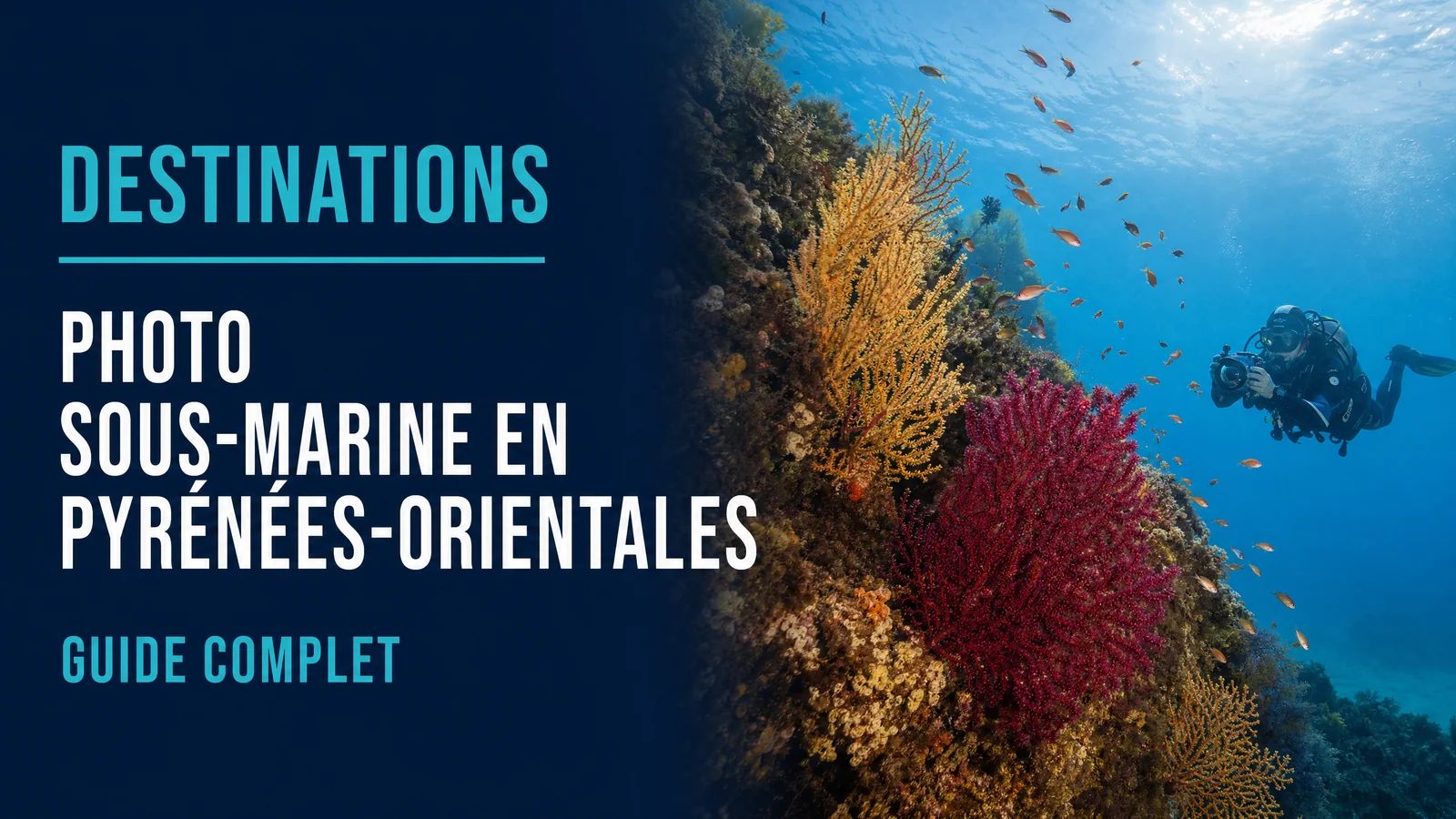
Imagine a place where the foothills of the Pyrenees drop directly into the Mediterranean. No long stretches of sandy beach, no flat and monotonous seabed. Here, the mountains continue underwater. The rocky formations create cliffs, canyons, overhangs, and all this topography generates an absolutely remarkable diversity of life.
We're talking about over 1,200 animal species and 500 plant species listed on just the Vermilion Coast. From nudibranchs with impossible colors to brown groupers that observe you with quiet curiosity, schools of barracuda patrolling the blue, and red and white gorgonias that dress the drop-offs like giant fans.
And there is the light. The Mediterranean light, that which enters the water with this particular quality that I have found nowhere else. A cold, precise light that outlines the contours with a sharpness that tropical waters, with their turquoise water but often laden with particles, do not always provide.
For a marine photographer who works in natural light (this is the philosophy of AquaExposure), the Pyrenees-Orientales offer an unparalleled playground. No flash, no 10,000-lumen lights are needed. The Mediterranean does the work.
The Best Diving Locations
The Vermilion Coast and the Port-Vendres area
This is the heart of diving in the PO (protected areas). Port-Vendres, Collioure, and Argelès-sur-Mer: three ports from which diving boats depart to reach sites ranging from Cap Bear to the Spanish border.
The area around the Mauresque, in Port-Vendres, is a classic dive site. From the dive point, heading northeast, the seabed alternates between rocky outcrops and sandy stretches before dropping to 14-15 meters on a coral reef, cut by canyons and small overhangs. The dive continues to a depth of 20-22 meters.
Moray eels, groupers, and octopuses can be found on every dive. The coast features small drop-offs and pinnacles, often covered in white gorgonians, and the area can be absolutely teeming with fish. Schools of sardines, hundreds of conger eels, and an abundance of sea urchins.
For the photographer, it's a paradise for macro and medium-range photography. The density of life allows you to work on composition without ever lacking a subject.
The Cerbère-Banyuls Marine Reserve
The first marine reserve in France, created in 1974. Six and a half kilometers of coastline, 650 hectares of protected area between Banyuls-sur-Mer and Cerbère. A reinforced protection zone of 65 hectares at the height of Cap Rédéris, where all human activity is formally prohibited.
What this means for a photographer is simple: the density of life there is unparalleled on the French coasts. The groupers, which were only a few dozen individuals in the 1980s, now number more than 630. The red corals, gorgonians, and coral formations covering 53 hectares of the reserve. The nudibranchs, these "jewels of the sea" that testify to the exceptional quality of the environment.
The diving sites of the reserve (the Three Monks, Tignes, Cap l'Abeille) are among the most beautiful in the Mediterranean. I have dedicated a complete article to it for those who want to learn more.
Cap Bear and Shipwrecks
North of Port-Vendres, Cap Bear offers rocky sites with cliffs and fissures. However, the real peculiarity of the area is the wrecks.
Alice Robert (nicknamed "the Banana"), Saumur, Astrée, José Illueca: Port-Vendres concentrates several accessible wrecks, some of which can be explored from Level 1. For a photographer, wrecks offer a fascinating composition exercise. The interplay between the light filtering through openings, the metal structures overgrown with life, and the beds of castagnoles (a type of shellfish) colonizing the superstructures.
In June 1893, a naturalist named Louis Boutan took the first underwater photographs in the world in the Bay of Banyuls. At different levels, up to 10 meters deep, he invented underwater photography. On the same coast of the French Riviera, where I now train photographers.
Underwater photography was born here 130 years ago. And when I think about it, when I dive on the same reefs where Boutan first pointed his camera, I find it deeply moving. The full story deserves its own article.
Diving with Aquatile, our partner in the PO
To experience diving in the Pyrénées-Orientales, you need a trusted center. Aquatile Plongée, based in the port of Argelès-sur-Mer, is a 5-star PADI IDC training center, certified by France Qualité Tourisme and Green Star Award. The club has been operating since 2003 and has trained divers of all levels, from introductory dives to instructors.
AquaExposure works in partnership with Aquatile to offer underwater photography training courses on the most beautiful sites of the French Riviera. The idea is simple: to combine the diving expertise of a 5-star center with the photographic approach of AquaExposure (natural light, ethical approach, patience as the photographer's first tool).
Whether you are a beginner or experienced diver, whether you have a compact waterproof camera or a DSLR in a housing, the conditions along the French Riviera and Aquatile's framing allow you to progress in an exceptional setting.
The Mediterranean before the tropics
There's a common misconception I often encounter: "the real photo diving is in the tropics." I've taught diving in Greece, Cyprus, the Seychelles, and the Maldives. And I can assure you that the Mediterranean, when it's protected and respected as it is in the Cerbère-Banyuls reserve, offers a photographic quality that many tropical sites envy.
The light is different, more directional, and more contrasty. The subjects are less obvious to find, which forces the photographer to develop their eye. The fauna is less "easy" than a tropical reef, where the colors explode every square centimeter, but when you find a fish that allows you to approach it, or when you discover a mauve flabelline resting on a gorgonian branch, the photo has an intensity that I can only describe as having character.
That's exactly where I learned to underwater photograph. Not in the Maldives. Not in the Seychelles. Here, on the Catalan coast, where the Pyrenees meet the sea.
Practical Information
The diving season in the PO (presumably referring to a specific location) extends from April to November, with the best conditions between June and September. The water temperature ranges from 14 degrees in the spring to 24-25 degrees in the summer. Visibility is generally excellent, often exceeding 20 meters in the summer.
Access is easy: Argelès-sur-Mer and Port-Vendres are 30 minutes from Perpignan, served by the TGV and Perpignan-Rivesaltes airport. The Côte Vermeille is also very close to the Spanish border and Cap de Creus, making it possible to combine diving in France and Spain on a single trip.
For underwater photography courses with AquaExposure in partnership with Aquatile, find all the information on our training page or directly on our AquaExposure training.
Frequently Asked Questions
What is the best season for underwater photography in the Pyrénées-Orientales?
The ideal season extends from June to September. The water reaches 24-25 degrees at the surface, visibility often exceeds 20 meters, and natural light is at its maximum. Spring (April-May) also offers good conditions with less crowding, but the water remains cool at around 14-16 degrees.
Is an advanced diving level required to photograph on the French Riviera?
No. Many sites are accessible from Level 1 (Open Water), including the Mauresque area and the Three Monks within the reserve. Shipwrecks such as the Bananier are also open to beginner divers. Some deeper sites (coral formations, red gorgonians) require Level 2 or equivalent.
Can you photograph underwater without a flash in the Mediterranean?
Absolutely. It's actually the philosophy of AquaExposure. The Mediterranean light is of remarkable quality, directional and precise. It allows you to create macro and wide-angle images without artificial lighting. Working in natural light develops the photographer's eye and produces images with a more authentic look.
Where to learn underwater photography in the Pyrénées-Orientales?
AquaExposure offers training in partnership with Aquatile Plongée, a 5-star PADI center based in Argelès-sur-Mer. The courses combine technical learning (composition, light, settings) and guided dives on the most beautiful sites of the French Riviera. The online courses are also accessible on the AquaExposure platform.
What are the best photo diving spots in the PO?
The must-visit locations include the Cerbère-Banyuls reserve (the Three Monks, the Tignes, the Cap l'Abeille) for its abundance of life, the Mauresque area in Port-Vendres for macro photography, and the wrecks (the Bananier, the Saumur) for architectural compositions. Each area offers different subjects and lighting conditions.
Want to improve your composition and framing underwater?
Module 5 of the AquaExposure training is dedicated to stability, framing, and composition while diving. Learning how to build an image underwater is what transforms a correct photo into one that tells a story. AquaExposure training
To Go Further
Each zone, each species, each site in the Pyrenees-Orientales deserves to be explored in detail. That's why I've prepared a series of articles dedicated to this guide: