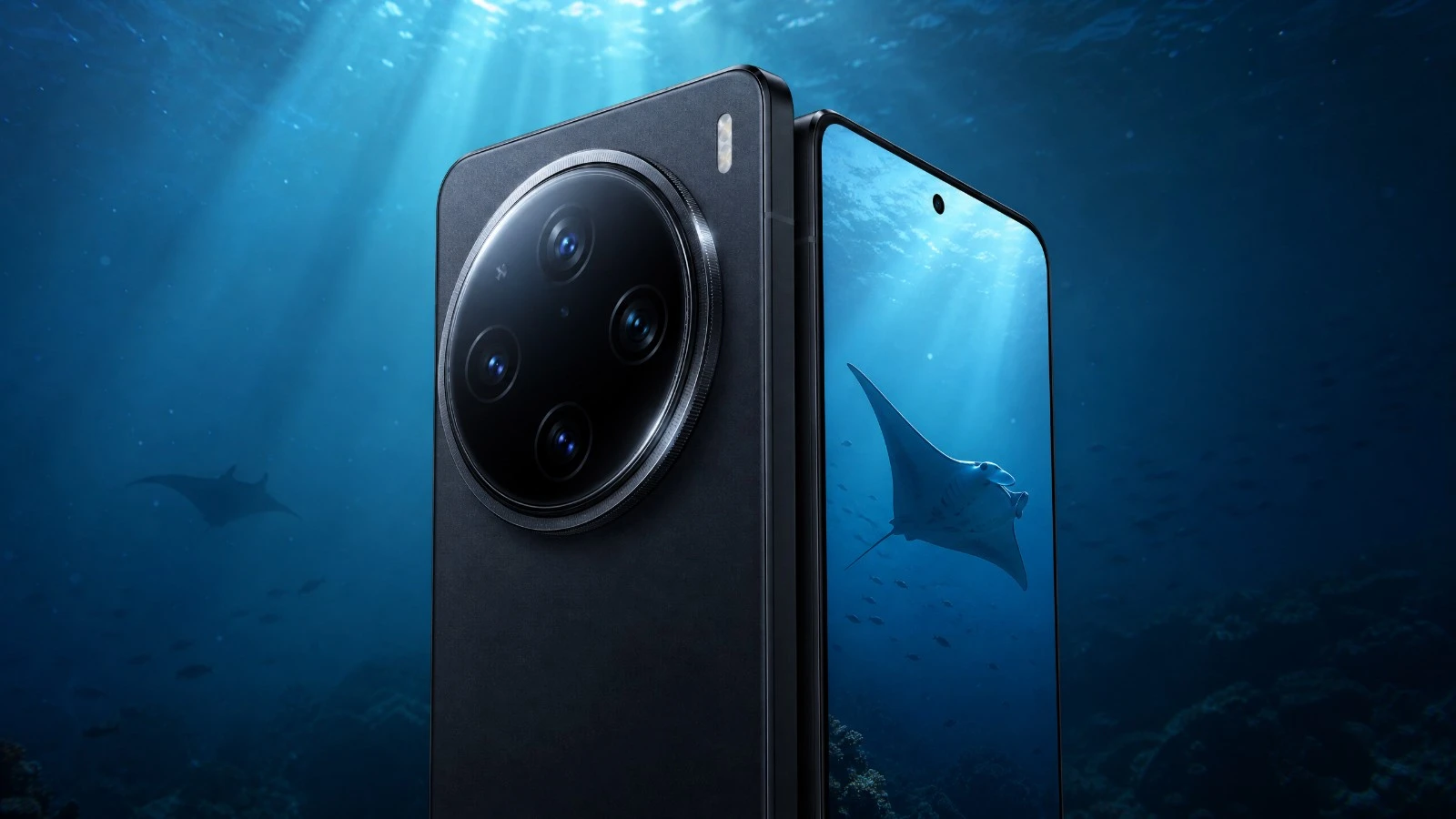
Vivo X300 Pro underwater camera test: Zeiss lens, MotionCam Pro, Divevolk case. Detailed scores, July 2026 price, and comparison with the X300 Ultra.
To learn how to get the most out of your gear underwater, discover the AquaExposure Training.
To learn how to use a smartphone for underwater photography - pre-dive settings, manual focus management, RAW workflow in natural light - the underwater photography training course AquaExposure. The review of the X300 Ultra is also available if you want to compare the two before purchasing.
Summary of Findings
| Block | Criterion | Weighting | Score |
|---|---|---|---|
| B1 | Optics | 20 % | 4.0 / 5 |
| B2 | RAW and colorimetry | 25 % | 4.3 / 5 |
| B3 | Storage | 15 % | 3.0 / 5 |
| B4 | Thermal performance | 15 % | 4.0 / 5 |
| B5 | Battery | 10 % | 4.0 / 5 |
| B6 | Autofocus | 10 % | 3.5 / 5 |
| B7 | Body | 5 % | 3.0 / 5 |
| Total | 100 % | 3.8 / 5 |
Designed for: The underwater photographer who wants a serious Android system without investing in a top-of-the-line device costing 2,000 euros. Ideal for diving trips in warm waters where value for money is important.
Not ideal for: divers who plan on frequent transfers between dives (the SSD OTG has limited performance), or those who want the most advanced video codec without compromise (the X300 Ultra excels in this area).
B1 - Optics (20%)
Score: 4.0 / 5
The X300 Pro features three modules. The main sensor is a Sony LYT-828 with a 1/1.28-inch size and 50 MP resolution, a 24mm focal length, an f/1.57 aperture, and gimbal-type OIS (Optical Image Stabilization). The ultra-wide-angle module uses a Samsung ISOCELL JN1 sensor with a 1/2.76-inch size and 50 MP resolution, an f/2.0 aperture, and macro focusing at 4 cm. The periscope telephoto lens has an 85mm focal length and boasts 200 MP on a Samsung HP9 sensor with a 1/1.4-inch size, an f/2.67 aperture, hardware OIS, and focuses as close as 10 cm in Zeiss APO certified tele-macro mode.
The T* anti-reflective coating is integrated into all modules. An off-axis flare issue documented on the X200 Pro generation has been corrected here thanks to a new optical treatment. Underwater in partial backlighting conditions, this results in a directly noticeable improvement.
The ability to focus at 10 cm on the 85mm telephoto lens opens up an interesting macro space without additional optics: portraits of cleaner shrimp, details of seashells, and coral texture from a reasonable distance without disturbing the subject. The wide-angle lens with f/1.57 is one of the brightest apertures available in this price range on Android in 2026.
The main sensor remains at 1/1.28 inch, while the X300 Ultra increases to 1/1.12 inch. This difference matters in deep water or low-light conditions. When diving in tropical waters between 5 and 20 meters with good visibility, the difference will be imperceptible.
B2 - RAW format and colorimetry (25%)
Score: 4.3 / 5
Three sub-components are evaluated separately.
B2a - Native RAW: The DNG format is available in Pro Mode through the Vivo camera application (OriginOS or Funtouch, depending on the version). The bit depth reaches 14 bits, which can be utilized thanks to the Dual Conversion Gain supported by the sensors. No special configuration is required: RAW mode works within the housing from the initial setup. Score: 4.5 / 5.
B2b - MotionCam Pro: The X300 Pro runs on Android 16 with full Google Mobile Services (GMS). MotionCam Pro is available on the Google Play Store and works natively with the phone's sensors. The app unlocks RAW video, focus peaking (which is not available in the native Vivo app), and an exposure pipeline that adjusts image by image. For natural light diving, focus peaking makes manual focusing in murky water easier. Score: 4.5 / 5.
B2c - Zeiss Color Science: The partnership with Zeiss for the X300 series is both hardware and colorimetric. "Zeiss Natural" and "Vibrant" profiles are available. Support for importing custom 3D LUTs is included. White balance can be locked in Kelvin values in Pro video mode – which is essential to avoid color shifts between underwater shots. A Vivo Log 10-bit profile is available for video. Score: 4.0 / 5 (the X300 Ultra adds a 12-channel spectral sensor and the APV codec, hence the difference in this aspect).
It's a good habit to lock the white balance in Kelvin before submerging your smartphone. In typical Mediterranean blue water, a value between 5,500 and 6,500 K provides a neutral base that can be used in post-production. The comparison of smartphones for underwater photography lists the recommended starting values depending on the conditions.
B3 - Storage (15%)
Score: 3.0 / 5
The X300 Pro is available in 256GB, 512GB, or 1TB configurations, with internal UFS 4.1 storage. There is no microSD card slot. The connector is a USB-C 3.2 Gen 1 according to the manufacturer's specifications.
A point that warrants explicit warning: several independent users report actual OTG transfer speeds to an external SSD being capped around 30 to 40 MB/s, which is a speed close to USB 2.0 despite the advertised standard. For a liveaboard or a day of 3 intensive dives in RAW format, this means that transferring 100 GB to an external SSD can take 40 to 55 minutes instead of the expected 5 to 10 minutes.
The solution is to either have the internal 1 TB storage (ideal for avoiding data transfers on location) or to accept transferring data overnight rather than between dives. It's essential to test your actual OTG transfer speeds with your own cable and SSD before you leave on your trip.
The score of 3.0 reflects this concrete and documented limitation, not the theoretical specifications.
B4 - Thermal (15%)
Score: 4.0 / 5
The X300 Pro chassis uses an aluminum frame with "Armor Glass" reinforced panels. The internal cooling system integrates a large vapor chamber with hydrophilic nanofluid, the effectiveness of which has been confirmed through independent stress tests and teardowns for extended use. Both IP68 and IP69 certifications are present.
Unlike the X200 Ultra, whose aluminum chassis could lead to noticeable condensation in cold environments, the X300 Pro benefits from better overall thermal management. No specific reports of critical condensation issues have been documented to date.
[WARNING] Silica gel: mandatory. The aluminum frame remains a thermal conductor. Despite the overall better performance compared to the X200 Ultra, condensation into cold water (below 15°C) remains a real risk without a silica gel protocol. Fresh packet before each dive, replacement every 3 days.
Tropical Overheating: The nanofluid steam chamber is very effective. In water at 28°C, the software-based overheating threshold is reached after approximately 25 minutes of continuous recording - a comfortable margin for clips of 3 to 5 minutes with breaks.
In cold water (below 15°C), a fresh desiccant packet inside the waterproof case is still recommended before each dive. This precaution applies to all smartphones in a closed waterproof case, regardless of brand. The guide to waterproof smartphone cases details best practices for maintenance.
B5 - Battery (10%)
Score: 4.0 / 5
The battery capacity depends on the version: 6,510 mAh with silicon-carbon chemistry for the Chinese market, potentially reduced to 5,440 mAh in the global and European versions. It is the European version that will be included in most devices sold in France, Belgium, and Switzerland.
Silicon-carbon (Si-C) chemistry, featured in the CN version, inherently offers better resistance to voltage drops in cold weather compared to standard Li-ion batteries. For the EU version with a 5440 mAh capacity, battery life remains excellent: it's possible to achieve a full day of shooting three dives in RAW format without needing to recharge in most situations.
The main advantage of the Si-C technology is its performance in cold water conditions. If you purchase directly from the manufacturer (CN version), you will receive the 6510 mAh Si-C battery. If you purchase from a European retailer, please verify the exact version being shipped.
Before each diving session, remember to check your external battery. Use our portable battery comparator tool to choose the right power bank for your dive equipment and desired battery life.
B6 - Autofocus (10%)
Score: 3.5 / 5
The AF system combines multi-directional PDAF, laser AF assist, and a colorimetric spectral sensor (flicker sensor). Focus peaking is available through MotionCam Pro (not integrated into the native Vivo app).
The underwater vigilance issue concerns the AF laser: in water containing particles (plankton, sediments, port water), the laser technology can latch onto suspended particles rather than the intended subject. No dedicated anti-particle mode is documented for this model. Switching to manual focus with peaking is the recommended solution in these conditions.
Before each dive, check if the AF laser can be disabled in the advanced settings of Pro Mode. If not, MotionCam Pro allows you to take complete manual control of the focus. Focus hunting in murky water is the expected behavior with any active autofocus system: anticipation is the only effective response.
B7 - Box (5%)
Score: 3.0 / 5
There is no dedicated rigid housing specifically for the X300 Pro. Divevolk officially announced compatibility of the SeaTouch 4 Max Platinum control panel with the X300 Pro series in early 2026. The gel touch membrane transmits the conductivity of the fingers to the capacitive screen, allowing access to 100% of the interface underwater: Pro mode, MotionCam Pro, focus peaking, RAW. Certified depth: 60 meters.
The score of 3.0 reflects the lack of a dedicated enclosure, with universal compatibility confirmed via the SeaTouch 4 Max Platinum. This is a reliable solution, but it's important to verify before purchasing that the exact model of your X300 Pro fits within the dimensions.
The advantage of the Divevolk touch membrane over systems with physical buttons is that access to the entire interface remains intact. On a button-based housing, only the functions that are hardwired are accessible. With the SeaTouch, changing modes, navigating MotionCam Pro, and manually adjusting exposure between shots – all can be done as if you were on the surface. See our Divevolk SeaTouch 4 Max Plus or Platinum comparison to choose the version that is right for your needs.
What you need to know before buying.
The Enclosure
Divevolk SeaTouch 4 Max Platinum, officially confirmed compatibility for the X300 Pro series (announcement in early 2026). Depth rating of 60 meters, with full touchscreen access. No other certified rigid options are documented to date. Please verify the exact dimensions of your unit upon purchase - Vivo may adjust thicknesses between production batches.
The Post-Dive Workflow
Three dives of 45 minutes with intensive RAW photography can generate between 60 and 120 GB of data, depending on the resolution and frame rate. Plan for a minimum configuration of 512 GB, or 1 TB if you are mixing photo and 4K Log video. For on-site transfers: anticipate real OTG transfer speeds of 30 to 40 MB/s (and not the expected USB 3.2 speeds). A 1 TB SSD and a high-quality USB-C cable remain useful, but plan to transfer the data overnight rather than between dives.
Current Prices (July 2026)
New: starting from €841.79 on Idealo.fr (July 2026, source: idealo.fr). Price observed for the 16/512 GB version. Up to €1,179 depending on the color and seller. Fnac offers the Black and Gold models in the 16/512 GB configuration. Import offers starting from €713 are reported on Kimovil, but without European warranty.
Refurbished/Used: Starting from €984.73 on Idealo (July 2026, source: idealo.fr). Back Market France offers refurbished units with a 12-month warranty.
Note: The prices for "used" phones that are close to new are explained by the recent launch date of the phone. This difference should widen by the end of the year.
X300 Pro vs X300 Ultra: Is it worth spending more?
The X300 Ultra starts at around €1,798 when imported and exceeds €2,000 with European retailers. The price difference compared to the X300 Pro is approximately €600 to €900, depending on the source.
What the X300 Ultra offers specifically for underwater photography: a larger main sensor (1/1.12 inch compared to 1/1.28 inch on the Pro), an APV 10-bit video codec, CIPA 7.0 stabilization on the telephoto lens, and a 12-channel spectral sensor to assist with white balance. For natural light photography (RAW, no advanced Log video), the difference in sensor size will be most noticeable in deep water (beyond 20 meters) or in low-light conditions.
If the advanced Log video feature is part of your regular workflow, the X300 Ultra justifies the price difference. If you primarily work with RAW photos and clear water up to 20 meters, the X300 Pro does the job at a significantly more reasonable price.
Our Verdict
The Vivo X300 Pro scored 3.8 / 5 in our AquaExposure test. This is a solid score for a smartphone that isn't the top-of-the-line model in its range.
The Zeiss T* optics with off-axis flare correction, the native 14-bit RAW format, full MotionCam Pro compatibility, and well-controlled thermal performance make it a coherent tool for underwater photography in natural light. The Divevolk SeaTouch 4 Max Platinum housing ensures access to all these functions underwater without any interface limitations.
The only factor that limits this score is the actual OTG transfer speeds, which are documented to be around 30 to 40 MB/s despite the advertised USB 3.2 standard. This is a logistical issue, not an aesthetic one – but it's relevant for users who might be on a liveaboard or taking a long trip without planned storage management.
For a photographer who dives and is looking for a serious Android system without reaching the price point of an X300 Ultra, the X300 Pro is a worthwhile option.
Compare this device with others.
Are you hesitant? Use our underwater photography equipment comparison tool to compare this camera with other tested models.
To learn more about condensation and overheating, read our dedicated article: Overheating and condensation on smartphones in underwater housings.
Share
Table of Contents
- 01Summary of Findings
- 02B1 - Optics (20%)
- 03B2 - RAW format and colorimetry (25%)
- 04B3 - Storage (15%)
- 05B4 - Thermal (15%)
- 06B5 - Battery (10%)
- 07B6 - Autofocus (10%)
- 08B7 - Box (5%)
- 09What you need to know before buying.
- 10The Enclosure
- 11The Post-Dive Workflow
- 12Current Prices (July 2026)
- 13X300 Pro vs X300 Ultra: Is it worth spending more?
- 14Our Verdict
- 15Compare this device with others.
Questions about the Journal
Can I use the photographs from this journal?
All images are protected by copyright. For any commercial or editorial use, please contact us via our form.
How can I be notified of new articles?
Follow us on social media or join the Sentinels Circle to receive our immersion stories before anyone else.
Do you offer hands-on workshops?
Yes, we organize masterclasses and field expeditions for members of our school. Check the Training page for details.