Do I need to be a strong diver to take an underwater photography course in a pool?
An Open Water certification (or CMAS/SSI equivalent) is recommended for a deep pool or quarry. At a diving pool like Nemo 33, Open Water is sufficient. Underwater photography actually starts with dry-land exercises that anyone can do before getting in the water.
What do you actually learn during a pool photography session?
Composition (rule of thirds, negative space, eye-level with subjects), exposure and white balance management, subject approach, flash-free stabilisation, and mobile post-processing. The pool allows immediate repetition without current, wildlife variables or visibility constraints.
How quickly do you see results?
Most participants bring back noticeably better images by the end of the first day. The pool enables a rapid correction loop: fix one habit, dive again, see the result on the next image. This cycle is very hard to replicate at sea.
What is the difference between pool training and sea training?
The pool is a laboratory: controlled conditions, no unpredictable wildlife, no current, perfect visibility. You can repeat the same exercise ten times in a row. The sea is a field: you apply what you have built. Both are necessary, in that order.
What camera gear should I bring to a pool training session?
Any waterproof device works: smartphone in a housing, GoPro, Insta360, Olympus TG-7. No professional gear required. The focus is on skills, not equipment. Bring whatever you already own.
Can I attend without owning any underwater camera?
Yes. Some training providers offer gear loans (check with organisers). Alternatively, a smartphone in an affordable housing is enough for every pool exercise. Equipment is not the limiting factor at this stage.
Does AquaExposure run training weekends in Belgium?
Yes. AquaExposure organises regular sessions in Brussels and at Belgian dive sites. The programme starts in the pool and progresses to quarries and lakes based on each participant's level.
To learn how to get the most out of your gear underwater, discover the AquaExposure training.
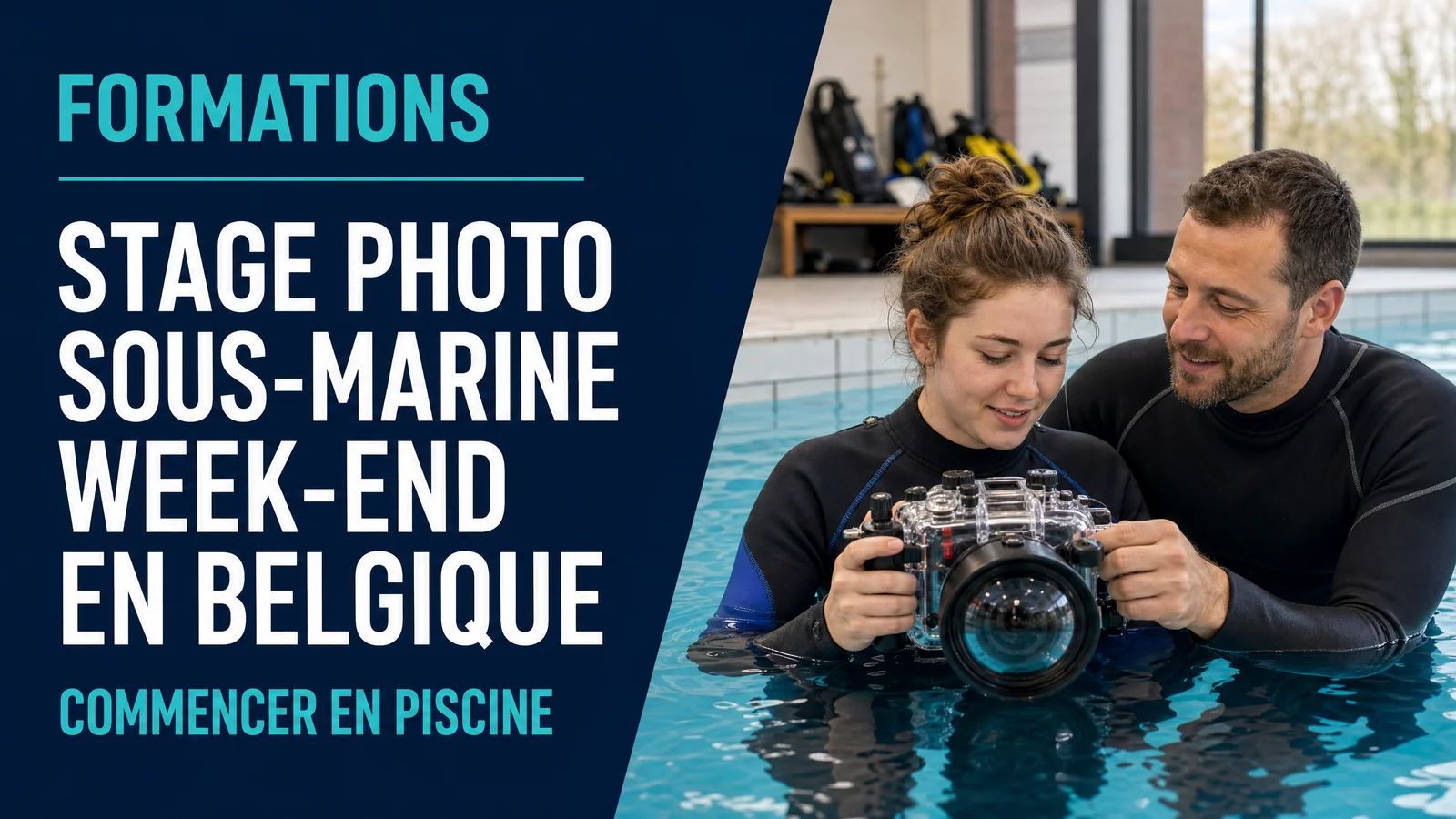
Weekend Underwater Photography Training in Belgium: Why Start in a Pool
There is a widely held belief in the underwater photography world: you really learn in the water. At sea. In the tropics, if possible.
This belief is expensive and produces slow progress.
When I started teaching underwater photography in Brussels, I tried both approaches. Training sessions directly in natural environments, with wildlife, currents and variable visibility. And pool sessions, with controlled conditions and the ability to repeat every exercise immediately after feedback.
The result was unambiguous: participants who start in a pool progress about twice as fast. And they are far more confident when they finally reach the sea.
Why a Pool Is a Better Starting Point
A pool looks nothing like the sea. That is precisely the point.
At sea, the variables stack up: current, visibility, unpredictable wildlife, depth management, buoyancy in realistic conditions. If you are a beginner at underwater photography and you need to manage all of these variables simultaneously while thinking about camera settings, exposure, composition and subject approach, you are in cognitive overload. And cognitive overload produces missed shots, stressful dives and very slow progress.
A pool removes the noise. Visibility is perfect. There is no current. Depth is controlled. Nothing swims away while you are setting up. You can repeat the same exercise ten times in a row, correct one habit immediately, and see the difference on the next image.
It is a laboratory. And a serious photographer starts in a laboratory.
What Pool Training Actually Teaches
Many participants arrive at a first session believing underwater photography is mostly about gear. Pool training corrects this within a few hours.
Composition. This is the foundation. Underwater photography composition rules (rule of thirds, negative space, eye level with the subject) are better absorbed in controlled conditions. In a pool, you can ask another diver to act as the subject, position yourself at different distances and angles, and compare images immediately after each attempt.
Stability. Perfect neutral buoyancy is the prerequisite for sharp underwater images. In a pool, you can work specifically on body stability without outside distractions. A stable body produces sharp images. A drifting body produces blurred images and fleeing subjects.
Exposure and white balance. Understanding how water absorbs colour at different depths, why auto mode fails underwater, and how to adjust manually. In a pool, you can drop from 1 metre to 5 metres and immediately see the colour impact on your images.
Subject approach. Even in a pool, using figurines or fellow divers as subjects, the approach instincts take shape: angle of view, focusing distance, anticipating movement. These instincts need to be in place before you encounter an octopus or a seahorse in the wild.
Mobile post-processing. Colour correction, cropping, recovering a slightly underexposed image: all skills you can practise at the pool's edge between sessions. The Lightroom Mobile editing workflow is accessible at every level.
The Weekend Format: Two Days to Build Lasting Habits
A two-day session is the minimum format for establishing habits that stick. Here is how a typical AquaExposure weekend is structured.
Day 1 - Saturday. Morning: theory and dry-land exercises (90 minutes). Composition, basic settings, gear handling out of the water. Dive 1 in the pool (45 minutes): stability and composition exercises on static subjects. Collective image review after the dive (30 minutes). Dive 2 in the pool (45 minutes): approach and dynamic framing exercises. End of day: introduction to mobile post-processing, corrections on the day's images.
Day 2 - Sunday. Morning: returning to weaknesses identified on Saturday. Dive 3 (45 minutes): free practice with individual targets. Optional Dive 4 (depending on level) in a nearby lake or quarry: applying skills in a natural environment. Afternoon: individual debrief, day's images reviewed, personalised progression plan.
This format is intensive without being exhausting. The goal is not maximum dives, it is building lasting reflexes through a tight repetition-correction-improvement cycle.
The Right Pool: Nemo 33 and Its Alternatives
For training sessions in Belgium, the reference pool is Nemo 33 in Forest (Brussels). At 33 metres maximum depth, filtered water and constant temperature, it is the ideal facility for serious technical work.
Other Belgian diving pools work as well: certain sports facilities with 4-metre-plus depth and diving authorisation. The essentials are depth and visibility.
The certified diver who has never done photography. The most common profile. Comfortable in the water but never thought about composition, underwater light or post-processing. The weekend provides foundations without overloading on the diving side.
The land photographer starting to dive. Already knows composition and exposure, but nothing about underwater specifics (colour absorption, buoyancy, animal approach). The weekend translates existing skills into a new environment.
The experienced diver whose images never satisfy. Has been diving for years but consistently brings back disappointing photos. Often has developed bad habits that are very hard to correct in a natural environment. The pool's controlled frame neutralises them.
The recent beginner. With a recent Open Water certification, starting underwater photography early is very possible. The key is that diving itself no longer consumes all of your attention. The pre-dive safety checklist needs to be automatic before adding the photography layer.
A note on photographer safety underwater: the camera must never take priority over monitoring your environment and your buddy. The pool makes this lesson easier to absorb than open water. It is another reason to start there.
What Happens After the Weekend
A two-day session is not an endpoint. It is a trigger.
After a pool weekend, participants have basic reflexes: they know how to hold their camera, how to frame, how to make a quick correction. This foundation consolidates with each subsequent dive.
Real progression comes afterwards: regular outings in Belgian lakes (the cold-water technique guide covers the best sites), weekends in Zeeland, and eventually a Mediterranean or tropical trip once the fundamentals are solid.
The idea of travelling to the other end of the world to "really learn" is the classic error. You arrive somewhere beautiful, you are distracted by everything, and you return with 400 mediocre images on a full memory card. A serious working weekend in a Brussels pool sets the foundations that make that beautiful trip actually work.
Progressing Without Going Far
Underwater photography is not reserved for people who travel. It starts in the pool next door, with the gear you already own, and exercises simple enough to repeat until they become automatic.
If you want to structure that progression, AquaExposure underwater photography training offers a complete programme from the very first pool session through to open-water dives: composition, settings, ethical animal approach, mobile post-processing. Available from Brussels, in French, with personalised follow-up.
AquaExposure receives no affiliate commission on any gear or dive centres mentioned in this article. All recommendations are based on field experience only.
Weekend Underwater Photography Training in Belgium: Why Start in a Pool | AquaExposure