If you are in France, Belgium or Switzerland and plan to dive locally: FFESSM Level 1. It is cheaper, local, and progressive. If you plan to travel after your course: PADI Open Water. It is recognised everywhere.
PADI is more expensive. Is it really better?
No. More expensive does not mean better. PADI is pricier because of higher commercial costs. A good FFESSM club equals a good PADI centre. Look for the right instructor, not the right logo.
I want to dive in France and also travel. How do I manage?
Dual certification. FFESSM for France, PADI for the rest of the world. Marginal cost: about 200 euros more for a year of flexibility, and it is worth it.
Wondering which course to choose? The best scuba diving course depends entirely on your plan, not the logo on your card. And I'm going to explain why someone jumping into the water in the Maldives doesn't have the same needs as a French diver wanting to explore the Mediterranean. Spoiler alert, you might need both.
Before we start, I owe you the truth: I sold PADI courses in the Maldives. I also saw divers with their FFESSM refuse to explore Southeast Asia because they didn't trust their certification. And I met a guy with an SSI who, honestly, didn't know how to kick his fins in apnea. The federation doesn't make the diver. Your training, your practice, your head do.
But there is a smart strategy to avoid getting ripped off. We're getting there.
The Problem: Too Many Acronyms, Not Enough Clarity
You type "scuba diving course" into Google and you're hit with four international federations, fifteen course variants, prices ranging from 200 to 500 euros for the same level, and instructors telling you: "Yeah, but our program is better."
That's normal. The diving market is fragmented. Each federation has its philosophy, its history, its business model. And that's good for diversity. It's bad for your decision.
Here's what you need to know before signing any attendance sheet.
The Four Major Federations: Philosophies and Realities
PADI: The American Express Empire of Diving
PADI (Professional Association of Diving Instructors) is the giant. Around 30% of the world's divers are PADI certified. Why? Because they invented standardized training at a time when diving was chaotic.
The PADI philosophy: Maximum accessibility. "Everyone can dive." As Sylvia Earle put it, PADI democratized this idea by creating clear certifications, precise manuals, a logical progression. Open Water, Advanced, Rescue. It's linear, it's clear, it's sellable.
"every person has the power to make a difference, and diving is one of the best ways to understand why the ocean matters."
The advantages: - Recognized everywhere in the world. You drop your PADI card in Bali, Egypt, the Galapagos: no problem. - PADI resorts and dive centers in abundance. If you travel a lot, it's a safety net. - PADI instructors follow a standardized curriculum. Not always excellent, but consistent. - Prices are competitive (especially in Southeast Asia, where competition is fierce).
The disadvantages: - It's commercial. PADI sells certifications. They have quotas, franchises, bonuses for instructors who sell more. That's no secret. It's not bad, it's just a fact. - Courses can be superficial if the instructor is just checking boxes. - In France and Belgium, PADI is less integrated into the local diving culture. It's a "tourist" choice.
The cost: 350-450 euros for Open Water (Level 1), 200-250 euros for Advanced (Level 2).
FFESSM: The French Heritage, Cousteau and Company
FFESSM (French Federation of Underwater Studies and Sports) is the French institution. It dates back to 1948. It carries the legacy of Jacques Cousteau and Albert Falco.
The FFESSM philosophy: Progressive autonomy. The FFESSM believes you should learn to think underwater, not just follow the rules. Level 1 (12m), Level 2 (20m with autonomy), Level 3 (40m autonomy), Level 4 (dive leading).
The advantages: - Very strong in France, Belgium, Switzerland. If you dive regularly in cold or temperate European waters, this is your federation. - FFESSM clubs are local associations. Less commercial, more "community." - The training emphasizes safety and autonomy, not rapid progression. - Cheaper in Europe (200-300 euros per level).
The disadvantages: - Not recognized in the USA and Southeast Asia. An FFESSM diver going to Thailand will hear: "We don't know that one." (It's not true, but that's what you'll hear.) - Clubs vary greatly in quality. A good FFESSM club beats a bad PADI center. But the reverse is also true. - Administrative. Clubs require memberships, licenses, paperwork.
The cost: 150-250 euros per level (cheaper, but you need to pay the club license).
SSI: The Tech Challenger
SSI (Scuba Schools International) was the underdog for a long time. But over the past decade, they've been gaining muscle. They push digital innovations and specialized certifications.
The SSI philosophy: Flexibility and digital. Online dive logs, distance learning modules, modern certifications (rebreather, sidemount, etc.).
The advantages: - Hybrid model: online training (theory) + pool/sea practice. - Excellent for digital natives. You can learn the theory in 48 hours from your couch. - Growing worldwide recognition (not PADI-level yet, but rising). - Good value (300-400 euros for Open Water).
The disadvantages: - Fewer centers in continental Europe (except Germany). - Still perceived as "less established" by traditional divers (even though that's incorrect).
The cost: 300-400 euros for Open Water.
SDI: The Technical Thing Nobody Knows (Well, Actually.)
SDI (Scuba Diving International) is the little sibling of TDI. It's the technical federation, used primarily for tech diving (rebreathers, nitrox, trimix, etc.).
The advantages: - If you want to go tech, this is where it happens. - Excellent reputation among experienced divers.
The disadvantages: - Not relevant for beginners. Seriously, forget SDI if you're just learning to breathe underwater.
The cost: Highly variable depending on the specialty (500-1,500+ euros for real tech).
Comparison Table: The Cheat Sheet
Criterion
PADI
FFESSM
SSI
SDI
Worldwide recognition
5/5
2/5
3/5
3/5
Best in Europe
3/5
5/5
3/5
2/5
Cost (Open Water)
350-450 euros
150-250 euros
300-400 euros
N/A
Beginner accessibility
5/5
4/5
4/5
0/5
Technical value
4/5
4/5
4/5
5/5
Learning format
The Strategic Hack: Dual Certification
Here's my real revelation after years of teaching and observing the market.
You don't have to choose one federation. You should do two.
Why? Because each federation has its strengths, and the limits of one are the strengths of the other.
Optimal Strategy: FFESSM Level 1 + PADI Open Water
Phase 1 (FFESSM Level 1, 150-250 euros, 2-3 days) You learn at a local club in France/Belgium/Switzerland. You dive to 12 meters maximum. This is your foundation: safety, balance, stress management. Most people stop here. It's more than enough for 80% of your needs.
Phase 2 (PADI Open Water, 350-450 euros, 3-4 days) You do your PADI Open Water 2-3 months later (yes, after). Why wait? Because you already have experience. You learn faster. And you get a card recognized worldwide.
Result: - You're FFESSM Level 1 for your local dives in France/Europe. - You're PADI Open Water for your holidays in Bali, Egypt, the Caribbean. - You've invested 500-700 euros instead of 800+ euros for a single federation. - You have real flexibility.
This is what I would have done for myself. This is what I would have advised my mother-in-law (if she dived).
The "Task Loading" Factor: Why Your Instructor Matters More Than the Logo
Here's a secret the federations don't tell you: the best predictor of your progress isn't the federation name, it's your instructor.
Why? Because "task loading" (cognitive load) is real. When you're a beginner, your brain is simultaneously processing: - Balance in the water - Breathing - Equipment - Depth - Potential dangers
A good instructor limits the task load. A bad instructor overwhelms you.
PADI has a standardized curriculum, but a sloppy PADI instructor can make the course terrible. FFESSM has a friendly club, but a harsh monitor can turn you off diving forever.
What this means: - Choose your instructor before choosing the federation. - Read reviews (Google, TrustPilot, local Facebook groups). - Meet the instructor before committing. - If something feels off, go elsewhere.
AquaExposure: Our Position in the Ecosystem
AquaExposure does not train for recreational diving. We train for underwater photography and videography, which is very different.
Our approach: you already have a certification (PADI, FFESSM, SSI, doesn't matter). You know how to breathe, manage your buoyancy, position yourself safely. Now, learn to see like a photographer underwater.
That's why you'll notice that most of our students have a PADI certification (worldwide) AND a local sensibility. They travel, they seek content, they seek authentic moments, and that's exactly our target audience.
If you don't have any certification at all, start with the basics (FFESSM or PADI depending on your plans), then come see us. We'll transform your diving into art.
Regional Specifics: France vs Belgium vs Switzerland
France
FFESSM dominates. Clubs are everywhere, prices are low, the culture is established. If you dive in the Mediterranean or North Atlantic, it makes sense. French marine reserves recognize all federations, but FFESSM has a privileged relationship.
Belgium
Fewer clubs than France, but FFESSM and PADI coexist well. Belgian dives are cold (North Sea) and often in quarries or rivers. FFESSM for locals, PADI for travelers.
Switzerland
Alpine lakes. FFESSM is dominant (Romandie), ACUC in German-speaking Switzerland. Lake training demands a certain discipline. Very good training ground.
The Real Differences in Detail: Actual Costs, Not Hidden Ones
Here's an honest estimate (2026):
FFESSM Level 1 (12m max)
License + club membership: 50-100 euros
Theory + practice training: 150-200 euros
Total: 200-300 euros
You have limited autonomy, requiring a supervisor.
PADI Open Water (18m max)
Training (manuals included): 350-450 euros
No additional membership.
Total: 350-450 euros
You have autonomy: two certified divers together.
FFESSM Level 2 (20m autonomy)
Training + practice: 200-250 euros
Total: 200-250 euros
You can dive as a pair without supervision.
PADI Advanced Open Water
Training: 200-250 euros
Total: 200-250 euros
Mixed Certifications
If you do FFESSM Level 1 + PADI Open Water, you spend 500-700 euros and have maximum flexibility. That's my recommendation.
FAQ: The 6 Questions Everyone Asks
1. Which course for a complete beginner?
If you're in France/Belgium/Switzerland and plan to dive locally: FFESSM Level 1. It's cheaper, it's local, it's progressive.
If you travel after your training: PADI Open Water. It's recognized everywhere, no surprises.
If you can do both: FFESSM Level 1 + PADI Open Water in that order. Total cost: 500-700 euros, maximum flexibility.
2. PADI is more expensive. Is it really better?
No. More expensive does not mean better. PADI is more expensive because: - They have higher commercial costs. - Resorts pay them more than FFESSM clubs. - They sell more certifications, so they can use dynamic pricing.
A good FFESSM club = A good PADI center. A bad FFESSM club = A bad PADI center. Look for the good instructor, not the good logo.
3. I want to dive in France and also travel. What do I do?
Dual certification (see "Strategic Hack" section). FFESSM for France, PADI for the rest of the world. Marginal cost: 200 euros more for a year of flexibility, totally worth it.
4. Is my FFESSM recognized abroad?
Yes. and no.
Technically, the FFESSM has signed mutual recognition agreements with PADI, SSI, and others. On paper, your FFESSM Level 1 equals PADI Open Water.
In practice? A dive center in Thailand will see your FFESSM card and say "what's that?" They'll Google it. They'll see it's French. They'll ask for additional training or refuse. Not always, but often enough.
Is it unfair? Yes. Is it real? Yes.
So the real answer: Your FFESSM is legally recognized, but not always practically recognized. If you travel a lot, get PADI too.
5. Is PADI Open Water enough for life?
Open Water means 18 meters maximum, two divers minimum, without supervision. That's 95% of what recreational divers do. Yes, it's enough.
If you want to explore deeper (40m+), take specialties (dry suit, nitrox, navigation), or guide other divers, you'll need more.
But for "my week in the Maldives," Open Water is more than enough.
6. What does AquaExposure offer? How does it fit into my diving path?
AquaExposure comes after your basic certification.
You learn to dive (FFESSM, PADI, SSI, doesn't matter). You accumulate experience (10-20 dives). You decide to do photo/video underwater. You come to us.
We teach you composition, exposure, color, ethical interaction with marine life, 4K video capture, post-production editing. We transform your dives into extraordinary content.
It's not a diving course. It's a diver-creator course.
The Final Advice: Honest, Not Commercial
You'll forget much of what I just wrote. Here's what you need to remember:
1The best course depends on your plan. No single answer.
2Look for a good instructor first, then a federation.
3FFESSM if you stay in Europe, PADI if you travel.
4Dual certification (FFESSM + PADI) is the strategic hack.
5A certification doesn't make you a good diver. Experience and practice do.
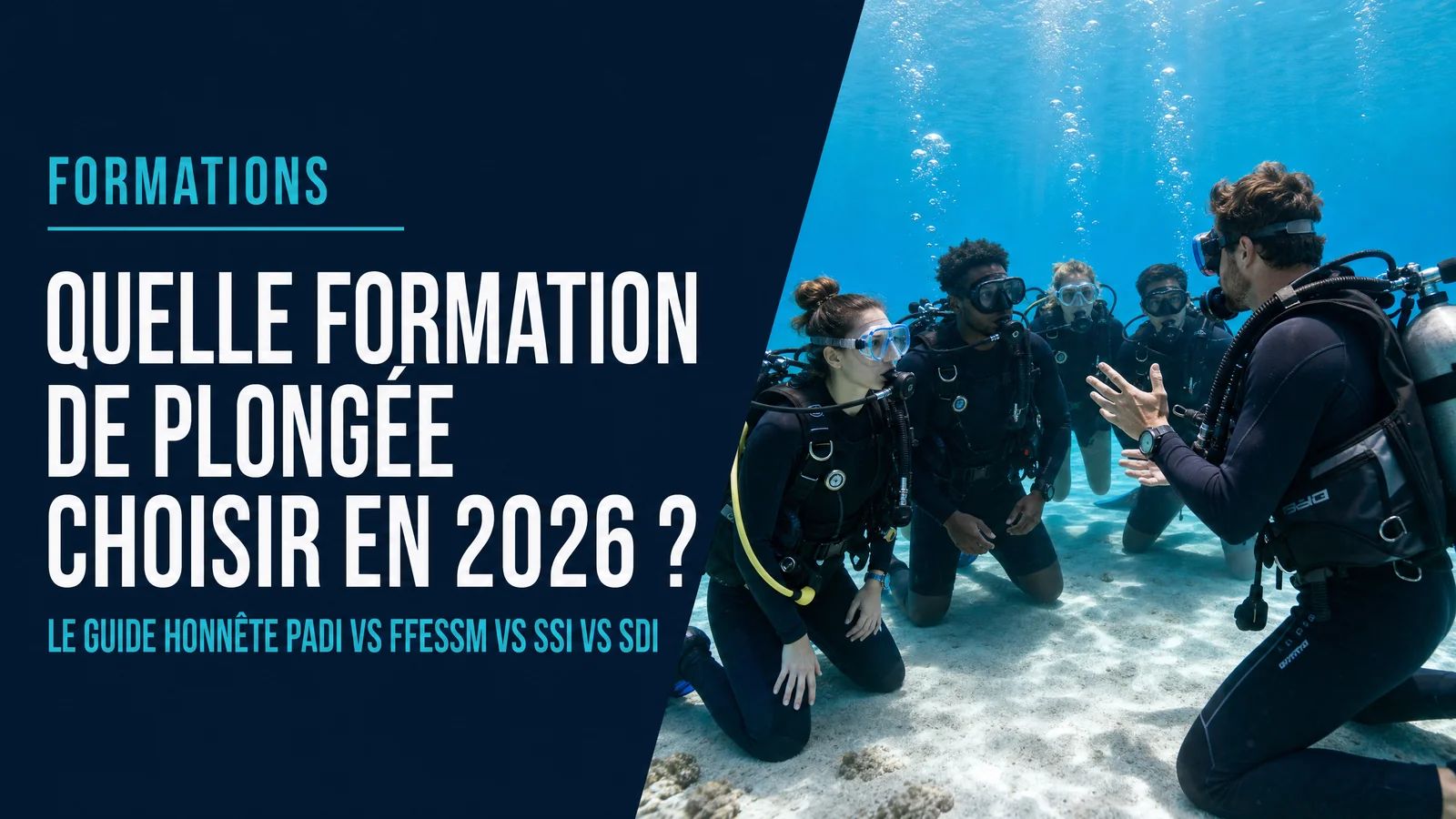
Which Scuba Diving Course to Choose in 2026? The Honest Guide: PADI vs FFESSM vs SSI vs SDI | AquaExposure
And if you really want to take my word for it: I would get two certifications. I would dive regularly (at least 12 dives per year to stay sharp). And I would never push beyond my limits just because I have a new card.
Diving is a sport that demands respect. Federations are tools. Not the other way around.
See you underwater.
Benjamin
Additional Resources
[FFESSM Website](/en/blog/PADI Website - The specialized underwater image course: what it provides that PADI doesn't cover.