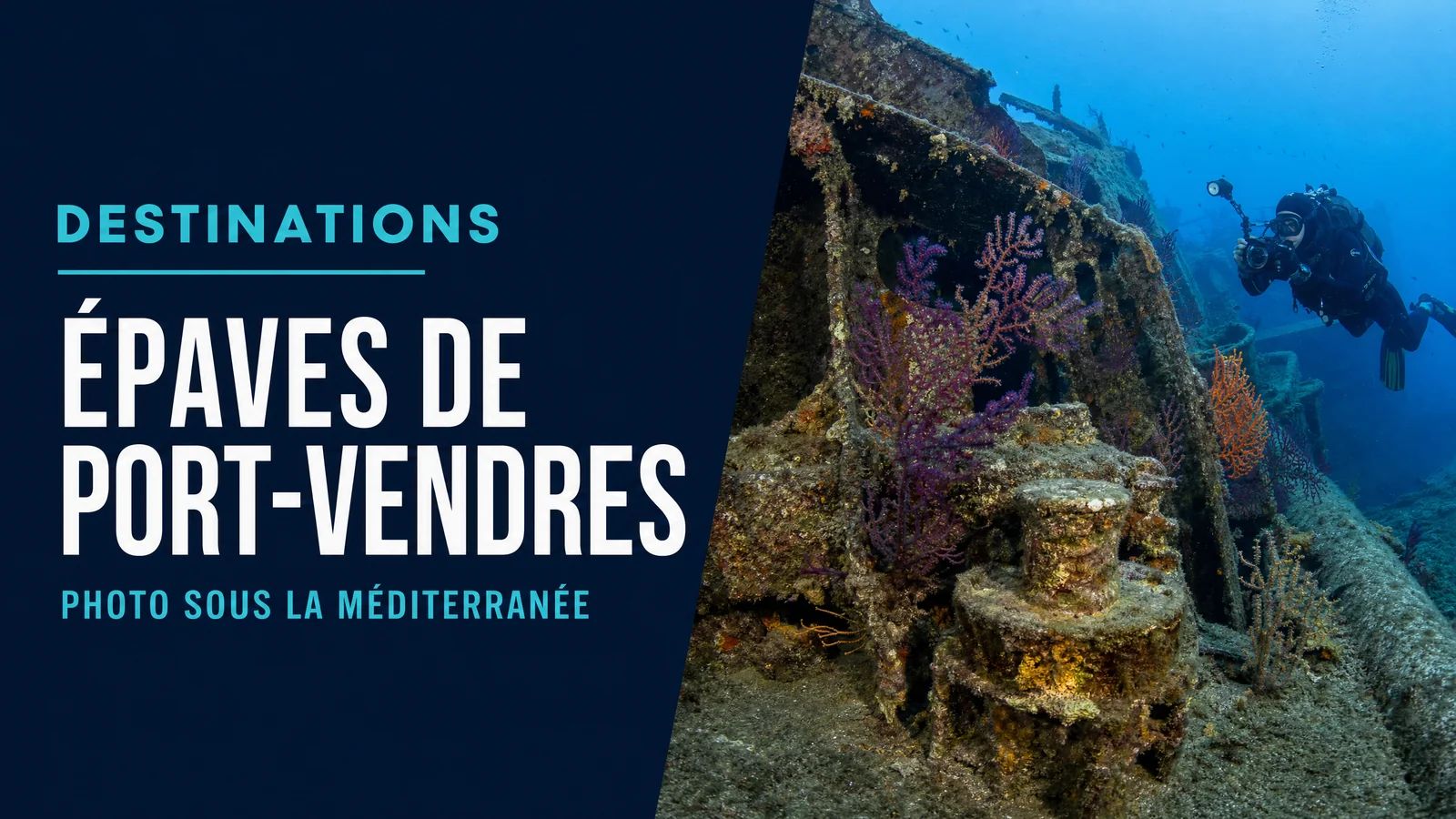
The main accessible wrecks are the Alice Robert (known as the Banana Boat), the Saumur, the Astree, and the Jose Illueca. Each has its own character: the Banana Boat is the most iconic with its structures colonized by gorgonians, the Saumur offers powerful architectural lines, and the Astree appeals with its broken-apart appearance and teeming life.
Do you need an advanced level to dive the Port-Vendres wrecks?
The Banana Boat is accessible from Level 1 (Open Water), making it an excellent wreck for beginners. The other wrecks (Saumur, Astree, Jose Illueca) are deeper and require Level 2 or equivalent. In all cases, good buoyancy control is essential to avoid stirring up sediment and to protect the life attached to the structures.
How to photograph a wreck without flash?
The fundamental principle is to use the wreck openings (portholes, breaches, hatches) as natural light sources. Position yourself facing the surface to work in backlight or silhouette. Metal structures serve as natural frames for subjects. The contrast between lit and shadowed areas creates a dramatic depth impossible to achieve with flash.
What is the best season to dive the Port-Vendres wrecks?
Optimal conditions are found between June and September, with generally good visibility and water at 22 to 25 degrees on the surface. Morning is the best time for photography, as light arrives at an angle that penetrates the hull openings and creates the most beautiful atmospheres. Spring also offers good conditions with fewer crowds.
There is something unique in wreck diving that doesn't exist anywhere else. It's not just diving. It's not just photography. It's the combination of the two, enhanced by this additional dimension that natural reefs don't offer: history. Every wreck carries the memory of a ship, a crew, an event. And underwater, this story continues to be written, as the sea reclaims its rights, life colonizes the metal, and the wreck becomes an artificial reef of often astonishing richness.
Port-Vendres, on the coast of the French Pyrenees, concentrates several wrecks accessible at different diving levels. This is a rare feature in the French Mediterranean, and for the underwater photographer, it is an exceptional area to explore.
L'Alice Robert, nicknamed "The Banana"
This is the iconic wreck of Port-Vendres, and likely one of the most photographed wrecks on the French Mediterranean coast. The Alice Robert, nicknamed "Le Bananier" due to its cargo, lies on a sandy seabed off the coast of Port-Vendres.
For the photographer, the Bananier offers a very comprehensive visual repertoire. The metal structures, overgrown with gorgonians and sponges, create natural compositions where the ship's geometry dialogues with the organic forms of marine life. The openings in the hull allow Mediterranean light to filter through, creating beams of light that pass through the interior of the wreck.
The fauna is abundant. Schools of small fish colonize the superstructure, while black sea urchins circle the hull, and moray eels find shelter in dark crevices. In macro, the walls offer colonies of hydroids, spirographs, and nudibranchs that use this artificial substrate to establish themselves.
In natural light, photographing the Bananier requires careful selection of the time and position. In the morning, the light arrives at an angle that penetrates the openings of the shell, creating the most beautiful atmospheres. By positioning yourself facing the light, you obtain silhouettes of metallic structures cut against the blue, a very powerful graphic effect.
Le Saumur
Le Saumur is a wreck that requires a bit more experience, both in diving and photography. Being deeper, it offers more challenging light conditions but also different photographic possibilities.
The Saumur is of particular interest to the photographer due to its size and structure. The architectural elements are well-preserved, allowing for the creation of compositions with strong leading lines. The viewer's gaze is naturally guided through the image by the beams, passageways, and railings.
The fauna is less immediately visible than on the Bananier, but for the patient photographer (and patience is truly the first tool of the underwater photographer), the encounters are often more memorable. Groupers frequent the deep areas of the wreck, crabs hide in the crevices, and it is not uncommon to encounter schools of barracuda patrolling around the structure.
L'Astrée
The Astrée is a wreck with a different profile, more degraded by time and the sea. For the photographer, it is precisely this progressive disintegration that creates visual interest. The twisted metal plates, the broken structures, the recognizable mechanical parts in the midst of the chaos – all of this tells a story of slow decomposition that has its own beauty.
Life has completely taken over the wreckage. Every metal plate has become a support for the attached organisms: colorful ascidians, bryozoans, and calcareous algae. In macro, the Astrée is an endless playground. In wide shots, the silhouettes of the wreckage in the blue create abstract compositions that move away from classic naturalist photography.
Le José Illueca
The José Illueca completes the picture of the wrecks in Port-Vendres. Each wreck has its own personality, its specific fauna, and its unique light conditions. The José Illueca contributes its own characteristics, with its architectural features and a unique biological colonization.
Photographing a shipwreck in natural light
Photographing shipwrecks without flash is a practice that may seem contradictory. Shipwrecks are often at depths where light is scarce, the interiors are dark, and the instinct is to want to illuminate. But working in natural light on a shipwreck means accepting that shadows should be part of the image. And when you accept that, you discover a completely different aesthetic than the classic flash-lit shipwreck photo.
The principle is simple: to use apertures as light sources. Windows, openings in the hull, and hatches become natural "windows" that partially illuminate the scene. The contrast between the lit areas and the shadowed areas creates a dramatic depth that flash, which illuminates uniformly, never achieves.
Some principles that I apply consistently. To position myself facing the light source (often the surface) to work in backlight or silhouette. To use metallic structures as a natural frame to frame the subject (a fish in an opening, a diver in a corridor). To play with suspended particles that become visible in the beams of light and add texture to the image.
Stability is essential. On a wreck, even the slightest contact with the structure creates a cloud of sediment that ruins visibility in seconds. The photographer must master their buoyancy perfectly, and this is another reason why AquaExposure training programs emphasize the fundamentals of diving before moving on to photography.
Shipwrecks and Ethical Approach
Shipwrecks are fragile sites. The life that has settled there is the result of decades of slow colonization. An uncontrolled impact can destroy organisms that have taken years to develop in a single second.
At AquaExposure, the approach is the same as for natural reefs: observe without touching, photograph without disturbing. On a wreck, this means, in practice, never to stand on the structure, never to enter a space that is too narrow to turn around in, and always to maintain a safety margin between your fins and the walls.
This is a demanding discipline, but it is precisely this discipline that distinguishes a photographer who takes pictures from a photographer who respects the environment they are photographing. And in the end, the images are all the better, because the water remains clear, the organisms remain in place, and the scene retains all its authenticity.
Practical Information
The wrecks of Port-Vendres are accessible from the diving centers of Port-Vendres, Argelès-sur-Mer, and Banyuls. Our partner Aquatile, based in Argelès-sur-Mer, organizes half-day and full-day excursions to the wrecks.
The Bananier wreck is accessible from Level 1 (Open Water). The other wrecks require a more advanced level due to their depth. Visibility on the wrecks is generally good, with optimal conditions from June to September.
Frequently Asked Questions
Which wrecks can be visited in Port-Vendres?
The main accessible wrecks are the Alice Robert (also known as "Le Bananier"), the Saumur, the Astrée, and the José Illueca. Each has its own character: "Le Bananier" is the most iconic, with its structures colonized by gorgonians, the Saumur offers powerful architectural lines, the Astrée seduces with its dilapidated appearance and abundant marine life.
Is an advanced level required to dive on the wrecks of Port-Vendres?
The Banana is accessible from Level 1 (Open Water), making it an excellent wreck for beginners. The other wrecks (Saumur, Astrée, José Illueca) are deeper and require Level 2 or equivalent. In any case, good buoyancy control is essential to avoid stirring up sediment and protecting the marine life attached to the structures.
How to photograph a shipwreck without flash?
The fundamental principle is to use the openings of the wreck (viewports, hatches, portholes) as natural light sources. You need to position yourself facing the surface to work in backlighting or silhouette. The metallic structures serve as a natural frame to frame the subjects. The contrast between illuminated and shadowed areas creates a dramatic depth that is impossible to achieve with flash.
What is the best season to dive on the wrecks of Port-Vendres?
The optimal conditions are found between June and September, with generally good visibility and water temperatures of 22-25 degrees at the surface. The morning is the best time for photography, as the light arrives at an angle that penetrates the openings of the hull and creates the most beautiful atmospheres. Spring also offers good conditions with less crowding.
Want to master composition on shipwrecks?
Module 5 of the AquaExposure training is dedicated to stability, framing, and composition while diving. Shipwrecks are an exceptional composition exercise, with straight lines, interplay of light, and natural frames. AquaExposure training